Stablecoins Are Now a Monetary Policy Issue: GEL₮, the ECB, the BoE, and the New Digital Currency…
Stablecoins are no longer just trading tools used inside crypto exchanges. They are becoming a critical layer of digital finance…
Stablecoins Are Now a Monetary Policy Issue: GEL₮, the ECB, the BoE, and the New Digital Currency War
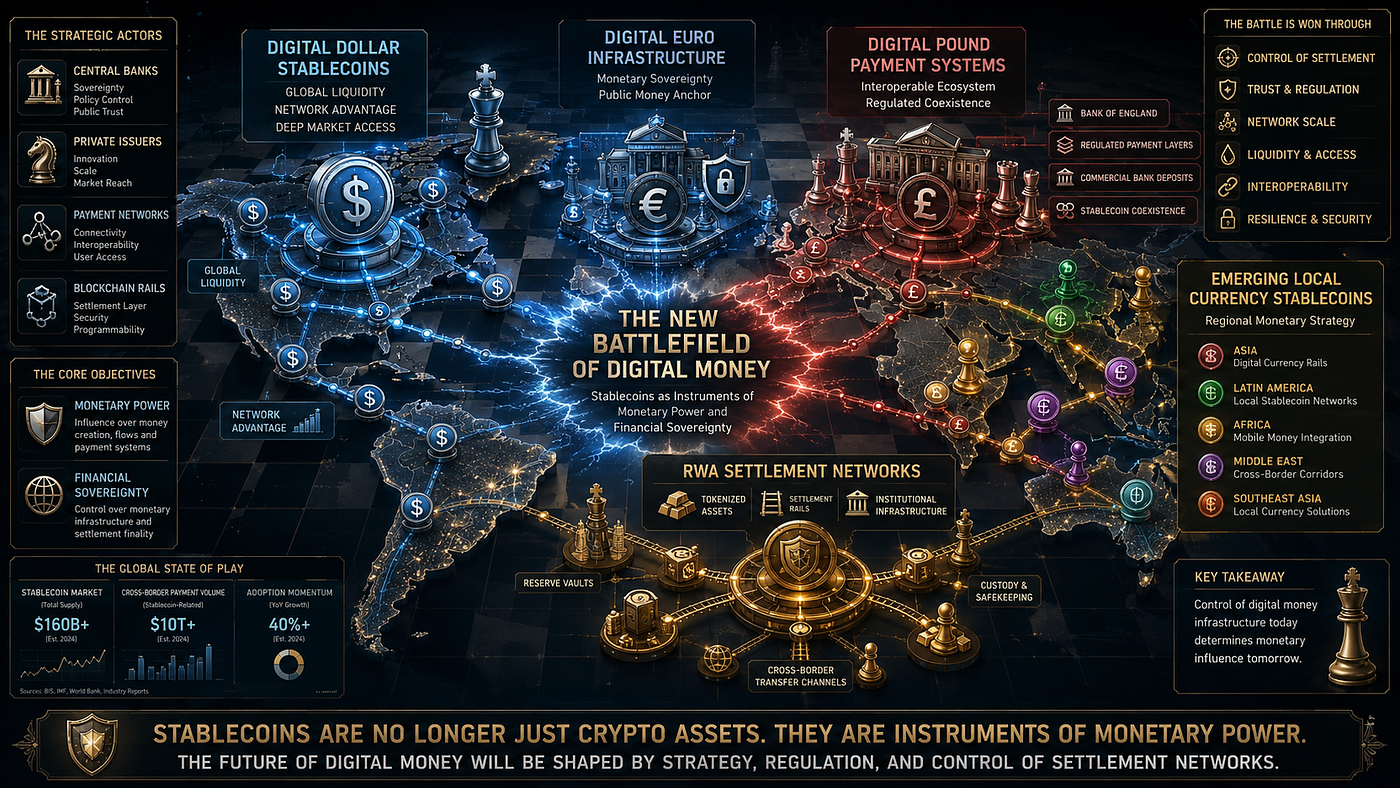
Stablecoins are no longer just trading tools used inside crypto exchanges. They are becoming a critical layer of digital finance, connecting payments, remittances, tokenized assets, on-chain finance, central bank policy, and monetary sovereignty. Georgia’s GEL₮, the European Central Bank’s digital euro strategy, and the Bank of England’s approach to the digital pound and private stablecoins all show that stablecoins have moved beyond the crypto market. The real question is no longer whether stablecoins are useful. The question is who will control the next generation of digital money infrastructure.
Table of Contents
- Why the Stablecoin Debate Is Heating Up Again
- Georgia’s GEL₮ Launch: A New Experiment Between the State and Private Issuers
- What Is the Difference Between an Official Stablecoin and a CBDC?
- Why the ECB and the BoE Are Taking Different Approaches
- Dollar Stablecoin Dominance and What It Means for Korean Won Stablecoins
- Conclusion: Stablecoins Are Not Just Crypto. They Are About Monetary Power.

1. Why the Stablecoin Debate Is Heating Up Again
Stablecoins are no longer just auxiliary tools used inside crypto exchanges.
In the past, they were often understood as digital dollars where investors could temporarily park capital while trading Bitcoin or Ethereum. In a highly volatile crypto market, stablecoins served as a cash-like waiting position, or as a tool for quickly moving funds between exchanges.
But today’s stablecoins have moved far beyond that role.
Stablecoins are becoming core financial infrastructure connected to payments, remittances, trade settlement, on-chain finance, tokenized asset transactions, national monetary policy, central bank digital currencies, and the broader debate over monetary power.
There are several clear reasons why the stablecoin debate has become heated again.
First, the market dominance of dollar-based stablecoins continues to grow.
Second, governments and central banks can no longer treat private stablecoins as simple crypto assets.
Third, some countries have started experimenting with local currency-based stablecoins in cooperation with private issuers.
Fourth, Europe and the United Kingdom are trying to regulate stablecoins from the perspective of payment infrastructure and monetary policy.
This shift represents an important change for the crypto market.
As stablecoins grow, the market moves away from a simple competition over token prices and toward a more fundamental question:
Who will control digital money infrastructure?
- Why Stablecoins Matter
Stablecoins are digital assets designed to track the value of fiat currencies.
For example, a dollar-based stablecoin is typically designed so that one token remains close to one U.S. dollar. Because of this structure, stablecoins can be used more easily for trading and payments than volatile assets such as Bitcoin or altcoins.
Stablecoins matter for several reasons.
① They can be transferred 24 hours a day.
② They can reduce the cost of cross-border remittances.
③ They are used like base currencies across exchanges and DeFi markets.
④ They can be used for corporate payments and settlement.
⑤ They can function as digital dollars in regions with limited access to bank accounts.
⑥ They can serve as settlement assets for RWA markets, including tokenized stocks, tokenized Treasuries, and digital gold.
⑦ They may become a new channel connecting central bank policy with private financial markets.
Stablecoins are no longer just crypto assets.
They are becoming a new payment layer for the digital era.
- Why Central Banks Are Reacting So Sensitively
Central banks are responsible for money issuance and financial stability.
When private stablecoins expand rapidly, several important issues arise from a central bank’s perspective.
First, private issuers may effectively begin to function like digital money suppliers.
Second, if bank deposits move into stablecoins, the funding structure of banks may be affected.
Third, if stablecoins based on a foreign currency become widely used for domestic payments, the influence of the local currency may weaken.
Fourth, if stablecoin reserve assets become concentrated in government bonds or short-term money markets, they may affect broader financial market stability.
For example, if dollar stablecoins become widely used in a country’s digital payments market, that country may become more dependent on dollar-based digital assets than on its own currency.
This is not just a matter of payment convenience.
It can affect the domestic currency’s user base, bank deposits, monetary policy transmission, foreign exchange management, and financial supervision.
In other words, stablecoins have become a monetary policy issue that central banks and governments can no longer ignore.
- From Exchange Tokens to Payment Infrastructure
Early stablecoins were mostly convenience tools inside exchanges.
Investors could sell Bitcoin and stay in USDT or USDC without withdrawing into dollars. Over time, however, stablecoins became the unit of settlement for on-chain finance.
Stablecoins are now used like money in DeFi lending, liquidity provision, on-chain derivatives, NFT transactions, RWA settlement, and cross-border remittances.
The fact that they can move 24 hours a day, regardless of bank operating hours, gives them a clear advantage over traditional financial rails.
This shift creates pressure for central banks.
If payment infrastructure moves toward private stablecoins, the relative role of central bank money and bank deposits may shrink.
- The Core Question of This Article
The central question of this article is simple.
Will stablecoins remain private-sector digital payment tools, or will they become core instruments of national monetary policy?
To answer that question, we need to examine Georgia’s GEL₮, the European Central Bank’s cautious approach to private stablecoins and digital euro strategy, and the Bank of England’s effort to design a coexistence model between the digital pound and private stablecoins.
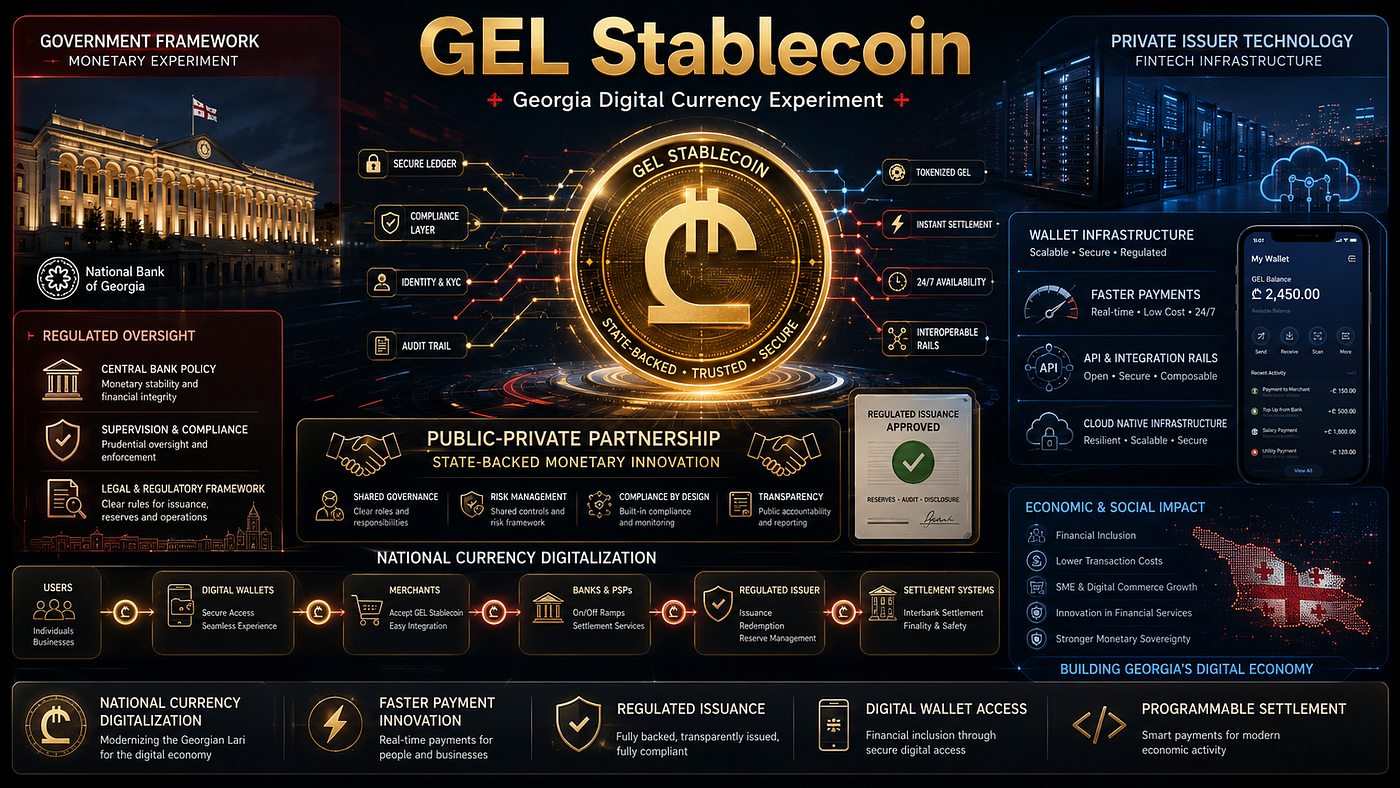
2. Georgia’s GEL₮ Launch: A New Experiment Between the State and Private Issuers
One of the most interesting recent examples in the stablecoin market is Georgia’s GEL₮.
GEL₮ has been introduced as a stablecoin linked to the Georgian lari, or GEL. What makes the project especially noteworthy is that it is being pursued through cooperation between a private stablecoin issuer and the state.
Traditionally, national currencies are issued and managed by central banks.
Stablecoins, by contrast, have often been issued by private companies.
The GEL₮ case blurs that boundary. It combines private issuer technology and liquidity with a national currency unit and institutional support from the state.
- Why GEL₮ Is Special
The core of GEL₮ is that it is linked to the Georgian lari.
Until now, the global stablecoin market has been overwhelmingly centered on the U.S. dollar. Dollar stablecoins such as USDT and USDC have effectively served as the base currencies of the crypto market.
GEL₮, however, is based not on the dollar, but on Georgia’s national currency.
This shows that even smaller countries can use digital currency infrastructure to expand the usability of their own currencies.
The significance of GEL₮ can be summarized as follows.
① It is an experiment in digitizing a national currency.
② It represents a cooperation model between a private issuer and the government.
③ It may reduce payment and remittance costs.
④ It provides a new example of a local currency-based stablecoin.
⑤ It offers a way to experiment with digital money without launching a full CBDC.
- Why Georgia?
Georgia is known as a relatively crypto- and blockchain-friendly country.
Energy costs, the mining industry, fintech growth, and digital economy strategies have created an environment where crypto-related experiments can be more easily accepted.
In that context, the launch of a local currency-based stablecoin is a natural development.
While larger economies move cautiously on CBDCs, smaller countries may use private technology to experiment more quickly with digital currency infrastructure.
For Georgia, GEL₮ is not just a crypto project.
It can be understood as an attempt to increase the digital usability of the national currency, test blockchain-based payment and remittance ecosystems, and strengthen Georgia’s presence in global digital finance.
- Is GEL₮ a CBDC or a Stablecoin?
The most important question when analyzing GEL₮ is this:
Is GEL₮ a central bank digital currency, or is it a private stablecoin?
Based on its current structure, GEL₮ appears closer to a local currency-linked stablecoin developed through cooperation between the government and a private issuer than to a traditional CBDC.
A CBDC is central bank money issued directly by a central bank.
GEL₮, by contrast, is better understood as a stablecoin model that combines private issuer technology and operating structure with a national currency reference.
This distinction matters.
A CBDC is a liability of the central bank.
A private stablecoin, however, depends on the issuer’s reserve assets and redemption structure.
Therefore, users must carefully examine who the issuer is, what the reserve assets are, how redemption is guaranteed, and who supervises the system.
- Advantages of Public-Private Stablecoins
A public-private stablecoin can become a middle model between a CBDC and a fully private stablecoin.
The state does not need to handle all technology and operations directly, while private issuers can contribute blockchain infrastructure and market experience.
At the same time, the model can combine a national currency unit with institutional credibility.
The advantages are clear.
① It can be launched faster than a CBDC.
② It can use private-sector technology.
③ It can increase the digital usability of the national currency.
④ It is suitable for global payment and remittance experiments.
⑤ It can increase the presence of the local currency in digital asset markets.
But there are also risks.
If reserve asset management is opaque, issuer responsibility is unclear, or stability weakens during mass redemption, trust can collapse quickly.
For public-private stablecoins, legal responsibility and reserve verification matter more than technology alone.
- The New Direction GEL₮ Reveals
GEL₮ shows that the stablecoin market may not remain a simple competition among dollar-based private tokens.
Countries and private issuers may increasingly cooperate to create local currency-based stablecoins and use them for payments, trade, and remittance infrastructure.
This has important implications for South Korea as well.
When discussing a Korean won stablecoin, it should not be understood merely as a substitute token used inside exchanges.
It should be viewed as infrastructure connected to digital circulation of the national currency, overseas remittances, trade settlement, fintech payments, and RWA transactions.
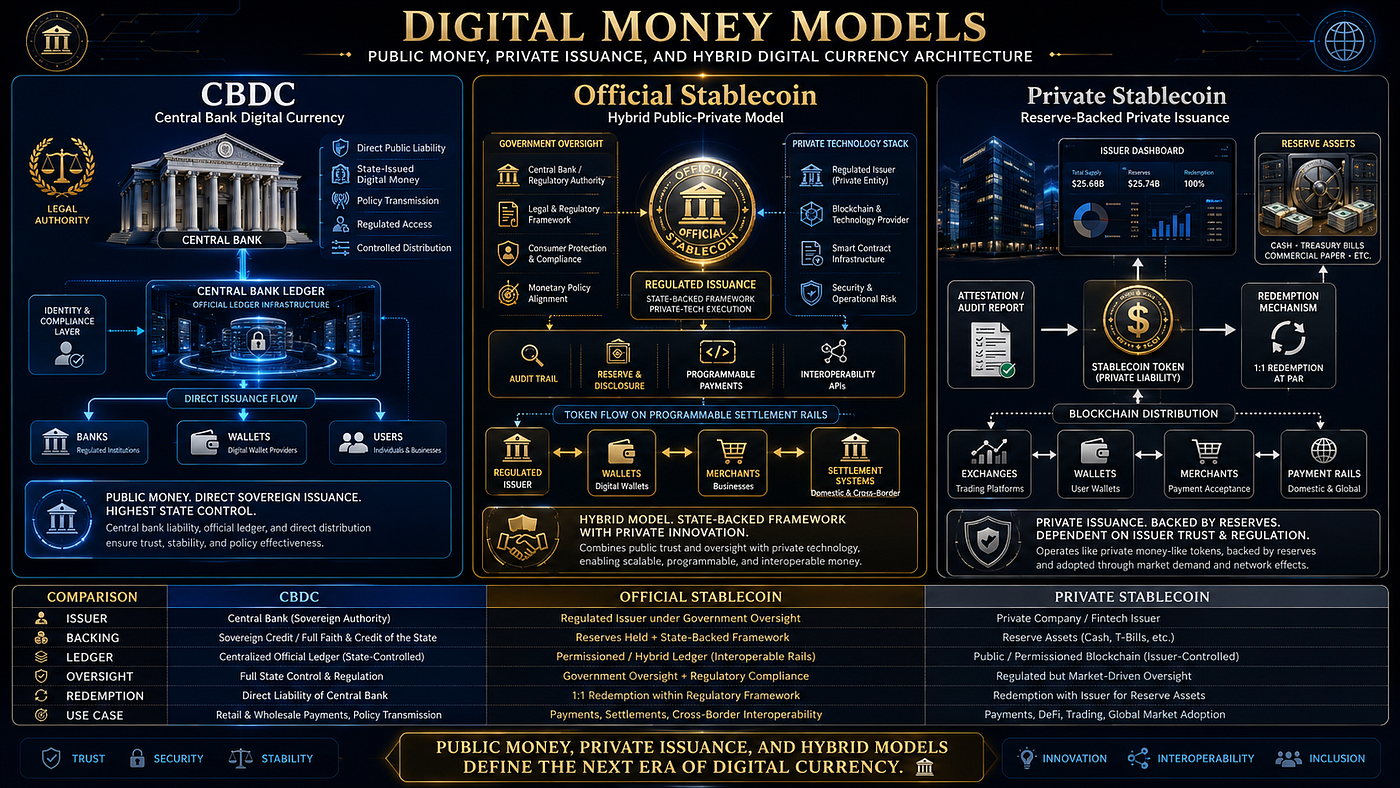
3. What Is the Difference Between an Official Stablecoin and a CBDC?
Stablecoins and CBDCs both look like digital money.
But they are fundamentally different.
If this distinction is not understood, cases like GEL₮ can easily be misinterpreted.
A stablecoin is a digital token issued by a private issuer and linked to a fiat currency or other asset.
A CBDC is digital legal tender issued directly by a central bank.
- Difference in Issuer
The most important difference is the issuer.
A CBDC is issued by a central bank.
Because it is central bank-issued digital money, it has the character of public money, similar to cash. A CBDC is therefore based on the credit of the central bank.
A stablecoin, by contrast, is issued by a private issuer.
The issuer holds bank deposits, short-term government bonds, cash-like assets, or other reserve assets, and issues tokens against those reserves.
Therefore, confidence in a stablecoin depends on the issuer’s reserve management and redemption ability.
- Difference in Legal Nature
A CBDC is central bank money.
It is official money issued by the state. Its legal status is therefore very clear. The central bank bears direct responsibility, and the CBDC is designed as part of the national monetary system.
Stablecoins, however, are classified differently across countries.
Some countries may treat them as electronic money or payment instruments. Others may treat them as crypto assets or financial products.
As a result, the legal nature of a stablecoin may differ depending on the country of issuance and the country of circulation.
For example, the same dollar-based stablecoin may not be treated identically in the United States, Europe, the United Kingdom, Japan, and South Korea.
One jurisdiction may view it as a payment instrument, another as electronic money, and another may examine whether it has the characteristics of a financial product.
- Difference in Reserves and Redemption Structure
Because a CBDC is issued directly by a central bank, users do not need to verify separate reserve assets.
Central bank money itself is the final settlement asset.
Stablecoins are different.
For stablecoins, reserve assets are essential.
Users must be able to verify whether the issuer actually holds one-to-one cash or safe assets, whether it is audited, and whether it can withstand large-scale redemptions.
This is why Proof-of-Reserve, external audits, redemption policies, reserve composition, and liquidity management are so important for stablecoins.
If reserves are opaque, a stablecoin can face a trust crisis at any time.
If users demand redemption all at once and the issuer cannot meet those requests, the one-dollar peg can break.
That is why trust and transparency are central to stablecoins.
- Difference in Innovation Speed and Control
Stablecoins can spread quickly because they are led by the private sector.
They can connect with exchanges, fintech companies, DeFi platforms, and payment companies, creating new services rapidly.
CBDCs, by contrast, move much more cautiously because they are designed by central banks and governments.
They must consider financial stability, privacy, bank deposit outflows, monetary policy effects, technology infrastructure, and cybersecurity.
In simple terms, stablecoins are fast but depend on private trust.
CBDCs are slower but based on public trust.
- The Rise of Official Stablecoins
A major recent change is the emergence of a middle form between the two.
Some governments are not directly issuing CBDCs, but they are exploring ways to use local currency-based stablecoins within the regulated system in cooperation with private issuers.
GEL₮ illustrates this trend.
It sits between a CBDC model, where the central bank issues everything directly, and a private stablecoin model, where a private company issues tokens independently.
Going forward, countries are likely to choose among three strategic options.
① A CBDC issued directly by the central bank
② A privately issued stablecoin regulated by the government
③ An official or semi-official stablecoin developed through public-private cooperation
This is not merely a technology decision.
It is a question of monetary policy and financial sovereignty.
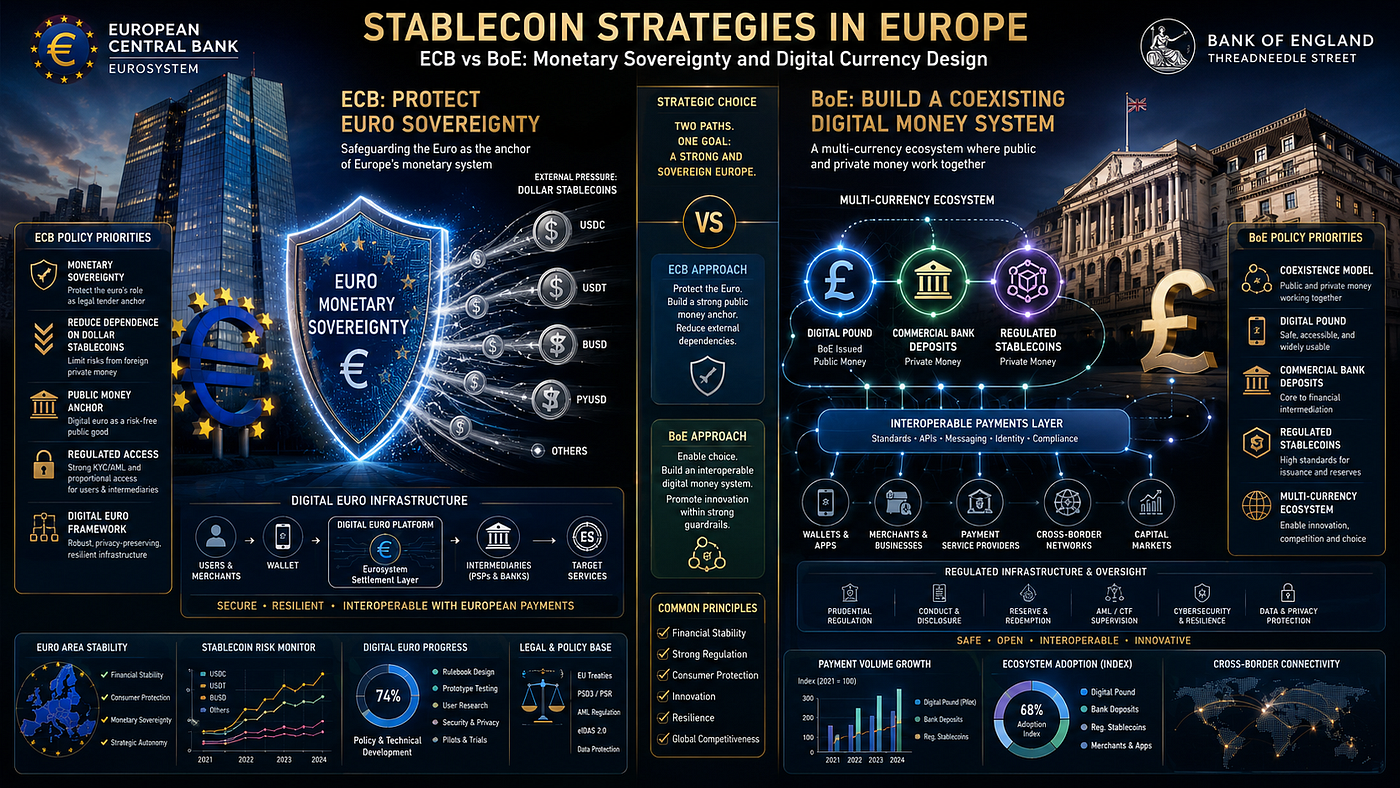
4. Why the ECB and the BoE Are Taking Different Approaches
The European Central Bank and the Bank of England both see the expansion of stablecoins as an important issue.
But their approaches differ.
The ECB is strategically pursuing the digital euro to protect the euro’s monetary sovereignty and the bank-centered financial system, while remaining relatively cautious about the expansion of private stablecoins.
The BoE, on the other hand, is examining the digital pound while also considering a multi-money ecosystem where private stablecoins, bank deposits, and central bank money can coexist.
- Why the ECB Is Cautious About Stablecoins
The ECB is cautious about stablecoins for three main reasons.
First, if dollar stablecoins penetrate Europe’s payment market, the role of the euro may weaken.
Second, if euro-based private stablecoins grow significantly, bank deposits may be affected.
Third, stablecoin reserve assets and redemption structures may create new risks for financial markets.
Europe has a bank-centered financial system.
Household and corporate deposits support bank lending capacity, and bank credit affects the broader economy.
If private stablecoins absorb part of those deposits, the funding structure of banks may weaken.
The ECB also places high importance on the monetary policy transmission mechanism.
When the central bank changes interest rates, those effects must flow through banks, loans, deposits, and market rates into the real economy.
If stablecoins disrupt that channel, the effectiveness of monetary policy may weaken.
- The Digital Euro Is Both a Defensive and Sovereignty Strategy
The ECB is not pursuing the digital euro merely to create a new payment tool.
The digital euro is a strategic project designed to protect Europe’s monetary sovereignty and payment autonomy.
If the digital payments market becomes dominated by U.S. Big Tech or dollar stablecoins, Europe may become more dependent on external payment infrastructure.
This is not merely a technological issue.
It is an economic security issue.
The digital euro therefore serves several purposes.
① Providing a digital alternative to cash
② Strengthening payment autonomy within Europe
③ Countering the spread of dollar stablecoins
④ Supporting the bank-centered financial system
⑤ Strengthening the international role of the euro
The ECB is not rejecting private stablecoins entirely.
Rather, it believes public money should continue to play a central role in the digital era.
- The BoE Is Designing a Multi-Money Ecosystem
The Bank of England’s approach is somewhat different.
The BoE is examining the digital pound while also recognizing that private stablecoins may play a role in the payment ecosystem.
However, that role must be allowed under strong regulation and safeguards.
The BoE’s core direction can be summarized as follows.
① Central bank money, bank deposits, and stablecoins may coexist.
② Systemically important stablecoins must be regulated strictly.
③ Reserve assets, issuer requirements, holding limits, and redemption structures must be clear.
④ Innovation can be allowed, but the stability of the monetary system must not be damaged.
This approach recognizes a degree of private innovation while preserving the central bank’s role as the ultimate safety anchor.
- The ECB-BoE Difference Comes from Economic Structure
The difference between the ECB and the BoE is not simply a matter of policy preference.
The eurozone consists of multiple countries using a single currency. This makes payment infrastructure and monetary sovereignty more complex.
If dollar stablecoins become widely used inside Europe, they could directly affect the monetary position of the euro.
The United Kingdom, by contrast, has a single national currency centered on the pound. This gives the BoE more room to design policy independently.
As a result, the BoE can more actively consider coexistence between the digital pound and private stablecoins.
Still, the two institutions share one major common view.
Neither wants to leave stablecoins unattended.
Both recognize that if stablecoins grow significantly, they may affect financial stability, bank deposits, monetary policy, and payment infrastructure.
- The Core Issue Is the Balance Between Private Innovation and Public Control
The difference between the ECB and BoE ultimately reflects the balance between private innovation and public control.
If stablecoins are restricted too strongly, a country may fall behind in digital financial innovation.
If they are allowed too loosely, risks around bank deposit outflows, money laundering, weakened monetary policy, and financial stability may grow.
Therefore, central banks will increasingly face a broader question.
The question is not simply whether to issue a CBDC.
The question is how far private stablecoins should be allowed, and under what conditions.
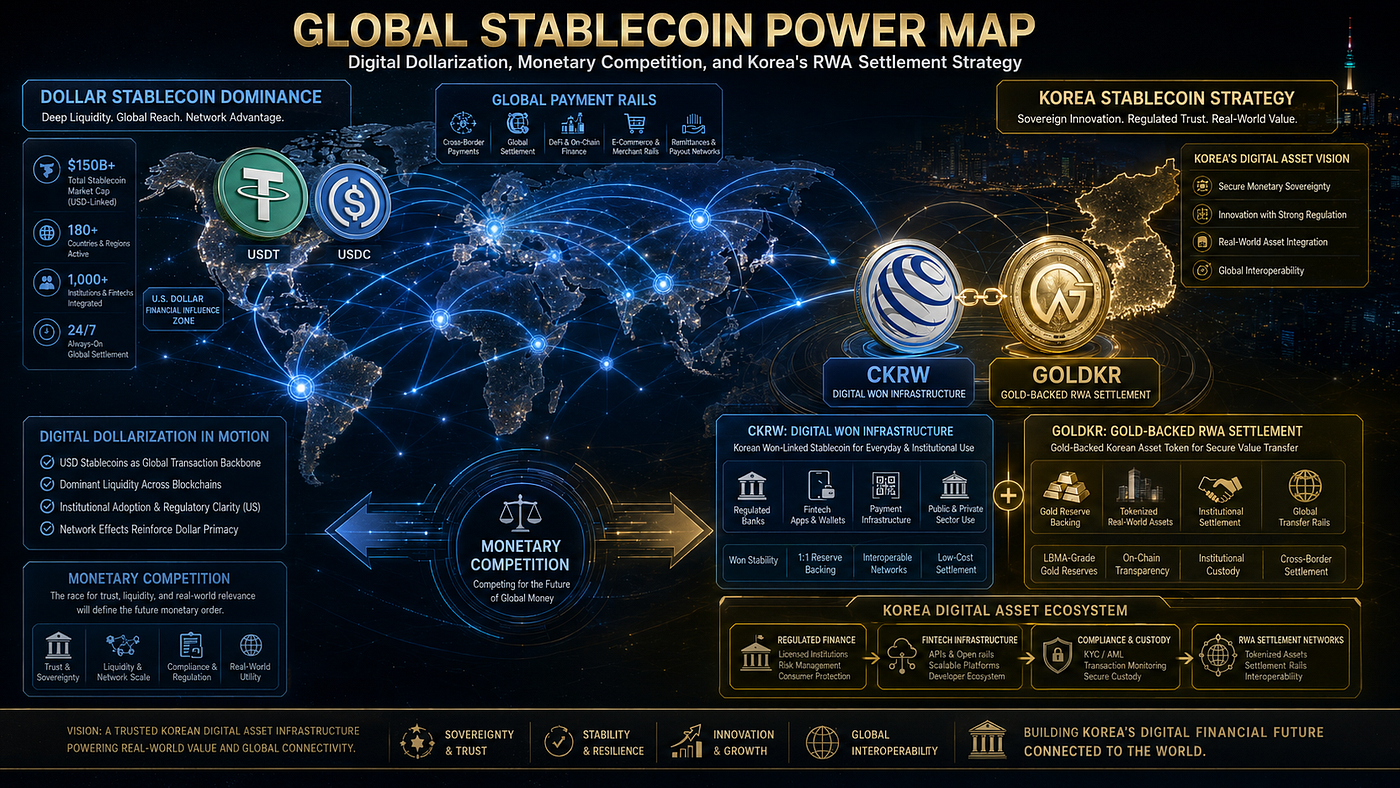
5. Dollar Stablecoin Dominance and What It Means for Korean Won Stablecoins
The global stablecoin market is currently centered on the U.S. dollar.
Dollar-based stablecoins such as USDT and USDC dominate crypto trading, DeFi, global remittances, and dollar demand in emerging markets.
This does not simply mean that U.S. companies have succeeded.
It means the dollar is becoming stronger in digital markets.
In other words, dollar stablecoins are becoming tools that extend the influence of the U.S. dollar into blockchain-based financial space.
- Dollar Stablecoins Are Digital Dollarization
Many countries have stronger demand for dollars than for their own local currencies.
In countries with high inflation or unstable financial systems, people often prefer dollars to their domestic currency.
In the past, holding dollars required physical cash or access to overseas bank accounts.
Now, with a smartphone and a digital wallet, users can hold dollar stablecoins.
This is digital dollarization.
As dollar stablecoins spread, the use of dollars becomes easier outside the United States.
This can strengthen the international influence of the U.S. dollar.
For other countries, however, it can weaken the user base of their own currencies.
- Why Europe Is Concerned
This is also why Europe is cautious about dollar stablecoins.
If dollar stablecoins are used excessively in European payments and digital asset transactions, the role of the euro may weaken.
In particular, if younger generations and digitally native companies begin to use dollar stablecoins naturally, the competitiveness of euro-based digital payment infrastructure may decline.
That is why the ECB views the digital euro not merely as payment technology, but as a strategic tool for protecting European monetary sovereignty.
- Implications for South Korea and Won Stablecoins
South Korea is not isolated from this trend.
The Korean crypto market is highly active, but the standard currency of the global digital asset market is still the dollar stablecoin.
Korean investors frequently use USDT and USDC when accessing overseas exchanges or DeFi.
If this structure continues, the role of the Korean won in digital asset markets may remain limited.
Won deposits and withdrawals are powerful inside domestic exchanges, but in the global on-chain market, dollar stablecoins are the de facto standard.
For that reason, a Korean won stablecoin should not be viewed merely as another coin product.
It should be understood as a question of Korea’s digital financial infrastructure.
For a won stablecoin to become meaningful, several conditions are necessary.
① Clear legal status
② Reserve assets and redemption structure
③ Connectivity with banks, fintech firms, and exchanges
④ AML/CFT and Travel Rule compliance
⑤ Use cases in payments and remittances
⑥ Exchangeability with global stablecoins
⑦ User protection and issuer responsibility
Without these conditions, a won stablecoin limited to exchange use may have weak global competitiveness.
- A Won Stablecoin Is a Monetary Policy Issue
If a won stablecoin emerges at scale, the Bank of Korea and financial regulators will have no choice but to approach it carefully.
They will need to examine whether a won stablecoin could replace bank deposits, increase money laundering risk, affect overseas remittances and capital movement, or alter the monetary policy transmission mechanism.
The issue becomes even more significant if a won stablecoin is used not only inside domestic exchanges, but also in the global on-chain market.
That would mean the Korean won itself could circulate directly as a currency in digital asset markets.
This is both an opportunity and a risk.
The opportunity is that the digital influence of the won could grow.
The risk is that if a won stablecoin spreads without sufficient regulation and reserve management, it could create financial stability problems.
- Implications for CWG and CKRW
Within the CWG ecosystem, CKRW could serve as a core asset functioning as a digital Korean won stablecoin.
If GOLDKR and CKRW are connected, users could directly exchange gold-backed assets and won-based digital liquidity.
This structure can carry important meaning in the global stablecoin competition.
In a market dominated by dollar stablecoins, a won-based digital asset needs to be more than a simple payment instrument. It must connect to real-world assets.
GOLDKR is a gold-backed store of value.
CKRW is a won-based exchange and settlement instrument.
When these two assets are connected, they can create a narrative around Korean digital gold and stablecoin infrastructure.
This also connects to the GEL₮ example.
In an era when countries are considering local currency-based digital money, CKRW can be framed as a private infrastructure model for the digitalization of the Korean won.
However, this also depends on regulatory suitability, reserves, redemption structure, AML controls, and user protection.
6. Conclusion: Stablecoins Are Not Just Crypto. They Are About Monetary Power.
The era of viewing stablecoins merely as convenience tools for crypto trading is coming to an end.
Stablecoins now sit at the intersection of national currencies, financial stability, payment infrastructure, central bank policy, and global monetary power.
GEL₮ is an example of a state and private issuer cooperating to experiment with a local currency-based stablecoin.
The ECB is strategically pursuing the digital euro while remaining cautious about the impact that dollar stablecoins and private digital money may have on the euro’s monetary sovereignty and banking system.
The BoE is examining a multi-money ecosystem where the digital pound, private stablecoins, and bank deposits may coexist.
These three cases show different possible paths.
- The Competition Between Three Models
The future digital currency market is likely to involve competition among three models.
① Privately issued stablecoins
This is the model represented by USDT and USDC, where private companies issue stablecoins that spread rapidly across global markets.
They are fast, network effects are powerful, but reserve and regulatory risks are central.
② Central bank digital currencies
This is the model represented by the digital euro and digital pound, where central banks directly examine issuance.
Public trust and monetary policy stability are strengths, but adoption is slower and requires political and technical debate.
③ Public-private official stablecoins
This is the model represented by GEL₮, where the state and private issuers cooperate.
It may move faster than a CBDC and combine private technology with public institutions, but legal responsibility and monetary policy impact must be carefully designed.
- The Real Nature of Stablecoin Competition
The essence of stablecoin competition is not technology.
Blockchain technology has already advanced enough.
The real competition is trust.
Who issues the stablecoin?
What backs it?
When can it be redeemed?
What legal protection does it have?
Which national currency is it connected to?
Which financial institutions and payment networks support it?
These questions matter more than the technology itself.
This is why stablecoins are about monetary power.
If dollar stablecoins grow, the influence of the dollar grows stronger in digital space.
The eurozone is preparing the digital euro because it recognizes this risk.
The United Kingdom is designing an order where the digital pound and private stablecoins may coexist.
Georgia is experimenting with a local currency-based stablecoin.
- The Question South Korea Should Not Ignore
South Korea should no longer view won stablecoins merely as a crypto market issue.
A won stablecoin is not just about convenience inside domestic exchanges.
It is about what role the Korean won will play in the digital era.
South Korea must ask several questions.
① What should the legal status of a won stablecoin be?
② Who should issue it, and who should be responsible?
③ How should reserve assets be managed?
④ What relationship should it have with bank deposits?
⑤ How should it compete with overseas dollar stablecoins?
⑥ How should it connect with real-world assets such as gold, government bonds, and RWA markets?
⑦ How should user protection and AML/CFT be designed?
Without answers to these questions, a won stablecoin may remain little more than an exchange-based point system.
If these questions are answered properly, however, a won stablecoin could become core infrastructure for Korea’s digital finance.
- Where CWG and CKRW Fit In
From the CWG perspective, stablecoins should not be viewed only as payment instruments.
When gold-backed coins and a won stablecoin are connected, the stablecoin becomes a settlement layer for buying and selling real-world assets.
If GOLDKR is digital gold denominated in 1 gram units, CKRW is the won-based digital liquidity that allows users to buy and sell it.
If this structure is designed together with transparent reserves, redemption mechanisms, user protection, and regulatory suitability, it could expand into Korean RWA payment infrastructure.
In other words, the future of a won stablecoin is not simply about creating a token pegged one-to-one to the Korean won.
The important question is what real-world assets, payment networks, user experiences, and regulatory structures that token connects to.
- The Question for the Next Article
If stablecoins are about monetary power, the next major issue is asset tokenization.
As national currencies become digitized and stablecoins become settlement infrastructure, the assets traded on top of that infrastructure will also become digital.
One of the most important areas is tokenized stocks.
Stocks are already among the largest financial assets in the world. If stocks can be traded 24 hours a day on blockchain networks, settled with stablecoins, and transferred across borders, financial markets could change dramatically.
But that raises a critical question.
Are tokenized stocks real stocks, or are they merely tokens that track stock prices?
In the next article, we will examine how far tokenized stocks may be allowed, focusing on the SEC’s innovation exemption and the investor protection debate.
Stablecoins #GELT #GEL₮ #GeorgiaStablecoin #ECB #BoE #DigitalEuro #DigitalPound #CBDC #DollarStablecoins #WonStablecoin #CKRW #GOLDKR #MonetaryPolicy #MonetarySovereignty #DigitalCurrency #RWA #CryptoMarket #Blockchain #Crypto
[Official CrypWorld Channels]
- Website: crypworld.io
- Whitepaper: Read Whitepaper
Community:
- Telegram Channel: Join Here
- Medium: Follow us
- Twitter (X): @Crypworld_CWG
- Instargram: https://www.instagram.com/crypworld_official/
- Blog: koreagabriel.blog
메타데이터
- post_id
- 17abf13170dc
- slug
- stablecoins-are-now-a-monetary-policy-issue-gel-the-ecb-the-boe-and-the-new-digital-currency-17abf13170dc
- url
- https://medium.com/@crypworld/stablecoins-are-now-a-monetary-policy-issue-gel-the-ecb-the-boe-and-the-new-digital-currency-17abf13170dc
- canonical_url
- https://medium.com/@crypworld/stablecoins-are-now-a-monetary-policy-issue-gel-the-ecb-the-boe-and-the-new-digital-currency-17abf13170dc
- author_url
- https://medium.com/@crypworld
- status
- ok
- fetched_at
- 2026-06-23 03:48:11