Reimagining Aadhaar: A Decentralized Identity System Using Hyperledger Indy and Aries
A privacy-first approach to Aadhaar using blockchain and self-sovereign identity.
Reimagining Aadhaar: A Decentralized Identity System Using Hyperledger Indy and Aries

Introduction
In the digital age, identity is everything — but so is privacy. India’s Aadhaar project, the world’s largest biometric ID system, has revolutionized identification and access to services. Yet its centralized nature poses substantial threats: from data breaches and misuse to government overreach.
We dared to imagine a new way forward — one where users own their data, consent is sacred, and verification doesn’t require surveillance. This is the story of our journey to decentralize Aadhaar using Hyperledger Indy, Aries, and Self-Sovereign Identity (SSI) principles.
Motivation: Why We Built This
Aadhaar brought digital identity to the forefront, enabling millions to access banking, healthcare, and welfare. But the centralized infrastructure — like the UIDAI database — creates a single point of failure. Data leaks, insider threats, and lack of user control plague the system.
Key pain points include:
- Privacy violations: Aadhaar holders cannot control how their data is stored or used.
- Lack of selective disclosure: Revealing your Aadhaar number often means exposing more than needed.
- Inadequate auditability: Users cannot track when and how their data is accessed.
We saw an opportunity to solve these issues using blockchain and decentralized identity frameworks, replacing central control with user empowerment.
Methodology and Implementation: Rebuilding Identity from the Ground Up
This is where our vision truly comes to life. Here’s a step-by-step breakdown of how we designed and implemented a decentralized Aadhaar identity system:
1. The Issuer (UIDAI): Creating Trust on the Ledger
- A trusted authority (government or verified organization which is UIDAI in this case) generates a Decentralized Identifier (DID) and cryptographic key pair.
- This DID and public key are registered on the Hyperledger Indy ledger, making the issuer publicly verifiable.
- The issuer defines a credential schema — a blueprint describing attributes like name, DOB, and Aadhaar number — and publishes this schema and its associated credential definition.
2. The Connection: Establishing Secure Communication
- The issuer (UIDAI) sends a credential offer to the holder via a QR code or link.
- The user (holder/citizen) accepts this offer using a digital wallet, generating a pairwise DID and key pair to enhance privacy.
- A secure DIDComm channel is established, enabling end-to-end encrypted, mutually authenticated communication.
Every message is signed with the sender’s private key and encrypted using the recipient’s public key, ensuring authenticity and confidentiality.
3. Credential Issuance: Empowering the User
- The issuer constructs a credential using the AnonCreds format. This includes:
- User’s attributes
- Metadata like schema ID, revocation info
- Cryptographic commitments
- The credential is digitally signed and securely sent to the holder’s wallet, enabling offline storage and full user control.
No central repository. No third-party access. Just ownership.
4. Identity Verification: Privacy-Preserving Proof
- When needed (e.g., opening a bank account), a verifier sends a proof request via DIDComm.
- The holder(citizen) responds with a Zero-Knowledge Proof (ZKP):
- Selectively reveals required claims (e.g., “above 18”) without disclosing full DOB.
- Proof is packaged into a Verifiable Presentation (VP) including ZKP Proofs, Credential metadata, Revocation checks, Issuer DID and timestamp.
5. Verification Process: Trust Without Centralization
- The verifier fetches the issuer’s public key and schema from the Indy ledger.
- They Verify:
- Signature integrity
- Schema Compliance
- Credential Revocation status
All without contacting any central Aadhaar database. This system is cryptographically secure, tamper-proof, and auditable by design.
Architecture Diagram
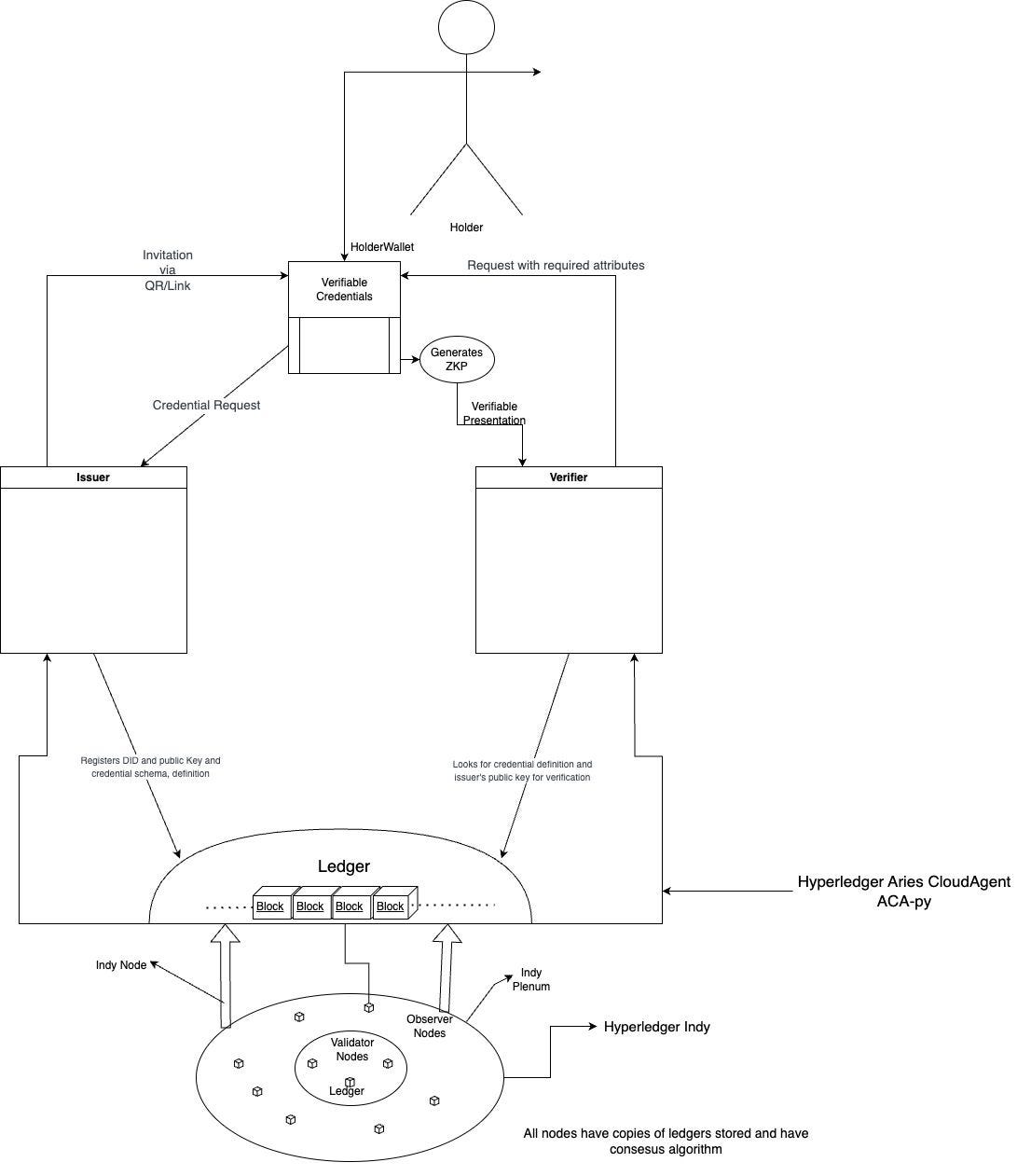
Deployment and Demonstration
Our system includes all critical agents:
- Issuer (UIDAI) : Defines and issues Aadhaar credentials.
- Holder (Citizens) : Receives and controls identity data in a digital wallet.
- Verifier (Third party) : Requests proofs and validates identity without violating privacy.
We deployed on the Von-Network, an open-source Indy test ledger, successfully simulating issuance, storage, and verification flows.
Future Roadmap: Building the Next Identity Layer
- Developing a mobile wallet app and integrating aries cloud agent in it.
- Add Biometric Verification in the mobile app.
- Make it more secure and scalable to transform it into a production ready tool.
Final Thoughts
The future of identity is not just digital — it’s decentralized, user-controlled, and privacy-first.
With this project, we’ve demonstrated a concrete path to reimagining Aadhaar for the 21st century using cutting-edge blockchain and SSI protocols. It’s not about replacing Aadhaar, but about making it safer, smarter, and sovereign.
Contributors:
- Mahim Yadav
- Drish Mahajan
메타데이터
- post_id
- 17e41d2fa2ae
- slug
- reimagining-aadhaar-a-decentralized-identity-system-using-hyperledger-indy-and-aries-17e41d2fa2ae
- url
- https://medium.com/@2023uee0142/reimagining-aadhaar-a-decentralized-identity-system-using-hyperledger-indy-and-aries-17e41d2fa2ae
- canonical_url
- https://medium.com/@2023uee0142/reimagining-aadhaar-a-decentralized-identity-system-using-hyperledger-indy-and-aries-17e41d2fa2ae
- author_url
- https://medium.com/@2023uee0142
- status
- ok
- fetched_at
- 2026-07-19 11:08:47



