Turning your AI models into a unified LLM Council
I’ve spent the past 3 years working hands on with a wide range of AI models. Each tend to have their strengths and “seasons” of when they…
Turning your AI models into a unified LLM Council

LLM Council — Turning Your AI Models into a Panel of Experts
I’ve spent the past 3 years working hands on with a wide range of AI models. Each tend to have their strengths and “seasons” of when they shine.
According to recent benchmarks, today it’s Gemini 3 Pro. Tomorrow it might be Claude or ChatGPT.
The cycle repeats.

AI Model Leaderboard via Poe
This constant change has taught me that building your workflow around one model isn’t just risky, it’s flawed.
Instead I adopted a new strategy. Using a panel of AI models, that can answer questions independently, then critique and rank each other’s answers, and ultimately pick the strongest combined answer.
The problem with only using one AI model
Most people tend to stick with one model because it’s convenient, familiar and they’ve already invested time in the model learning about them.
Or they might have had a poor experience with one of the models early on and have created a bias towards it.
Then a new update arrives, costs shift, latency changes.
Your once dependable and optimized workflow suddenly breaks down or has become inferior to a newly updated model.
This creates a misalignment between your tool and your process.
Think of AI models like different tools in a toolbox. A hammer is great until you need a screwdriver.
Each model has strengths and weaknesses, and forcing one model to handle every task is where problems begin.

Think of each AI Model as different toosl in your toolbox
Here are the risks this causes:
- Vendor lock-in: You become dependent on one model ecosystem that may change without warning.
- Output stagnation: If that model gets predictable or falls behind, your content loses freshness.
- Strategic fragility: If the model’s performance drops or access changes you lose visibility and momentum.
- Scaling bottlenecks: One model’s limitations may slow you down when you try to expand workflow or capacity.
It’s time to stop treating LLMs as isolated choices. What if you used them as a panel of experts instead of depending on a single oracle?
Introducing the “LLM Council” approach
What it is
Think of a panel of experts, not a single guru. The tool I use sends your question to multiple LLMs at once via OpenRouter and collects their individual answers.
This lets each model respond individually, then has them critique and rank each other, all before a designated Chairman LLM pieces everything together into one final, refined answer.

The LLM Council Approach
Why it matters
- You get multiple perspectives instead of a single viewpoint.
- The critic models help catch weaknesses in first responses.
- The chairman model creates a polished answer, benefiting from the debate.
- You increase resilience: if one model drops in performance or access you’re not vulnerable.
- You build a more transparent audit trail: you can trace how each model contributed, making AI-powered decisions easier to justify.
How the LLM Council Works
Instead of asking one model one question you engage several in parallel and orchestrate a debate.
Here’s the workflow:
1. First responses — You send the same query to multiple models (for example GPT 5.1, Gemini 3 Pro, Claude Sonnet 4.5).

2. Peer review — Each model anonymously sees the other models’ answers and ranks them on relevance, accuracy and insight.

3. Aggregate Rankings — All of the results from the peer reviews are combined and aggregated, where the lower the score the better.
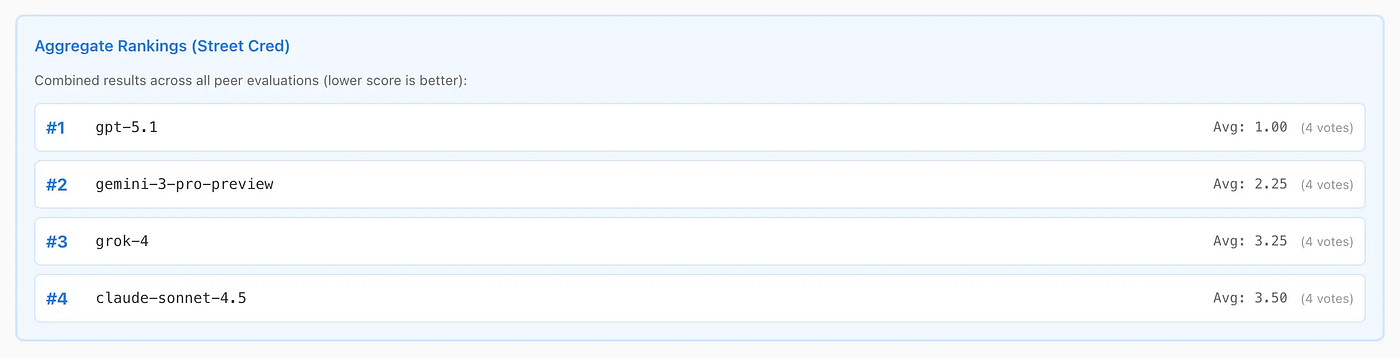
4. Final answer — A designated “Chairman” model synthesizes the responses and peer reviews into a single refined answer.

Picture a mini-panel of AI experts debating before delivering the final verdict.
How I use LLM Council in my AI strategy
When a major question, complex topic, or big decision is needed to be made I start with prompting the LLM Council right away.
Personally, I like to get multiple validated perspectives, funnel them into one model for actionable output, then send the draft back to the panel for final critique.
Here is my workflow:
- Submit the core question to the LLM council of models via OpenRouter (for example GPT 5.1, Gemini 3 Pro, Claude Sonnet 4.5)
- Collect first responses from each model in parallel
- Have each model review and rank the others’ answers anonymously on relevance, insight and accuracy for validation
- Take all responses, critique details and ranking data and feed them into a single model (e.g. ChatGPT, Claude, Gemini depending on the output I’m after)
- Within the single model, I’ll provide all of the context and use that to ask follow up questions, produce assets, and execute the work.
- Submit the completed asset back to the LLM Council for final review and refinement by the panel with the Chairman model delivering the final version
🚨 Because the API calls can add up (roughly $0.50 per question) this workflow is reserved for high-impact decisions and content.

Openrouter Cost / Speed of a single Question
The result? A well-considered answer that benefits from multiple vantage points, layered critique and strategic synthesis.
What it takes to build your own LLM Council
Here is a practical roadmap I use:
- Deploy a routing layer such as OpenRouter so you can plug in multiple model APIs
- Select models from different vendors and capabilities (reasoning, factual recall, creativity).
- Build the peer review layer ensuring anonymity so the models cannot favor each other
- Choose your Chairman model upfront. This model can change based on the latest benchmarks. It’s often the one optimized for synthesis rather than raw generation
- Monitor key metrics: latency, cost per token, accuracy, model drift
- 💌 **Send me a DM on LinkedIn** and I’ll send you a copy of the LLM Council tool that I’m using.
# Council members - list of OpenRouter model identifiers
COUNCIL_MODELS = [
    "openai/gpt-5.1",
    "google/gemini-3-pro-preview",
    "anthropic/claude-sonnet-4.5",
    "x-ai/grok-4",
]

# Chairman model - synthesizes final response
CHAIRMAN_MODEL = "google/gemini-3-pro-preview"
Final thoughts
In a world where AI models leapfrog each other your strategy needs more than a single “best” option.
It needs a panel, it needs an LLM Council.
One model can be good. A council of models is better.
💌 If you’d like a copy of the LLM Council tool I adopted (routing template, debate engine, workflow)** send me a DM on LinkedIn** and I’ll send you the link.
Keep sharpening those tools!
메타데이터
- post_id
- 17f0aeb1480f
- slug
- turning-your-ai-models-into-a-unified-llm-council-17f0aeb1480f
- url
- https://medium.com/@johnnythezilla/turning-your-ai-models-into-a-unified-llm-council-17f0aeb1480f
- canonical_url
- https://medium.com/@johnnythezilla/turning-your-ai-models-into-a-unified-llm-council-17f0aeb1480f
- author_url
- https://medium.com/@johnnythezilla
- status
- ok
- fetched_at
- 2026-06-09 15:37:30




