What Arvind Gupta’s Life Teaches Us About Nurturing Curiosity in Children
This article is inspired by Arvind Gupta’s interview with Dr. Subodh Mahanti, published in INVENTION INTELLIGENCE (January–February 2026)…
What Arvind Gupta’s Life Teaches Us About Nurturing Curiosity in Children
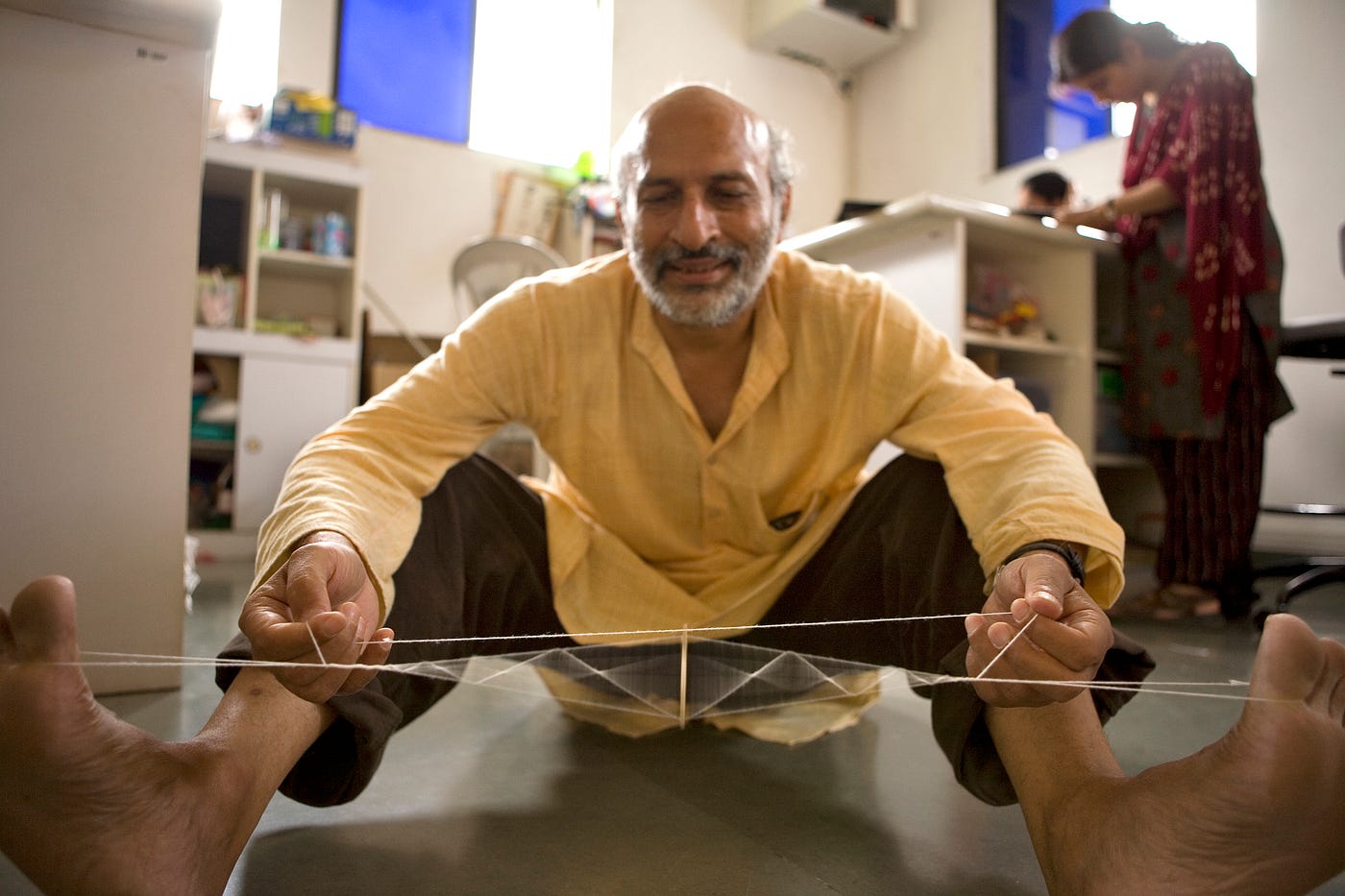
Photo courtesy — Arvind Gupta
This article is inspired by Arvind Gupta’s interview with Dr. Subodh Mahanti, published in INVENTION INTELLIGENCE (January–February 2026), a publication of the NRDC, Department of Scientific and Industrial Research, Ministry of Science & Technology, Government of India.
Written by Sourav Dutta
When I first encountered Arvind Gupta’s story, I found myself reflecting on something I suspect many adults wrestle with: How do we truly help children learn? Not through tests and grades, but through genuine discovery and joy. His journey from a secure engineering career to creating over 1,500 science experiments from waste materials offers a powerful answer, one that speaks directly to every parent, teacher, and adult who cares about a child’s growth.
Arvind Gupta’s life reminds us that the most meaningful learning often begins with a simple moment of curiosity. After joining the Hoshangabad Science Teaching Programme in the early 1970s, he visited a local market and bought whatever he could find; mirrors, bangles, old tube valves. Within a month, using scraps and matchsticks, he created the Matchstick Mecanno. “For the first time I felt that I did something worthwhile in my life!” he recalls. That single moment of joy became the spark that transformed not just his career, but the lives of millions of children.

Shri Arvind Gupta holding Matchstick Mecanno. Photo courtesy — Arvind Gupta
This teaches us something crucial: we don’t need elaborate plans or expensive resources to ignite a child’s passion for learning. A used plastic bottle, some newspaper, a discarded tube, these become gateways to understanding gravity, magnetism, and the physics that surrounds us. When we show children that learning can happen with what’s already in their hands, we liberate them from the belief that knowledge is something distant and expensive.
One of Arvind ji’s core beliefs is that science should be accessible to the poorest child on earth. In a world obsessed with consumption, he flipped the script entirely. While others were buying expensive laboratory equipment, he was showing how 100 toys could be made from old plastic bottles, how 50 models could emerge from discarded Frooti Tetra packs, and how 20 caps could be fashioned from old newspapers.
This approach speaks to something deeper about how adults can support children’s learning: accessibility is not a limitation, it’s liberation. When a child realises that a plastic sack can demonstrate static electricity better than an expensive Gold Leaf Electroscope, something shifts in their mind. They begin to see the world not as consumers waiting for resources, but as creators who can innovate with what surrounds them.
For us as adults, this means rethinking how we support learning. It’s not about spending more or buying the latest educational gadgets. It’s about showing children that the materials for discovery are already present in their everyday world. A kitchen, a garden, a pile of discarded items, these become laboratories of wonder when we approach them with curiosity.

Photo courtesy — Arvind Gupta
When children create something with their own hands, they experience a kind of learning that no lecture can replicate. During Arvind ji’s 11 years conducting free workshops at IUCAA, he observed something remarkable: children were so absorbed in making models that they never even ate their lunch. In all those years, not a single child interrupted their creative work to eat.
This is the power of engagement, when learning becomes play, when discovery becomes creation, children don’t need rewards or punishments. They simply need space, permission, and materials.
What This Means for Adults Supporting Children
- Step back from controlling the outcome. Let children experiment, fail, and discover. The learning happens in the doing, not in perfection.
- Create time for hands-on work. Whether it’s building something from household items or conducting a simple experiment with water and light, physical engagement matters deeply.
- Celebrate the process, not just the result. A broken model that a child built teaches more than a flawless toy that an adult created.
- Show them that their hands and minds are enough. You don’t need to buy expensive kits. Show children how to observe, question, and create with whatever is available.
Arvind ji’s work challenges the entire system of rote memorisation that has dominated education for decades. He points out a critical flaw in how we measure learning: major entrance exams like JEE and NEET give no weightage to practical learning. Students can crack them by mastering multiple-choice questions without ever dirtying their hands.

Arvind ji showing science models to students. Photo courtesy — Arvind Gupta
This reveals something important for adults: the way we assess learning shapes how children approach it. If we only value information retrieval, children learn to memorise. If we value curiosity and creativity, they learn to question and explore.
As parents and educators, we can shift this in our immediate circles. We can ask children not “What is the answer?” but “How would you find out?” We can praise them not for getting it right, but for trying something new. We can model the kind of thinking we want them to develop, the thinking that says, “I don’t know, let’s figure it out together.”
Arvind Gupta didn’t accomplish his mission alone. He was deeply influenced by Dr. Anil Sadgopal, a senior researcher who left TIFR to start a grassroots science teaching program. He worked with remarkable colleagues like Dr. Vidula Mhaiskar and Ashok Rupner. He was mentored by giants like Prof. CNR Rao, Prof. Jayant Narlikar, and Laurie Baker.
This matters because it reminds us that children learn profoundly from being in the presence of adults who are genuinely passionate about learning itself. You don’t need to be a famous educator. You just need to show children what it looks like when someone is excited about discovering how things work.
How Adults Can Be This Kind of Mentor
- Share your own curiosity. When you encounter something you don’t understand, show children your process of finding answers.
- Learn alongside them. You don’t need to be an expert. Learning together builds connection and models intellectual humility.
- Tell them the stories of people who followed their passion. Stories like Arvind Gupta’s show children that unconventional paths can lead to remarkable impact.
- Notice and nurture what ignites them. Every child has something that makes their eyes light up. That’s where their learning will flourish.
Another dimension of Arvind ji’s life that inspires me is his commitment to making knowledge freely available. He’s translated over 290 books into Hindi and other Indian languages. He’s uploaded thousands of videos to YouTube, reached 120 million viewers, and contributed thousands of materials to the Internet Archive.
When asked why he invests so much in free access, his answer is striking: “The internet opened up the possibility of making every book, in every language, available to every child for free.”
This teaches us something vital: knowledge should not be gatekept. As adults, we can practice this principle in small ways. We can share what we know freely. We can create opportunities for children to access books, videos, and learning without financial barriers. We can recognise that the more we freely give, the more we receive in return, in terms of children’s curiosity, engagement, and growth.
The true measure of Arvind Gupta’s work isn’t the awards he’s received, though he’s earned many, including the Padma Shri, India’s fourth-highest civilian honour. The real measure is something subtler and more profound: millions of children now believe that science is for them. They understand that they don’t need to be born into wealth or privilege to become scientists, innovators, and thinkers. They’ve seen that curiosity can be satisfied with what’s around them, and that their minds and hands are powerful instruments of discovery.
For those of us supporting children’s learning, this is the highest calling: to help them believe in themselves as learners and creators. To show them that the obstacles they face, lack of resources, coming from a poor school, living far from a city, these don’t define what’s possible for them. What defines them is their curiosity, their willingness to try, and the adults around them who believe in their potential.
As you finish reading this, you don’t need to revolutionise education or transform entire systems. You simply need to notice the next moment when a child asks “Why?” or “How?” or “What if?” and instead of rushing to give them the answer, hand them the materials to discover it themselves.
Find something in your home that could become a toy for learning. Visit a local market or your recycling bin. Sit with a child and ask: “What could we make with this? What could we discover?” Watch what happens when you step into the role not of the teacher with all the answers, but as a fellow explorer in the world of curiosity.
That’s the gift Arvind Gupta has given us, not just through his toys and videos and books, but through his example of a life dedicated to making learning joyful, accessible, and free. And that gift is something every adult can give to every child, starting today.
This article is inspired by Arvind Gupta’s interview with Dr. Subodh Mahanti, published in INVENTION INTELLIGENCE (January–February 2026), a publication of the NRDC, Department of Scientific and Industrial Research, Ministry of Science & Technology, Government of India. Click here to read the interview.
메타데이터
- post_id
- 1882e2dba7b0
- slug
- what-arvind-guptas-life-teaches-us-about-nurturing-curiosity-in-children-1882e2dba7b0
- url
- https://medium.com/@filmkarigar/what-arvind-guptas-life-teaches-us-about-nurturing-curiosity-in-children-1882e2dba7b0
- canonical_url
- https://medium.com/@filmkarigar/what-arvind-guptas-life-teaches-us-about-nurturing-curiosity-in-children-1882e2dba7b0
- author_url
- https://medium.com/@filmkarigar
- status
- ok
- fetched_at
- 2026-06-09 15:37:30






