The Infinity Paradox
A trip to infinity
Beyond Time
The Infinity Paradox
A trip to infinity
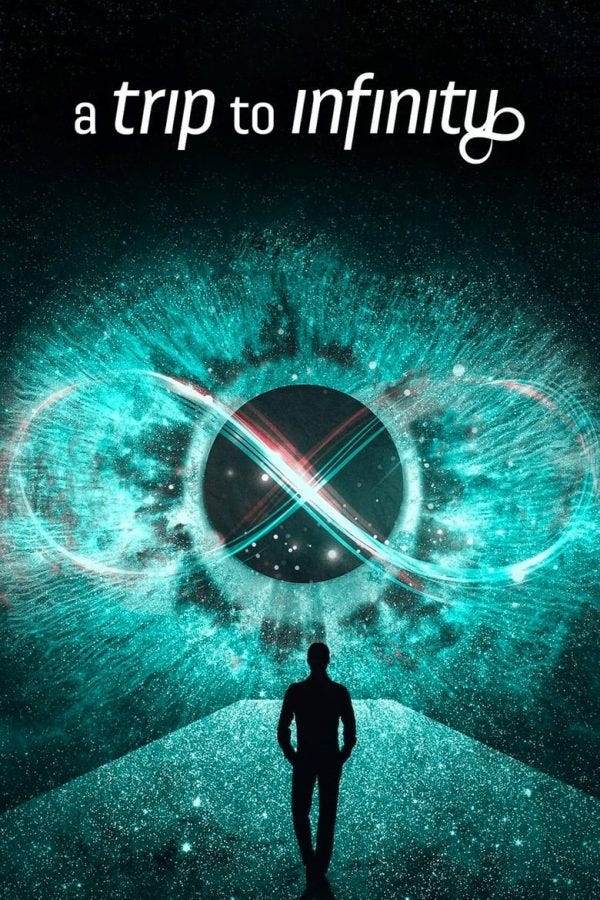
A trip to infinity (Photo : Planetary Store)
I just finished watching "A Trip to Infinity" on Netflix, and my mind is still spinning. It’s not a typical documentary packed with facts and narration. Instead, it feels like a guided meditation on one of the most elusive ideas humans have ever grappled with: infinity
Infinity Isn’t a Number—It’s the Horizon That Keeps Receding
Right from the start, the documentary dismantles the childhood notion I (and probably most of us) had: that infinity is just the biggest number imaginable. I pictured stacking bigger and bigger piles—1,000, a trillion, a googol (1 followed by 100 zeros)—until you hit some ultimate ceiling. But no. You can always add one more. Infinity isn’t a destination on a number line; it’s the endless continuation itself.
This clicked for me like realizing the difference between a finish line and a road that never ends. In mathematics, this prevents the treatment of infinity as an ordinary quantity you can casually calculate with. It humbled me. Our lives are full of beginnings and endings—meals, days, even relationships. Infinity whispers that some aspects of reality might escape those boundaries entirely, inviting a kind of awe mixed with unease about what we can truly comprehend.
Discovering Layers of Endlessness: Cantor’s Quiet Revolution
One moment that stopped me cold was learning there are different “sizes” of infinity. Georg Cantor, a mathematician from the 1800s, showed this with sets. The natural numbers—1, 2, 3, 4…—stretch on forever. That’s one infinity. But the real numbers, which fill in all the decimals, fractions, and irrationals like π or the square root of 2, form a denser, larger kind of infinity. You simply can’t match them one-to-one with the counting numbers without leftovers.
It felt like finding out that not only is the beach endless, but some “beaches” contain vastly more grains of sand than others in a way that defies simple counting. This shattered the ancient view of infinity as a single, uniform vastness. It expanded my sense of mathematical reality. It made me wonder: if abstract ideas already harbor such hierarchy and mystery, how much more layered might the physical cosmos be? Our intuition, tuned for counting apples or coins, fails here, yet math gives us tools to navigate it rigorously. That gap between intuition and truth is both exciting and a bit lonely.
The Infinite Hotel Paradox: Full, Yet Always Room for More
The animation of Hilbert’s Infinite Hotel stuck with me long after. Picture a hotel with infinitely many rooms, every single one occupied. A new guest shows up. A regular hotel would hang up the “No Vacancy” sign. But the manager just shifts everyone: room 1 moves to 2, 2 to 3, and so on. Boom—room 1 frees up. You could even fit infinitely many new buses of guests with clever rearrangements like moving everyone to even-numbered rooms to free up all the odds. The hotel is "full" yet always has space.
Watching this, I laughed at how absurd it seems, yet it’s logically airtight. It reveals how infinity bends rules we take for granted, like “full means no more space.” For me, it mirrored bigger philosophical puzzles: our finite minds evolved in a world of limited resources—enough food for the tribe, daylight hours for hunting. Infinity operates on different logic, forcing us to expand our conceptual toolkit. It’s a beautiful reminder that reality (or at least our descriptions of it) can be far more accommodating and strange than common sense allows.
Where Physics Meets the Infinite: Warnings in the Equations
As the documentary moved into physics, I felt a shift from playful wonder to deeper existential weight. Equations in general relativity spit out infinities at black hole centers—gravity becoming infinitely strong, crushing matter beyond imagination. The Big Bang seems to start from infinite density. The experts interviewed didn’t celebrate these as discoveries of literal endlessness. Instead, many see them as red flags: our theories are hitting their limits and probably need a better framework, like quantum gravity, to resolve the singularities.
This struck me philosophically as a metaphor for human knowledge itself. We build elegant models, only to find cracks where infinity leaks through, signaling incompleteness. It’s humbling. Science isn’t about having all the answers but about recognizing when our maps fail and daring to redraw them. In my everyday life, it makes me appreciate how even the most advanced tools reveal the boundaries of what we can currently grasp.
An Infinite Universe? Copies of Everything, Including Me?
The question of whether space itself is infinite left me staring at the ceiling. Current data can’t rule it out. If it is, and if matter configurations in any volume are finite in variety, repetitions become inevitable. Far, far away—beyond any imaginable distance—there could be another version of Earth, another me making slightly different choices, living alternate histories.
It sounds like wild science fiction, but it follows from straightforward assumptions. The multiverse ideas go even further: infinite universes with different laws, or branching realities from every quantum event. These are speculative frontiers, not settled science, but they expand the imagination wildly. Watching this, I felt a strange mix of connection and insignificance—part of something vastly larger, yet one tiny pattern in an endless tapestry.
The Heart of It: Math’s Power, Reality’s Caution, and Human Limits
What lingered most was the tension between mathematics, where infinity thrives as a precise tool, and physics, where it often signals trouble. Just because we can describe endlessness beautifully on paper doesn’t mean the physical world embodies it perfectly. Our brains, wired for survival amid finite dangers and opportunities, struggle to truly picture it. Yet here we are, using symbols and logic to probe what lies beyond experience.
This raises a quiet philosophical ache: Are there truths accessible through math that we can never fully feel or visualize? The documentary doesn’t force conclusions. It simply shows infinity as indispensable in our understanding, a recurring guest in modern science, and a mirror to our own limitations.
Why This Documentary Stays
“A Trip to Infinity” didn’t just explain concepts—it made me feel the wonder and mystery anew. It portrays infinity not merely as endless size, but as a symbol of the boundless human drive to know more, even as each answer births new questions. In a world that often feels small and pressured by deadlines, it’s liberating to sit with the idea that some journeys have no final stop.
If you haven’t seen it, I highly recommend it. It left me more curious, more humble, and strangely hopeful about the strangeness of existence. The universe, it seems, may be far weirder and more open-ended than our daily grind lets us imagine, and that’s worth the trip.
메타데이터
- post_id
- 1883b9a48d7f
- slug
- the-infinity-paradox-1883b9a48d7f
- url
- https://medium.com/new-literary-society/the-infinity-paradox-1883b9a48d7f
- canonical_url
- https://medium.com/new-literary-society/the-infinity-paradox-1883b9a48d7f
- author_url
- https://medium.com/@khalilsamoo
- status
- ok
- fetched_at
- 2026-07-14 13:28:58