What Happens When Childhood Becomes Content?
The Cost of Growing Up Online
What Happens When Childhood Becomes Content?
The Cost of Growing Up Online
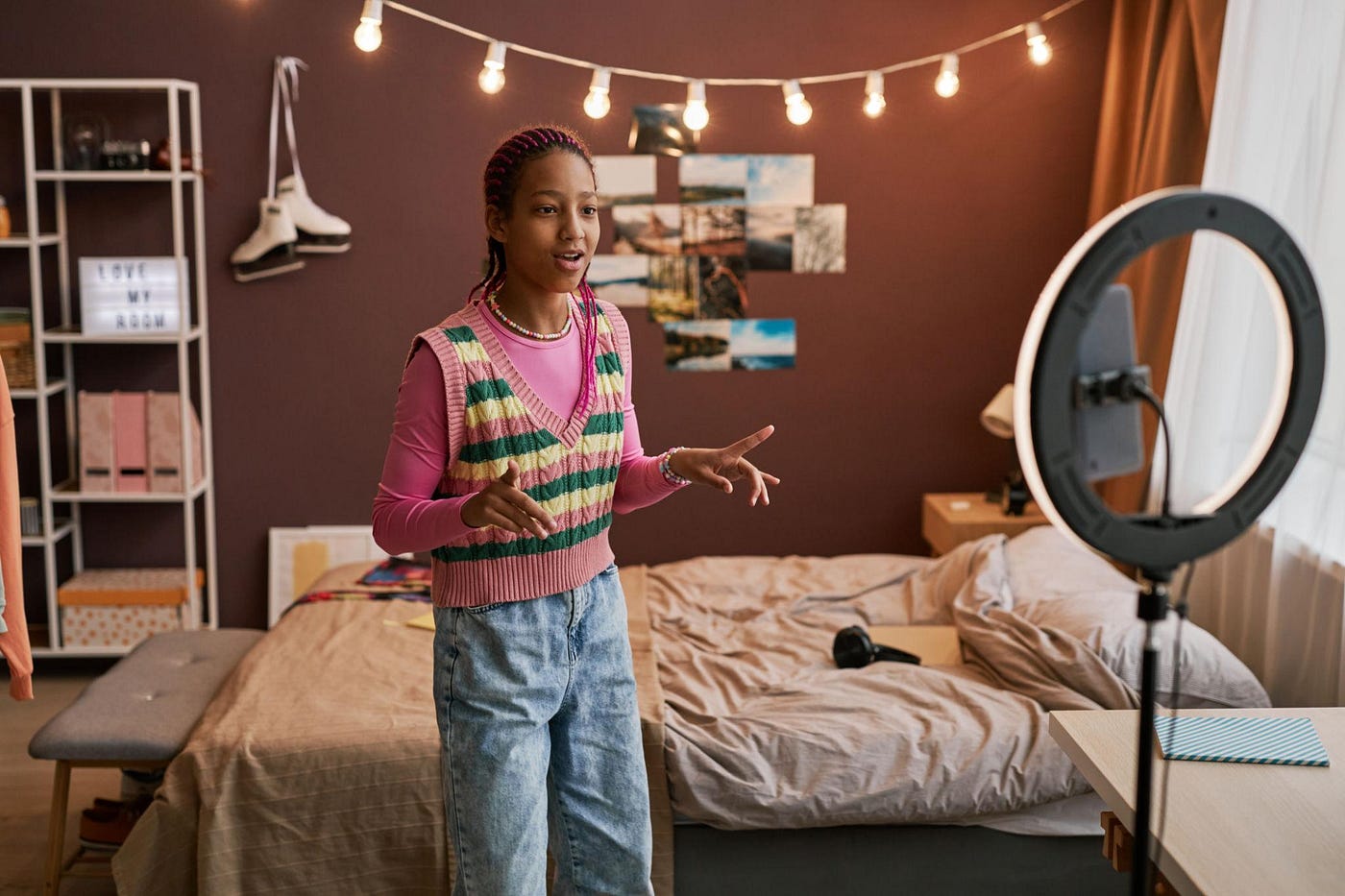
Image generated by AI
As social media turns identity into performance and attention into currency, young people are growing up under a level of public scrutiny previous generations never experienced.
At one time, it was all but possible to grow up while you weren’t looking. Childhood and adolescence were periods of life marked by uncertainty, awkwardness, and messiness.
The youth tried on various masks, failed, changed their perspective, and eventually found their identity.
Many of these activities occurred on a private level in the family, in the classroom, among friends, and in communities. The awkwardness and the bad judgment were all but forgotten, and the rough spots were over.
On the contrary, the increase in the publicness of growing up is a fact of current times. Not all childhoods are the same. Not all childhoods are ‘just children’s.'
It’s turned into a kind of content. Social media has changed the way identities, self-expression, and social validation are experienced for adolescents.
It is now a common expression to depict a personal quest of self-discovery, but these days it is more likely to be done in front of an audience.
The outcome is more than just changing how technology is used. This is a radical change in life experience for a child.
The Pressure To Be Seen
Today’s digital culture has a value of visibility. Platforms let users express themselves, record their experiences, and showcase an edited version of themselves in public. When it comes to visibility, it’s not just a social phenomenon anymore; it’s a currency too.
Likes, comments, shares, followers and views are publicly measurable attention markers.
For adolescents who are already dealing with a sense of belonging and self-worth, this adds to the barbs. So what used to be a question of identity is now a question of who you are. It is the process of self-determination and, at the same time, making oneself known to an audience. Before they have developed a sense of themselves, young people must already have a personal brand.
Young people are supposed to have a personal brand before they have a sense of themselves. They are asked to develop visibility, to keep being relevant, and to engage in an endless loop of visibility.
It’s been a challenge to differentiate between self-expression and self-promotion. In many cases, identity becomes a project to be optimised, rather than the person at your heart.
In many cases, it is not the person at your heart; it’s identity itself that’s being optimized.
The Disappearance of Private Adolescence
The thing that seems most important is the loss of privacy. The adolescent years have been a time of experimentation ever since they began. It’s a time when they experiment with thoughts, embrace new interests, mimic others, reject others, and gradually form their own opinions.
This process is not one that can be done without making mistakes. Errors are not only necessary but inevitable.
However, digital platforms tend to forever retain those errors. Words that are thrown out in the heat of the moment, ideas that come too early, or fashions that are simply caught up in the moment can linger long after the individual has put them out of their heads.
The previous generations got to grow up, and the earlier generations grew up. In today’s digital world, youth may also have a digital legacy of their own. The result is not that obvious but important. The greater the chance for every action to be recorded, shared, and evaluated, the riskier the experimentation.
Self-discovery can start to become a form of self-monitoring. Whereas “Who am I becoming?” is a question posed to youth, they may be asking, “How will this be received? ”.
When attention becomes validation
It is not approval-seeking that is the problem with young people. It’s a thing that each generation has done. The feedback scale and its immediacy are the only things that have changed.
Historically, the main source of validation was from family members, friends, teachers, and the community. In today’s world, it can come from a hundred or thousands of strangers in a matter of seconds. Many digital platforms are designed to maximize engagement and reward the attention they receive, to get users to come back for more.
This can also tend to confuse people’s idea of self-worth with being recognized publicly over time. It’s not technology that’s the issue; it’s the notion that visibility equals value.
As attention becomes a criterion of importance, youth might start to think that what is unseen is not as important. But there are other things about being a child that can be most pivotal: reflection, curiosity, vulnerability, and personal development that happen in the absence of a spotlight.
The Business Of Growing Up
Parental controls, screen time, or age restrictions are often the topics of debate when it comes to social media.
Such dialogues are necessary but may be distracting from a bigger story. There are lots of digital platforms that are built on top of the monetization of attention. The more time users spend interacting with content, the more valuable they are to the audience and to the platform and ad owner.
The young are NOT just a part of this ecosystem; they are active contributors. This gives rise to uneasy queries. In terms of driving engagement and, ultimately, revenue, what does it offer to moderate? When platforms not only thrive on being always connected but also on being always on, what space is there for disconnection, reflection, or privacy?
The worry is that tech firms are purposely changing childhood all around. It’s that children are growing up in a world where the systems being created are geared more towards getting attention.
Reclaiming The Right To Grow Up
There is a polarization in the debate on young people and social media. Some call for tougher rules and regulations, as well as for personal responsibility and digital freedom.
But, perhaps most importantly, there is a question that is not political nor technological. What is the child we want to save? Safety settings and limits are not enough for a healthy adolescence.
It needs space for exploration and non-judging. It needs space to allow for errors to be made that aren’t saved as permanent records, and freedom to change over time without being forced to show each part of the change to an audience.
Life is never easy when you’re a kid growing up. It has always been a matter of uncertainty, self-doubt, and change. The differences today are that such experiences are becoming more and more public. We are not in a situation just now of regulating technology.
It’s a matter of maintaining the space where youth are able to be young. Children were never supposed to perform, and they were never supposed to be acting.
[embed]Write With Us, Right Now! A home for all ‘Restless Quills.’medium.com
Edited for Restless Quills by Wandering Mind
메타데이터
- post_id
- 18a3fac2bfd1
- slug
- what-happens-when-childhood-becomes-content-18a3fac2bfd1
- url
- https://medium.com/restless-quills/what-happens-when-childhood-becomes-content-18a3fac2bfd1
- canonical_url
- https://medium.com/restless-quills/what-happens-when-childhood-becomes-content-18a3fac2bfd1
- author_url
- https://medium.com/@gifteric2001
- status
- ok
- fetched_at
- 2026-06-23 17:05:31