Saturn: The Fascinating World Beyond the Rings
What Is Saturn?
Saturn: The Fascinating World Beyond the Rings
What Is Saturn?
Saturn is the sixth planet from the Sun and the second-largest planet in our Solar System, after Jupiter. It is classified as a gas giant, meaning it does not have a solid surface like Earth.
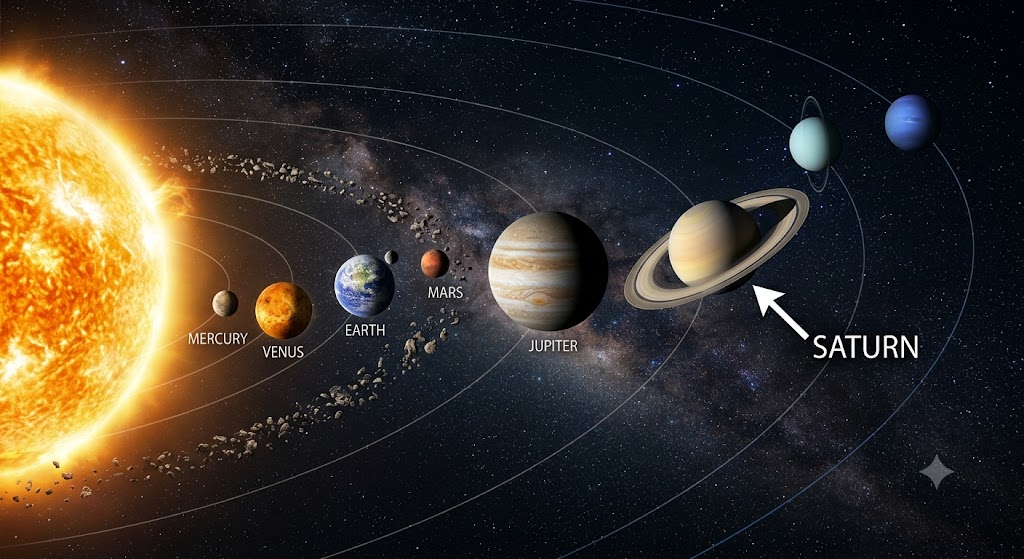
Saturn is located about 1.4 billion kilometers from the Sun on average. Because of this enormous distance, sunlight takes roughly 80 minutes to reach Saturn.
Discovery of Saturn
- Galileo Galilei — 1610: First observed Saturn through a telescope and noticed unusual shapes around the planet, which were later understood to be its rings.
- Christiaan Huygens — 1655: Correctly identified Saturn’s rings and discovered its largest moon, Titan.
- Giovanni Domenico Cassini — 1675: Discovered the major gap in Saturn’s rings, now known as the Cassini Division.
How Long Is a Day on Saturn?
A day on Saturn lasts about 10.5 hours, while one year on Saturn is equal to approximately 29.5 Earth years.
Weather and Atmosphere of Saturn
Saturn has an extremely cold and windy atmosphere. Its upper atmosphere experiences winds that can reach around 1,800 km/h, making them some of the fastest winds in the Solar System. The planet also experiences powerful storms and unusual atmospheric features, including the famous hexagon at its north pole.
Gases Present on Saturn
Saturn is mainly made up of:
- Hydrogen — about 96%
- Helium — about 3%
- Methane and ammonia — present in smaller amounts
- Trace amounts of water vapor and other hydrocarbons
Its atmosphere gradually becomes denser and hotter as you move deeper into the planet.
How Many Moons Does Saturn Have?
Saturn is not only famous for its spectacular rings; it also has an incredible collection of moons. As of 2026, Saturn has 274 confirmed moons, making it the planet with the largest known number of moons in the Solar System.

Titan: Saturn’s Largest Moon
Titan is Saturn’s largest moon and the second-largest moon in the Solar System, after Jupiter’s Ganymede. It is especially interesting because it has a thick atmosphere and lakes and seas made of liquid methane and ethane.
Enceladus: A Moon With an Ocean
Enceladus is much smaller than Titan, but it has a large ocean hidden beneath its icy surface. Water and ice particles shoot into space through cracks near its south pole.
Phoebe: Saturn’s Mysterious Moon
Phoebe is one of Saturn’s most unusual moons. It has a dark, irregular surface covered with craters and follows a retrograde orbit, moving in the opposite direction to most of Saturn’s moons. Scientists believe Phoebe may have formed far from Saturn and was later captured by the planet’s gravity.
Saturn’s Seven Main Rings
Saturn has seven main ring groups, named D, C, B, A, F, G, and E, in order from the planet outward. These rings are made mainly of ice particles, along with rock and dust.
- D Ring: The faintest and closest to Saturn.
- C Ring: A relatively faint ring with many gaps.
- B Ring: The brightest and one of the densest rings.
- A Ring: The outermost of the two main bright rings; it contains the Encke Gap.
- F Ring: A narrow, bright ring with a complex structure.
- G Ring: A faint and diffuse ring.
- E Ring: The outermost major ring, supplied largely by material from the moon Enceladus.

Saturn’s Mysterious Hexagon
Saturn’s hexagon is a giant six-sided jet stream surrounding its north pole. Each side is approximately 14,000 kilometers (8,700 miles) long, making it wider than Earth. The unusual shape is created by powerful winds in Saturn’s atmosphere and has remained remarkably stable for decades.
Mythology of Saturn
Hindu Mythology — Shani
- Shani (Shanideva) represents the planet Saturn.
- He is traditionally considered the son of Surya (Sun god) and Chhaya.
- Associated with karma, justice, discipline, and consequences.
- Believed to teach people patience, responsibility, and humility through challenges.
Greek Mythology — Cronus
- Saturn is associated with Cronus, one of the Titans.
- Cronus was the son of Uranus (Sky) and Gaia (Earth).
- He overthrew his father and became ruler of the Titans.
- He was eventually defeated by his son Zeus.
Roman Mythology — Saturn
- Saturn was a Roman god associated with agriculture, wealth, and prosperity.
- He was celebrated during Saturnalia, a major Roman festival.
- Saturnalia was known for feasting, celebration, and temporary social freedom
Saturn’s Rotation and Magnetic Field
Unlike most magnetized planets, Saturn’s magnetic field is almost perfectly aligned with its rotation axis, with a tilt of less than 0.01°. For comparison, Earth’s magnetic field is tilted by about 11°, while Jupiter’s is tilted by about 10°. This makes Saturn unusual because its magnetic field does not produce strong, easily detectable signals that reveal its rotation rate. As a result, scientists have had to use other observations, including radio emissions and measurements of Saturn’s magnetosphere, to study its rotation.
Major Missions to Saturn
- Pioneer 11–1979: First spacecraft to fly past Saturn. It studied the planet, rings, and magnetic environment.
- Voyager 1–1980: Sent detailed images and data about Saturn and discovered new information about its rings and moons.
- Voyager 2–1981: Conducted a second close flyby and provided further observations of Saturn’s atmosphere, rings, and moons.
- Cassini-Huygens — 2004–2017: The most extensive Saturn mission. Cassini studied Saturn, its rings, and moons for more than 13 years, while the Huygens probe landed on Titan in 2005.
- Dragonfly — planned: NASA’s upcoming mission will send a rotorcraft to Titan to study its surface, atmosphere, and chemistry.
Amazing Facts About Saturn
- Saturn is the least dense planet in the Solar System. Its average density is lower than that of water.
- Saturn produces a powerful radio emission, which scientists use to study its rotation and magnetic field.
- Saturn’s rings are extremely thin compared with their enormous width. In some places, they are only tens of meters thick.
- Saturn experiences seasonal changes because its axis is tilted, similar to Earth.
- The planet has auroras at its poles, produced by interactions between charged particles and its magnetic field.
- Saturn’s rings are not permanent. Scientists believe they may eventually disappear over astronomical timescales.
- Saturn’s rings can vibrate and ripple due to gravitational effects, creating patterns that help scientists study the planet’s interior.
- Saturn is so large that more than 760 Earths could fit inside it by volume, although its low density makes it much less massive than that comparison might suggest.
메타데이터
- post_id
- 190a58d63aff
- slug
- saturn-the-fascinating-world-beyond-the-rings-190a58d63aff
- url
- https://medium.com/@vethika1681/saturn-the-fascinating-world-beyond-the-rings-190a58d63aff
- canonical_url
- https://medium.com/@vethika1681/saturn-the-fascinating-world-beyond-the-rings-190a58d63aff
- author_url
- https://medium.com/@vethika1681
- status
- ok
- fetched_at
- 2026-08-09 07:44:01