Why can liquids flow but solids cannot?
Solids and liquids are the two general states of matter, but they differ in how their particles move and maintain their shape. In solids…
Why can liquids flow but solids cannot?
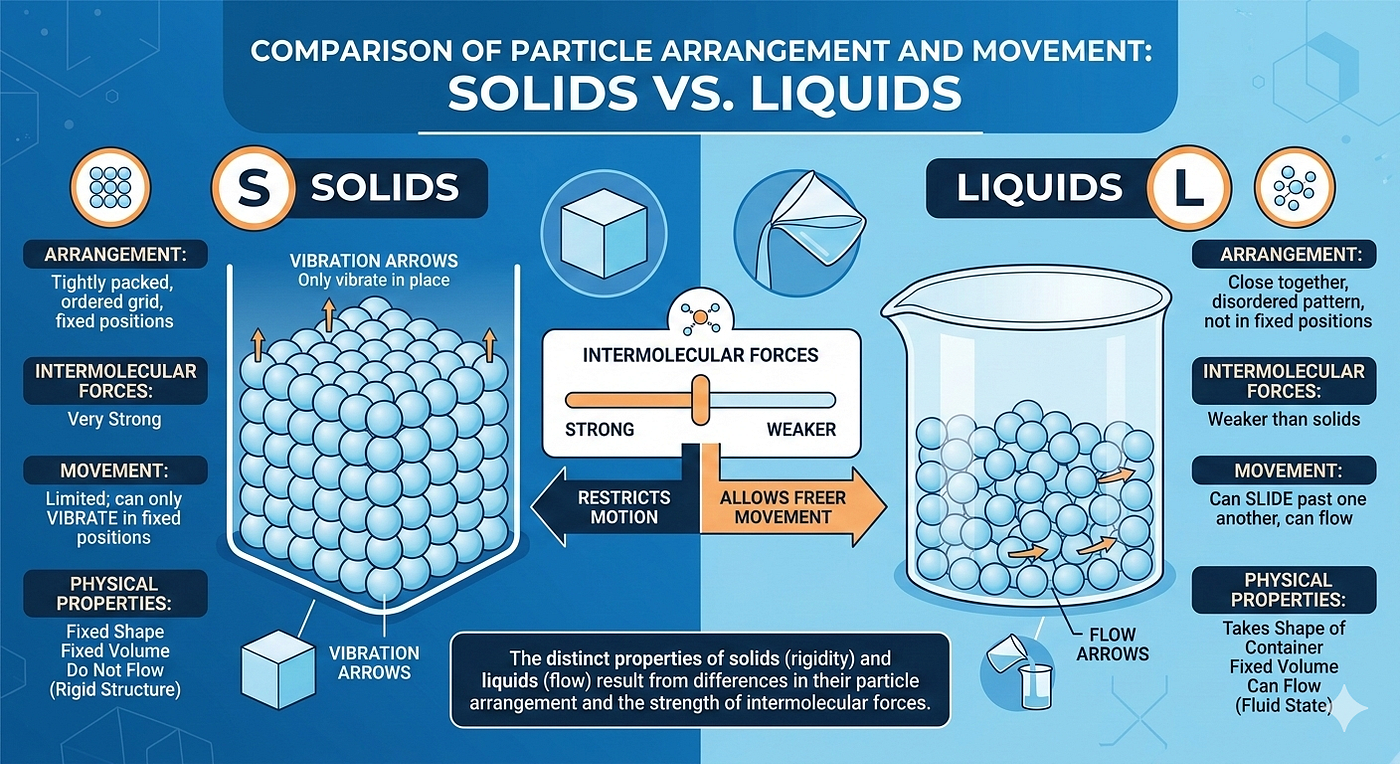
A detailed review of how intermolecular forces and particle arrangements define the physical properties and motion of solids and liquids.
Solids and liquids are the two general states of matter, but they differ in how their particles move and maintain their shape. In solids, the particles are tightly packed and held in place by strong forces. They can only vibrate in place, which gives solids a fixed shape and prevents them from flowing. In contrast, the particles in liquids are close together but not stationary. The weak forces between them allow them to move and slide over each other. Because of this freedom of movement, liquids do not have a fixed shape and can flow easily into the shape of the container they are placed in.
Arrangement of Particles in Solids
In solids, the particles are arranged very closely and neatly. The atoms, molecules, or ions that make up a solid are tightly packed together, with very little space between them. Because of this compact arrangement, each particle occupies a fixed position in the structure of the solid. These particles are held together by strong intermolecular or interatomic forces, which keep them firmly in place.
The regular and stable arrangement of particles forms a fixed structure, which in many solids is called a crystal lattice. In this structure, the particles are located in a repeating and organized pattern that gives the solid its rigidity and fixed shape. Due to the strong attractive forces between neighboring particles, they cannot easily move from one place to another.
Although the particles in solids cannot move freely, they are not completely motionless. They constantly vibrate around their fixed positions. However, this vibration is limited and does not allow the particles to slide past each other.
Because the particles remain fixed in their positions, solids maintain a fixed shape and volume. This tightly packed arrangement is the main reason why solids are rigid and do not flow like liquids or gases.
Limited Movement of Particles in Solids
In a solid, particles such as atoms, molecules, or ions are very closely arranged and held together by strong intermolecular forces. Because of these strong forces, the particles remain fixed at specific locations in a structured arrangement known as a lattice. Unlike particles in liquids or gases, solid particles do not have enough freedom to move from one place to another.
Although they cannot move freely, the particles in a solid are not completely motionless. They vibrate continuously around their fixed positions due to the energy they possess. This vibration becomes stronger as the temperature increases, but the particles remain confined to their positions until the solid melts.
The main reason why solids maintain a fixed shape and volume is the limited movement of the particles. Since the particles cannot slide over each other, the overall structure remains rigid and stable. This rigidity prevents solids from flowing like liquids. When an external force is applied, a solid may deform slightly or break, but its particles are still not free to move throughout the substance.
Therefore, the limited movement of particles in solids explains why solids are dense, have a fixed shape, and cannot flow like liquids.
Arrangement of Particles in Liquids
In liquids, the arrangement of particles is less rigid than in solids but still relatively close to each other. Unlike the stable and well-ordered structure found in solids, particles in liquids do not occupy a permanent position. They remain close because there are attractive forces between them, but these forces are not strong enough to hold the particles in place. As a result, the arrangement of particles in liquids is irregular and constantly changing.
The particles in liquids have enough energy to move around each other and yet remain close to each other. This movement allows them to slide easily over each other. Because of this loose arrangement, liquids can change their shape depending on the container that holds them. However, the particles are still so closely packed that liquids maintain a fixed volume.
Another important feature of the arrangement of particles in liquids is the small distances between the particles. These distances allow the particles to constantly move and rearrange themselves. This dynamic structure gives liquids their flexibility and mobility and keeps them more compact than gases.
Therefore, the arrangement of particles in fluids is best described as close together but not fixed, constantly moving, and randomly arranged, which explains many of the unique properties of fluids.
Movement of Particles in Liquids
In liquids, particles are closely packed but not rigidly fixed like in solids. The intermolecular forces between the particles are strong enough to hold them close together, but weak enough to enable them to move around each other. Because of this balance of forces, particles in liquids are in constant motion.
Particles in liquids move randomly in all directions. Instead of vibrating in a fixed position like solid particles, they can slide past each other. This motion allows liquids to change shape easily while maintaining a fixed volume. When a liquid is poured into a container, its particles move and rearrange themselves to take the shape of the container.
The ability of particles to move freely also explains why liquids can flow. When a force is applied, such as bending a glass or pouring water, the particles slide past each other and rotate, allowing the liquid to move easily. The speed of movement of particles can also increase with temperature because heating gives the particles more kinetic energy.
Thus, the movement of particles in liquids is elastic and dynamic. This constant motion and the ability to slide past neighboring particles are the main reasons why liquids can flow while solids cannot.
Effect of Intermolecular Forces
Intermolecular forces are the forces of attraction between particles of matter. These forces play a major role in determining whether a substance behaves as a solid, liquid, or gas. The strength of these forces directly affects how freely the particles of matter can move.
In solids, intermolecular forces are very strong. The particles are tightly bound together and held in a fixed position. Because of these strong attractions, the particles cannot move from one place to another. They can vibrate slightly around their fixed positions. This limited movement gives solids a fixed shape and prevents them from flowing.
In liquids, intermolecular forces are weaker than in solids. The particles are still close to each other, but they are not confined to fixed positions. As a result, the particles can move and slide over each other while remaining close to each other. This ability to move allows liquids to easily change shape and flow when a force is applied.
The difference in the strength of intermolecular forces explains why solids remain rigid while liquids can flow. Strong forces restrict the movement of particles, while weak forces allow for greater freedom of movement.
Resulting Physical Properties
The differences in the arrangement and motion of particles give solids and liquids their distinct physical properties. In solids, the particles are very closely packed together and are held in a fixed position by strong intermolecular forces. Because of this strong attraction, the particles can only vibrate slightly about their positions and cannot move freely. As a result, solids maintain a fixed shape and fixed volume. They are rigid and cannot flow under normal conditions. Solids usually resist deformation and retain their structure when a force is applied.
In liquids, the particles are also close together but not locked in a fixed position. The intermolecular forces are weaker than in solids, allowing the particles to move and slide over each other. Because of this mobility, liquids do not have a fixed shape. Instead, they take the shape of the container they are placed in and still maintain a fixed volume. This freedom of motion allows liquids to flow easily.
These differences explain why solids are dense and fixed, while liquids are flexible and capable of movement. The ability of liquid particles to change their position relative to each other is the primary reason why liquids flow, while the fixed arrangement of particles in solids prevents them from doing so.
Conclusion
Liquids can flow while solids cannot because of differences in how their particles are arranged and how strongly they attract each other. In solids, the particles are tightly packed in fixed positions and held together by strong intermolecular forces. They can only vibrate around these positions, so the solid maintains a fixed shape and cannot move freely. In liquids, the particles are still close together but are not fixed in place. The forces between them are weak, allowing the particles to slide past each other. This freedom of movement allows liquids to change shape and flow easily, maintaining a nearly constant volume under normal conditions.
Read more articles
- Why do gases spread throughout a room on their own?
- How does entropy influence spontaneous processes in nature?
- Why do moving clocks run slower in special relativity?
- Derive the time dilation formula using Lorentz transformations in special relativity.
- How does gauge invariance lead to the existence of force-carrying bosons in quantum field theory?
메타데이터
- post_id
- 190bf47fcfeb
- slug
- why-can-liquids-flow-but-solids-cannot-190bf47fcfeb
- url
- https://medium.com/@sciencespectrum/why-can-liquids-flow-but-solids-cannot-190bf47fcfeb
- canonical_url
- https://medium.com/@sciencespectrum/why-can-liquids-flow-but-solids-cannot-190bf47fcfeb
- author_url
- https://medium.com/@sciencespectrum
- status
- ok
- fetched_at
- 2026-07-13 06:23:13