The Digital Decision Makers: A Guide to Logic Gates
In the world of microcomputing, every complex action — from rendering a 3D graphic to sending a text — boils down to a series of tiny…
The Digital Decision Makers: A Guide to Logic Gates
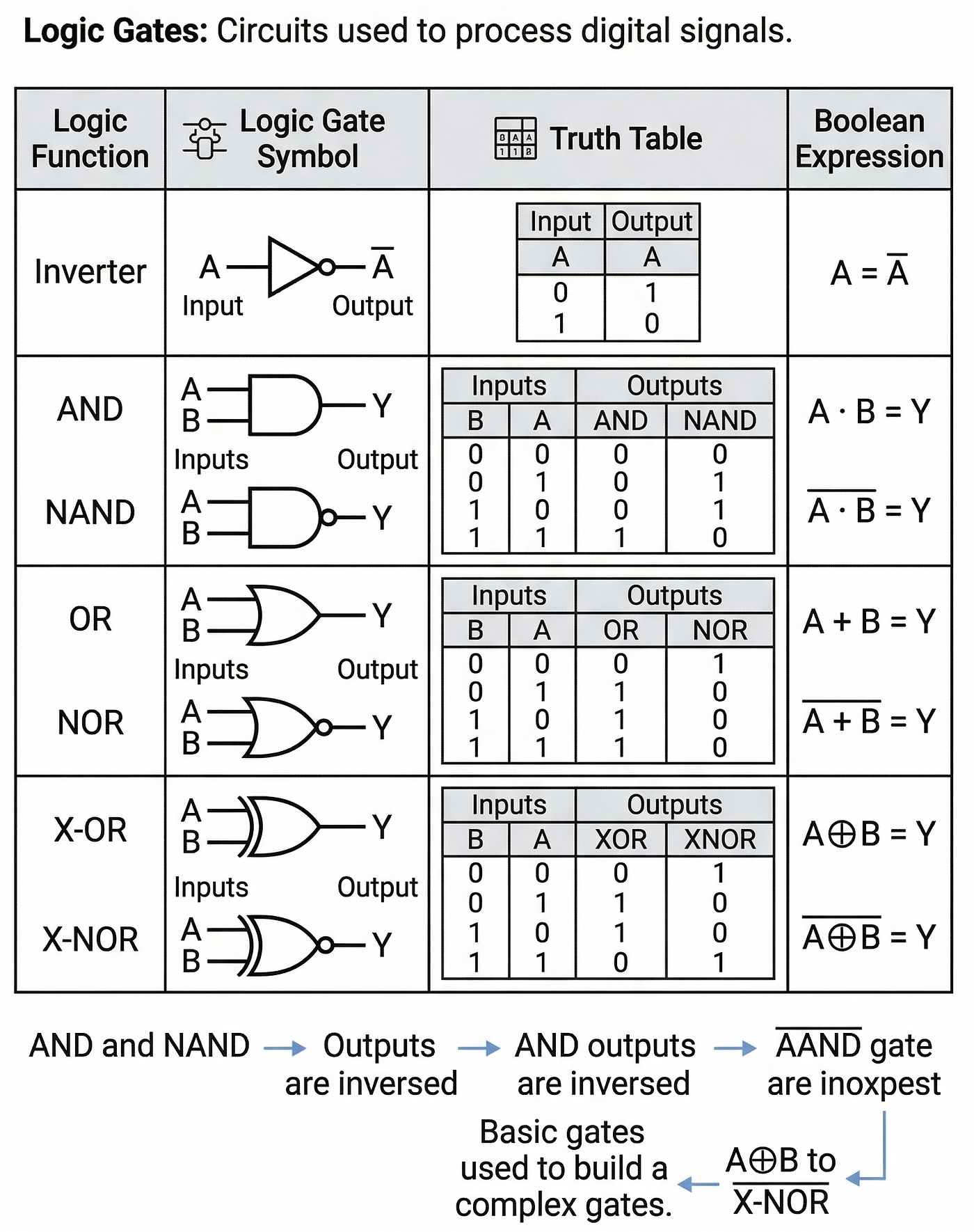
In the world of microcomputing, every complex action — from rendering a 3D graphic to sending a text — boils down to a series of tiny binary decisions. These decisions are made by Logic Gates.
Logic gates are the physical building blocks of digital circuits. They take one or more binary inputs (0s and 1s) and produce a single output based on a specific set of rules. Here is a breakdown of the primary gates that power our digital world.
1. The Inverter (NOT Gate)
The simplest of all gates is the Inverter. Its job is straightforward: it flips the input. If a “1” goes in, a “0” comes out, and vice versa.
- Boolean Expression: $A = \bar{A}$
- Real-world logic: Think of it as a “No” switch. If the input is “True,” the output is “False.”
2. The Gatekeepers: AND & NAND
The AND Gate is a strict gatekeeper. It only produces a “1” if both inputs (A and B) are “1.” If even one input is “0,” the gate stays closed.
- The NAND Twist: As shown in your diagram, a NAND gate is simply an AND gate followed by an Inverter. It does the exact opposite: it stays “1” unless everything going in is a “1.” In circuit design, NAND gates are legendary because they are “universal” — you can build any other gate using only NANDs.
3. The Inclusive Choice: OR & NOR
The OR Gate is more flexible. It will output a “1” if either Input A or Input B is “1.” It only stays at “0” if both inputs are silent.
- The NOR Twist: Like the NAND, the NOR gate is the inverse. It only outputs a “1” when both inputs are “0.” It’s a “Neither/Nor” logic.
4. The Specialists: XOR & XNOR
The X-OR (Exclusive OR) is the “one or the other, but not both” gate. It is incredibly important for arithmetic operations like addition. It outputs a “1” only if the inputs are different (one 0 and one 1).
- X-NOR: This is the “Equality” gate. It outputs a “1” only if both inputs are the same (both 0 or both 1).
From Simple Gates to Complex Systems
As the bottom of the diagram suggests, these basic gates don’t work in isolation. By “chaining” an AND gate to an Inverter to create a NAND, or combining XOR gates, engineers create the complex logic required for a Microprocessing Unit (MPU) to function.
These gates are the “vocabulary” of the computer. When we write high-level code as developers, we are ultimately just rearranging these trillions of tiny “Yes/No” decisions to perform incredible tasks.
*Note: “NAND and NOR gates are the ‘inversed’ versions of AND and OR, serving as the functional foundation for building more complex logic like X-OR.”
메타데이터
- post_id
- 1913dd7c7283
- slug
- the-digital-decision-makers-a-guide-to-logic-gates-1913dd7c7283
- url
- https://medium.com/@technobeastsys/the-digital-decision-makers-a-guide-to-logic-gates-1913dd7c7283
- canonical_url
- https://medium.com/@technobeastsys/the-digital-decision-makers-a-guide-to-logic-gates-1913dd7c7283
- author_url
- https://medium.com/@technobeastsys
- status
- ok
- fetched_at
- 2026-08-10 16:34:27