A Screened Two-Sheet Scalar — Tensor Extension of ΛCDM: Formulation, Background Coupling, and…
Matthew Hodgkins
A Screened Two-Sheet Scalar — Tensor Extension of ΛCDM: Formulation, Background Coupling, and Current Constraints
Matthew Hodgkins
Independent researcher (Genesis / Dual Sheet Model project)
Abstract
We present the Lane-A sector of the Dual Sheet Model (DSM), a conservative extension of ΛCDM motivated by a CPT-conjugate two-sheet cosmology and implemented as a screened scalar — tensor theory with a single additional background-geometry parameter κ. The model augments the Friedmann equation with a term ΔE²(a) = κ·(Ω_m/a³)·(1−a), which we show arises as the leading linear response of the de Sitter branch of a Hassan — Rosen bimetric interaction to the matter content of the observable sheet. A conformally coupled radion scalar with a quartic potential supplies a chameleon screening mechanism that renders the model’s fifth force compatible with Solar System constraints: the effective radion mass spans roughly ten orders of magnitude between intergalactic and terrestrial densities, recovering general relativity in the high-density regime. The corrected radion growth coupling is attractive, μ(a,k) = 1 + 2β²/[1 + (m_eff a/k)²], recovering ΛCDM on large scales and enhancing growth by at most a per-cent on small scales. Confronting the model with DESI DR2 baryon acoustic oscillations, a compressed-CMB likelihood, redshift-space distortions, and the full Pantheon+ Type Ia supernova sample, we find that a nonzero κ is permitted but not required: on the full background dataset (N = 1711) the fair model comparison yields ΔAIC = −0.19, ΔAICc = −0.18, and ΔBIC = +5.25 relative to ΛCDM, indicating statistical indistinguishability with a mild Bayesian preference for the simpler model. The predicted S₈ = 0.797 (canonical) places DSM in the high-S₈ regime, consistent with weak-lensing measurements but in tension with CMB-derived values. We argue that the leading two-sheet back-reaction is degenerate with cold dark matter, which structurally explains the weakness of current constraints, and we identify the observational programs capable of resolving the predicted sub-per-cent signal. We delineate explicitly which results are derived, which are phenomenological, and which remain open, including the non-linear ghost-freedom of the combined bimetric-plus-radion theory.
- Introduction
- The six-parameter ΛCDM model remains an excellent description of cosmological observations, yet it leaves several structural questions unaddressed. Among these is the origin of the cosmic baryon asymmetry and, more abstractly, the absence of an evident counterpart to the cosmological initial condition: if the conservation laws that govern physics admit no boundary, the question of what balanced the initial singularity is not obviously meaningless. A natural response, explored in CPT-symmetric cosmologies [Boyle, Finn & Turok and related work], is that the observable universe is one of a CPT-conjugate pair, with the antimatter and reversed thermodynamic arrow residing in a partner sector related to ours by the discrete symmetry CPT.
- The Dual Sheet Model (DSM) is a long-term programme that takes this proposition as its founding principle and asks whether a two-sheet cosmology can be made concrete, predictive, and observationally testable. The programme separates cleanly into two sectors. The first, which we term Lane A and which is the subject of this paper, concerns the cosmological consequences of the two-sheet structure at the level of the background expansion and linear growth: a scalar — tensor extension of ΛCDM with a screened fifth force and a single additional background parameter. The second sector, concerning the fermionic realisation of the CPT partner and the matter — antimatter ledger, is a separate and as yet unformulated problem that we do not address here.
- Our aim in this paper is deliberately modest and, we hope, honest. We do not claim that DSM is preferred over ΛCDM by current data; we show that it is permitted by them. We present the Lane-A model, derive the origin of its background coupling κ as far as is presently possible, establish its consistency with Solar System and cosmological constraints, and state precisely which of its features are derived from first principles, which are phenomenological parametrisations, and which remain open theoretical problems. We regard this delineation as the principal contribution: a non-standard cosmological model is most useful to the community when the boundary between what it establishes and what it assumes is drawn sharply.
- The paper is organised as follows. Section 2 presents the Lane-A action and field content. Section 3 derives the background coupling κ from the de Sitter branch of the bimetric interaction and analyses what the derivation does and does not establish. Section 4 treats the radion sector and the chameleon screening mechanism. Section 5 gives the linear growth coupling. Section 6 describes the likelihoods and the fair model comparison. Section 7 discusses the S₈ landscape. Section 8 collects the open theoretical items, including the ghost-freedom analysis. Section 9 concludes.
-
- The Lane-A model
- We work with a theory comprising a Hassan — Rosen ghost-free bimetric sector and a conformally coupled radion scalar. The bimetric action is
- S_HR = (M_g²/2) ∫ d⁴x √−g R(g) + (Mf²/2) ∫ d⁴x √−f R(f) − 2m⁴ ∫ d⁴x √−g Σ{n=0}^{4} β_n e_n(√(g⁻¹f)),
- where g is the metric of the observable sheet, f that of the partner sheet, and e_n are the elementary symmetric polynomials of the matrix square root √(g⁻¹f). To this we add a radion sector
- S_φ = ∫ d⁴x √−g [ −½ (∂φ)² − V(φ) ] + S_m[A²(φ) g, Ψ],
- with quartic potential V(φ) = ½ m²φ² + ¼ λφ⁴ and conformal coupling A(φ) to matter. Ordinary matter couples to the observable metric g; partner-sector matter, which does not enter the present analysis, couples to f.
- In the Lane-A implementation the radion is treated as an independent scalar — tensor sector on the physical metric g, and κ encodes the leading back-reaction of the bimetric interaction potential rather than a full non-linear identification of φ with the metric ratio. The combined theory whose consistency must ultimately be established is S_tot = S_HR + S_φ; the status of its non-linear ghost-freedom is discussed in Section 8.
- The background expansion is governed by a modified Friedmann equation, written in dimensionless form as
- E²(a) ≡ H²(a)/H₀² = Ω_m a⁻³ + Ω_r a⁻⁴ + Ω_Λ + κ (Ω_m/a³)(1−a), (1)
- with the canonical parameter set h = 0.690, the standard density parameters, and κ a small dimensionless coefficient. The final term is the DSM background signature, and its origin is the subject of the next section.
-
- Origin of the background coupling κ
- 3.1 Bimetric reduction and the de Sitter branch
- Specialising both metrics to spatially flat FRW form and defining the ratio of scale factors r ≡ a_f/a_g, the bimetric interaction contributes to the observable-sheet Friedmann equation an effective energy density that is a function of r,
- 3 H² M_g² = ρ_m + m² M_g² B(r), B(r) = β₀ + 3β₁ r + 3β₂ r² + β₃ r³. (2)
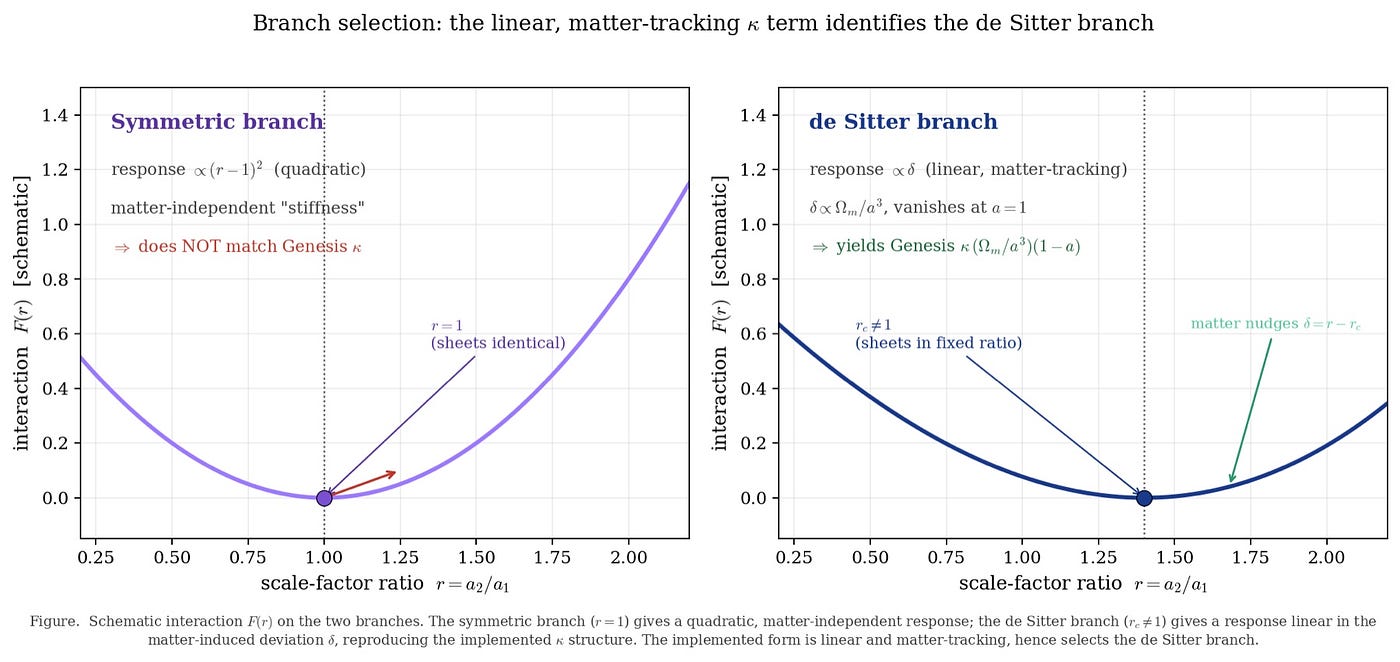
- This is the standard bimetric FRW result. The dynamics admit distinct branches. On the symmetric branch (r = 1) the leading deformation is quadratic in (r−1) and matter-independent — a “stiffness” of the two-sheet system. On the de Sitter branch the ratio settles to a constant r_c ≠ 1, and the leading response is linear in the deviation and couples to matter. The κ term in Eq. (1), being linear in the deviation and proportional to Ω_m/a³, corresponds to the de Sitter branch; this identification is forced by the functional form implemented and is consistent with the CPT motivation, in which the two sheets are conjugate but not identical.
- 3.2 Linear response and the matter-tracking structure
- Writing r(a) = r_c + δ(a) with |δ| ≪ 1 and expanding B around r_c, the constant term B(r_c) is absorbed into Ω_Λ and the leading correction is F’(r_c) δ(a). Near the de Sitter fixed point, where ρ_m(r_c) = 0 and ρ_m is analytic in r, one has δ(a) ∝ Ω_m/a³ at leading order. Thus the matter-tracking structure of κ — its proportionality to Ω_m/a³ — is derived: it is the de Sitter-branch back-reaction sourced by ordinary matter.
- A consequence deserves emphasis. A contribution scaling as pure Ω_m/a³ is degenerate with cold dark matter: it renormalises Ω_m and carries no independent observable signature. The leading two-sheet back-reaction is therefore observationally invisible, absorbed into the fitted matter density. The observable part of κ is precisely the sub-leading correction that breaks the a⁻³ scaling. This structurally explains the empirical result of Section 6, that current data permit but do not require κ: the model’s leading effect hides within an existing parameter.
- 3.3 The (1−a) factor: derived shape, modelled scaling
- The deviation δ(a) obeys a linearised Bianchi constraint of the form
- dδ/d ln a + γ δ = η Ω_m a⁻³, (3)
- with γ, η constants set by the interaction. The exact solution satisfying δ(a=1) = 0 is
- δ(a) = [η Ω_m/(γ−3)] (a⁻³ − a⁻ᵞ). (4)
- Two statements follow, which we are careful to separate. First, expanding Eq. (4) about a = 1 gives δ(a) ∝ (1−a) at leading order, independently of γ: any solution vanishing at the present epoch vanishes linearly there, so the (1−a) shape is a robust, controlled first-order result. Second, the exact form (1−a)·Ω_m/a³ used in Eq. (1) is recovered across all redshifts only for the specific value γ = 2; we have verified symbolically that γ = 2, not the value γ = 4 suggested by a naive argument, is required (γ = 4 yields (1−a)/a⁴). Whether the physical interaction yields γ = 2 depends on the β_n and is not established here.
- We therefore regard the (1−a) factor as derived in its leading, vanishing-today behaviour, while the accompanying Ω_m/a³ scaling away from the present epoch is a physically motivated modelling choice — it ties the term to the matter density that sources it and preserves its observational distinguishability — rather than a fully derived result. The κ term is thus a controlled low-redshift expansion of the de Sitter-branch response, with κ absorbing F’(r_c), η, and normalisation constants.
- 3.4 Effect on the expansion history
- Numerically, with κ = −0.016 and Ω_m = 0.315, the κ term modifies E(z) by approximately −0.7% at a = 0.1, decreasing monotonically to exactly zero at a = 1. Recast as an autonomous dynamical system in the standard scalar-field variables, the Lane-A background retains the usual radiation, matter, and de Sitter fixed points; κ enters as an explicitly time-dependent, decaying deformation Ω_κ(a) ∝ a⁻³(1−a) that perturbs the matter era but leaves the late-time attractor unchanged. The model is therefore a conservative deformation of the standard expansion history rather than a structural alteration of it.
-
- Radion sector and chameleon screening
- The radion effective potential in an environment of matter density ρ is
- V_eff(φ; ρ) = ½ m²φ² + ¼ λφ⁴ + βρφ,
- with the field-value minimum φ̄(ρ) solving m²φ + λφ³ + βρ = 0. The effective mass is the curvature at the minimum,
- m_eff²(ρ) = m² + 3λ φ̄(ρ)². (5)
- We note that the density dependence enters solely through the shifted minimum φ̄(ρ); for the linear coupling βρφ implemented here there is no additional explicit term in the curvature, a point on which an earlier diagnostic was corrected. In the low-density regime φ̄ ≈ −βρ/m² and m_eff ≈ m (light, long-range); in the high-density regime φ̄ ≈ (−βρ/λ)^{1/3} and m_eff ∝ ρ^{1/3} (heavy, short-range).
- With canonical parameters (m_radion = 10⁻³, λ = 0.01, β = 0.052), the effective mass spans roughly ten orders of magnitude across cosmic densities: m_eff ≈ 1.8×10⁻⁶ m⁻¹ in the intergalactic medium (Compton wavelength ~540 km), rising to ≈ 3.2×10³ m⁻¹ at terrestrial density (Compton wavelength ~0.3 mm). In dense environments the fifth force is consequently screened to sub-millimetre range, and the model satisfies the Cassini bound on |γ_PPN − 1| by a wide margin. The scalar sector is free of kinetic ghost for β < 1/√2, comfortably satisfied by the canonical and best-fit values.
-
- Linear growth coupling
- In the quasi-static, sub-horizon limit the modified Poisson equation takes the form k²Ψ = −4πG a² μ(k,a) ρ_m Δ, with the scalar — tensor coupling
- μ(a,k) = 1 + 2β² / [1 + (m_eff a / k)²]. (6)
- The sign is attractive (μ ≥ 1): the corrected coupling enhances structure growth, in contrast to an earlier suppressive form that has been retired as a sign error. The limiting behaviour is μ → 1 + 2β² on small scales (k ≫ m_eff a, full enhancement) and μ → 1 on large scales (k ≪ m_eff a, GR recovery). For canonical β the maximal enhancement is 2β² ≈ 0.5%, so the growth modification is at most per-cent level. We verify numerically that Eq. (6) reproduces μ = 1.0054 at k = 100 h Mpc⁻¹ and μ → 1 at k = 10⁻⁵ h Mpc⁻¹.
-
- Likelihoods and model comparison
- We constrain the model against: DESI DR2 baryon acoustic oscillations (seven D_V/r_d points, z = 0.295 to 2.33); a compressed-CMB likelihood; redshift-space distortions (treated provisionally, see Section 8); and the full Pantheon+ Type Ia supernova sample (1701 SNe with the Brout et al. covariance). The background analysis combines BAO, compressed CMB, and Pantheon+ for N = 1711 data points.
- We perform a fair model comparison, penalising DSM for its additional parameter relative to ΛCDM. With χ²_ΛCDM = 1770.82 (k = 3) and χ²_DSM = 1768.63 (k = 4), the raw improvement Δχ² = −2.19 is consistent with the gain expected from a single extra parameter absorbing statistical fluctuations. The information criteria give
- ΔAIC = −0.19, ΔAICc = −0.18, ΔBIC = +5.25,
- relative to ΛCDM. The AIC and AICc are inconclusive; the BIC, which more heavily penalises parameters at this sample size, mildly favours ΛCDM. We conclude that κ is permitted but not required by current background data, and that DSM and ΛCDM are statistically indistinguishable. We emphasise that an earlier claim of strong preference for DSM rested on an unfair baseline (ΛCDM evaluated at the DSM value of h) and is retired; the comparison above uses each model at its own best fit.
- Expressed as a distance residual, the κ term predicts a deviation in D_V/r_d of at most a few tenths of a per-cent across the constrained redshift range, while the DESI DR2 uncertainties are 0.5 — 1.5%. The predicted signal is therefore smaller than the present measurement precision, the quantitative content of “permitted but not required.”
-
- The S₈ landscape
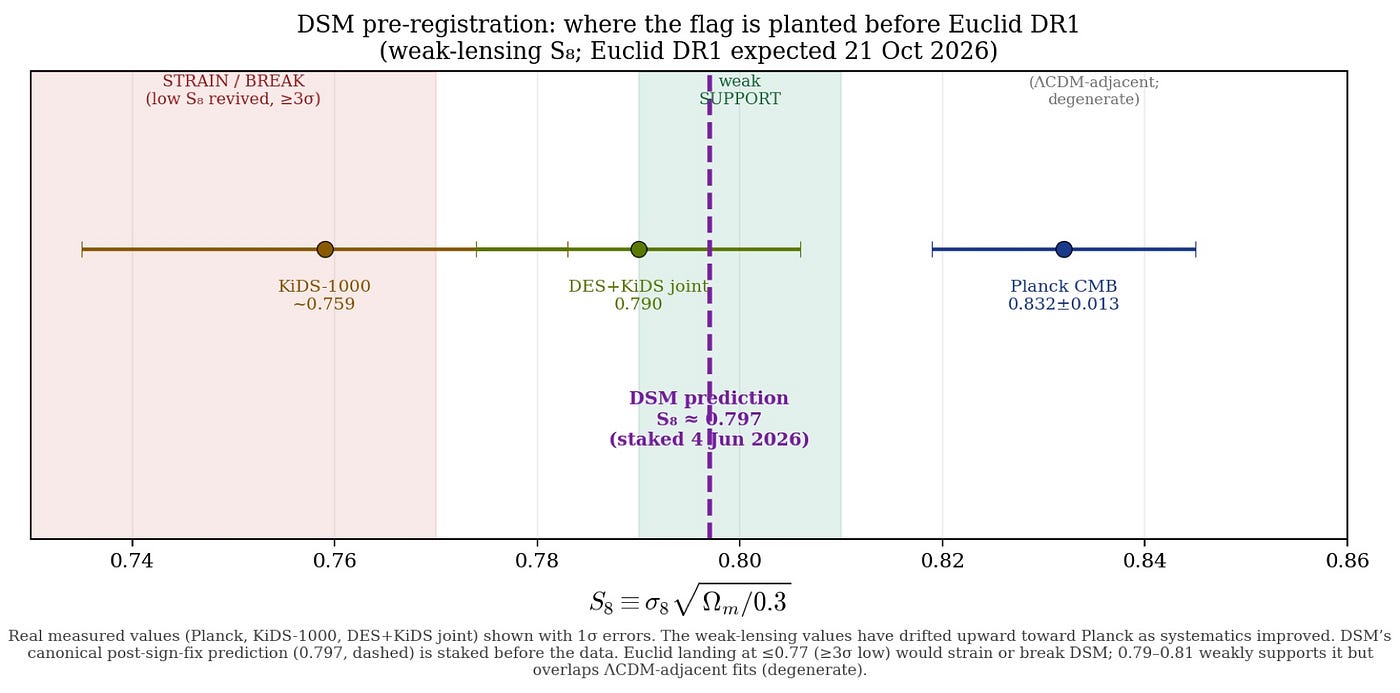
- With the corrected attractive coupling, the model predicts S₈ = 0.797 at canonical parameters and 0.812 at the re-tuned best fit. These values place DSM in the high-S₈ regime: consistent with DES-Y3 (S₈ = 0.776 ± 0.017) at the ~1σ level and with KiDS-Legacy (0.815 ± 0.016) and CMB lensing (0.818 ± 0.014), but in tension with the higher CMB-derived values, including a 2026 combined-CMB benchmark (0.836 ± 0.013) against which the canonical prediction sits ~3σ low. We treat the combined-CMB value as a benchmark adopted on citation rather than incorporated into the likelihood. We do not claim that DSM resolves the S₈ tension; the corrected model sits within the high-S₈ grouping, and the earlier claim of a low-S₈ resolution, an artefact of the retired sign error, is withdrawn.
-
- Open theoretical items
- We state the principal unresolved problems explicitly.
- Non-linear ghost-freedom. The Hassan — Rosen sector is ghost-free by construction, and the radion sector, coupling only to the observable metric g and introducing no quadratic-lapse terms, is expected to preserve the Hamiltonian constraint structure that removes the Boulware — Deser mode. This expectation is not a proof. A full ADM analysis of S_tot = S_HR + S_φ is required to verify that the lapse-Hessian retains the rank yielding the primary constraint, and that the secondary constraint survives; we leave this well-posed but technically demanding calculation to future work.
- Linear stability. On the de Sitter branch the helicity-0 mode must satisfy the Higuchi bound m_eff² ≥ 2H², which we have cast as an explicit inequality on the β_n, and the scalar sector must have positive sound speed c_s² > 0. These define a finite search over the β_n that simultaneously must reproduce γ ≈ 2 (Section 3.3). The search may admit no solution, in which case the de Sitter-branch κ is not realisable in a healthy theory and the parametrisation must be revised; the outcome is genuinely open.
- Redshift-space distortions. The DESI DR2 RSD data used here are of unverified provenance and are treated as provisional; growth-rate constraints await a validated dataset.
- The partner sector. The fermionic realisation of the CPT partner — the founding motivation of the programme — is not addressed by Lane A and remains unformulated.
-
- Conclusions
- We have presented the Lane-A sector of the Dual Sheet Model as a screened two-sheet scalar — tensor extension of ΛCDM with a single additional background parameter. The model recovers general relativity in the Solar System through chameleon screening, recovers ΛCDM in the limit κ → 0, and predicts a sub-per-cent deformation of the expansion history and a per-cent-level enhancement of structure growth. Its background coupling κ is derived as the leading linear response of the de Sitter branch of a bimetric interaction to ordinary matter, with the matter-tracking structure and the vanishing-today behaviour established and the exact all-redshift form and the underlying coefficients left open. Confronted with current data, the model is statistically indistinguishable from ΛCDM: κ is permitted but not required, with a mild Bayesian preference for the simpler model.
- We have argued that this status is structurally inevitable at present precision, because the leading two-sheet back-reaction is degenerate with cold dark matter and only its sub-leading, observable remainder is constrained. The predicted signal lies below current measurement uncertainties but within reach of the next generation of surveys — DESI’s full release, the Rubin Observatory, Euclid (whose first cosmology release is anticipated in late 2026), and the Roman Space Telescope — whose improved precision in the distance — redshift relation and in weak-lensing S₈ will either reveal a κ-sized deviation or tighten the constraint substantially.
- We have been explicit throughout about the boundary between what is derived, what is phenomenological, and what is open, including the non-linear ghost-freedom of the combined theory, which we regard as the principal theoretical question outstanding. We submit that a CPT-motivated two-sheet cosmology, implemented conservatively and tested honestly, is a viable and falsifiable extension of the standard model, and that its remaining open problems are well-posed rather than vague — a state in which it is ready to be confronted by both the relevant expertise and the coming data.
Acknowledgements. This work was developed using a cross-model verification protocol in which derivations and data were treated as proposals to be checked against executed code and primary literature; several proposed results were corrected or retired in the process. Computations were performed with the Genesis codebase (v26.8.7).
Data and code availability. The Genesis codebase, derivation notes, and figure-generation scripts underlying this analysis are maintained as part of the public Genesis / Dual Sheet Model project.
메타데이터
- post_id
- 1937d362f44a
- slug
- a-screened-two-sheet-scalar-tensor-extension-of-λcdm-formulation-background-coupling-and-1937d362f44a
- url
- https://medium.com/@mattygh01/a-screened-two-sheet-scalar-tensor-extension-of-%CE%BBcdm-formulation-background-coupling-and-1937d362f44a
- canonical_url
- https://medium.com/@mattygh01/a-screened-two-sheet-scalar-tensor-extension-of-%CE%BBcdm-formulation-background-coupling-and-1937d362f44a
- author_url
- https://medium.com/@mattygh01
- status
- ok
- fetched_at
- 2026-06-09 15:37:30