Decoding Rotary Positional Embeddings (RoPE): The Secret Sauce for Smarter Transformers
Introduction
Decoding Rotary Positional Embeddings (RoPE): The Secret Sauce for Smarter Transformers
Introduction
In the fast-paced world of Natural Language Processing (NLP), one of the most revolutionary concepts is Rotary Positional Embeddings (RoPE). Ever wondered how Transformers know the order of words in a sentence when they process everything in parallel? The magic lies in positional embeddings, and RoPE takes this magic to the next level by embedding relative positions into token representations.
In this blog, we’ll take a journey into the math, visualizations, and code behind RoPE, breaking down why it’s important, how it works, and how you can implement it from scratch. Buckle up — this ride will be both creative and deeply informative!
The Problem: Why Do We Need Positional Embeddings?
Transformers process sentences like a magician shuffling cards — they don’t naturally “see” the order of the words. Unlike RNNs or LSTMs, Transformers treat every word as if they were all equally positioned. But context matters! For example, the difference between “Sam ate an apple” and “An apple ate Sam” lies in word order.
Thus, positional embeddings inject the notion of sequence into Transformers. Traditional positional embeddings like sinusoidal embeddings do this job well, but as we push boundaries into tasks that need longer context windows or more relative understanding (e.g., summarization or translation), a better method emerged: Rotary Positional Embeddings (RoPE).
The Core Idea Behind RoPE
Let’s start with a visualization to better understand RoPE. The key idea is to rotate token embeddings in a multi-dimensional space based on their position. Each token’s embedding is rotated by an angle proportional to its sequence position, ensuring the model captures relative position more effectively.
How RoPE Works: A High-Level View
Imagine a 3D plane, with the token embedding represented as a vector. RoPE rotates this vector using a rotation matrix, encoding its positional information. The beauty of RoPE is that it is invariant to shifts in sequences, meaning the same transformation applies regardless of where in the sequence the token appears.
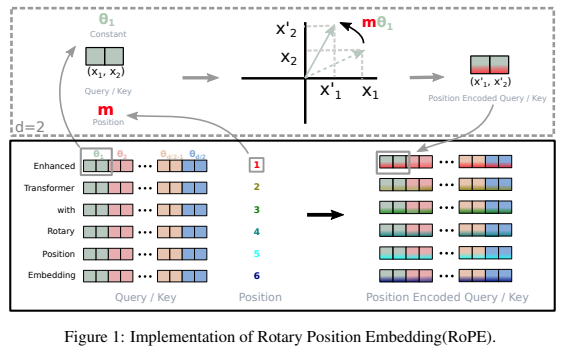
A basic implementation of 2-Dimensional Rotary Positional Embeddings(2D-RPE) Source-lucidrains’s github RoPE repo
In this rotating vector animation, the position of the token is encoded as a rotation in a high-dimensional space, making the representation position-aware. This rotation is the essence of RoPE.
Mathematics of Rotary Positional Embeddings
The magic of Rotary Positional Embeddings (RoPE) lies in how it introduces relative position information into the Transformer architecture by rotating the embeddings in a multi-dimensional space. This rotation-based method effectively encodes the order of tokens, enhancing the model’s ability to understand context, especially in long sequences.
Let’s take a deep dive into the mathematics of RoPE, inspired by the insights shared by EleutherAI’s blog.
Understanding the Key Idea
Unlike traditional positional embeddings, which add positional information directly to the token embeddings, RoPE modifies them using complex-valued rotation matrices. This method doesn’t just inject position information; it integrates it in a way that captures relative positioning between tokens.
For a token embedding vector xxx at position kkk, we want to rotate it based on the position, and this rotation is governed by the rotation matrix. This matrix effectively rotates pairs of dimensions (features) of the embedding.
Detailed Mathematical Breakdown
Step 1: Defining the Embeddings
Suppose the token embedding x has an even dimension d. We can split x into two parts, each with dimension d/2:

We treat this embedding as a series of complex numbers:

This representation allows us to treat pairs of dimensions as complex vectors, which can be rotated using complex multiplication.
Step 2: Applying the Rotation
For each token at position k, we apply a rotation matrix characterized by the angle θ_k. The embedding for position k is rotated by multiplying it with the complex exponential:

The result of this multiplication for each dimension pair is equivalent to:

Substituting e^iθk with cos(θk)+isin(θk), the resulting rotated embedding at position k is:

Where:
- Re(x_k) and Im(x_k) are the real and imaginary parts of the embedding vector.
- θ_k = k ⋅ θ is the position-dependent angle.
Step 3: Implementing the Rotation Across Dimensions
The key insight is that this rotation needs to be applied consistently across all pairs of dimensions in the embedding vector, making the operation efficient and smooth. In practice, we introduce a precomputed set of angles:

This predefined set controls how the embeddings are rotated differently across each dimension.
Key Properties: Relative Position Invariance
The brilliance of RoPE is that when you calculate the dot product between two rotated vectors, say x_k at position k and x_j at position j, their relative position k−j is inherently encoded:

This means RoPE preserves the relative positional information without losing the absolute position, making it particularly powerful for tasks requiring long-context understanding.
Let’s visualize RoPE implementation with an Example
To make this clearer, let’s plot a 2D example where embeddings are rotated based on their sequence position.
import numpy as np
import matplotlib.pyplot as plt

def plot_RoPE(embedding_dim=2, seq_len=10):
    angles = np.linspace(0, 2 * np.pi, seq_len)
    x = np.cos(angles)
    y = np.sin(angles)

    plt.figure(figsize=(8, 8))
    for i in range(seq_len):
        plt.plot([0, x[i]], [0, y[i]], label=f'Position {i}')

    plt.scatter(x, y, c='red')
    plt.quiver(0, 0, x, y, angles='xy', scale_units='xy', scale=1)
    plt.xlim([-1.5, 1.5])
    plt.ylim([-1.5, 1.5])
    plt.title("Rotary Positional Embeddings (2D Projection)")
    plt.xlabel("Real Part")
    plt.ylabel("Imaginary Part")
    plt.grid(True)
    plt.legend()
    plt.show()

plot_RoPE()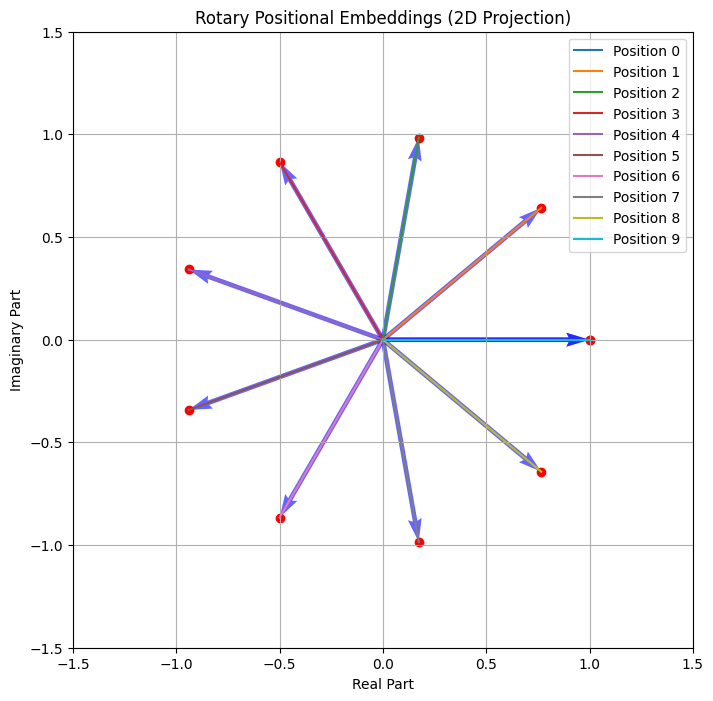
Vizualization of 2D-RPE
In this plot, each arrow represents the embedding of a token, rotated according to its position in the sequence. As you can see, the rotation gives each embedding its own unique orientation, embedding positional information into the space where the Transformer operates.
Diving into the Code: RoPE from Scratch
We can implement RoPE from scratch in PyTorch to better understand how the concept is applied in practice. Let’s break this down step by step.
Step 1: Generating Positional Embeddings
We first need to generate the positional embeddings that serve as the basis for the rotations. Here’s how:
import torch

def get_positional_embeddings(seq_len, dim):
    inv_freq = 1.0 / (10000 ** (torch.arange(0, dim, 2).float() / dim))
    pos = torch.arange(seq_len, dtype=torch.float).unsqueeze(1)
    sinusoid_inp = torch.einsum("i,j->ij", pos, inv_freq)
    embeddings = torch.cat((sinusoid_inp.sin(), sinusoid_inp.cos()), dim=-1)
    return embeddings
In this code:
- We calculate inverse frequencies for embedding rotations.
- We multiply position indices by these frequencies to get the rotation angles, creating sinusoidal input (like in the original Transformer).
- The result is a matrix of positional embeddings, which contains both sine and cosine terms that we’ll use to rotate the token embeddings.
Step 2: Applying the Rotation
Next, we apply the rotary transformation to the embeddings:
def apply_RoPE(x, positional_embeddings):
    seq_len, dim = x.shape[1], x.shape[2]
    x_rotated = torch.einsum("bnd,nd->bnd", x, positional_embeddings)
    return x_rotated
This function uses Einstein summation (torch.einsum) to efficiently multiply each token embedding with its corresponding positional embedding, performing the rotation.
Step 3: Incorporating RoPE into Self-Attention
Now, we integrate RoPE into the self-attention mechanism of a Transformer model.
import torch.nn as nn
from torch import Tensor

class RotaryMultiheadAttention(nn.Module):
    def __init__(self, embed_dim, num_heads):
        super().__init__()
        self.attention = nn.MultiheadAttention(embed_dim, num_heads)
        self.positional_embeddings = get_positional_embeddings(512, embed_dim)

    def forward(self, query: Tensor, key: Tensor, value: Tensor, mask: Tensor = None):
        query = apply_RoPE(query, self.positional_embeddings)
        key = apply_RoPE(key, self.positional_embeddings)
        attn_output, _ = self.attention(query, key, value, attn_mask=mask)
        return attn_output
Here, we modify the MultiheadAttention layer to apply RoPE to the queries and keys. This ensures that the self-attention mechanism is aware of the relative positions of the tokens.
Visualization of Attention
To visualize the effect of RoPE on attention, we can plot the attention weights before and after applying rotary embeddings. This will give us insights into how the model’s focus changes when it understands the relative positions of tokens.
import numpy as np
import matplotlib.pyplot as plt

def plot_attention_matrix(attention_weights):
    plt.imshow(attention_weights, cmap='viridis', aspect='auto')
    plt.colorbar(label='Attention Score')
    plt.title('Attention Heatmap')
    plt.xlabel('Tokens')
    plt.ylabel('Tokens')
    plt.show()

# Generate a sample attention weights matrix (e.g., for 10 tokens)
attention_weights = np.random.rand(10, 10)

plot_attention_matrix(attention_weights)
By visualizing the attention scores, we can see the shift in focus when RoPE is applied. The attention matrix should exhibit sharper focus around tokens that have significant relative positions in the sequence.
Conclusion: The Beauty of Rotation in NLP
Rotary Positional Embeddings are a powerful extension of the traditional positional encodings used in Transformers. By rotating embeddings in a multi-dimensional space, RoPE allows the model to handle relative positions in a natural, elegant way. This makes it particularly useful for tasks where context and word order matter.
With RoPE, you gain:
- Relative position encoding that adapts to shifts in the sequence.
- Simple math that introduces minimal computational overhead.
- Improved performance in long-context tasks like summarization and translation.
Want to Dive Deeper?
Explore these additional resources for a deeper understanding of RoPE:
메타데이터
- post_id
- 193cbc01e4ed
- slug
- decoding-rotary-positional-embeddings-rope-the-secret-sauce-for-smarter-transformers-193cbc01e4ed
- url
- https://medium.com/@DataDry/decoding-rotary-positional-embeddings-rope-the-secret-sauce-for-smarter-transformers-193cbc01e4ed
- canonical_url
- https://medium.com/@DataDry/decoding-rotary-positional-embeddings-rope-the-secret-sauce-for-smarter-transformers-193cbc01e4ed
- author_url
- https://medium.com/@DataDry
- status
- ok
- fetched_at
- 2026-07-25 04:43:31




