The Quark and the Jaguar
Murray Gell-Mann’s guide to simplicity and chaos
The Quark and the Jaguar
Murray Gell-Mann’s guide to simplicity and chaos
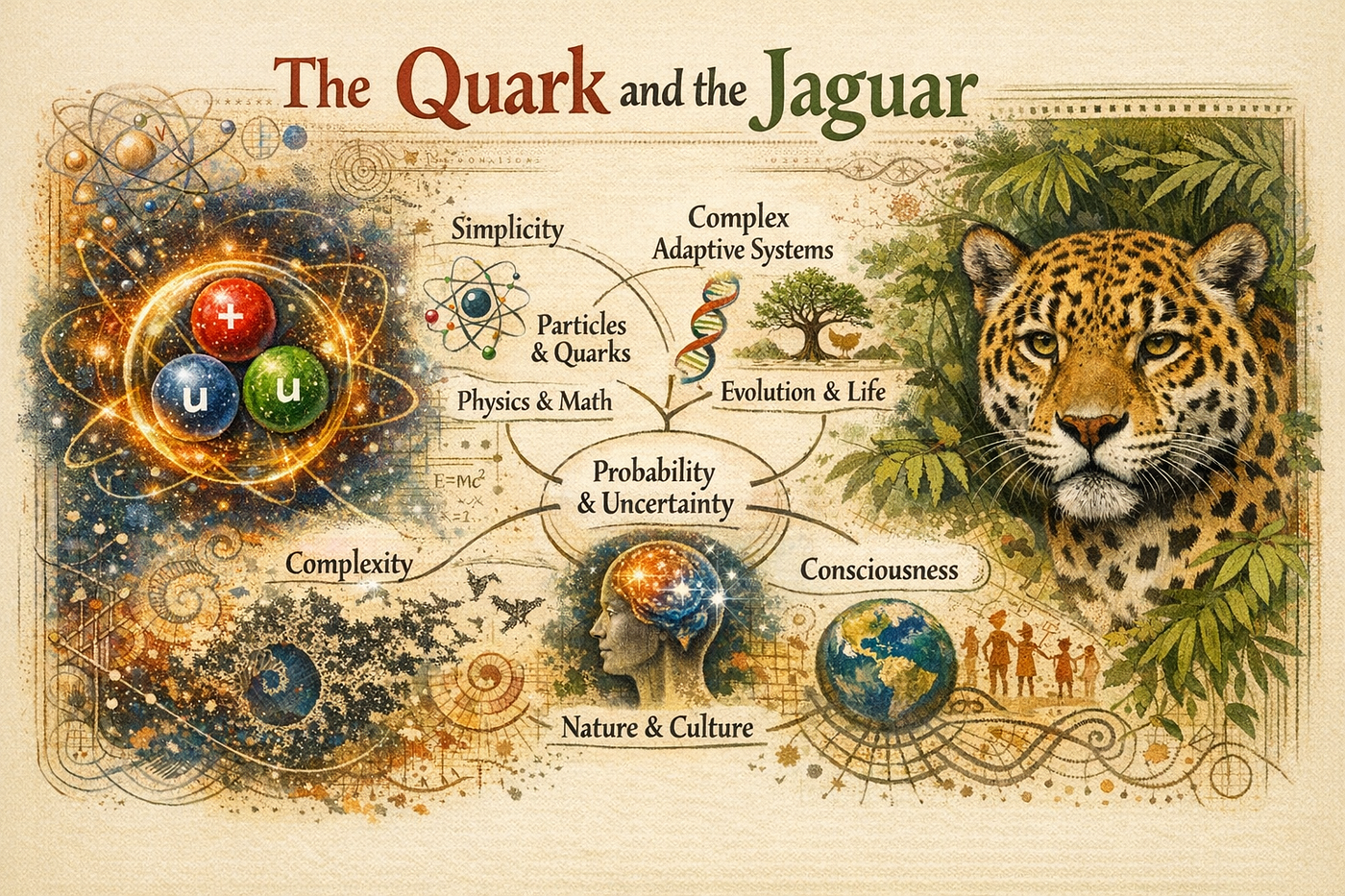
‘The Quark and the Jaguar’, illustration generated by ChatGPT and released under public domain
“… a dark figure appeared on the trail about a hundred yards in front of me. I stopped short and carefully raised my binoculars to get a closer look. It was a medium-sized wild cat, a jaguarundi. For all I knew, the jaguarundi had been standing there for some time, its brownish eyes trained on me as, bewitched by the mysteries of quantum mechanics, I drew nearer. Though obviously alert, the animal seemed utterly at ease. We stared at each other, both motionless in our tracks, for what seemed like several minutes.”
This passage from the preface of Murray Gell-Mann’s ‘The Quark and the Jaguar: Adventures in the Simple and the Complex’ (1994), describes his encounter with a jaguar. The author explains that the universe’s basic building blocks, such as quarks, follow remarkably simple laws, yet those same laws produce astonishing complexity, such as the jaguar. He wonders: how does a universe governed by simple, fundamental rules produce something so complex?
Murray Gell-Mann (1929–2019), born in New York City to Jewish Ukrainian immigrants, was a child prodigy. He graduated from the Columbia Grammar & Preparatory School at 14 and received his bachelor’s degree in physics from Yale in 1948. He was awarded his Ph.D. in physics from MIT in 1951.
The ‘Particle Zoo’
In the 1950s, new particle accelerators and cosmic ray detectors led to the discovery of new subatomic particles. Where there had once been just protons, neutrons, and electrons, now there were pions, kaons, lambda particles, and others, discovered almost every month. The resulting confusion was jokingly referred to as the ‘particle zoo’. Enrico Fermi reportedly told a student: “If I could remember the names of all these particles, I would have been a botanist.” Particle physics desperately needed someone to impose order.
Gell-Mann was a polymath. He taught himself to read at three, entered Yale at fifteen, and was curious about everything: ornithology, archaeology, linguistics, philosophy, Mayan glyphs, and natural history, in addition to physics. The most important thing Gell-Mann brought to particle physics was his unusual approach.
Having spent years identifying birds, organizing specimens, and studying taxonomy (the science of classifying things into ordered groups), he realized that classification is the first stage of understanding. Linnaeus’s taxonomy came a century before Darwin’s theory of evolution, but it made it possible. Mendeleev’s periodic table classified elements by their chemical behaviours, offering the structure needed for the development of quantum mechanics. Gell-Mann looked at the subatomic particles like a taxonomist, and this perspective made all the difference.
In 1953, Gell‑Mann (and, independently, the Japanese theoretical physicist Kazuhiko Nishijima) introduced a new property called ‘strangeness’ to explain why certain particles decayed much more slowly than others. Drawing on his knowledge of group theory (a branch of algebra), he argued that these particles weren’t fundamental at all, but different manifestations of a basic, hidden symmetry. He described this symmetry using a mathematical structure called SU(3) (Special Unitary group in 3 dimensions), which encoded all possible rotations of an object in a hidden three-dimensional space. This allowed him to arrange particles into families organized by two properties: ‘strangeness’ and ‘electric charge’. His classification system functioned like a periodic table for particles; he named it ‘Eightfold Way’, borrowing the term from Buddhism (the Buddha’s Noble Eightfold Path to enlightenment).
In 1962, Soviet physicist Lev Okun introduced the term ‘hadron’ for particles that are subject to the strong nuclear force. This set them apart from ‘leptons’, light particles like electrons and neutrinos, which are not subject to this force.
In 1964, Gell-Mann published ‘A Schematic Model of Baryons and Mesons’, a paper suggesting a radical solution: hadrons are composed of more fundamental particles, which he named quarks, borrowing the word from ‘Three quarks for Muster Mark!’, a line from James Joyce’s ‘Finnegans Wake’. Independently, physicist George Zweig at CERN had the same idea, calling the particles ‘aces’, but Gell-Mann’s term prevailed. The three quark varieties, which he later called ‘flavours,’ were: Up (u), Down (d), and Strange (s).
The Nobel Prize in physics
In 1969, the Nobel Committee awarded Gell-Mann the physics prize “for his contributions and discoveries concerning the classification of elementary particles and their interactions.” The award recognized not only Gell-Mann’s quark model but the entire research program that laid the foundation for the Standard Model of particle physics. Although initially met with scepticism, the quark theory soon became a cornerstone of particle physics.
The Santa Fe Institute
Gell-Mann recognized that complex phenomena like ecosystems or economies cannot be fully understood by breaking them down into simpler parts. In 1984, he co-founded with other scientists the Santa Fe Institute (SFI), to create a research center dedicated to cross-disciplinary research into complex systems. SFI was designed to bring together physicists, biologists, economists, computer scientists, and social scientists to work on complex-systems problems like emergence, adaptation, and self-organization.
The Quark and the Jaguar
When Gell‑Mann published ‘The Quark and the Jaguar’ in 1994, readers expected a book about particle physics. But the book was far more ambitious. One of its central ideas was effective complexity: systems are never purely ordered nor purely random. Instead, they are a mixture of both. A crystal is highly ordered but not very complex. A living organism contains both order and randomness, and this combination produces complexity.
The quark is the ultimate simplicity: an elementary particle governed by simple laws. The jaguar is the ultimate complexity: a lifeform representing the complex systems generated from the same laws. How can one lead to the other? Gell-Mann’s answer: a universe of simple rules, running through billions of years of what he calls ‘frozen accidents’ (outcomes that, once they occur, become permanent), inevitably generates complex adaptive systems. According to him, complexity is not the enemy of simplicity; it is what simplicity produces given enough time.
Gell-Mann was particularly concerned about oversimplification, the human tendency to rely on simplified mental models that ignore complexity. He warned that oversimplification leads to errors in science, politics, and everyday life. For Gell‑Mann, understanding complexity requires humility: the world is full of surprises, and our models are always incomplete; we must adjust continuously, test our assumptions, and remain open.
Gell‑Mann’s genius lay in his ability to understand that the laws of physics are the foundation of everything, but also that the richness of reality comes from the layers of complexity built on top of those laws. The ‘Quark and the Jaguar’ encourages readers to think freely across disciplines and to appreciate the connection between simplicity and complexity. The book reflects Gell‑Mann’s own approach: curious, interdisciplinary, always looking for patterns. For him, the universe is a dynamic, evolving system full of beauty, mystery, and meaning.
메타데이터
- post_id
- 195a339da48e
- slug
- the-quark-and-the-jaguar-195a339da48e
- url
- https://medium.com/brain-labs/the-quark-and-the-jaguar-195a339da48e
- canonical_url
- https://medium.com/brain-labs/the-quark-and-the-jaguar-195a339da48e
- author_url
- https://medium.com/@PeterManthos
- status
- ok
- fetched_at
- 2026-06-29 01:02:39