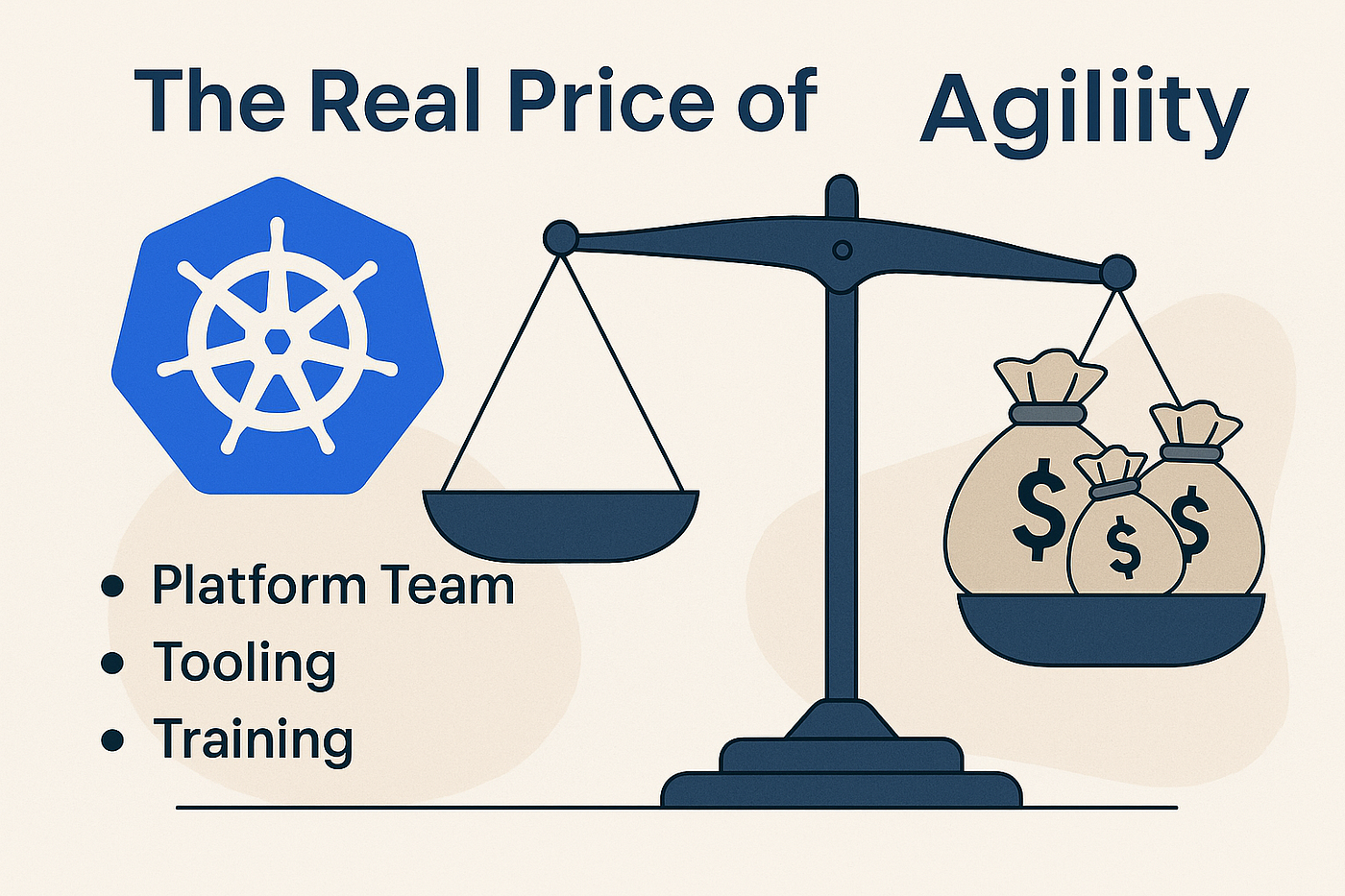
The Real Price of Kubernetes Agility
From a veteran’s tale from bare metal to the container jungle.
The Real Price of Kubernetes Agility
From a veteran’s tale from bare metal to the container jungle.
I’ve been in this game long enough to remember the sound of fans spinning up in cold server rooms.
Back then, deploying a service meant plugging in a physical server and praying the RAID didn’t blink red. Then came virtualization. Then the cloud. Then containers. And with each leap, we were promised more speed, more scale, less hassle.
But nothing — and I mean nothing — has created more confusion, friction, and false expectations than Kubernetes.
For years, the promise of Kubernetes has been agility, scalability, and cost savings. But for many organizations, including one I recently witnessed, that promise turned into a four-month deployment nightmare for a simple website — costing untold hours and significant budget just to get off the ground.
A few months ago, I watched a team try to move a simple website — yes, a website — from Azure Europe to Azure Singapore. Same provider. Same setup. But because it was wrapped in Terraform, Helm, Kustomize, and running on Kubernetes… it took 4 months and a dozen back-and-forth cycles to finish the migration.
That’s when it hit me: Kubernetes is no longer a deployment tool. It’s an ideology.
And ideologies come with hidden costs. This isn’t just about technical choices; it’s about organizational mindset, team structure, and unexpected budget allocations. Decision-makers often greenlight Kubernetes initiatives based on perceived “best practices” or hype, without fully understanding the underlying ‘ideology’ and its downstream effects.
The Prometheus Rabbit Hole
“Why is our pod restarting?” someone asked.
Silence. Then a Slack thread. Then another hour goes by. We had logs — in five different places. Metrics in Prometheus, but no alerts were set up yet. Grafana dashboards looked cool but didn’t explain why the app was failing.
To replicate what we had on ECS took:
- Prometheus
- Grafana
- Loki or Fluent Bit
- Alertmanager
- A custom sidecar for log shipping
Oh, and don’t forget: maintaining those stacks, upgrading versions, reconfiguring retention, tuning queries. We didn’t adopt Kubernetes. We inherited a monitoring platform we never asked for, demanding continuous attention and specialized skill.
Suddenly, monitoring wasn’t something we plugged in — it was something we had to architect.
When YAML Becomes Your API
In ECS, I deployed with a few lines. In Kubernetes, I deploy with a dozen files.
Service. Deployment. Ingress. HPA. ConfigMap. Secret. RBAC. Sometimes CRDs I didn’t even know existed.
You change one field, and something silently breaks. You misalign a port definition, and the Ingress goes dark. Suddenly, YAML is no longer configuration — it’s your API surface. Your contract. Your burden.
And in Kubernetes, broken contracts don’t return 500s — they just silently fail.
And yes, it’s versioned. Until someone force-pushes to the main branch.
The First Downtime (and the Five Tools You Didn’t Know You Needed)
The app went down. In ECS, I’d check logs, CPU metrics, and rollback.
In Kubernetes, we needed:
kubectlaccess (with the right context)- A debugging pod (like netshoot)
- Access to Ingress logs
- Access to cluster logs
- Grafana, with pre-built dashboards (which we hadn’t finished yet)
Oh, and most importantly: someone who knew where to look.
That’s when I realized Kubernetes demands not just a new platform, but a fundamental organizational overhaul — a shift in how teams operate, troubleshoot, and even think about their infrastructure.
The Team You Didn’t Budget For
Here’s the truth: Kubernetes is not a shortcut. It’s a hiring plan.
You need:
- Platform engineers who know CRDs, networking, and Helm
- Devs who understand liveness probes, init containers, readiness gates
- SREs who can troubleshoot CNI, kube-proxy, and metrics pipelines
- A security person who understands RBAC and PodSecurityPolicy (or now, PodSecurityAdmission)
If you’re a 5-person startup hoping Kubernetes will make you “cloud-native” — you’re about to stretch your team thin across tech they didn’t sign up for, diverting critical resources from core product development.
Not Everything Belongs in Kubernetes
We once put a cron job into Kubernetes. Just one.
It pulled some reports every morning. The job itself was simple, but to follow best practices, we ended up creating:
- A CronJob manifest
- A custom ServiceAccount
- A Role + RoleBinding for permission
- A ConfigMap for parameters
- A PersistentVolumeClaim for file output
That’s 5 separate YAML files for a 1-minute script.
In hindsight, this was unnecessary overhead. We eventually migrated it to a managed scheduled task outside Kubernetes — simpler, cheaper, easier to debug.
Lesson: just because it runs in a container doesn’t mean it belongs in Kubernetes.
So… Why Even Bother?
Given all the complexities, the natural question for any decision-maker is: why would anyone willingly take on such a challenge? The answer lies in the strategic long-term advantages that Kubernetes, when implemented correctly, can unlock for an organization. It’s not about immediate ease, but about building a robust, scalable, and resilient foundation for the future.
Because when you do it right — when you build a platform, document your patterns, and treat YAML like code — Kubernetes provides capabilities that are difficult to achieve otherwise. It scales not just your applications, but your operations and developer velocity, enabling your teams to move faster and more consistently as you grow.
It gives you:
- Declarative Deployments: Imagine specifying what you want your system to look like, and the platform continuously works to achieve that state. This dramatically reduces human error and ensures consistency across environments, from development to production. For a decision-maker, this means fewer unexpected outages and a more predictable operational landscape.
- Isolation and Resilience: Kubernetes inherently isolates workloads, meaning a problem in one application is less likely to bring down others. If a part of your application fails, Kubernetes can automatically restart it or shift traffic to healthy instances. This built-in self-healing capability translates directly to higher uptime, improved service availability, and reduced business risk.
- Workload Portability (if you invest early): While the initial migration might be tough, a well-architected Kubernetes setup can provide a layer of abstraction that makes your applications less dependent on a single cloud provider. This offers strategic flexibility, potential cost optimization through multi-cloud strategies, and reduced vendor lock-in — critical considerations for long-term business agility.
- Native Autoscaling: Kubernetes can automatically scale your applications up or down based on demand, ensuring optimal resource utilization. This means you only pay for what you use, avoiding over-provisioning costs during low traffic and preventing performance bottlenecks during peak periods. It’s a powerful tool for managing operational expenses while maintaining performance.
- A Consistent Operations Layer for All Teams: Once the initial platform is mature, Kubernetes provides a standardized way to deploy, manage, and observe all your applications, regardless of the underlying language or framework. This consistency simplifies training, streamlines collaboration between development and operations teams, and accelerates the rollout of new features by reducing bespoke deployment processes.
But it’s not free.
If you go in blind, chasing trends rather than business needs, you’ll pay dearly in lost time, burned out engineers, and a sense of complexity that never leaves. The “why” must be clear and compelling, aligned with strategic business goals, not just technical aspiration.
The Real Cost of Kubernetes (And Where to Invest)
If you must go Kubernetes, invest smartly. This isn’t just about tooling; it’s about structuring your teams and processes to extract value, not just complexity.
Ultimately, the hidden cost of Kubernetes is the realization that it is not a ready-made platform, but a powerful toolkit for building your own robust, production-grade platform. This is where the internal Platform-as-a-Service (PaaS) team becomes critical. They are the guardians of your production environment, building and maintaining the essential guardrails, simplified interfaces, and automated workflows that enable your developers to focus on delivering business value, not operational complexity.
Entrusting direct, unfettered access to Kubernetes’ intricate layers to every developer, without clear scopes, boundaries, and validation, is a direct path to instability, security vulnerabilities, and costly downtime. The PaaS team creates that vital layer of control and expertise, ensuring your Kubernetes investment truly supports high uptime, scalability, and secure operations, rather than becoming an Achilles’ heel.
Here’s how to invest wisely:
- Build an internal platform-as-a-service team. Let your devs focus on code, not YAML. While developers desire flexibility and direct control, their core expertise is application logic, not the intricacies of distributed systems. Allowing unfettered access to define all aspects of Kubernetes can lead to:
- Operational Instability: Misconfigured resource requests, liveness probes, or network policies by well-meaning developers can cause cascading failures, “noisy neighbor” issues, or endless restarts, consuming valuable SRE time.
- Accidental Downtime & Business Impact: What seems like a minor YAML change can trigger significant performance degradation or outright downtime for your production environment, directly impacting revenue and reputation.
- Security Gaps: Broad developer access to Kubernetes configuration opens a wide attack surface, making consistent security posture difficult to enforce.
- Reduced Velocity (Paradoxically): Developers spend less time building features (their core value) and more time debugging infrastructure, researching Kubernetes, or maintaining bespoke deployments. A dedicated PaaS team provides sensible defaults, simplified interfaces, and automated guardrails, empowering developers to deploy rapidly and confidently, knowing the underlying platform handles operational nuances.
- Choose a golden stack (Prometheus, Loki, Ingress, cert-manager) and automate it. Don’t let every team reinvent the wheel for core services like monitoring, logging, and ingress. Standardizing and automating the deployment of these essential components reduces operational overhead, ensures consistency, and provides a unified view of your system’s health. This means less friction for new projects and faster troubleshooting.
- Bake in security early: RBAC, namespaces, policy gates. Security cannot be an afterthought in Kubernetes. Designing a robust Role-Based Access Control (RBAC) strategy, segmenting workloads with namespaces, and implementing policy enforcement tools (like OPA Gatekeeper) from day one is crucial. This proactive approach prevents misconfigurations, limits blast radius, and ensures compliance, saving immense reactive effort and preventing costly breaches down the line.
- Document everything. K8s without documentation is a trap. The complexity of Kubernetes means institutional knowledge often gets siloed. Comprehensive, up-to-date documentation — from architectural diagrams to common troubleshooting steps and deployment patterns — is non-negotiable. It accelerates onboarding, empowers teams to self-serve, and drastically reduces the “who knows what?” guesswork during critical incidents.
- Train your team. Don’t hire unicorns. Grow them. Kubernetes expertise is in high demand and expensive. Instead of chasing a handful of “unicorns,” invest in upskilling your existing engineering teams. Provide structured training paths, mentorship, and opportunities to learn by doing (within safe boundaries). A well-trained team is more adaptable, engaged, and ultimately more effective in leveraging Kubernetes’ power.
And above all: know why you chose Kubernetes in the first place.
It’s not the fast way. It’s not the easy way.
But it can be the right way — if you treat it with respect.
So before you embark on the Kubernetes journey, ask yourself not just “Can we?” but “Should we?” And more importantly, “Are we prepared to invest not just in the technology, but in the people, processes, and a fundamental shift in our operational philosophy?” Because while Kubernetes offers immense power, its true cost is only revealed when you treat it with the strategic respect it demands.
메타데이터
- post_id
- 199728eacf7d
- slug
- the-real-price-of-kubernetes-agility-199728eacf7d
- url
- https://medium.com/@nagorn/the-real-price-of-kubernetes-agility-199728eacf7d
- canonical_url
- https://medium.com/@nagorn/the-real-price-of-kubernetes-agility-199728eacf7d
- author_url
- https://medium.com/@nagorn
- status
- ok
- fetched_at
- 2026-06-11 16:11:38






