Australian Retail in 2025: The Role of ERP in Omnichannel Success
Have you noticed how customers seem to move faster than retail systems?
Australian Retail in 2025: The Role of ERP in Omnichannel Success
Have you noticed how customers seem to move faster than retail systems?
In 2025, Australian shoppers don’t think in terms of online or in-store. They expect to browse on their phone, check stock availability instantly, buy wherever it’s convenient, and return items without friction. To them, it’s one brand, one experience.
If your systems aren’t connected, customers feel it immediately — and they don’t wait around. In today’s retail landscape, omnichannel isn’t a “nice to have.” It’s a survival requirement.
Why Customer Expectations Are Raising the Stakes
Australian retail is evolving at speed. Convenience, accuracy, and consistency now define whether customers stay loyal or switch brands.
Recent research highlights just how wide the gap is:
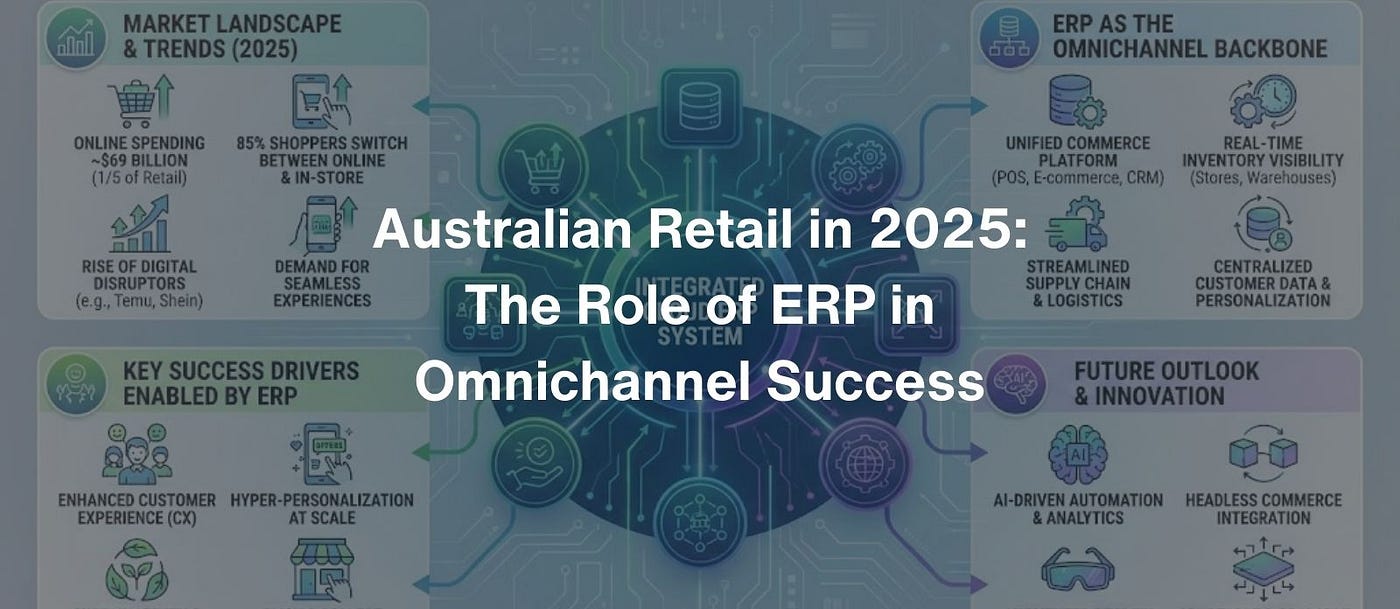
- 85% of Australian shoppers expect smooth, integrated experiences across all channels
- Only 42% of retailers have implemented unified commerce solutions
- Just 27% of retailers allow customers to initiate and track returns online
That gap between expectation and reality is where retailers lose sales — and where competitors win them.
ERP: The Backbone of Omnichannel Retail
At the heart of successful omnichannel retail is a modern ERP system.
ERP (Enterprise Resource Planning) connects every part of the business — eCommerce, physical stores, inventory, supply chain, finance, and customer data — into a single, real-time platform. Instead of juggling disconnected tools, retailers gain one source of truth.
ERP doesn’t just improve efficiency. It enables growth, innovation, and better customer experiences.

The Biggest Challenges Facing Australian Retailers
Many retailers struggle not because they lack ambition — but because their systems can’t keep up.
Common challenges include:
- Disconnected online and in-store sales channels
- Inaccurate inventory across locations
- Manual and slow order fulfillment
- Limited real-time visibility into performance
- Little ability to personalize customer interactions
These issues create friction for both customers and staff, leading to lost revenue and rising operational costs.
How ERP Solves Omnichannel Complexity
A Unified Commerce Platform
ERP connects digital and physical retail, allowing customers to browse, buy, collect, return, or exchange seamlessly across channels.
Real-Time Inventory Visibility
Live inventory data reduces stockouts and prevents overstocking, ensuring customers see accurate availability — online and in store.
Automated Order Fulfillment
Orders are routed, processed, and tracked automatically, speeding up delivery and reducing human error.
Data-Driven Decision Making
Dashboards provide instant insights into sales, margins, inventory trends, and customer behavior — helping retailers act faster and smarter.
Personalized Customer Experiences
With centralized customer data, staff can access purchase history and preferences to deliver tailored recommendations and better service.
The Measurable Impact of ERP in Retail
Retailers that adopt ERP-driven omnichannel strategies are seeing strong results:
- 92%+ inventory and order accuracy, up from 60–70% in manual systems
- 15–25% improvement in cash flow through better working capital visibility
- 15–30% increases in sales from higher conversion rates and better availability
- Faster fulfillment and fewer returns errors
- Stronger customer loyalty driven by consistent experiences
In practical terms, ERP turns operational efficiency into a competitive advantage.
Technology Enhances — Not Replaces — the Human Touch
Despite digital growth, physical retail still matters.
Research shows 60% of Australian shoppers believe digital channels can’t replace in-store human interaction. ERP enhances this human element by equipping staff with real-time customer and order insights — allowing them to serve customers better, not slower.
When staff are informed, service feels personal. And that’s what keeps customers coming back.

Practical Steps to ERP Success
Retailers that succeed with ERP focus on execution, not just software:
- Define clear business objectives
- Choose an ERP designed for retail operations
- Map existing processes before digitizing
- Plan data migration carefully
- Train teams across stores and head office
- Partner with experienced implementers like Work Made Simple (WMS)
The Opportunity Retailers Can’t Ignore
When 85% of shoppers expect omnichannel but fewer than half of retailers deliver it, the opportunity is obvious.
Retailers who act now can capture market share from slower competitors, build stronger customer loyalty, and future-proof their operations.
Final Thoughts: Omnichannel Success Starts with ERP
ERP isn’t just a back-office system anymore. It’s the foundation of modern retail.
By unifying operations, improving accuracy, and enabling personalized experiences, ERP bridges the gap between customer expectations and operational reality.
Australian retailers who invest in ERP today aren’t just keeping up — they’re setting themselves up to lead in 2025 and beyond.
If you’re exploring ERP for retail, Work Made Simple (WMS) helps Australian SMBs implement solutions that deliver real, measurable outcomes — not just new technology.
메타데이터
- post_id
- 199e4b36cf67
- slug
- australian-retail-in-2025-the-role-of-erp-in-omnichannel-success-199e4b36cf67
- url
- https://medium.com/@contact_70658/australian-retail-in-2025-the-role-of-erp-in-omnichannel-success-199e4b36cf67
- canonical_url
- https://medium.com/@contact_70658/australian-retail-in-2025-the-role-of-erp-in-omnichannel-success-199e4b36cf67
- author_url
- https://medium.com/@contact_70658
- status
- ok
- fetched_at
- 2026-06-09 15:37:30




