Following the Digital Footprints of a Crypto Influencer: My Walkthrough of NAIJA OSINT CTF 2026…
The inaugural NAIJA OSINT CTF 2026 introduced participants to a challenging cryptocurrency fraud investigation designed to test a broad…
Following the Digital Footprints of a Crypto Influencer: My Walkthrough of NAIJA OSINT CTF 2026 Challenge 1: “Name Cannot Be Blank”
The inaugural NAIJA OSINT CTF 2026 introduced participants to a challenging cryptocurrency fraud investigation designed to test a broad range of Open-Source Intelligence (OSINT) skills. Unlike traditional Capture The Flag (CTF) challenges that focus on a single discipline, this investigation required participants to combine image analysis, digital footprinting, domain intelligence, social media investigations, archived content analysis, Reddit research, and geolocation techniques to gradually uncover the identity and activities of a target linked to a cryptocurrency project.
The scenario revolved around a public figure associated with a cryptocurrency initiative known as CxCoin. Participants were tasked with identifying the individual behind a limited set of clues and following their digital footprint across multiple online platforms. As the investigation progressed, seemingly unrelated pieces of information began to connect, revealing a much larger intelligence picture than what initially appeared on the surface.
What made this challenge particularly interesting was the way it mirrored real-world investigations. There was no single source containing all the answers. Instead, every finding acted as a pivot point, leading to additional sources, additional evidence, and occasionally additional confusion. Several stages required revisiting earlier discoveries, validating assumptions, and exploring rabbit holes before the correct path became clear.
This write-up documents my full investigation process, including the methodologies used, the pivots that proved useful, the dead ends encountered during the investigation, and the techniques that ultimately led to each stage of the challenge.
A special acknowledgment goes to the organizers, challenge creators, mentors, and volunteers who contributed to the successful launch of the first NAIJA OSINT CTF. Challenges like this provide an excellent opportunity for investigators, students, and cybersecurity professionals to strengthen practical OSINT skills through realistic investigative scenarios.
For Anyone Interested in challenge you can try it out: https://preciousvincentct.medium.com/challenge-osint-1-name-cannot-be-blank-644e69e71299
⚠️ WARNING: SPOILERS AHEAD ⚠️
This article contains detailed explanations of the investigation process and challenge solutions. If you intend to solve the challenge independently, consider attempting it before continuing with this walkthrough.
Investigation Overview
Before diving into the technical details, it is worth understanding the broader investigative flow of the challenge.
The investigation began with a single image and gradually expanded into a full digital footprint analysis. Throughout the challenge, I relied on several OSINT disciplines, including:
- Reverse Image Searching
- Digital Identity Correlation
- Domain and Infrastructure Intelligence
- Social Media Investigations
- Reddit Analysis
- Historical Content Analysis
- Internet Archive Research
- Geolocation Techniques
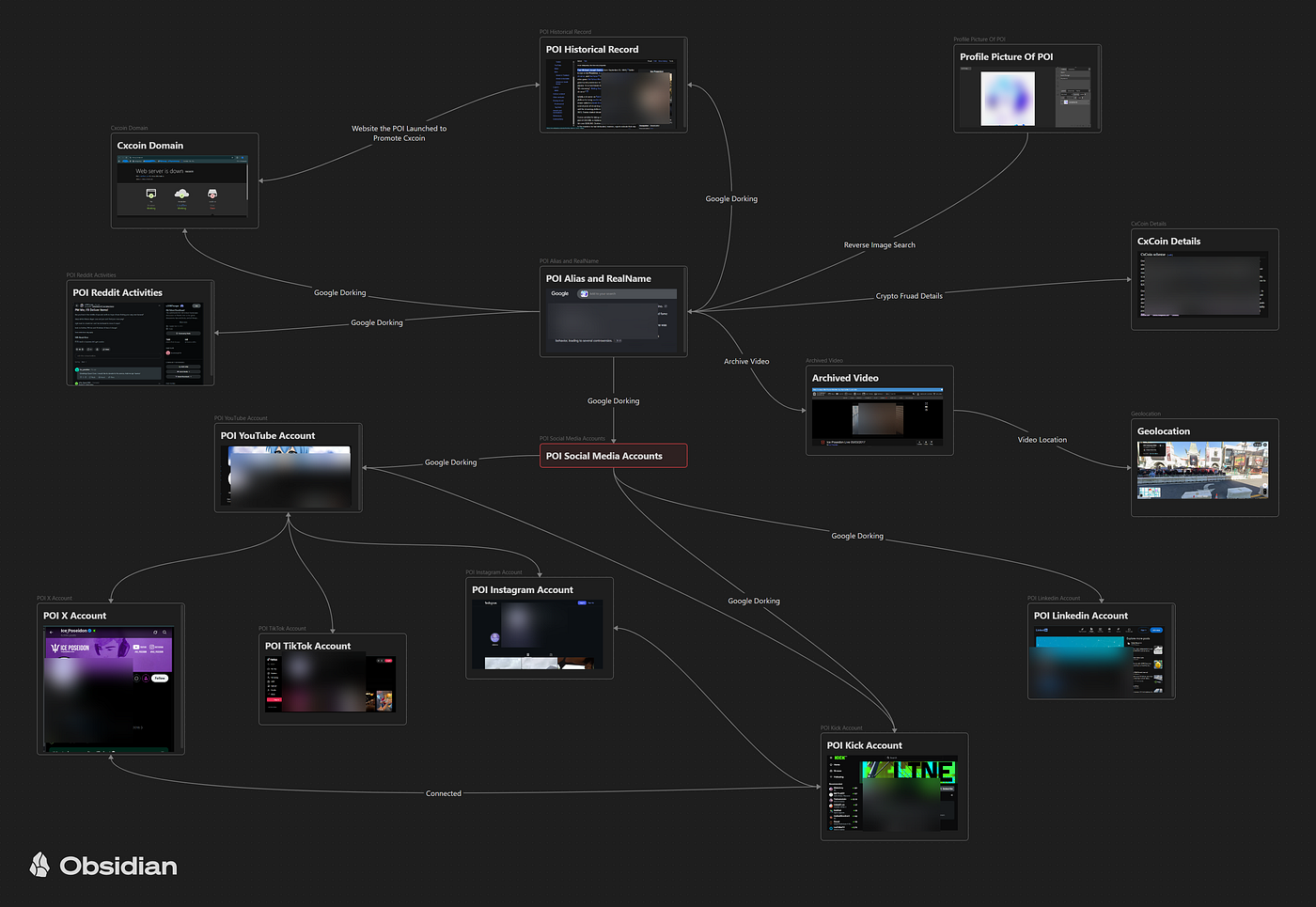
- Relationship Mapping and Intelligence Correlation
By the conclusion of the investigation, multiple independent data points had been linked together to establish a comprehensive understanding of the target’s online presence and associated activities.
With that context established, the investigation began with the most basic question:
Who is the person in the image?
Phase 1: Image Recovery and Attribution
Objective
The challenge began with a single image file. The image had been intentionally darkened, and participants were tasked with restoring it before conducting reverse-image analysis to identify the individual shown.

Approach
Before performing any searches, I examined the challenge instructions carefully. The scenario explicitly stated that no useful metadata remained within the image. As a result, I deliberately avoided spending time on metadata extraction and instead focused on image restoration.
The image was uploaded into Photopea, where brightness and visibility adjustments were applied to recover as much visual detail as possible.

After restoration, several visual characteristics became apparent, including distinctive hair colouring, facial features, and general appearance.
With the image restored, I performed a reverse-image search using Google’s image search capabilities.
Findings
The search quickly produced numerous matches across articles, websites, and social media platforms.
One observation stood out immediately: the same individual appeared repeatedly across multiple independent sources.
These results consistently referenced the online personality known as “Ice Poseidon.”

Further validation across multiple search results confirmed that the image belonged to a well-known public internet figure. The identification provided two critical assets for future phases:
- A verified alias.
- A verified real-world identity.
These identifiers would become the foundation for subsequent searches.
Pivot
With the target successfully identified, the next objective became investigating the business infrastructure and cryptocurrency project associated with the individual.
Phase 2: Investigating the Business Footprint
Objective
The next challenge focused on a cryptocurrency venture reportedly launched by the person of interest. Participants were tasked with identifying the project’s primary domain and recovering business contact information associated with it, despite the website no longer being operational.

Approach
Using the alias identified during Phase 1, I began conducting targeted web searches and advanced search-operator queries.
The objective was to locate references connecting the person of interest to the cryptocurrency project.
Initial searches returned numerous articles discussing both the individual and the cryptocurrency venture.
One of the first useful sources was Wikipedia, which provided general background information regarding the project and confirmed its existence.

Additional articles proved more valuable, as they referenced the project’s official website.

After identifying the domain, I attempted to access the website directly.
The site was no longer operational.
Rather than treating this as a dead end, the inactive status became a pivot point.
Findings
Although the website itself was unavailable, the domain name had already been recovered.
Historical domain intelligence sources were then used to investigate archived registration records and ownership information.
Through historical domain research, it became possible to recover registration-related details that were no longer visible through the live website.

In parallel, additional searches focused on locating public business contact information connected to the individual.
This led to a business email address published on one of the POI public profile, His Youtube Profile

Analysis
The website’s shutdown initially appeared to limit further investigation.
However, historical domain intelligence demonstrated a common OSINT principle: even when infrastructure disappears, traces often remain elsewhere.
Recovering both the domain and associated contact information strengthened attribution between the project and the person of interest.
Pivot
With infrastructure-level intelligence established, attention shifted toward mapping the individual’s wider online presence and identifying the platforms through which they maintained their public identity.
Phase 3: Mapping the Digital Footprint
Objective
Having identified the target and associated business infrastructure, the next goal was to map the individual’s online ecosystem across multiple platforms.
Approach
Using previously identified aliases, I conducted platform-specific searches and targeted web queries designed to uncover publicly associated accounts.
Because the person of interest is a public figure, a substantial amount of information was already indexed across search engines.
The challenge therefore became one of verification rather than discovery.
Searches quickly revealed multiple profiles associated with the individual.
Among the most valuable discoveries was the target’s YouTube channel
The channel served as an aggregation point, linking directly to several additional social media platforms.
Findings
The YouTube profile contained references to multiple social accounts, allowing direct correlation between platforms. Additional searches uncovered the target’s presence across streaming platforms, social networks, and personal websites.
These discoveries included:
- YouTube

- TikTok

- X (Twitter)


- Streaming platforms


- Personal websites

Cross-referencing profile information, branding, usernames, and linked accounts demonstrated consistent attribution across the discovered platforms.
Pivot
With a verified digital footprint established, the next stage focused on validating background information and recovering additional personal identifiers associated with the target.
Phase 4: Background and Identity Verification
Objective
With the target’s digital footprint established, the next challenge focused on recovering and validating personal background information associated with the individual. The objective was not simply to locate biographical information but to verify it through multiple independent sources and identify additional records that could strengthen attribution.
Approach
Using both the verified alias and the real name recovered during earlier phases, I conducted a series of targeted searches designed to locate biographical records, public profiles, interviews, and reference sources.
The initial searches produced numerous articles discussing the target’s online career, streaming history, and cryptocurrency activities.
While these sources provided useful context, they did not immediately contain all of the information required by the challenge.
Several search paths produced incomplete results, forcing additional refinement of search queries and search operators.

As more information became available, the previously identified real name became increasingly valuable, allowing searches to move beyond the public persona and focus on records associated with the individual behind the alias.

Findings
Through cross-referencing multiple sources, it became possible to recover and verify a range of background information, including:
- Full name
- Date of birth
- Place of birth
- Nationality
- Known aliases
- Public biographical details
Some information was easily accessible through public sources, while other details required significantly more investigation and correlation before they could be confidently verified.
Pivot
With both the target’s digital footprint and personal identity verified, the investigation shifted toward uncovering historical interactions and online activity hidden within community platforms.
Phase 5: Investigating the Reddit Trail
Objective
The next challenge required locating a specific interaction involving the person of interest on Reddit.
Unlike previous phases, the objective was not simply to identify an account but to discover a particular engagement associated with that account.
Approach
Using previously identified aliases, I began by searching for Reddit accounts connected to the target.
Advanced search operators quickly revealed a Reddit profile that appeared to belong to the individual.
However, identifying the account turned out to be the easy part.
The real challenge was locating a specific comment buried within years of activity.
Initial searches produced numerous references to the account but failed to identify the exact interaction required by the challenge.

At this stage, standard search-engine queries were no longer sufficient.
A different approach was required.
Findings
To overcome this limitation, I pivoted toward Reddit activity analysis.
Using Reddit analysis tools, I examined historical posts, comments, engagement patterns, and activity timelines associated with the account.

This significantly narrowed the search space.
After reviewing the account’s activity, I was eventually able to locate the exact comment thread referenced by the challenge.

Analysis
This phase demonstrated an important OSINT lesson.
Finding an account is not always the same as finding the information you need.
Although attribution had already been established, the challenge required deeper analysis of user behaviour and historical activity.
The successful pivot from account discovery to behavioural analysis ultimately produced the required evidence.
Pivot
The Reddit investigation revealed valuable historical context surrounding the target’s online activities.
The next phase would take this concept even further by exploring archived content preserved across the web and Geolcation.
Phase 6: Recovering Historical Evidence
Objective
The challenge now shifted toward historical web content.
Participants were required to locate archived material connected to the person of interest and recover information that was no longer easily accessible through current sources.
Approach
The investigation began by identifying platforms previously associated with the target.
Several usernames, profiles, and social media accounts recovered during earlier phases were used as starting points for archive-based research.
Initial searches through traditional search engines produced limited results.
Many links were either unavailable or no longer contained the original content.
This made archived sources particularly valuable.
Using Archive.org and other historical web resources, I began systematically reviewing archived versions of previously identified profiles and pages.
Findings
After exploring multiple archived records, I eventually located a preserved video matching the challenge description.
The archived content showed the person of interest walking through a recognizable public location while carrying a bag and a phone.
The archived record also contained useful metadata, including timestamps and descriptive information.

Pivot
The archived footage contained visible environmental clues.
Those clues created an opportunity to determine where the video had been recorded.
This led directly into the geolocation.
Geolocation Analysis
The goal of this phase was to identify the exact location shown in the archived video.
Approach
The investigation began by carefully reviewing the video and extracting visual clues.
A brief segment near the beginning contained several environmental features that appeared suitable for geolocation.
The video was paused at key moments and individual frames were examined.
These frames were then submitted to reverse-image search tools in an attempt to identify possible locations.

Initial results did not provide an exact match.
However, they significantly narrowed the search area and provided several strong leads.
Findings
Using the candidate locations generated during reverse-image analysis, I began comparing visible landmarks, building layouts, road structures, and surrounding environmental features against Google Maps imagery.
This process required substantial manual correlation.
Several locations appeared similar but ultimately failed verification.
Continued comparison eventually revealed a location whose features matched those visible in the archived footage.

Analysis
Geolocation rarely succeeds through a single search.
Instead, it often requires combining multiple sources of evidence and gradually eliminating incorrect possibilities.
The successful identification of the location resulted from repeated comparison, verification, and correlation rather than a single tool or search result.
Pivot
With the location identified, all major investigative objectives had now been completed.
The final step was to bring together every piece of intelligence collected throughout the challenge.
Phase 7: Correlation and Link Analysis
Objective
The final phase focused on transforming individual discoveries into a coherent intelligence picture.
Rather than collecting new information, the objective was to identify relationships between the information already recovered.
Approach
All findings from previous phases were reviewed and organized.
This included:
- Identity information
- Social media accounts
- Domain intelligence
- Business contacts
- Archived content
- Geolocation findings
The goal was to identify overlapping identifiers and establish clear relationships between entities.
Findings
Multiple connections emerged across the dataset.
Information recovered during earlier phases consistently reinforced attribution and demonstrated links between the target’s online identities, business activities, public profiles, and historical content.
Visualizing these relationships made it easier to understand how separate pieces of information connected together.
Final Thoughts
What fascinated me most about this challenge was not the process of finding answers.
It was observing how seemingly unrelated fragments of information gradually evolved into intelligence.
A single image became an identity.
An identity became a network of social media accounts.
Those accounts led to business infrastructure, archived content, historical activity, and ultimately geolocation findings.
The challenge served as an excellent reminder that successful OSINT investigations rarely depend on a single tool or technique.
Instead, they rely on persistence, verification, documentation, and the ability to connect information across multiple independent sources.
The inaugural NAIJA OSINT CTF provided a realistic opportunity to apply these principles in practice and reinforced the importance of thinking beyond individual clues to understand the larger intelligence picture.
메타데이터
- post_id
- 199fce0843de
- slug
- following-the-digital-footprints-of-a-crypto-influencer-my-walkthrough-of-naija-osint-ctf-2026-199fce0843de
- url
- https://medium.com/@azutech/following-the-digital-footprints-of-a-crypto-influencer-my-walkthrough-of-naija-osint-ctf-2026-199fce0843de
- canonical_url
- https://medium.com/@azutech/following-the-digital-footprints-of-a-crypto-influencer-my-walkthrough-of-naija-osint-ctf-2026-199fce0843de
- author_url
- https://medium.com/@azutech
- status
- ok
- fetched_at
- 2026-08-09 20:41:40