Entry Into the Third Division
Chapter 76 of Who Was WM? Investigating a Televisionary: The Life and Work of Wolfgang Menge
Entry Into the Third Division
Chapter 76 of Who Was WM? Investigating a Televisionary: The Life and Work of Wolfgang Menge

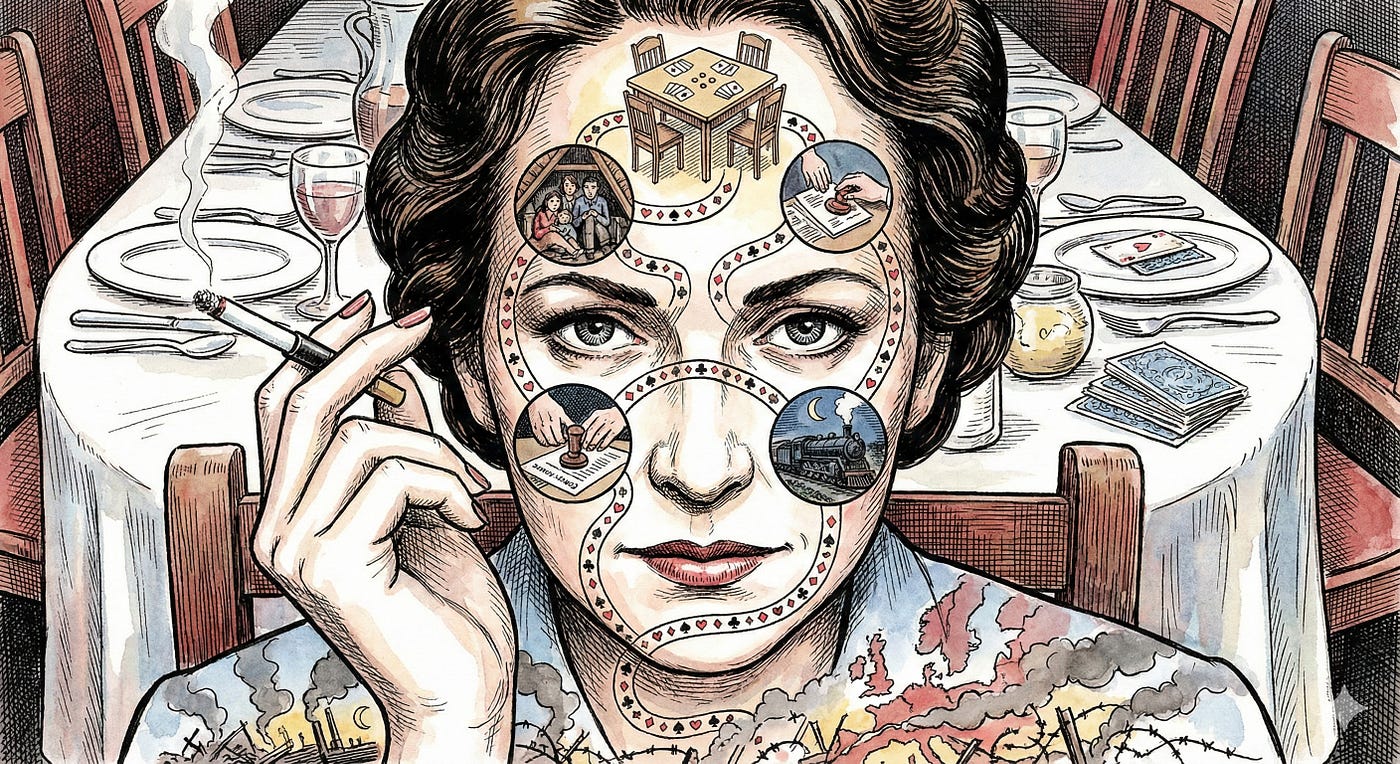
“A family must once again be a safe haven in this unsafe world”: WM’s introduction to Germany’s first sitcom could hardly be more cynical (traced by Google’s DeepMind Imagen)
At Home With the Tetzlaffs
It’s January 15, 1973 — probably early afternoon. The exact recording time is unknown, but the episode will air at 9 p.m. The black-and-white camera shows, in the then-standard 4:3 TV format, a lower-middle-class living room. Two windows face the street. Their light-colored sheer curtains provide privacy. Outside, it is dark. The chandelier’s light reflects in the right window. Longer drapes frame both windows on the left and right. Their roughly stylized floral pattern clashes rather unpleasantly with the wallpaper’s intricate geometric design. The black-and-white checkered television image only hints at their garish colors.
A group of upholstered furniture forms the center of the room. A sofa stands against the right wall, with a painting hanging above it. The subject of the painting is not recognizable from this side angle. In front of the sofa, two smaller armchairs and a larger one are arranged around a coffee table. Except for the sofa, the furniture rests on a thick carpet whose concentric border patterns visually unify the seating group. On the window side of the sofa, a floor lamp casts a cone of light; on the other side stands a wooden sewing basket with a carrying handle. Its placement, along with the presence of a larger, more comfortable armchair, suggests established seating positions within the family living here.
The room is empty of people. However, its petty-bourgeois order is disrupted in the foreground by a small chaos: scattered newspaper pages, some crumpled, lie before the built-in oil heater, whose outer and inner flaps are propped open. A medium-sized oil can stands among them. Whoever tried to light the heater has failed.
Multi-voiced murmuring can be heard in the background. The camera begins a slow pan, moving out of the living room set and across studio equipment, then past a street set featuring a phone booth and an apartment building facade, toward the source of the murmuring. On a gallery, middle-aged men and women sit in three rows, dressed in subdued suits and modest costumes. The gentleman in the front row on the left could be WDR director Werner Höfer. WM’s bald head is clearly recognizable two rows behind him, next to him, probably Günter Rohrbach’s dark hair. Further to the right, before the camera pans across a small staircase to a second group of viewers, the editor responsible for this show, Peter Märthesheimer, has taken his seat. The pan ends just before the right edge of the gallery with perhaps seventy viewers.
The Family As a Disharmonious Community of Fate
The camera focuses on a blonde woman in her late forties with short, curled hair, sitting on a chair in front of the first row of viewers. A microphone hangs above her head; behind her stands another TV camera. The woman wears — a fitting choice for the living room set where the camera began its pan — a white blouse with a floral pattern and a dark skirt with a geometric design. She holds several sheets of paper in her hands, as television announcers do. However, she does not read from them but speaks freely into the camera.
“Just a few years ago, a family was the unquestioned foundation of an orderly society. Back then — to put it simply — a family was still a family. Today, unfortunately, that has changed. The general signs of dissolution have regrettably not spared the smallest cell of the nation. This must change, we believe. As before, a family must once again be a safe harbor in this uncertain world, where everyone — father, mother, son, or daughter — takes the place nature assigned to them. They must not face the struggles of life alone but as a harmonious community.”
Now she falters and looks helplessly at the pages in her hands for the first time. She finds her line and looks up again, relieved:
“They must be exactly what our title says: One Heart and One Soul!”
Fade out.
An accordion plays a valse musette that will become known as “Alfred’s Theme.” The series title appears in white lettering on a black background, followed by the author’s name and the first episode’s title: “The Chicken.”
Fade in.
The Fire Has Gone Out
We’re back in the living room set. A man of about fifty stands in front of the oil heater — Alfred Tetzlaff. He wears an ill-fitting suit with a vest, white shirt, and tie. A minor clerk. He reads aloud, half to himself, a few sentences from a crumpled page of a daily newspaper. The other sections still lie scattered on the floor. Alfred sets his reading aside and tries again, still in vain, to get the oil heater working. Soon, his wife, Else, returns home — she played the “announcer” — followed by their daughter Rita, in her early twenties. At some distance, we meet the fourth family member, son-in-law Michael. Family life can begin. And it starts with trouble. The heater is off, and it is cold. Also, everyone except Alfred gets dinner. His mutton roast is burned. And sharing isn’t really this family’s thing — contrary to the meaning of the Bible verse WM chose as the title: “Now the whole group of those who believed were of one heart and soul, and no one claimed private ownership of any possessions, but everything they owned was held in common.”
One might almost feel sorry for Alfred — if he did not reveal himself within minutes as a brutal and blustering petty bourgeois, utterly devoid of decency, manners, or honesty. Reactionary and racist, misogynistic and shamelessly tyrannical at home. Alfred hates Jews, guest workers, communists, and all men with long hair. Every small change frightens and enrages him. And this in a time of tremendous change.
The sitcom’s focus is on the mood — or mood imbalance — of West Germany. The lifestyle revolt ignited by youth rebellion and the student movement reaches the heart of society in the 1970s. Since 1969, a coalition of SPD and FDP governs for the first time. Under the chancellorship of former anti-Nazi emigrant Willy Brandt, a fiercely contested social upheaval is underway. WM satirically accompanies this process, which unsettles a majority of West Germans and challenges their accustomed ways of thinking and living, with One Heart and One Soul.
“You must not forget the times,” WM said decades later in an interview. “There was a spirit of new beginnings in this country. We had the social-liberal coalition. And if now someone comes along and grumbles against the government, goes against the grain, that’s naturally funny.”
Between Kiesinger and Kissinger, Pompidou and Pompadour
The changes to be absorbed range from a new policy towards the German Democratic Republic (GDR), as the Russian-occupied part of Germany calls itself, to evolving sexual politics. Détente is called for in both areas. The GDR receives constitutional recognition, and neighborly relations are contractually agreed upon. Paragraphs 175 and 218 of the criminal code, which, since 1872, have rigorously criminalized homosexuality and abortion, are reformed. In his Ruhr Valley row house, Alfred Tetzlaff recognizes what Germany is threatened with: the sellout to the communists, along with perversion and immorality!
The fifth column has already moved in with the Tetzlaffs anyway — in the form of the clever but lazy son-in-law Michael, who comes from the GDR and supports the SPD. However, Alfred’s wife Else notices nothing. She is hopelessly simple-minded, at least in her husband’s eyes. Else confuses everything that can be confused in contemporary politics and history — Kiesinger and Kissinger, Pompidou and Pompadour. Alfred regularly calls her a “stupid cow.” Their daughter Rita is cheekier but hardly less harmless. After all, she married Michael, a probable East German spy. Alfred alternately calls him “Communist pig,” “red snotnose,” or “long-haired Bolshevik hyena.” Else and Rita are blind to the dangers of the present. Alfred wants to warn them because he reads the tabloid Bild and knows what’s what. But in vain!
At least anti-hero Alfred and public broadcaster ARD’s politically overcorrect cultural bureaucrats in 2024 have this in common. They too know better and want to warn: their audience. Specifically, about “Nasty Alfred”! Because the series contains “passages that today can be considered discriminatory.”
Oh… They were not discriminatory back then, in the enlightened social-liberal 1970s? And isn’t that precisely the deeper meaning of all these hilarious entanglements and catastrophes that WM invents? Doesn’t he want to parade the German petit bourgeois in all his prejudiced madness — discrimination nonstop, as crude and mean as it gets?
***
Previous Chapter: 75 Longing for Real Time
Next Chapter: **77 One Heart and One Soul**
German-Language Version: Wer war WM?
German Book Edition — published in December 2024

This post is part of a series: new chapters appear weekly. The book is already available in German. If you don’t want to wait — and read German — you can order it from Amazon.de or directly from the publisher Kadmos. They also offer an e-book version
메타데이터
- post_id
- 19a6ef1b3abe
- slug
- entry-into-the-third-division-19a6ef1b3abe
- url
- https://medium.com/@gundolffreyermuth/entry-into-the-third-division-19a6ef1b3abe
- canonical_url
- https://medium.com/@gundolffreyermuth/entry-into-the-third-division-19a6ef1b3abe
- author_url
- https://medium.com/@gundolffreyermuth
- status
- ok
- fetched_at
- 2026-07-28 05:39:03