The Managed Service Model Quietly Solving the Healthcare Talent Shortage in Integration Engineering
There is a staffing problem sitting inside most health system IT departments that rarely makes it onto the workforce strategy agenda — not…
The Managed Service Model Quietly Solving the Healthcare Talent Shortage in Integration Engineering
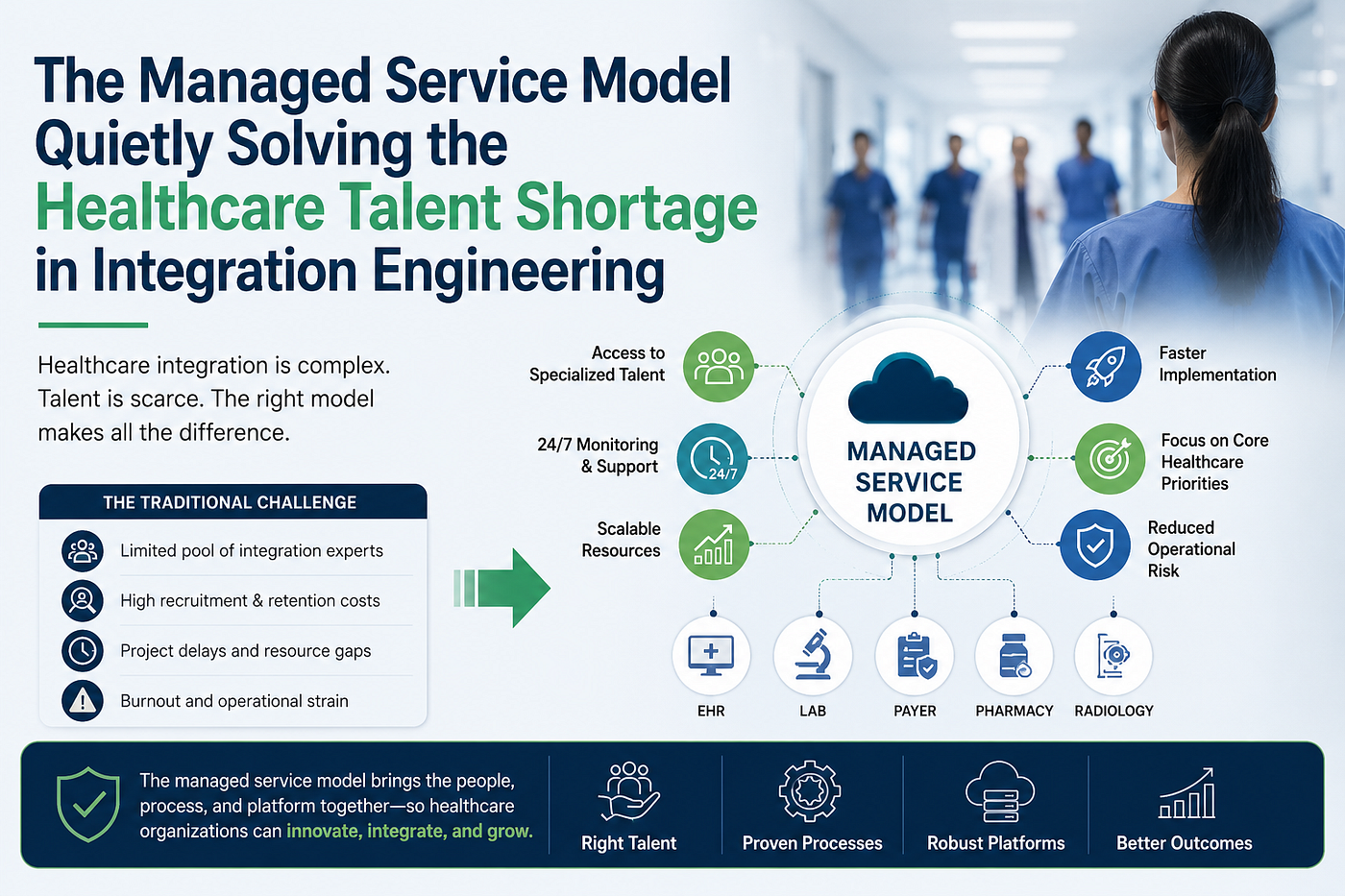
There is a staffing problem sitting inside most health system IT departments that rarely makes it onto the workforce strategy agenda — not because it is small, but because it is easy to misclassify.
It shows up as project delays. As deferred integrations. As institutional knowledge concentrated in one or two people who everyone quietly hopes do not leave. It shows up as a job requisition that has been open for seven months with no qualified candidates. It shows up as the CIO who knows the organization’s integration architecture is a strategic liability but cannot find the people to fix it.
The problem is a shortage of integration engineering talent in healthcare — and it is more acute, more structural, and more consequential than most health system leaders recognize.
The healthcare integration managed service model has emerged as one of the few operationally viable answers to it. Not as a stopgap. As a durable structural solution.
The Talent Problem Is Real, and It Is Getting Worse
Healthcare integration engineering sits at an unusual intersection. It requires deep technical fluency — HL7 v2, FHIR, SMART on FHIR, REST APIs, EDI, and a range of proprietary vendor formats — combined with meaningful clinical workflow knowledge, understanding of healthcare data governance, and the operational patience to work inside organizations where change moves slowly and the stakes of errors are high.
That combination does not emerge from a standard computer science curriculum. It is built through years of domain-specific experience. And the people who have it are increasingly expensive, increasingly scarce, and increasingly being recruited away from provider organizations by technology vendors, consulting firms, and digital health startups that can offer compensation structures that most health systems cannot match.
The numbers reflect the pressure. Healthcare IT job postings for integration-related roles — interface analysts, integration architects, interoperability engineers — consistently outpace available qualified candidates. The American Hospital Association and CHIME have both flagged healthcare IT workforce gaps as an operational priority. The Bureau of Labor Statistics projects continued growth in healthcare IT roles through the decade, with demand outpacing supply in specialized technical disciplines.
The pipeline is not catching up. Integration engineering is a specialty that takes years to develop, and the incentive structures of the current labor market point experienced talent away from provider organizations, not toward them.
Why Health Systems Cannot Hire Their Way Out of This
The instinctive executive response to a talent gap is a hiring strategy. Post the role. Raise the salary band. Engage a recruiter. Eventually, fill the seat.
That approach has historically worked for many IT functions. For healthcare integration engineering specifically, it is running into structural walls that are worth naming clearly.
The compensation ceiling is real. Health systems operate under margin pressures that most technology companies do not. A senior integration architect who could command $180,000 to $220,000 at an Epic, Oracle, or a well-funded digital health company may be unattainable at a regional health system operating on thin margins. The gap is not small, and it is widening.
The retention problem is as severe as the recruitment problem. Health systems that do successfully hire experienced integration engineers face ongoing attrition risk. The same market forces pulling candidates toward technology employers continue pulling existing employees. Institutional investment in an individual’s development — the years spent getting them oriented to clinical workflows, legacy systems, and organizational culture — walks out the door when they accept an offer from a vendor.
The knowledge concentration risk is underappreciated. In many health systems, integration architecture knowledge is concentrated in a small number of individuals — sometimes just one or two people. When that person leaves, the organizational capability does not just diminish. It collapses. The remaining team knows how to operate the integrations that exist. They may not know why certain architectural decisions were made, what the dependencies are, or how to safely evolve the environment.
The workload math does not work. Even where health systems can recruit and retain, the volume of integration work required to support digital strategy, EHR optimization, M&A activity, and regulatory compliance often exceeds what any reasonably sized internal team can deliver. The backlog grows. Strategic integrations get deprioritized. Clinical and operational leaders grow frustrated with IT’s apparent inability to execute.
None of these problems is solved by hiring faster.
What a Healthcare Integration Managed Service Actually Provides
A healthcare integration managed service provides access to a dedicated team of integration specialists — interface analysts, integration architects, FHIR developers, middleware platform engineers — operating under defined service levels, with documented processes, on behalf of a health system client.
That description sounds transactional. The operational reality is considerably more significant.
Depth of specialization that no single health system can sustain internally. A managed service provider focused on healthcare integration maintains teams with expertise across Epic, Oracle Health (Cerner), Meditech, Veradigm, Rhapsody, Mirth Connect, MuleSoft, Azure Integration Services, and the full range of formats and standards in active use across the industry. No internal team at a regional or mid-sized health system can realistically maintain that breadth. When a complex integration problem arises — a custom FHIR implementation, a difficult EDI mapping, a non-standard vendor API — the managed service team has likely encountered a version of it before.
Continuity that does not depend on any individual. The critical vulnerability of internal integration teams is their concentration in a small number of people. A managed service model distributes that knowledge institutionally. When an individual leaves the managed service provider’s team, the client’s operations are not disrupted — because the knowledge is documented, the processes are systematized, and a trained replacement is onboarded to the account. The health system’s integration capability becomes a function of the service relationship, not of any particular individual’s continued employment.
Scalable capacity that matches the actual workload curve. Integration demand inside health systems is not linear. M&A activity creates surge demand. EHR upgrades create surge demand. Regulatory deadlines create surge demand. An internal team sized for steady-state operations cannot absorb surges without either delaying everything else or burning out the people on it. A managed service model provides elastic capacity — the ability to scale up when the workload requires it and scale back when it does not — without the overhead of hiring, training, and eventually rightsizing a larger internal team.
A talent pipeline that health systems cannot build on their own. Managed service providers invest in recruiting, training, and developing integration engineering talent as a core business function. They can offer career progression, specialization depth, and peer learning environments that a single health system IT department cannot replicate. This allows them to attract and retain talent that the health system market cannot otherwise access.
The Strategic Shift: From Talent Problem to Operating Model Decision
The healthcare talent shortage in integration engineering is real and is not going away. But framing it purely as a talent problem — something to be solved through better recruiting, higher salaries, or retention bonuses — misses the more important organizational question.
The question is not: How do we hire enough integration engineers?
The question is: What is the right operating model for integration capability in our organization?
Those are different questions, and they lead to different answers.
For most health systems, the right operating model is not a fully internal team. The economics do not support it. The labor market does not support it. The knowledge concentration risk does not support it. And the variable demand curve — surges around M&A, go-lives, and regulatory deadlines — does not support it.
The right operating model, for a growing number of health systems, is a healthcare integration managed service — a structured service relationship that provides the depth, continuity, scalability, and accountability that internal teams cannot reliably deliver in the current environment.
This is not a concession. It is a strategic decision about where to invest organizational energy and where to leverage external capability. Health systems that have made this shift are not outsourcing a core competency. They are recognizing that integration engineering, done at the required level of quality and governance, is a specialty function — and that accessing it through a managed service model is more operationally sound than attempting to build and sustain it entirely from scratch.
What Changes Operationally When You Make This Shift
Health systems that have transitioned to a healthcare integration managed service model tend to observe a consistent set of operational changes in the 12 to 24 months following the transition.
Project backlogs are clear. Integrations that have been queued for months — sometimes years — begin to move. Clinical and operational leaders who had grown accustomed to IT saying “we don’t have the bandwidth right now” start receiving different answers.
Institutional knowledge becomes documented. One of the underappreciated benefits of a managed service engagement is the documentation rigor it imposes. Managed service providers document what they build and how they operate it — because their own continuity depends on it. Health systems that previously had integration architecture living primarily in the heads of two or three individuals find themselves with actual documentation.
The internal IT team’s role evolves. This is important to understand correctly. A managed service model does not eliminate the need for internal IT involvement in integration. It changes what that involvement looks like. Instead of hands-on-keyboard interface development, internal team members shift toward vendor relationship management, clinical workflow translation, governance oversight, and strategic direction. For many IT leaders, this is a more valuable use of their team’s time.
Compliance and governance posture improves. Managed service providers operate with defined standards for security, audit logging, change management, and documentation. These standards often exceed what internally resourced teams can consistently maintain under competing workload pressures. Health systems benefit from this elevation in governance quality as a built-in feature of the service relationship.
Attrition risk moves off the health system’s books. When a key integration engineer leaves the managed service provider’s team, that is the managed service provider’s problem to solve — not the health system’s. The service levels are maintained. The health system’s operations continue. The anxiety that comes with watching a critical team member’s LinkedIn activity diminishes.
Questions That Surface Whether a Managed Service Model Is Right for Your Organization
Not every health system is at the same place in this evaluation. These questions help calibrate where the conversation should start.
How many active integrations does your organization operate, and do you have a current, maintained inventory of them? If the inventory does not exist or is out of date, internal governance capacity is likely insufficient.
What is the average time from integration request to go-live in your current operating model? If the answer is measured in quarters rather than weeks for routine integrations, the operating model has a capacity problem.
What would happen to your integration operations if your two most experienced integration engineers left in the same month? The answer to this question describes the actual resilience of your current model.
How many integration-related job requisitions have been open for more than 90 days? This is a direct measure of market accessibility — how well the current model can recruit the talent it needs to function.
Is integration engineering keeping pace with your organization’s digital strategy, or is it consistently a bottleneck? If clinical and operational leaders consistently flag integration capacity as a constraint on digital initiatives, the operating model is misaligned with organizational ambition.
The Broader Implication for Healthcare IT Strategy
The talent shortage in integration engineering is part of a broader pattern. Healthcare IT is becoming more complex, more regulated, and more strategically consequential, while the labor market for specialized technical talent is becoming more competitive and more expensive. The gap between what health systems need from their IT functions and what they can build and sustain internally is widening.
Managed service models — across integration, cybersecurity, cloud operations, and other technical specialties — are one of the primary structural responses to this gap. They allow health systems to access the technical capability their digital strategies require without the overhead, risk, and market uncompetitiveness of attempting to build every function from scratch.
For integration specifically, where domain specialization is deep, attrition risk is high, and the compliance stakes are significant; the case for a managed service model is particularly strong.
The health systems that recognize this early — and build managed service relationships that give them reliable, scalable, expert-level integration capability — will execute their digital strategies faster, with fewer disruptions, and with less organizational anxiety about the talent market’s next move.
The ones that keep waiting for the right hire to come along are going to keep waiting.
Healthcare executives evaluating their integration operating model should start with a capacity and capability assessment — understanding the gap between current integration team bandwidth and the demand required to support the organization’s digital strategy is the prerequisite to making a well-informed decision about managed services.
메타데이터
- post_id
- 19bd5cca7c19
- slug
- the-managed-service-model-quietly-solving-the-healthcare-talent-shortage-in-integration-engineering-19bd5cca7c19
- url
- https://medium.com/@Larisa10/the-managed-service-model-quietly-solving-the-healthcare-talent-shortage-in-integration-engineering-19bd5cca7c19
- canonical_url
- https://medium.com/@Larisa10/the-managed-service-model-quietly-solving-the-healthcare-talent-shortage-in-integration-engineering-19bd5cca7c19
- author_url
- https://medium.com/@Larisa10
- status
- ok
- fetched_at
- 2026-07-07 01:49:13