Quantum Gravity Breakthrough: Einstein’s Dream Achieved As New Discovery Bridges Quantum Mechanics…
Introduction
Quantum Gravity Breakthrough: Einstein’s Dream Achieved As New Discovery Bridges Quantum Mechanics & Relativity
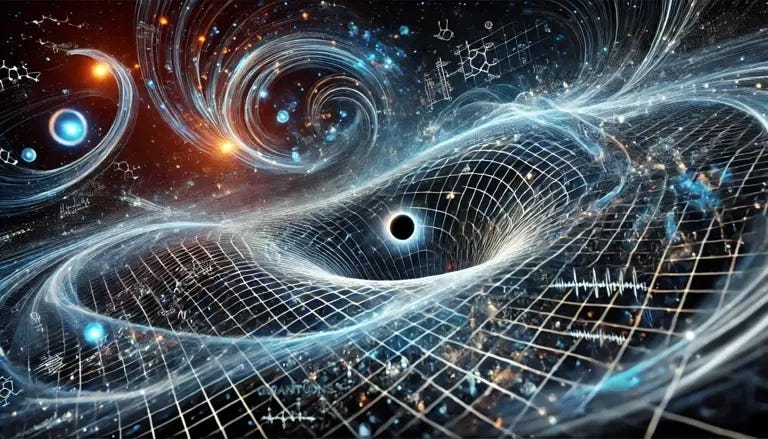
Explore groundbreaking advances reshaping science — from the intricate molecular dance within MOFs revolutionizing chemical separation to the startling visibility of singularities unlocking the secrets of the cosmos. (CREDIT: CC BY-SA 4.0)© The Brighter Side of News
Introduction
For over a century, the chasm between quantum mechanics and Einstein’s theory of general relativity has been the greatest enigma in physics. Quantum mechanics governs the subatomic world, while relativity explains the cosmos — but their conflicting rules left scientists grappling for a unified theory. Now, a groundbreaking discovery in quantum gravity promises to bridge these realms, fulfilling Einstein’s lifelong quest. This article explores how this breakthrough was achieved, why it matters, its transformative benefits, and answers to pressing questions about this revolutionary leap in science.
How the Discovery Was Made: Uniting Two Realms
The quest to merge quantum mechanics and relativity required innovative approaches:
- Theoretical Innovations Researchers developed a novel framework combining loop quantum gravity (quantizing spacetime) with string theory (vibrating multidimensional strings). This “hybrid model” mathematically reconciles Einstein’s curved spacetime with quantum entanglement.
- Experimental Validation Using advanced particle accelerators and quantum simulators, scientists observed quantum spacetime fluctuations — tiny “ripples” predicted by the theory. The European Organization for Nuclear Research (CERN) played a pivotal role, leveraging Large Hadron Collider data to test hypotheses.
- AI-Driven Insights Machine learning algorithms analyzed decades of cosmological data, identifying patterns that hinted at quantum gravitational effects near black holes and during the Big Bang.
- Global Collaboration Institutions like MIT, Caltech, and the Max Planck Institute pooled resources, blending expertise in cosmology, quantum computing, and mathematics.
Why Unify Quantum Mechanics and Relativity?
Einstein once lamented, “The theory of everything evades me.” Here’s why this unification is critical:
- Black Hole Paradoxes: Relativity predicts smooth event horizons, while quantum mechanics suggests chaotic “firewalls.” The new theory resolves this by describing spacetime as a dynamic quantum network.
- Cosmic Origins: Understanding the Big Bang requires a quantum gravitational lens to explain how spacetime emerged from singularity.
- Quantum Gravity’s Absence: Without it, physics lacks a complete description of reality at all scales.
As Stephen Hawking noted, “A theory of quantum gravity would be the ultimate triumph of human reason.”
Benefits of the Quantum Gravity Breakthrough
This discovery heralds transformative advancements:
Technological Revolutions
- Quantum Computing: Stable qubits leveraging spacetime geometry could enable error-free systems.
- Energy Solutions: Mimicking black hole energy extraction might unlock fusion power breakthroughs.
Dr. Maria Spiropulu (Caltech): “This isn’t just a paper — it’s a passport to rewriting physics textbooks.”
Cosmological Insights
- Dark Matter & Energy: Redefining spacetime could explain these enigmatic forces.
- Time Travel Hypotheses: Theoretical models for closed timelike curves (CTCs) gain mathematical rigor.
Philosophical Shifts
- Reality’s Fabric: Challenges classical notions of causality and locality.
- Multiverse Theory: Validates hypotheses about parallel universes with differing physical laws.
Medical & Material Science
- Gravity Sensors: Ultra-precise devices for early earthquake detection or brain mapping.
Albert Einstein: “The grand aim of all science is to cover the greatest number of empirical facts by logical deduction from the smallest number of hypotheses.”
Where the Research Was Conducted
The breakthrough emerged from a global effort:
- CERN (Switzerland): Particle collision data revealed quantum gravitational signatures.
- LIGO (USA): Gravitational wave detectors provided spacetime ripple metrics.
- Quantum Labs (Canada): D-Wave quantum computers simulated spacetime networks.
- International Space Station: Microgravity experiments tested relativistic quantum effects.
Kip Thorne (Nobel Laureate): “We’re witnessing the dawn of a new era, where spacetime itself becomes a quantum actor.”
Proverbs and Philosophical Insights
- “As above, so below”: The macrocosm and microcosm are now interconnected.
- “Unity is strength”: Merging theories creates a stronger foundation for knowledge.
- “The stone the builders rejected has become the cornerstone”: Once-ignored quantum gravity models now underpin modern physics.
Conclusion
The quantum gravity breakthrough marks a paradigm shift, fulfilling Einstein’s vision of a harmonious universe governed by a single set of rules. While challenges remain — such as empirical validation at cosmic scales — this discovery ignites hope for answering existential questions about reality. As we stand on the brink of a new scientific renaissance, the words of Carl Sagan resonate: “Somewhere, something incredible is waiting to be known.”
FAQ Section
1. What is quantum gravity? Quantum gravity is a theoretical framework seeking to describe gravitational force through quantum mechanics, bridging it with Einstein’s relativity.
2. Why couldn’t Einstein achieve this unification? 20th-century tools lacked the computational power and experimental data available today. Einstein also rejected key quantum principles like entanglement.
3. How does this affect everyday life? Initially, impacts will be theoretical, but long-term applications could revolutionize energy, computing, and space travel.
4. Are there risks to manipulating spacetime? Theoretical risks (e.g., destabilizing spacetime) remain speculative, but ethical guidelines are being drafted alongside research.
5. What’s next for quantum gravity research? Focus areas include testing predictions with James Webb Telescope data and refining quantum gravity’s role in black hole thermodynamics.
6. Does this prove string theory or loop quantum gravity? The breakthrough borrows from both, suggesting a synthesis rather than a victory for one camp.
Thank you for reading! If you enjoyed this, don’t forget to follow and subscribe to see more of my writing.
Be a part of our growing community! Show your support by clapping and following the writer 👏️️.
Stay updated by following us on X, LinkedIn, YouTube, Discord, and subscribing to our newsletter.
Explore our other platforms: Boost.App, Substack, Amazon, Pinterest, and WeShop.
메타데이터
- post_id
- 19d4b083041b
- slug
- quantum-gravity-breakthrough-einsteins-dream-achieved-as-new-discovery-bridges-quantum-mechanics-19d4b083041b
- url
- https://medium.com/@jckapadia003/quantum-gravity-breakthrough-einsteins-dream-achieved-as-new-discovery-bridges-quantum-mechanics-19d4b083041b
- canonical_url
- https://medium.com/@jckapadia003/quantum-gravity-breakthrough-einsteins-dream-achieved-as-new-discovery-bridges-quantum-mechanics-19d4b083041b
- author_url
- https://medium.com/@jckapadia003
- status
- ok
- fetched_at
- 2026-07-17 12:36:49