🚀 𝐂𝐨𝐝𝐢𝐧𝐠 𝐢𝐧 𝐂𝐨𝐝𝐞, 𝐖𝐞𝐢𝐠𝐡𝐭𝐬 & 𝐄𝐧𝐠𝐥𝐢𝐬𝐡: 𝐓𝐡𝐞 𝐑𝐢𝐬𝐞 𝐨𝐟…
Software development has long been dictated by how we instruct machines. First, through lines of code, then through weights learned from…
🚀 𝐂𝐨𝐝𝐢𝐧𝐠 𝐢𝐧 𝐂𝐨𝐝𝐞, 𝐖𝐞𝐢𝐠𝐡𝐭𝐬 & 𝐄𝐧𝐠𝐥𝐢𝐬𝐡: 𝐓𝐡𝐞 𝐑𝐢𝐬𝐞 𝐨𝐟 𝐒𝐨𝐟𝐭𝐰𝐚𝐫𝐞 𝟑.𝟎
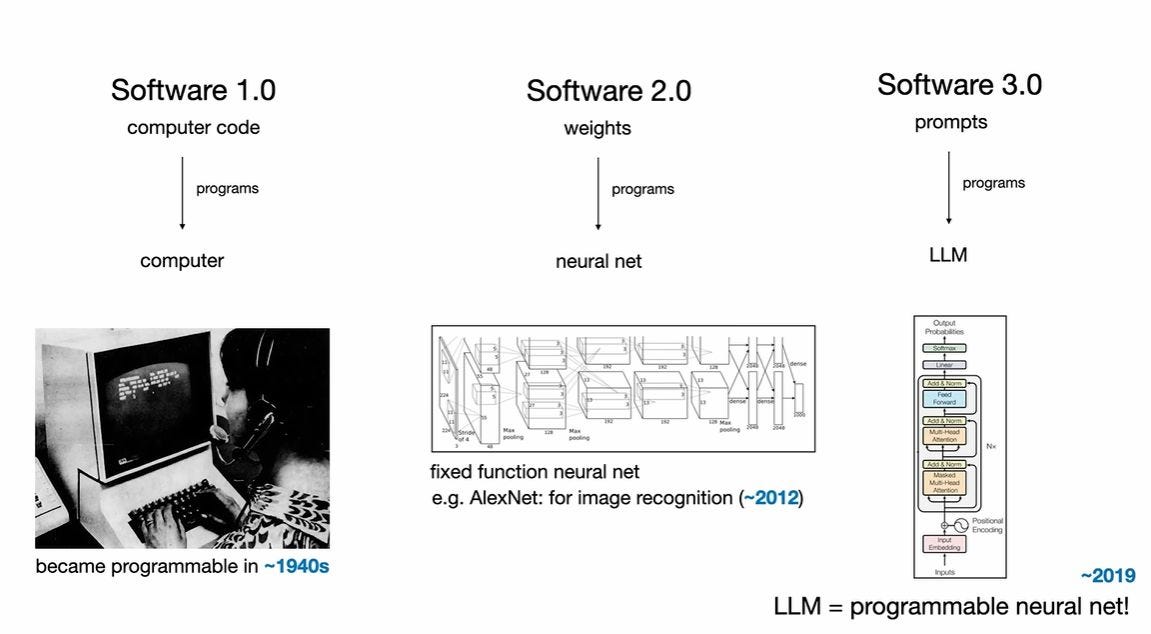
Software development has long been dictated by how we instruct machines. First, through lines of code, then through weights learned from data, and finally through natural language itself. We’re entering a new era, one where English acts as a programming interface, and prompts become the new source code.
In this article, we trace how we moved from Software 1.0 → 2.0 → 3.0, why this shift matters, and what it means for engineering in the future.
🔍 What You’ll Learn
- Software 1.0 — Traditional programming: explicit logic in C++, Python, etc.
- Software 2.0 — The ML revolution: training models to learn the code via.
- Software 3.0 — The new frontier: prompts written in natural language (e.g., English) are now programming instructions.
🛠️ 𝗪𝗵𝘆 𝗜𝘁 𝗠𝗮𝘁𝘁𝗲𝗿𝘀
Software 3.0 radically changes who can build software and how we build it:
- Democratisation of programming: If you can describe your idea in English, you can instruct an LLM to build it.
- LLMs as platforms: They increasingly behave like utilities, fabrication plants, and operating systems — the hidden infrastructure shaping tomorrow’s apps.
- Strategic decisions: Every company must now ask: Should this be coded (1.0), trained (2.0), or prompted (3.0)? The balance determines speed, scalability, and innovation.
⚙️ How the Shift Happened
Software 1.0 → Software 2.0
Hardcoded rules gave way to learned behaviours. A well-known example is Tesla: early autopilot systems used C++ rules for visual detection, but deep learning (2.0) eventually replaced most handwritten logic.
Software 2.0 → Software 3.0
Now we describe behaviour, not code. LLMs act like general-purpose computers — they don’t need explicit logic or training for every task. They need instructions, and those instructions are written in everyday language.

LLMs as Platforms
They’re accessible through APIs, backed by massive compute clusters, and forming a new abstraction layer for building software. Just as cloud computing abstracted hardware, LLMs are abstracting logic.

📣 Join the Conversation
- Share your experience: Which software era are you working in today, or shifting toward?
- Engage in the comments: Where do you draw the line between code, model, and prompt?
- Spread the word: Tag someone who needs to hear how “programming in English” is reshaping software engineering.
💡 Final Thought
Software 3.0 isn’t an incremental upgrade; it’s a paradigm shift. The prompt is the new code, English is the new compiler, and LLMs are the new machines. As programming becomes more conversational, the skill of the future isn’t just writing code — it’s designing intelligence.
메타데이터
- post_id
- 1a152e87c3ea
- slug
- -1a152e87c3ea
- url
- https://medium.com/@sivasivatharshan12/-1a152e87c3ea
- canonical_url
- https://medium.com/@sivasivatharshan12/-1a152e87c3ea
- author_url
- https://medium.com/@sivasivatharshan12
- status
- ok
- fetched_at
- 2026-08-07 01:06:24




