Modular Automation Market Share Across Hardware, Software, and Services
The global Modular Automation Market is witnessing robust expansion as industries increasingly embrace smart manufacturing, digital…
Modular Automation Market Share Across Hardware, Software, and Services
The global **Modular Automation Market** is witnessing robust expansion as industries increasingly embrace smart manufacturing, digital transformation, and Industry 4.0 technologies. Modular automation enables manufacturers to develop highly flexible and scalable production systems using standardized automation modules that can be easily configured, upgraded, or expanded according to changing operational requirements. The market is broadly segmented into hardware, software, and services, with each segment contributing significantly to the overall value chain. While hardware continues to account for the largest market share due to substantial investments in automation equipment, software and services are experiencing rapid growth as manufacturers focus on intelligent production management, predictive maintenance, and long-term operational optimization. The combined evolution of these three segments is creating a comprehensive automation ecosystem capable of supporting next-generation manufacturing facilities.
The hardware segment currently represents the largest share of the modular automation market because it forms the physical foundation of automated production systems. Hardware includes programmable logic controllers (PLCs), industrial robots, sensors, actuators, servo motors, drives, industrial communication devices, machine vision systems, human-machine interfaces (HMIs), control panels, conveyors, modular workstations, and safety equipment. These components work together to perform manufacturing operations with high precision, reliability, and efficiency. Continuous industrial investments in factory modernization and production capacity expansion continue driving strong demand for advanced automation hardware across multiple industries.
Industrial robots remain one of the fastest-growing categories within the hardware segment. Manufacturers increasingly deploy robotic systems for assembly, welding, packaging, palletizing, material handling, inspection, and precision manufacturing tasks. Modular automation allows robotic cells to be integrated quickly into production lines while providing flexibility for future expansion or reconfiguration. The growing adoption of collaborative robots, which operate safely alongside human workers, is further strengthening hardware demand by enabling flexible automation for small and medium-sized production facilities.
Download PDF Brochure @ https://www.marketsandmarkets.com/pdfdownloadNew.asp?id=10649136
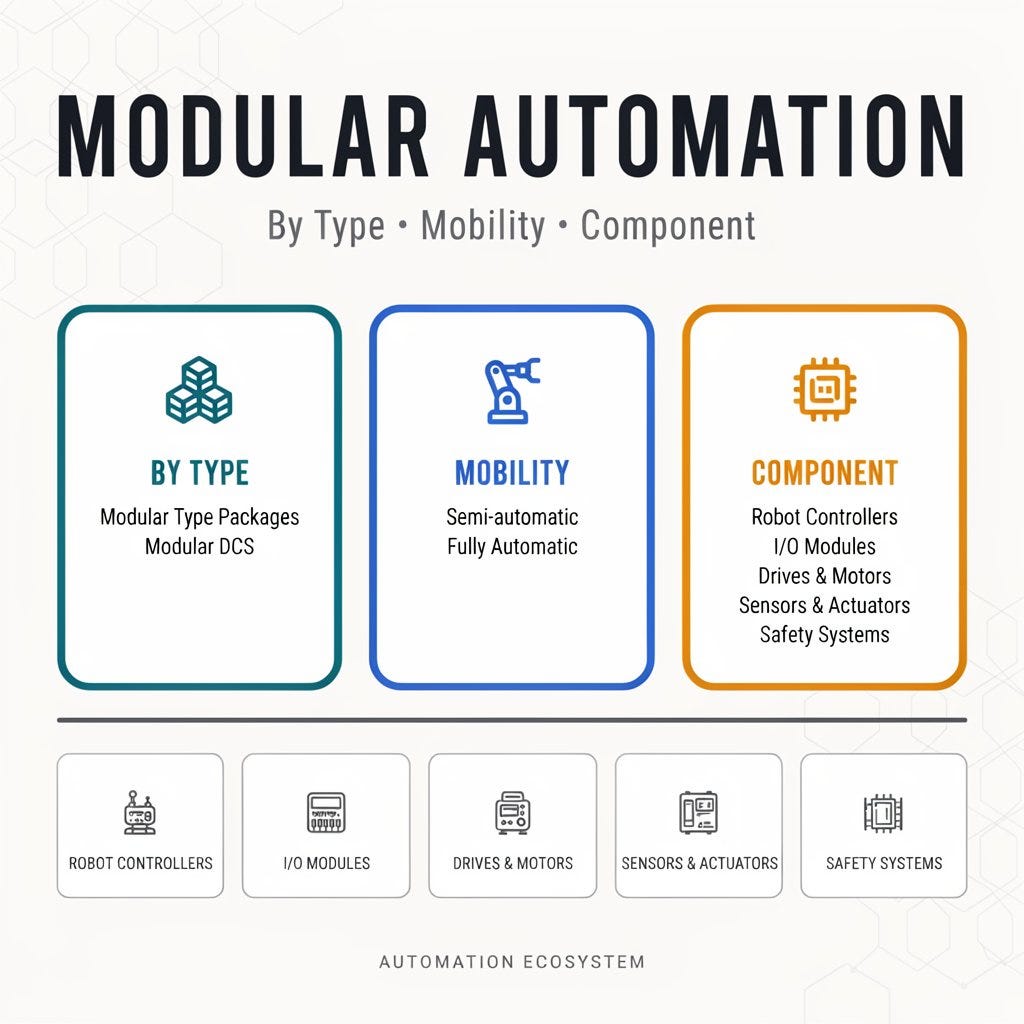
Sensors and intelligent field devices have become indispensable components of modular automation systems. Modern manufacturing relies on a wide range of sensors to monitor temperature, pressure, vibration, position, motion, proximity, flow, and product quality in real time. These sensors continuously collect operational data that supports intelligent decision-making, predictive maintenance, and automated process control. As Industrial Internet of Things technologies become increasingly integrated into manufacturing operations, demand for advanced sensor hardware is expected to continue growing throughout the forecast period.
Machine vision systems also contribute significantly to hardware market growth. AI-powered cameras and vision sensors perform automated inspection, defect detection, dimensional measurement, barcode verification, and product identification with exceptional speed and accuracy. These systems improve production quality while reducing dependence on manual inspection processes. Modular automation architectures enable machine vision modules to be integrated easily into existing production lines, supporting continuous quality improvement and manufacturing efficiency across industries such as electronics, automotive, pharmaceuticals, and food processing.
Although hardware represents the largest market share, the software segment is emerging as one of the fastest-growing areas of modular automation. Manufacturing software serves as the intelligence behind automated production systems by coordinating equipment, analyzing operational data, optimizing production workflows, and enabling communication between machines and enterprise management platforms. Software solutions include supervisory control and data acquisition systems, manufacturing execution systems, industrial analytics platforms, digital twin applications, production scheduling software, engineering tools, and industrial cybersecurity solutions.
Artificial intelligence is significantly accelerating software adoption within modular automation environments. AI-powered applications analyze production data to identify bottlenecks, optimize machine performance, predict equipment failures, and improve manufacturing quality. Machine learning algorithms continuously refine operational processes based on real-time production information, enabling manufacturers to achieve higher productivity while minimizing waste and downtime. As smart manufacturing becomes increasingly data-driven, software platforms capable of supporting intelligent automation are expected to capture a growing share of the overall market.
Inquiry Before Buying @ https://www.marketsandmarkets.com/Enquiry_Before_BuyingNew.asp?id=10649136

Cloud computing has further expanded the role of software within modular automation. Cloud-based manufacturing platforms allow organizations to monitor production performance across multiple facilities, manage automation systems remotely, deploy software updates, and analyze manufacturing data from centralized locations. These cloud-enabled capabilities improve operational visibility, simplify system management, and support global manufacturing operations. As manufacturers increasingly adopt hybrid cloud and edge computing architectures, software will continue becoming an increasingly valuable component of modular automation solutions.
Digital twin technology is another important contributor to software market growth. Digital twins create virtual representations of manufacturing systems that allow engineers to simulate production processes, evaluate equipment configurations, optimize factory layouts, and predict operational performance before implementing physical changes. Integration between modular automation hardware and digital twin software reduces engineering risks, shortens commissioning time, and enhances production planning while supporting continuous operational improvement.
The services segment is also becoming increasingly important as organizations seek comprehensive support throughout the lifecycle of modular automation systems. Services include consulting, system design, engineering, installation, integration, commissioning, training, maintenance, technical support, software upgrades, and lifecycle management. As manufacturing systems become more sophisticated and digitally connected, businesses increasingly rely on experienced automation providers to ensure successful implementation and long-term operational performance.
System integration services account for a significant portion of the services market. Manufacturing facilities often incorporate automation equipment from multiple vendors, requiring specialized expertise to achieve seamless interoperability between hardware, software, communication networks, and enterprise management systems. Professional system integrators help organizations design customized automation architectures that maximize production efficiency while ensuring compatibility across complex manufacturing environments.
View detailed Table of Content here — **https://www.marketsandmarkets.com/Market-Reports/modular-automation-market-10649136.html**

Maintenance and lifecycle management services are becoming increasingly valuable as manufacturers prioritize operational continuity and equipment reliability. Predictive maintenance solutions powered by Industrial Internet of Things sensors and artificial intelligence allow service providers to identify potential equipment failures before they result in costly production interruptions. Remote diagnostics, software updates, and condition monitoring services further improve equipment availability while reducing maintenance costs and extending system lifespan.
Training and workforce development services are also gaining importance within the modular automation market. As manufacturers implement increasingly advanced automation technologies, operators, engineers, and maintenance personnel require specialized technical knowledge to manage sophisticated production systems effectively. Automation vendors provide comprehensive training programs covering equipment operation, software management, safety procedures, troubleshooting, and cybersecurity, helping organizations maximize the value of their automation investments.
Demand for hardware, software, and services varies across industries but continues growing consistently. Automotive manufacturers invest heavily in robotics, control systems, and manufacturing software to support electric vehicle production and flexible assembly lines. Electronics manufacturers require highly precise automation hardware combined with advanced software for semiconductor fabrication and consumer electronics production. Pharmaceutical companies emphasize integrated automation systems that combine intelligent control software with validation and regulatory compliance services. Food and beverage manufacturers increasingly adopt modular automation supported by maintenance and integration services to improve production flexibility and food safety.
Regionally, North America maintains a strong market position due to high investments in industrial automation, digital manufacturing, and smart factory technologies. Europe continues expanding automation adoption through Industry 4.0 initiatives, sustainability programs, and advanced engineering capabilities. Asia Pacific is projected to account for the fastest market growth as manufacturing expansion, industrial modernization, and government support for digital transformation accelerate across China, Japan, South Korea, India, and Southeast Asia.
Looking ahead, the modular automation market will continue evolving through the balanced growth of hardware, software, and services. While hardware will remain the foundation of automation infrastructure, software will increasingly drive intelligent decision-making and production optimization, and services will ensure seamless implementation, operational reliability, and continuous improvement. The integration of artificial intelligence, Industrial Internet of Things, cloud computing, digital twins, cybersecurity, and predictive maintenance across all three segments will strengthen the overall modular automation ecosystem, supporting the long-term evolution of smart manufacturing worldwide.
메타데이터
- post_id
- 1a2bbb608dbb
- slug
- modular-automation-market-share-across-hardware-software-and-services-1a2bbb608dbb
- url
- https://medium.com/@avinashgogawale14/modular-automation-market-share-across-hardware-software-and-services-1a2bbb608dbb
- canonical_url
- https://medium.com/@avinashgogawale14/modular-automation-market-share-across-hardware-software-and-services-1a2bbb608dbb
- author_url
- https://medium.com/@avinashgogawale14
- status
- ok
- fetched_at
- 2026-07-10 08:54:07