Why AI Needs Photonics
Seeing the way forward in AI performance
Photonics
Why AI Needs Photonics
Seeing the way forward in AI performance
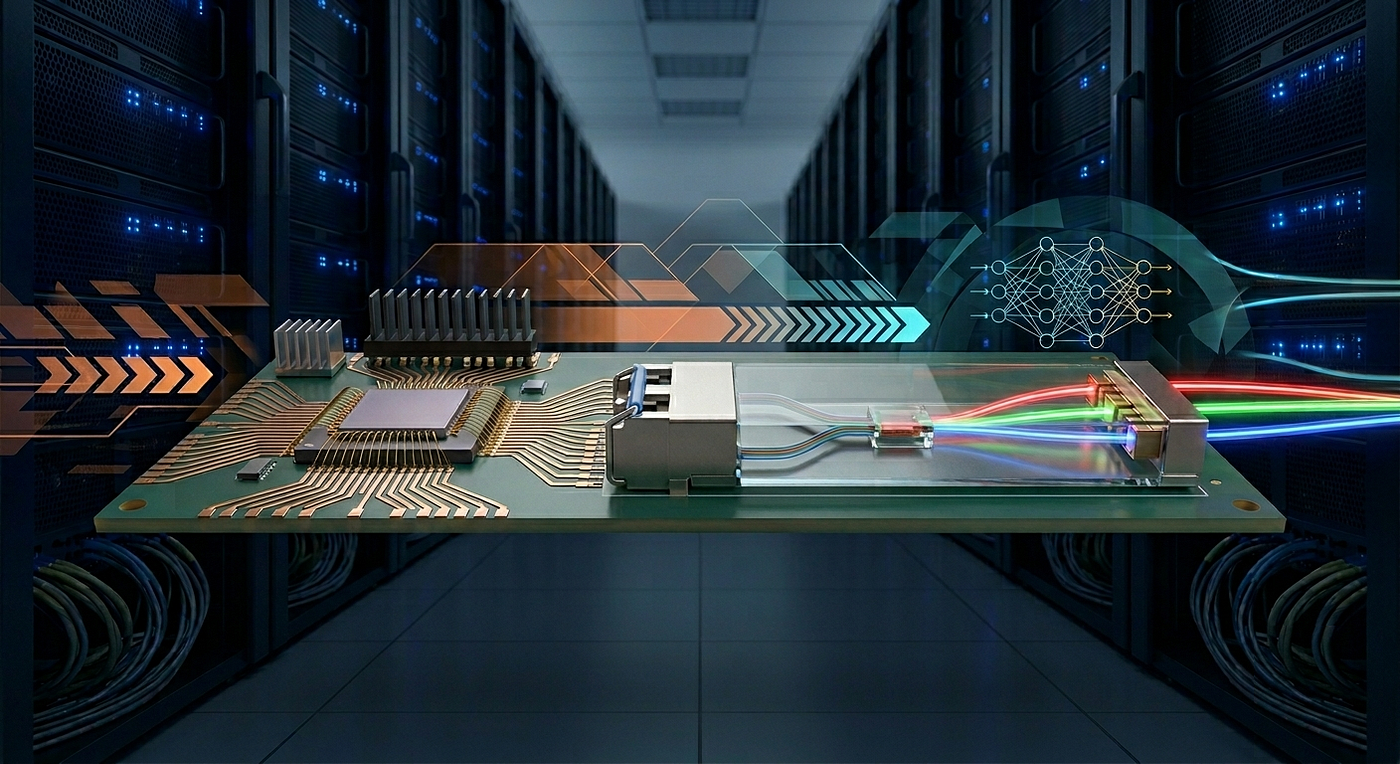
Whatever you think about the impact of artificial intelligence on our lives, AI faces some very real barriers to progress. Besides its current architectural wrong turn down the LLM road (my personal view) and its insatiable demand for electrical power, it faces the hard reality of physics as chips approach the physical limit defined by quantum tunnelling effects.
The ultimate physical limit for chip fabrication is defined by the size of the atoms themselves. Silicon, the primary material for semiconductors, has an atomic lattice spacing of approximately 0.5 nanometres.
Fabricating structures that are only a few atoms wide makes it nearly impossible to maintain the material consistency required for reliable electrical properties. At this scale, even the variation of a single atom within a critical structure can alter the performance of a transistor, leading to unacceptable rates of manufacturing defects and operational failure.
The most advanced fabrication is now approaching 2 nanometres.
Now photonics
The integration of photonics into modern computing marks a shift in how systems handle the demands of artificial intelligence. As neural networks grow in scope and complexity, the constraints of traditional electronic hardware have become increasingly evident.
Traditional processors rely on the movement of electrons through copper pathways, a process that inherently generates heat and faces physical limitations regarding signal speed and bandwidth.
Photonics, which utilises light to process and transmit information, offers a path to bypass these bottlenecks. This shift is not merely a theoretical prospect but a practical evolution, as seen in the recent commercial and strategic investments made by entities that recognised the potential of this technology over a decade ago.
Limitations of electronic circuits
The primary challenge for current hardware lies in the inefficiency of electrical signal transmission where energy is lost as heat due to electrical resistance.
In large-scale data centres, this heat generation requires cooling systems that consume significant portions of the facility’s total energy budget — and water, as I wrote about recently.
Furthermore, as AI models demand faster data movement between processors and memory, traditional copper-based interconnects struggle to maintain the required bandwidth without suffering from signal degradation or crosstalk. This bottleneck prevents the scaling of AI infrastructure, forcing the industry to seek alternatives that can sustain the exponentially rising demand for computational power.
Advantages of light-based processing
Photonics operates on a different set of physical principles. By using photons to represent and transmit data, systems can achieve higher frequencies and lower latency.
Unlike electrons, photons do not interact with the medium in a way that generates resistive heat, allowing for energy savings during data transmission.
A significant advantage is the ability to leverage wavelength division multiplexing, where multiple data streams are carried simultaneously on different wavelengths of light through the same fibre-optic medium.
This parallel processing capability allows for a massive increase in throughput, enabling AI systems to handle the complex matrix multiplication tasks fundamental to deep learning with greater speed and efficiency than traditional electronic counterparts.
That is how most of the world’s data is carried, probably even to your own front door.
Strategic investments in optical infrastructure
The recognition of this technology’s potential has led to significant capital allocation. A decade-long commitment by venture capital firms to the field of photonics has recently resulted in successful returns, demonstrating the viability of long-term investment in deep tech.
For example, early funding rounds in companies developing optical connectivity components have proven prophetic as the demand for AI hardware has surged. Major industry players are now following this trend, with large-scale acquisitions and multi-billion dollar commitments aimed at securing optical connectivity solutions.
[embed]
These financial movements reflect a broader consensus that the future of computing infrastructure is tethered to the successful implementation of photonic integration at the chip and system levels.
Hybrid architectures for current needs
Rather than an immediate or total replacement of silicon, the current transition favours hybrid architectures.
Designers are increasingly integrating optical modules with traditional complementary metal-oxide-semiconductor circuits.
In these systems, photonic components handle the heavy lifting of linear matrix operations — the most computationally expensive parts of neural network training and inference — while electronic components manage logic, memory, and control functions.
This dual-domain approach capitalises on the strengths of each technology, allowing manufacturers to use established fabrication processes while introducing the benefits of light-based processing into existing AI hardware ecosystems.
Sustainability and future scalability
The environmental impact of AI development is a growing concern, as data centres contribute significantly to global electricity consumption.
Photonics delivers the physics for increasing the sustainability of these operations. By reducing the energy per operation and minimising the heat generated, photonic accelerators could lower the power requirements of training and running advanced models.
This transition is important for the continued evolution of AI, as the industry approaches a point where traditional scaling methods are no longer economically or environmentally viable. On-site power generation is increasingly being required by planning authorities as grid supplies approach overload conditions.
As light-based processing becomes more integrated into the architecture of modern data centres, the performance-per-watt metrics of AI systems are expected to improve, providing the necessary foundation for the next wave of technological progress.
If you live near an AI datacentre that should give you some comfort as major AI firms and now investing in the development of SMRs — small modular reactors. That is, a nuclear reactor in your neighbourhood. Such are the demands that AI is forecasting.

Screenshot
[embed]The Jevons Paradox Hits AI Cheaper, bigger, exponentially crazy?medium.com
https://en.wikipedia.org/wiki/Photonics
https://www.photonics21.org/download/news/2025/Photonics_for_AI_final.pdf
https://news.mit.edu/2024/photonic-processor-could-enable-ultrafast-ai-computations-1202
https://effectphotonics.com/how-photonics-enables-ai-networks/
https://www.photonics.com/Articles/Photonics_Reshapes_the_Future_of_Computing/a69683
https://www.photondelta.com/blog/how-do-photonic-chips-compare-to-traditional-processors/
메타데이터
- post_id
- 1a2d5444d814
- slug
- why-ai-needs-photonics-1a2d5444d814
- url
- https://medium.com/the-dock-on-the-bay/why-ai-needs-photonics-1a2d5444d814
- canonical_url
- https://medium.com/the-dock-on-the-bay/why-ai-needs-photonics-1a2d5444d814
- author_url
- https://medium.com/@james-marinero
- status
- ok
- fetched_at
- 2026-06-14 11:28:49