The World’s Most Advanced Medical Research May Be Hiding Inside a Snake
What if evolution has already solved some of medicine’s biggest problems?
SCIENCE|HEALTH
The World’s Most Advanced Medical Research May Be Hiding Inside a Snake
What if evolution has already solved some of medicine’s biggest problems?
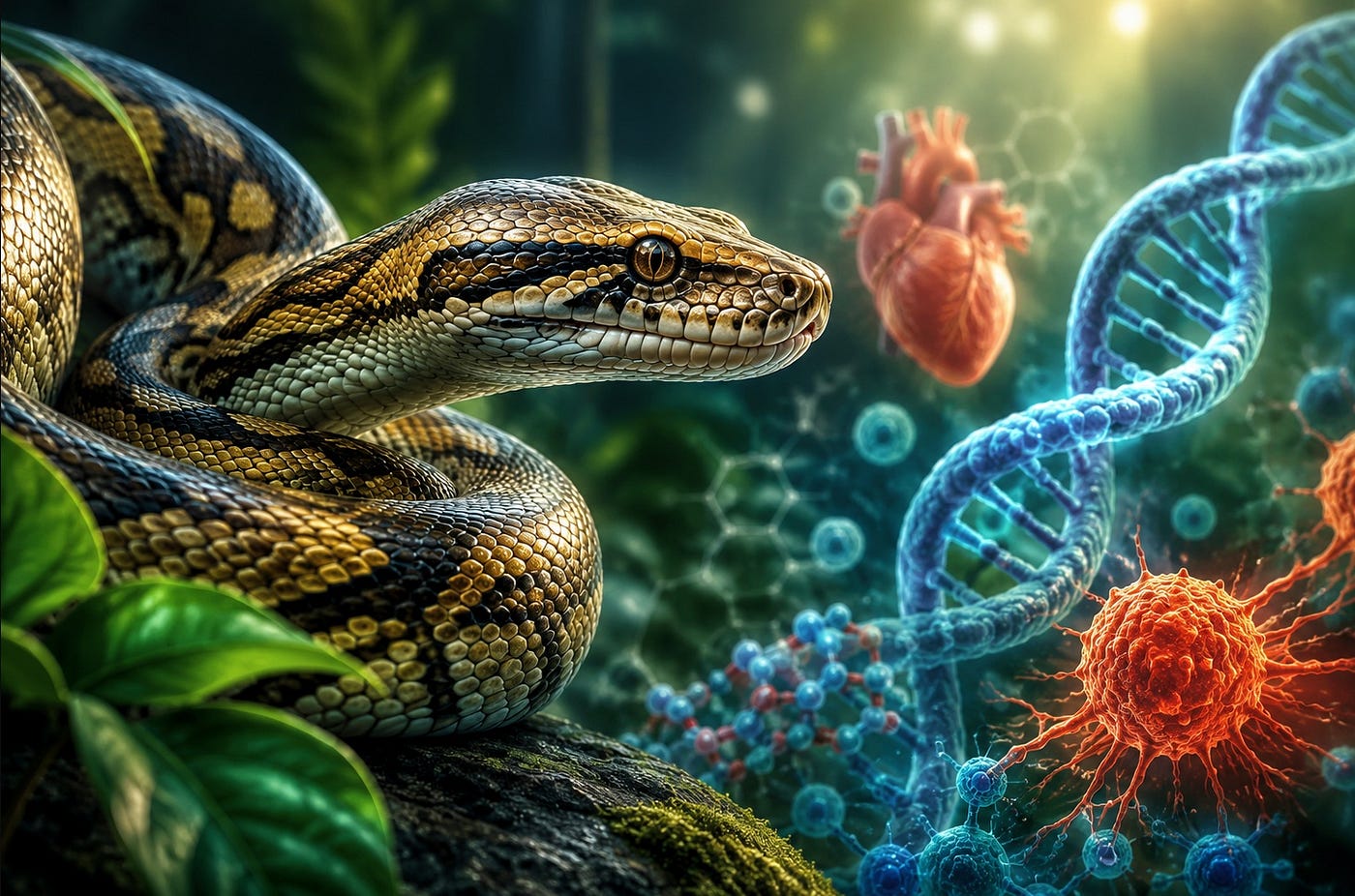
Imagine not eating for nearly a year. Now imagine losing almost none of your muscle during that entire time. That shouldn’t be possible. Yet pythons do it.
That single fact sent me down a rabbit hole I never expected. Before long, I realized this wasn’t really a story about giant snakes. It was a story about one of the biggest changes happening in medicine that almost nobody is talking about.
For generations, we’ve assumed medical progress meant inventing something entirely new. Increasingly, scientists are asking a very different question. What if evolution got there first?
Nature’s Greatest Research Laboratory
Every living species alive today represents millions of years of biological trial and error. Evolution has been running experiments far longer than humans have been practicing medicine. Every animal that survives carries solutions to problems that nature has already solved.
Nature wasn’t trying to invent medicine. It was simply trying to survive. Medicine is only now beginning to read the answers. For decades, scientists admired those adaptations. Now they’re beginning to study them for an entirely different reason. Some of them may help solve human disease.
Few animals have attracted more attention than the python.
Researchers at the University of Colorado Boulder and collaborating institutions have spent years studying these remarkable snakes because they routinely accomplish biological feats that human bodies simply can’t.
The Snake That Refuses to Lose Muscle
Here’s the part that amazed me. Some pythons can go months, sometimes nearly a year, without eating. If humans did that, we’d lose enormous amounts of muscle. We’d become weaker with every passing week.
The python somehow plays by different rules. When prey finally appears, it doesn’t stagger toward dinner. It explodes into action with incredible speed and crushing strength.
Scientists believe understanding how these snakes preserve muscle during prolonged fasting could someday help people suffering from age-related muscle loss or diseases that gradually rob the body of its strength.
The snake isn’t remarkable because it’s unusual. It’s remarkable because evolution may have already solved a problem medicine still hasn’t.
That’s when I started wondering how many other medical breakthroughs we’ve overlooked simply because we were looking in the wrong places.
Then I Learned Something Even Stranger
A python’s heart grows, but not over a period of years. It grows right after a meal. Digesting a massive animal requires an enormous amount of energy, so the snake’s heart enlarges to pump more blood throughout its body.
If you’ve ever known someone with heart disease, you know that enlarged hearts are usually bad news. Except not for pythons. Once digestion is complete, the heart gradually shrinks back to its original size without the permanent damage doctors often see in people.
Scientists are now studying the biological signals behind that process, hoping they may eventually lead to new ways of treating heart disease. Again, the hidden story isn’t the snake. It’s the possibility that nature already knows something we don’t.
And It Gets Stranger Still
I thought those discoveries were remarkable. Then I learned what happens to a python’s metabolism. It doesn’t simply increase after a meal. It skyrockets.
Researchers have found that a python’s metabolism can surge between ten and forty times its normal resting level while digesting food. Afterward, it quietly returns to normal as though nothing extraordinary happened.
Scientists aren’t fascinated because it’s bizarre. They’re fascinated because understanding how the snake safely manages these dramatic changes could eventually reveal new ways of thinking about human metabolism.
Sometimes progress doesn’t come from inventing something. More often it comes from asking why nature already does it better.
The Discovery Nobody Expected
Just when I thought the story couldn’t become any more surprising, it did. While studying python blood after feeding, researchers identified a naturally occurring molecule called pTOS. It increased nearly one thousand-fold.
When scientists tested the molecule in obese mice, the animals ate less and lost weight. It’s still early research, and years of testing lie ahead before anyone knows whether it could someday become a medicine for people.
But discoveries like this explain why scientists continue looking for answers in unexpected places. Sometimes evolution invents biological tools that humans never would have imagined.
Maybe We’ve Been Looking in the Wrong Places
The more I write stories like this, the more I notice the same pattern. We often imagine progress arriving as something brand new. revolutionary invention.
A miracle drug. A groundbreaking discovery. But sometimes progress doesn’t come from inventing something. Sometimes it comes from finally recognizing what nature has been doing successfully for millions of years.
Maybe that’s the hidden truth. Evolution wasn’t trying to cure heart disease. It wasn’t trying to prevent muscle loss. It wasn’t trying to create the next obesity treatment. It was simply solving the problems of survival.
Scientists are only now beginning to realize those solutions may have something to teach us. I think that’s one of the most fascinating shifts happening in medicine today. The next great medical breakthrough may not begin with a brand-new invention.
It may begin with a simple question. What if nature got there first?
메타데이터
- post_id
- 1a4185e97d12
- slug
- the-worlds-most-advanced-medical-research-may-be-hiding-inside-a-snake-1a4185e97d12
- url
- https://medium.com/bouncin-and-behavin-blogs/the-worlds-most-advanced-medical-research-may-be-hiding-inside-a-snake-1a4185e97d12
- canonical_url
- https://medium.com/bouncin-and-behavin-blogs/the-worlds-most-advanced-medical-research-may-be-hiding-inside-a-snake-1a4185e97d12
- author_url
- https://medium.com/@kelly.carmichael
- status
- ok
- fetched_at
- 2026-07-14 20:46:09