When Performance Metrics Suddenly Change: Panic or Investigate?
Every marketing or programmatic team has experienced the same situation. You open your dashboard in the morning and immediately notice that…
When Performance Metrics Suddenly Change: Panic or Investigate?
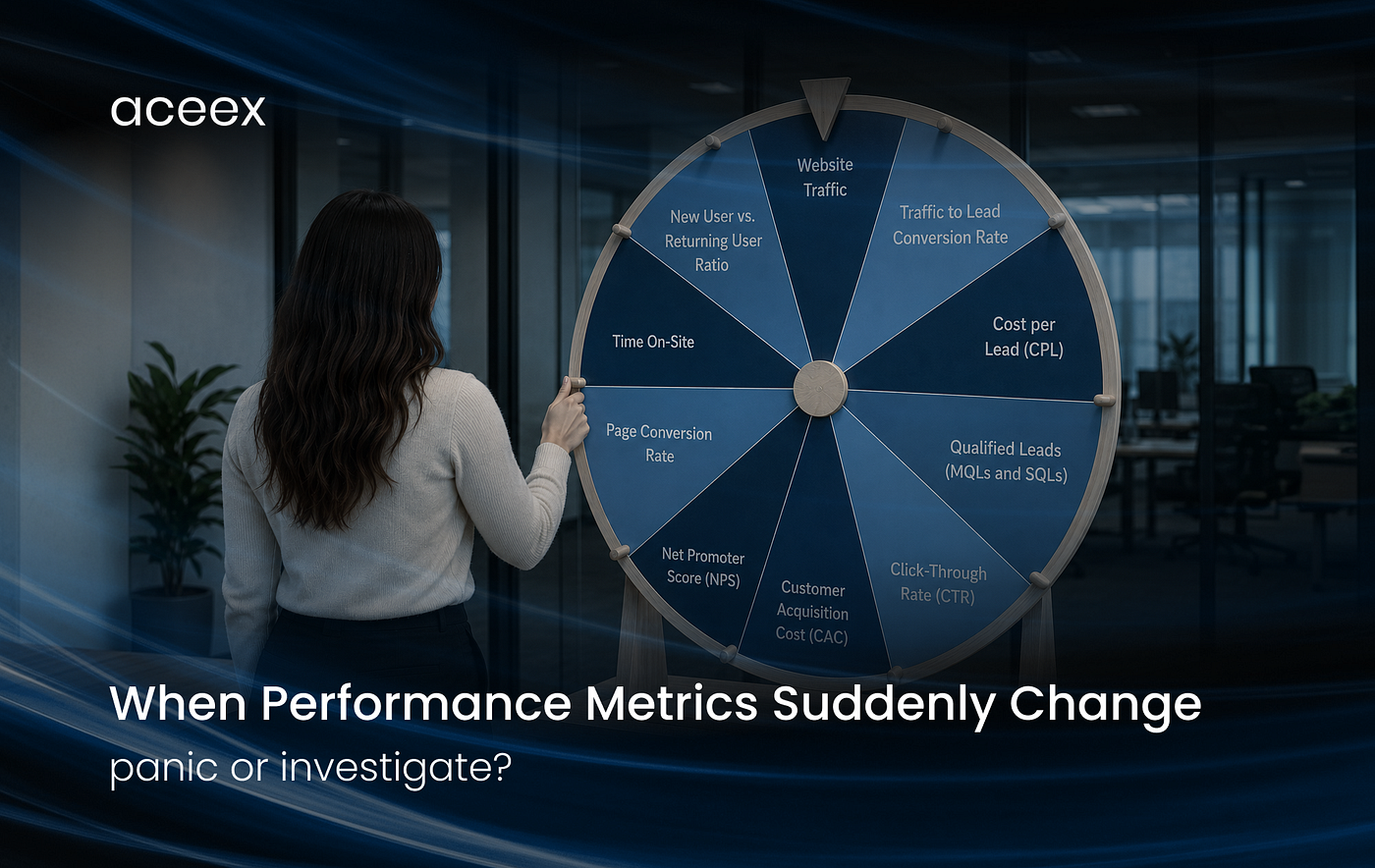
Every marketing or programmatic team has experienced the same situation. You open your dashboard in the morning and immediately notice that one of your key metrics has changed dramatically negative.
Or perhaps everything looks unusually positive: CTR is much higher than usual, conversions increase overnight and acquisition costs suddenly fall. The first instinct is almost always the same — someone starts looking for a problem, while someone else immediately begins suggesting optimizations.
In reality, this is often the wrong reaction.
One metric almost never tells the whole story. Advertising performance is an ecosystem where almost every KPI influences another one. Looking at a single number without understanding what changed around it often leads teams to optimize something that isn’t actually broken. The most experienced AdTech companies know that dashboards should trigger investigation before they trigger action.
A metric is only a signal, not a conclusion
One of the biggest misconceptions in digital advertising is believing that every KPI has a universal interpretation. A lower CTR is automatically considered bad. A higher CPL immediately raises concerns. An increase in website traffic is celebrated before anyone checks where that traffic actually came from.
But performance metrics don’t work like traffic lights where green always means “good” and red always means “bad.”
Imagine that your website traffic grows by 60% after launching a new campaign. At first glance, marketing appears successful. However, when you look deeper, you discover that the Traffic-to-Lead Conversion Rate has dropped significantly, qualified leads are decreasing, and sales teams report that most new inquiries don’t match the ideal customer profile. The campaign attracted more visitors, but not more business.
The opposite scenario happens just as often. Traffic decreases because targeting becomes more precise, yet conversion rate improves, lead quality increases, and Customer Acquisition Cost falls. Looking only at traffic would suggest declining performance, while the business itself is becoming more efficient.
This is why experienced performance teams rarely evaluate metrics independently. They look for relationships between them.
Website traffic should never be analyzed alone
Website traffic remains one of the most visible KPIs because it is easy to measure and easy to explain in reports. However, it is also one of the easiest metrics to misinterpret.
More visitors only create value if they represent the right audience. A campaign that brings 100,000 irrelevant users is usually far less successful than one attracting 20,000 highly qualified visitors. That is why traffic should always be evaluated together with Traffic-to-Lead Conversion Rate, Time on Site, and the number of Qualified Leads.
For example, if traffic suddenly increases while average session duration falls and almost nobody completes a contact form, the issue is probably not with the website itself. More likely, acquisition channels have started attracting users who were never likely to become customers.
Without looking beyond the traffic graph, that conclusion would never become obvious.
Cost per Lead becomes dangerous when viewed without context
Few metrics create more anxiety than Cost per Lead. Marketing teams naturally want CPL to decrease because lower acquisition costs appear to indicate greater efficiency.
Unfortunately, reality is usually more complicated.
Suppose your CPL increases by 25%, but Sales Qualified Leads grow at the same time and Customer Acquisition Cost actually decreases because sales close a much higher percentage of opportunities. From a marketing dashboard, performance seems worse. From a business perspective, performance has improved considerably.
The opposite situation can be even more misleading. Low-cost campaigns often generate impressive volumes of leads, but if those leads never progress beyond initial conversations, the business spends far more time and money processing opportunities that never become customers.
The purpose of lead generation is not producing leads. It is producing customers.
CTR is one of the most misunderstood metrics in digital advertising
CTR reacts almost instantly to creative changes, audience targeting and messaging adjustments, which makes it one of the first numbers marketers monitor.
But higher CTR doesn’t necessarily mean higher performance, at the same time clickbait headlines generate excellent CTR and poorly qualified audiences often click more frequently than decision-makers.
Highly targeted B2B campaigns frequently deliver relatively modest CTR while generating excellent commercial results because they reach the right people rather than simply encouraging curiosity.
This becomes particularly visible in programmatic advertising. Many optimization algorithms initially prioritize engagement signals, but experienced teams understand that clicks are only valuable when they eventually contribute to qualified business outcomes.
A campaign with slightly fewer clicks but significantly more qualified opportunities is usually performing much better than one producing impressive CTR alone.
Customer Acquisition Cost reveals problems that marketing dashboards often hide
Customer Acquisition Cost is perhaps the most comprehensive business metric because it reflects everything that happens after a visitor clicks an advertisement.
Marketing quality matters, sales efficiency matters, product positioning matters and even onboarding speed and operational processes influence CAC.
When Customer Acquisition Cost increases, companies often assume marketing campaigns require optimization. In reality, the cause may lie elsewhere. Longer procurement cycles, delayed technical integrations or slower sales qualification can all increase acquisition costs despite advertising performance remaining stable.
This is why CAC should never be treated as purely a marketing KPI. It measures the efficiency of the entire commercial system.
Performance metrics rarely fail one by one
Perhaps the most valuable habit performance teams develop is learning to investigate patterns instead of individual numbers.
A sudden drop in CTR accompanied by higher conversion rates may indicate that targeting has become more accurate. A rising CPL together with stronger lead quality may actually improve profitability. Lower website traffic combined with better engagement often reflects healthier audience acquisition.
By contrast, when several metrics begin deteriorating simultaneously — traffic declines, conversion rates fall, qualified leads decrease, and CAC increases — the probability of a genuine operational problem becomes much higher.
The difference between experienced teams and inexperienced ones is rarely their ability to read dashboards. It is their ability to understand the relationships between the numbers.
Investigation should always come before optimization
The advertising ecosystem changes constantly. Browser updates, auction dynamics, seasonality, competitor activity, creative fatigue, privacy requirements and user behaviour all influence performance metrics. Expecting dashboards to remain perfectly stable is unrealistic.
Instead of asking, “Which metric should we fix?”, stronger teams ask a different question:
“What changed in the system that produced this result?”
That shift in thinking often prevents weeks of unnecessary optimization work. Performance is not about making every graph move upward at all times. It is about understanding which changes are natural, which ones create opportunities, and which ones genuinely require intervention.
The best AdTech companies do not panic when numbers change. They investigate first, identify the real cause, and only then decide whether optimization is necessary. In a market where almost every metric fluctuates every day, that ability to distinguish normal variation from meaningful signals has become one of the strongest competitive advantages a performance team can have.
메타데이터
- post_id
- 1a5f48640227
- slug
- when-performance-metrics-suddenly-change-panic-or-investigate-1a5f48640227
- url
- https://medium.com/@aceex/when-performance-metrics-suddenly-change-panic-or-investigate-1a5f48640227
- canonical_url
- https://medium.com/@aceex/when-performance-metrics-suddenly-change-panic-or-investigate-1a5f48640227
- author_url
- https://medium.com/@aceex
- status
- ok
- fetched_at
- 2026-07-14 02:47:01