The Hierarchical Architecture of the Palindromic Geopolitical Theory: A Multi-Layer Analytical…
✍️ Apolítik0. Creator of the Palindromic Geopolitical Theory (PGT)
The Hierarchical Architecture of the Palindromic Geopolitical Theory: A Multi-Layer Analytical Framework
Apply the PAL-8 template and anticipate the system — access here: ∞ → PAL-8 Basic Template ← ∞ Identify Region, Resources, Routes, and Networks in seconds
✍️ Apolítik0. Creator of the Palindromic Geopolitical Theory (PGT)
∞ → ← ∞
A methodological formalization derived from comparative empirical analysis
Introduction — The Need to Structure the Model
In the conceptual evolution of the Palindromic Geopolitical Theory (PGT), the systematic analysis of empirical cases has revealed the need to more precisely define the internal organization of its analytical components. Although the structural axes and variables of power had previously been established, comparative practice demonstrated that not all elements operate at the same functional level or share the same causal nature.
This formalization does not emerge as an autonomous theoretical expansion, but rather as a result of applying the model to real-world scenarios. Across different analytical contexts, it became evident that clearly distinguishing between structure, operational configuration, contextual causality, and observable systemic manifestations is methodologically necessary.
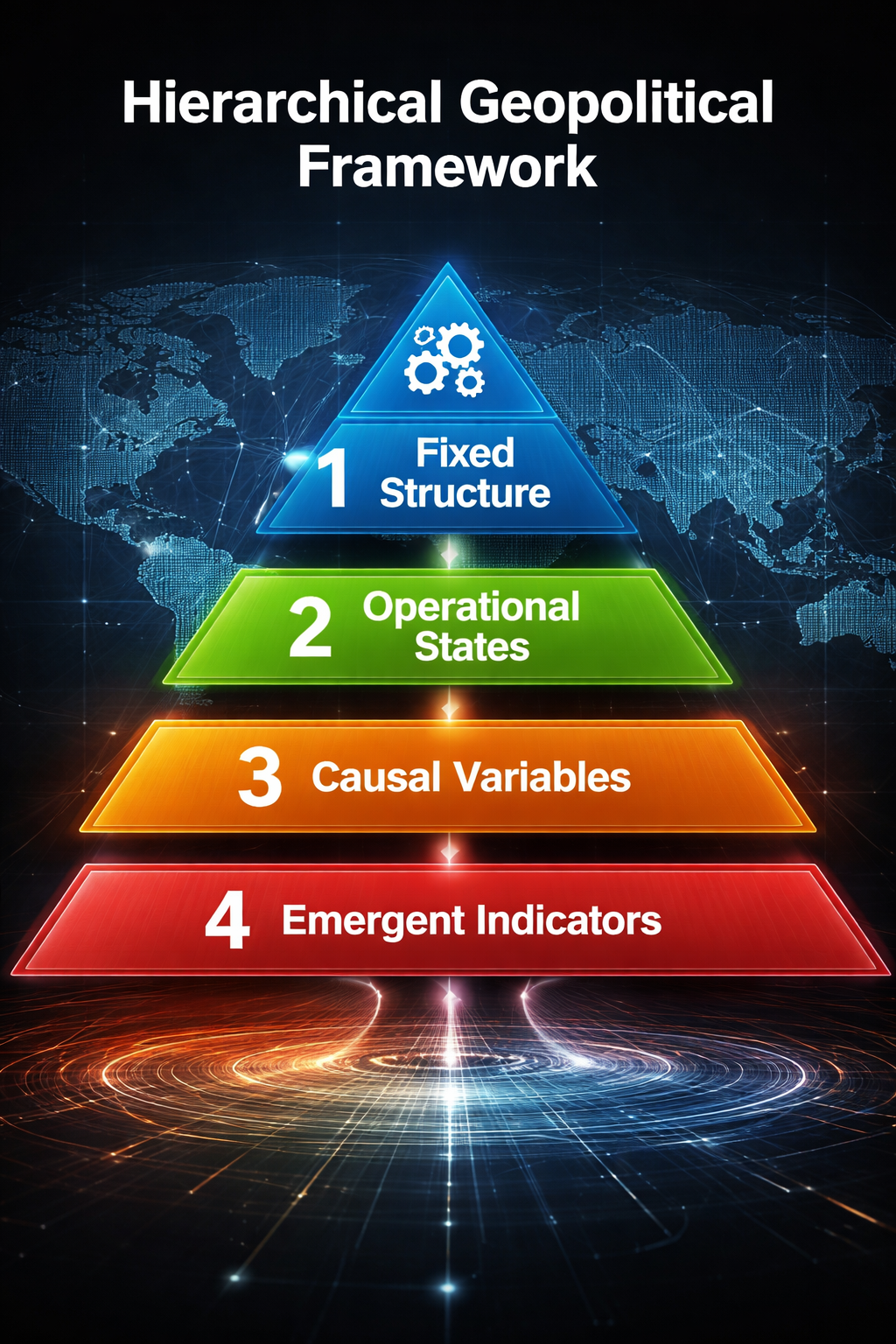
To avoid conceptual ambiguity and strengthen the model’s internal coherence, this article proposes a four-level hierarchical architecture: fixed structure, operational states, contextual causal variables, and observable emergent indicators. This differentiation does not redefine the core of PGT; instead, it organizes it to enhance empirical applicability and epistemological consistency.
∞ → ← ∞
Level 1 — Fixed Structure (System Ontology)
The first level corresponds to the ontological structure of the system: the ERE Axes of Power (Region, Resources, Routes, and Networks). These are not contingent variables but permanent structural dimensions within which strategic competition unfolds.
The structure does not change from case to case; what varies is the degree of control, influence, or appropriation of these axes by different actors. The “fixed” character refers to the permanence of the analytical categories themselves, not to the empirical invariability of their material or technological configurations.
In every geopolitical configuration, strategic interaction necessarily occurs within these dimensions.
∞ → ← ∞
Level 2 — Operational States (Dynamic Configuration)
The second level is composed of operational states, understood as dynamic configurations that describe how actors interact across the structural axes.
Defense, appropriation, saturation, reconfiguration, latency, and stabilization do not constitute causes in themselves, but rather modes of system functioning at a given moment. These states are reversible and can transition between one another depending on contextual conditions.
These states represent recurrent operational configurations of the system and are not necessarily exhaustive. Not every transition between states constitutes a complete palindromic cycle. The cycle represents a specific pattern of reversibility that emerges when strategic control over the structural axes is altered.
Within this framework, operational states constitute the space within which such a pattern can manifest. Vectors of power — defense, appropriation, and reversibility — do not form part of the structural hierarchy, but instead express the direction of power movement within this dynamic space.
Consequently, operational states do not constitute the palindromic cycle. Rather, they represent the set of possible system configurations within which the cycle may — but does not necessarily — emerge as a specific pattern of directional transition of power.
While states describe system configurations, vectors express directionality, and the palindromic cycle constitutes the organization of that directionality.
∞ → ← ∞
Level 3 — Contextual Causal Variables
The third level consists of contextual causal variables such as energy, cohesion, technology, legitimacy, logistics, or mobilization capacity.
These variables function as factors influencing the ability of actors to modify, sustain, or transform operational states over the structural axes. They are contingent, comparable across cases, and susceptible to qualitative or quantitative assessment.
Not all variables carry equal weight in every scenario. Some operate as direct drivers of operational transitions; others modulate strategic effectiveness. Their relative impact depends on context and timing.
∞ → ← ∞
Level 4 — Observable Emergent Indicators
The fourth level consists of observable emergent indicators such as friction, resilience, strategic elasticity, attrition, or dominance.
These do not constitute causes or states, but systemic manifestations derived from the structured interaction between the axes (Level 1), operational states (Level 2), and causal variables (Level 3). They are not directly activated; rather, they emerge as cumulative expressions of tensions, equilibria, or imbalances within the system.
Indicators function as empirical observation points of structural dynamics, through which variables can be inferred, allowing the identification of configurations, levels of tension, and potential transitions between operational states.
Within these indicators, a distinction can be made between descriptive indicators and trigger indicators. The former reflect the state of the system, revealing levels of tension, equilibrium, or structural imbalance. The latter function as observable signals that may precede, accompany, or indicate transitions between operational states.
In this sense, trigger indicators do not constitute direct causes, but empirically detectable inflection points that allow anticipation of potential changes in the system’s dynamic configuration.
Distinguishing between causal variables and emergent indicators, as well as between descriptive and trigger indicators, preserves the hierarchical coherence of the model and avoids confusion between causes, states, and manifestations.
∞ → ← ∞
Postulate: Structural–Empirical Correspondence in the TGP
Within the hierarchical architecture of the Palindromic Geopolitical Theory, variables constitute structural dimensions that are not directly observable, while indicators represent their observable empirical manifestations.
The relationship between these levels is inferential: indicators do not explain the system by themselves, but reveal underlying structural configurations. Consequently, the interpretation of geopolitical behavior should not focus on observable events per se, but on the structures those events express.
This principle ensures coherence between the theoretical architecture and its empirical application, avoiding confusion between causes, states, and manifestations, and preserving the analytical integrity of the model.
∞ → ← ∞
Methodological Proposition 2: Thresholds and Phase Transitions
Within the Palindromic Geopolitical Theory, variations in indicators are not analytically neutral, but reflect changes in the intensity of structural tensions within the system.
When the accumulation or combination of indicators reaches certain critical levels — defined as thresholds — the system tends to transition between operational states (equilibrium, tension, transition, rupture, and reconfiguration).
These thresholds are neither universal nor fixed, but context-dependent, shaped by the geopolitical configuration of the ERE axes and the interaction between actors. However, their identification allows the recognition of inflection points in the system’s dynamics.
Within this framework, trigger indicators acquire analytical relevance, as they function as empirical signals of proximity to such thresholds, enabling anticipation of potential phase transitions without assuming linear or deterministic causality.
∞ → ← ∞
Analytical Delimitation: Structure vs. Dynamics
The hierarchical architecture of the Palindromic Geopolitical Theory (PGT) defines the structural components of power — namely the ERE axes, variables, and indicators. However, not all analytical elements of the theory belong to this hierarchy.
Vectors of power — understood as defense, appropriation, and reversibility — do not constitute an additional structural layer. Instead, they belong to the palindromic cycle and represent the directional dynamics through which power operates across the ERE axes.
This distinction is critical: while the architecture explains what composes the system, the cycle explains how power moves within it. Confusing vectors with variables or structural elements would imply conflating direction with instrument, thereby undermining the analytical clarity of the model.
∞ → ← ∞
Example of Model Operationalization (Axis-Level)
The following structure illustrates, in a simplified manner, the operationalization of the model within a specific axis:
Axis: Routes
Key variables: – Flow – Security – Logistical capacity
Descriptive indicators: – Continuity of transit – Level of congestion
Trigger indicators: – Interruption of passage – Attack on infrastructure
Operational state: – Disruption / Reconfiguration
PGT reading: Alterations in critical variables affecting the Routes axis may generate indicators of tension which, upon reaching certain thresholds, act as trigger signals for transitions between operational states.
∞ → ← ∞
Operational Interaction Logic
The hierarchical architecture of the PGT is not merely a classification of levels, but a dynamic system of interaction.
Causal variables (Level 3) influence the configuration of operational states (Level 2) within structural axes (Level 1). The interaction among these levels generates observable manifestations (Level 4), enabling the identification of tensions, transitions, and stabilizations within the system.
In this sense:
– Variables drive or modulate change – States configure system behavior – Indicators reveal systemic effects
This logic allows the translation of theoretical structure into an observable and applicable analytical process.
∞ → ← ∞
Relationship with the Palindromic Cycle
The formalization of this hierarchical architecture does not replace the palindromic cycle; it situates it structurally.
The cycle represents a dynamic pattern of reversibility that may manifest at the level of operational states when control over structural axes shifts.
In this sense:
– The architecture organizes the system – The cycle dynamizes its behavior
Both operate at distinct yet complementary analytical levels.
∞ → ← ∞
Methodological Implications and Projection
The introduction of a multi-layer architecture strengthens the PGT in four fundamental dimensions:
– It clarifies levels of analysis – It differentiates cause, state, and manifestation – It improves comparability across cases – It reinforces falsifiability by distinguishing what is measurable from what is observable
This structuring does not expand the model, but operationally stabilizes its internal architecture. The PGT does not become a rigid scheme, but an organized analytical system that clearly distinguishes structural ontology, operational dynamics, contextual causality, and systemic emergence.
By establishing this differentiation, the theory becomes better equipped to address complex systemic behavior, including nonlinearity, strategic thresholds, and reversible transitions between operational states.
This formalization constitutes the structural foundation upon which empirical analysis can be rigorously developed. It does not represent an expansion of the theory, but a consolidation of its internal architecture prior to systematic validation.
Ultimately, this refinement is itself an indicator that the analytical laboratory is functioning: when empirical application demands greater conceptual precision, the model responds by organizing its own internal levels.
∞ → ← ∞
Operational Matrix of the PGT
To translate the hierarchical architecture into an applicable analytical tool, the PGT can be expressed through an operational matrix that organizes the relationship between structural axes, variables, indicators, operational states, and phases of the palindromic cycle.
This matrix does not constitute a closed quantitative model, but rather an analytical device that structures observation, comparison, and interpretation across different strategic contexts.
Operational Structure by Axis
For each axis of power (ERE), analysis can be structured as follows:
Axis: [Region / Resources / Routes / Networks]
Key variables: – [Factors affecting the axis]
Observable indicators: – [System manifestations]
Operational state: – [Current dynamic configuration]
Palindromic phase: – Defense – Appropriation – Transition – Reconfiguration – Reversibility
Rupture is not considered an autonomous phase within the matrix, but a possible trigger indicator that may manifest within processes of transition between operational states. In this sense, it operates as a condition or event that can accelerate, reveal, or trigger changes in the system’s dynamic configuration, without replacing the processual logic of the palindromic cycle.
∞ → ← ∞
Logic of the Matrix
The operational matrix articulates the different levels of the model into a coherent analytical sequence:
– Variables influence actors’ capabilities – Indicators reveal system behavior – Operational states describe dynamic configurations – Palindromic phases situate the system within cycles of power transformation
This articulation allows not only the description of the system, but also the identification of transition patterns, detection of inflection points, and anticipation of structural reversibility.
∞ → ← ∞
Analytical Function
The operational matrix fulfills three primary functions:
– Structuring analysis – Enabling comparability across cases – Supporting projection of potential transitions
∞ → ← ∞
Methodological Scope and Projection
This formalization focuses on the structural and operational organization of the model. The translation of its components into quantitative metrics is not addressed at this stage, as it requires progressive development grounded in systematic empirical application.
In this sense, the quantification of variables, indicators, and operational transitions is conceived as a subsequent line of refinement, aimed at strengthening the model’s comparative and predictive capacity.
The matrix does not replace strategic interpretation; rather, it guides it. Its function is to reduce analytical ambiguity and provide a structured framework for interpreting power dynamics.
In this regard, the operational matrix represents the interface between the theoretical architecture of the PGT and its empirical application.
∞ → ← ∞
∞ → Based on the Palindromic Geopolitical Theory (PGT), created by Apolítik0. All rights reserved.
✍️ Apolítik0
📖 Discover the full vision in the book: Amazon — Palindromic Geopolitical Theory (PGT) ← ∞
∞ → The Balance decide ← ∞
∞ → ← ∞
The translation of its components into quantitative metrics is not addressed at this stage, as it requires progressive development grounded in systematic empirical application. In this sense, the quantification of variables, indicators, and operational transitions is conceived as a subsequent line of refinement, aimed at strengthening the model’s comparative and predictive capacity.
∞ → ← ∞
This article provides a structured operational framework that translates the Palindromic Geopolitical Theory (PGT) into an analytically applicable system. By organizing its internal hierarchy and clarifying the interaction between structure, dynamics, causality, and emergence, the model establishes a coherent foundation for systematic empirical analysis and future quantitative development.
∞ → ← ∞
Update Note
This article has been refined as part of the progressive development of the Palindromic Geopolitical Theory (PGT). Subsequent conceptual adjustments have clarified elements of the analytical architecture and its operationalization without altering the structural core of the model. These refinements result from ongoing empirical application and the methodological consolidation of the theory.
Conceptual Clarification Note
In subsequent developments of the PGT, the concept of “rupture” has been more precisely reinterpreted. Rather than constituting an autonomous phase of the palindromic cycle, rupture can be understood as a trigger indicator within processes of transition between operational states. In this sense, it acts as a condition or event that may accelerate, reveal, or trigger changes in the system’s dynamic configuration, without replacing the processual logic of the cycle.
∞ → ← ∞
**This article is also available in Spanish on my Substack**
**Arquitectura Jerárquica de la Teoría Geopolítica del Palíndromo: Un Marco Analítico Multinivel**
∞⟷∞
Official Prompt PAL-8 | PGT
Apply the PAL-8 Protocol of the Palindromic Geopolitical Theory (PGT) to the following case: -CASE-
Develop the analysis according to the following sequence:
- Identification of the strategic node
- Power axes involved (Region, Resources, Routes, and Networks — ERE)
- Actors and capabilities
- Systemic pressure
- Friction or emerging disequilibrium
- Dynamics of control or dispute
- Risk of rupture or escalation
- Prospective scenario of reversibility or stabilization
Maintain a structural, strategic, and replicable approach.
Avoid descriptive or journalistic analysis.
Prioritize systemic logic, power relations, and patterns of strategic reversibility.
메타데이터
- post_id
- 1a805bb3724c
- slug
- the-hierarchical-architecture-of-the-palindromic-geopolitical-theory-a-multi-layer-analytical-1a805bb3724c
- url
- https://medium.com/palindromic-geopolitical-theory/the-hierarchical-architecture-of-the-palindromic-geopolitical-theory-a-multi-layer-analytical-1a805bb3724c
- canonical_url
- https://medium.com/palindromic-geopolitical-theory/the-hierarchical-architecture-of-the-palindromic-geopolitical-theory-a-multi-layer-analytical-1a805bb3724c
- author_url
- https://medium.com/@apolitik0
- status
- ok
- fetched_at
- 2026-06-15 20:49:13