The Future Team May Not Have Dedicated Leads Anymore
AI won’t just reduce coding effort. It may fundamentally change why teams, leadership layers, and dedicated ownership structures exist in…
The Future Team May Not Have Dedicated Leads Anymore
AI won’t just reduce coding effort. It may fundamentally change why teams, leadership layers, and dedicated ownership structures exist in the first place.
In case you don’t have a paid Medium account, you can read it here.
A question has been bothering me lately.
Not: “Will AI replace developers?”
That debate has already become LinkedIn’s version of “Is pineapple allowed on pizza?”
The more interesting question is:
“If AI genuinely delivers the productivity jump everyone is promising… are organizations even ready for what happens next?”
Because I’ve been asking many business leaders a very simple question:
“If your teams suddenly become 2x or 3x more productive… what is the next set of backlog items ready to go? Are your customers ready for the features dropping at this fast pace?”
Most answers are: “We haven’t thought about that yet.”
And honestly, that response is more dangerous than people realize.
Because organizations today are mostly using AI to accelerate coding, generate test cases, automate documentation, summarize meetings, create user stories nobody will read fully anyway, etc.
All low-hanging fruit! All focused on areas of the SDLC that take up 40% of the overall lifecycle. But the rest of the system?
Still slow, layered, approval-driven, and waiting for business signoffs, architecture reviews, governance checkpoints, funding approvals, steering committee blessings, and occasionally Mercury retrograde to end before a decision is made
Which means we are once again optimizing one layer while ignoring the overall system.
Exactly what happened during Agile transformations.
Teams started shipping every sprint. Customers still received value once or twice a year.
Now AI risks becoming: “Agile theater with GPUs.”
And if AI truly compresses engineering effort significantly, one uncomfortable reality emerges very quickly:
We may no longer need leadership structures designed around large teams.
Especially dedicated leads for every single team. That’s the real debate nobody wants to have.
The future may not have “Team Leads” the way we know them today
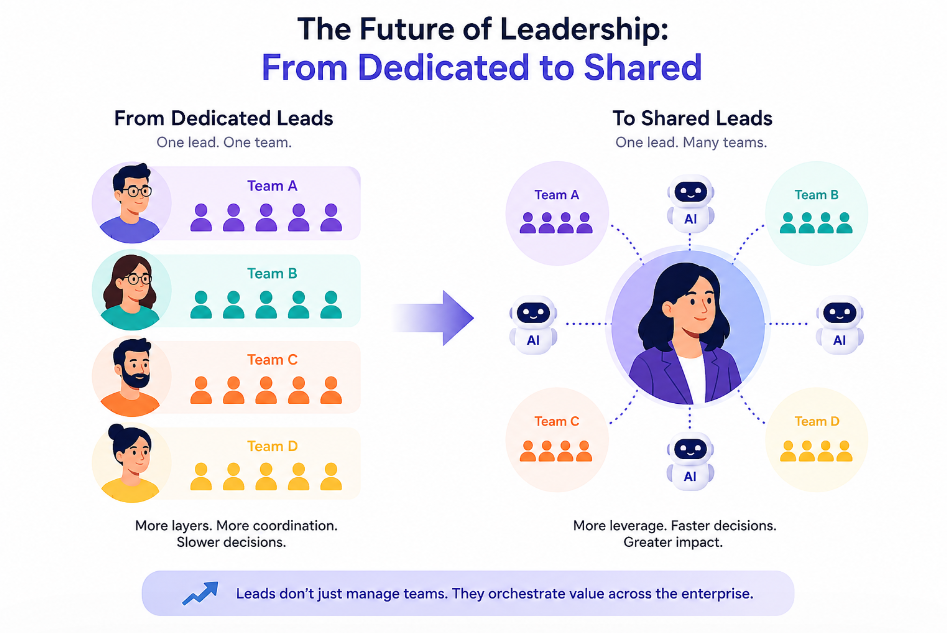
Today, most enterprises operate with fixed ownership models:
- Team A has Lead A
- Team B has Lead B
- Team C has Lead C
Every team gets:
- a hierarchy
- a reporting structure
- coordination layers
- status tracking layers
- delivery management layers
Because historically, managing delivery required a lot of operational coordination.
But AI changes leverage. A smaller AI-enabled team may soon deliver what previously required:
- multiple scrum teams
- several leads
- large testing groups
- PMO coordination
- manual dependency management
Which naturally raises the question:
Why would organizations continue maintaining dedicated leads for every small execution pod?
The future may look very different.
Instead of: “one lead per team”
We may move toward: “one strong lead across multiple AI-assisted teams.”
Shared leads. Not because organizations want cost-cutting headlines. But because the nature of leadership itself changes.
Shared leads are probably inevitable
This is the part many people are underestimating.
Today, a significant portion of lead responsibilities involves:
- coordination
- tracking
- follow-ups
- status reporting
- dependency handling
- effort management
- sprint operations
AI aggressively compresses all of that. So what remains valuable? Not operational supervision.
Contextual leadership.
A strong lead in the future may:
- guide multiple product areas
- support different business units
- move dynamically across teams
- focus on bottlenecks instead of ownership boundaries
- operate more like a systems orchestrator than a team supervisor
In many ways, future leads may resemble:
- enterprise architects
- product strategists
- internal consultants
- value stream coaches
More than traditional “delivery leads.” And honestly, it’s not new. We already see early versions of this today.
The best architects already operate across multiple teams. Strong product people already influence multiple streams. Great agile coaches already unblock entire organizations instead of managing one squad.
AI simply accelerates this operating model.
The uncomfortable truth: many leads are optimized for a world that is disappearing
This sounds harsh. But leadership roles must evolve faster than execution roles. Because AI reduces coordination overhead first. Not strategic thinking.
If someone’s primary value comes from:
- asking for updates
- running meetings
- tracking Jira tickets
- escalating blockers
- preparing reports
- monitoring sprint progress
AI will increasingly eat large parts of that work, which means leads must evolve upward. Very Fast.
The future lead is not: “manager of tasks.”
The future lead is:
- Manager of context
- Orchestrator of decisions
- Optimizer of flow
- Translator between business and technology
- Curator of AI-human collaboration
The shift is massive. And honestly, many organizations are not preparing leads for it at all.
The biggest change is not skillset. It is a mental model.
This is where the real transformation sits.
Most discussions around future skills become generic: “Learn AI.” “Understand prompts.” “Use tools.”
That’s surface-level thinking. The actual shift required is much deeper. The future leader cannot think only at the team level anymore. They must think at the system level.
Earlier, many leads optimized:
- sprint success
- team velocity
- local delivery
- execution tracking
Future leads must optimize:
- enterprise flow
- customer value movement
- business responsiveness
- architecture sustainability
- AI leverage across systems
- organizational throughput
That changes how they look at everything.
Future-ready leads think differently
1. They stop thinking in “my team”
This is the biggest shift.
Traditional leads think — my developers, my testers, my backlog, my sprint, my metrics
Future leads must think:
- overall value stream
- enterprise bottlenecks
- reusable capabilities
- cross-team leverage
- shared execution models
The question changes from: “How do I optimize my team?”
To: “How do I improve the system?”
Huge difference.
2. They understand business deeply, not just delivery
Many delivery leads today still operate one level away from actual business outcomes.
That model becomes risky.
Because when AI compresses execution effort, business understanding becomes disproportionately valuable.
Future leads need to understand:
- how the company makes money
- where margins exist
- what customers truly care about
- which processes create friction
- where delays destroy value
- which capabilities differentiate the business
Otherwise they simply become faster task coordinators. And faster coordination is not transformation.
3. They start thinking architecturally
This is critical.
As teams shrink and become more AI-leveraged, architectural mistakes become even more costly. Future leads need architectural thinking even if they are not architects.
Not low-level coding depth necessarily, but system-level understanding:
- how platforms connect
- data flow implications
- integration complexity
- technical debt impact
- scalability tradeoffs
- reuse opportunities
- AI workflow integration points
Why?
Because shared leads cannot survive by operating only at ticket level. They must operate at the capability level.
4. They think in leverage, not utilization
Traditional management asks: “How busy is the team?”
Future leadership asks: “What creates disproportionate value?”
That changes behavior completely.
Sometimes the best decision is to reduce meetings, eliminate approvals or automate coordination.
This line alone will send shivers down the spine of many managers, but it’s something everyone must think and plan for.
The future lead optimizes organizational energy. Not resource occupancy.
5. They become comfortable leading without control
This may be the hardest adjustment.
Shared leadership models mean:
- teams may not fully report to you
- priorities may continuously shift
- AI agents may execute autonomously
- decisions may happen faster than traditional governance cycles
The future lead succeeds NOT through hierarchy but through:
- influence
- clarity
- systems thinking
- trust building
- context sharing
And many enterprises still train leaders almost entirely through hierarchy.
So how do organizations actually make shared-lead models work?
This is where the conversation becomes practical.
Because shared leadership cannot work by simply saying: “One lead now manages four teams. Good luck.”
That’s not transformation. That’s burnout with AI branding.
The organizations moving in the right direction are doing a few things differently.
1. They reduce operational noise aggressively
Shared leads cannot survive in meeting-heavy environments.
If leads still spend entire days:
- chasing updates
- preparing decks
- manually coordinating
- attending status calls
The model collapses immediately.
Organizations need:
- transparent systems
- real-time visibility
- AI-assisted reporting
- autonomous workflows
- fewer approval layers
Otherwise shared leadership simply becomes shared exhaustion.
2. They redesign teams around capabilities, not silos
This is important.
Traditional structures optimize ownership boundaries. Future structures optimize flow.
Instead of: “this lead owns this team permanently.”
Organizations will increasingly move toward:
- floating expertise
- dynamic leadership allocation
- temporary capability-based ownership
- cross-functional orchestration
The lead becomes a high-value shared capability. Almost like how elite architects or transformation leaders operate today.
3. They intentionally grow business-oriented leads
Many organizations still promote leads primarily based on execution strength. That is no longer enough.
Future-ready leads need exposure to:
- customer conversations
- business strategy
- financial thinking
- product discussions
- enterprise architecture
- operational models
Because the future lead must connect business intent to AI-enabled execution rapidly. That requires much broader thinking.
4. They normalize AI-human hybrid operating models
This is critical. Organizations must stop pretending AI is just another tool.
AI changes team economics, which means:
- ownership models change
- coordination models change
- decision loops change
- leadership spans change
The sooner organizations accept this, the more effectively they can redesign intentionally rather than react painfully later.
Final thought
I genuinely believe one of the biggest organizational shifts ahead is not: “developers using AI.”
It is: “leadership structures becoming fundamentally different.”
The future may not need:
- one dedicated lead per team
- multiple coordination layers
- large operational hierarchies
Instead, organizations may move toward:
- smaller AI-leveraged teams
- shared leadership capability
- cross-team orchestration
- high-context decision makers
- system-level thinking
And the leads who thrive in that future will not be the ones best at managing tasks.
They will be the ones best at understanding the business, navigating complexity, and improving the overall system.
Everyone else may still be running sprint ceremonies for teams that no longer need them.
메타데이터
- post_id
- 1a8e6afcdebd
- slug
- the-future-team-may-not-have-dedicated-leads-anymore-1a8e6afcdebd
- url
- https://medium.com/@satynath/the-future-team-may-not-have-dedicated-leads-anymore-1a8e6afcdebd
- canonical_url
- https://medium.com/@satynath/the-future-team-may-not-have-dedicated-leads-anymore-1a8e6afcdebd
- author_url
- https://medium.com/@satynath
- status
- ok
- fetched_at
- 2026-06-27 07:40:21