Essential Tremor: Causes, Symptoms, and Advanced Treatment Options in Istanbul
Essential tremor is the most common movement disorder in the world — and one of the most treatable. For patients whose shaking has…
Essential Tremor: Causes, Symptoms, and Advanced Treatment Options in Istanbul
Essential tremor is the most common movement disorder in the world — and one of the most treatable. For patients whose shaking has progressed beyond what medication can manage, precision Deep Brain Stimulation (DBS) surgery in Istanbul, Turkey offers outcomes that consistently exceed published medical benchmarks, with over 90% average improvement in tremor severity.
This guide walks you through everything you need to know: what essential tremor is, why it happens, how it is diagnosed, and what advanced treatment — including DBS surgery performed by Prof. Atilla YILMAZ, M.D. at Ataşehir Medicana International Hospital — can realistically achieve for you.
Is Essential Tremor the Same as Parkinson’s Disease?

No. Essential tremor and Parkinson’s disease are distinct neurological conditions, though both involve shaking. The most reliable way to tell them apart is by observing when the tremor occurs.
- Essential tremor is an action tremor — it appears during deliberate movement, such as reaching for a glass, writing, or holding a position against gravity. It typically quiets when the limb is fully at rest.
- Parkinson’s tremor is predominantly a resting tremor — the hand shakes when completely relaxed and often decreases during intentional movement.
Parkinson’s disease also tends to present with rigidity, slowness of movement, and changes in gait — features that are generally absent in essential tremor. Because the two conditions are frequently confused, and because their treatment paths are fundamentally different, evaluation by a movement disorder specialist is essential before any treatment plan is established.
What Is Essential Tremor?

Essential tremor is a progressive neurological condition that causes involuntary, rhythmic shaking. It is not anxiety, not a normal sign of aging, and not a side effect of another disease. The word “essential” in the name indicates that the tremor is the primary condition — not a symptom of something else.
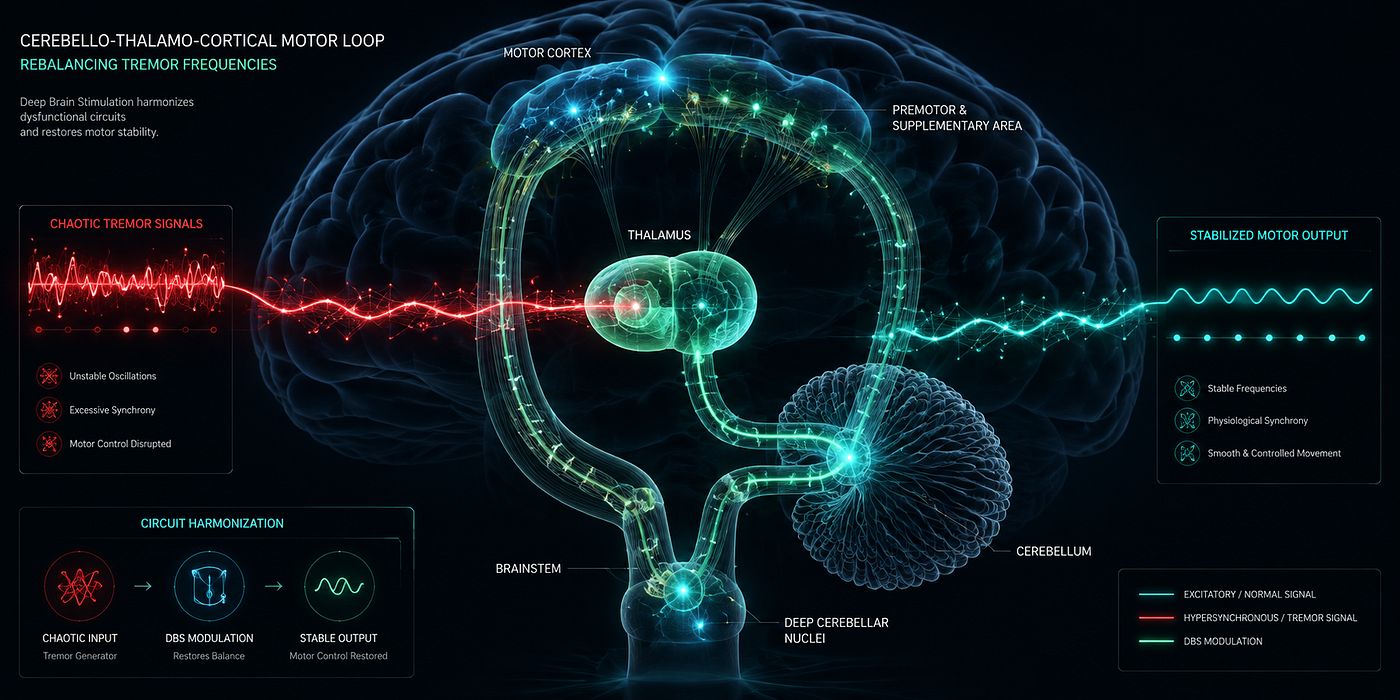
The shaking originates in disrupted communication between key brain structures: the cerebellum, the thalamus, and the brainstem — the circuit responsible for coordinating smooth, precise movement. When these pathways misfire, the result is the characteristic rhythmic tremor that interferes with everyday tasks.
Unlike physiological tremor — the faint, invisible muscle activity that every healthy person has — essential tremor is larger, more persistent, and directly tied to intentional movement. It does not resolve with rest or reassurance. Left untreated, it typically progresses.
What Causes Essential Tremor?

Essential tremor is primarily caused by abnormal brain signaling, with genetics playing a significant role in many cases.
Familial Tremor: The Genetic Connection
Essential tremor frequently runs in families. If a parent has the condition, their child carries a meaningfully elevated risk of developing it as well. When this pattern is present, physicians refer to it as familial tremor. This genetic link helps explain why the tremor appeared — and signals that other family members may benefit from monitoring their own symptoms over time.
Idiopathic Cases: When No Family History Exists
Not every case has a clear genetic explanation. In a meaningful proportion of patients, essential tremor appears without any known family history. These idiopathic cases share the same symptoms, progression pattern, and treatment responses as familial cases. The absence of a known genetic cause does not change the condition or its treatability.
Recognizing the Symptoms of Essential Tremor

Essential tremor most commonly begins in the hands and arms, then may progress to affect the head and voice. Recognizing the specific symptom pattern matters — both for seeking an accurate diagnosis and for identifying when symptoms have progressed to the point where advanced intervention becomes the right next step.
Hand and Arm Tremor
The hands and arms are almost always the starting point. The shaking appears during deliberate movement — reaching for a glass, pouring liquid, using utensils, or writing — rather than when the limb is at rest. For many patients, the dominant hand is affected first, making tasks like signing documents, using a phone, or handling small objects particularly challenging.
Head Tremor
As essential tremor progresses, many patients develop visible head tremor — typically a rhythmic horizontal movement resembling a repetitive “no” motion, though a vertical “yes” motion is also possible. Head tremor is highly visible and frequently causes significant self-consciousness and social withdrawal, even in patients who have otherwise adapted to their hand tremor.
Voice Tremor
When essential tremor involves the vocal cords, the voice takes on a shaky, quivering, or strained quality during speech. Voice tremor makes ordinary conversation feel exhausting and unpredictable, and it contributes substantially to the social isolation that many essential tremor patients quietly endure.
The Defining Pattern: Action Tremor
The hallmark of essential tremor is straightforward: the shaking appears with action and subsides with rest. When your arms are resting comfortably in your lap, the tremor settles. The moment you reach forward, hold an object, or attempt a precise task, it returns. This action-tremor pattern is one of the key clinical features specialists use to confirm the diagnosis.
How Is Essential Tremor Diagnosed?

Essential tremor is diagnosed through expert clinical evaluation — there is no blood test or imaging scan that definitively confirms it. A movement disorder specialist will ask you to complete specific tasks: drawing a spiral, writing a sentence, extending your arms, touching your finger to your nose. They will observe precisely how and when your tremor occurs.
A comprehensive evaluation also includes a detailed neurological and family history, and the systematic exclusion of other conditions that can cause similar shaking — including Parkinson’s disease, thyroid disorders, and medication-related tremors.
Because essential tremor can closely mimic other conditions, and because the correct diagnosis is the direct foundation of the correct treatment plan, this evaluation is not something to leave to chance. Seeing the right specialist early avoids years of mismanagement.
At our center in Istanbul, Turkey, every patient referred for possible essential tremor receives a comprehensive assessment led by Prof. Atilla YILMAZ, M.D. — one of the world’s most experienced stereotactic and functional neurosurgeons, with over 25 years of medical experience and more than 15 years specializing exclusively in neuromodulation. This evaluation is the starting point for everything that follows.
Standard Treatment Options for Essential Tremor

Standard treatment for essential tremor focuses on reducing tremor severity and restoring function, beginning with medication for mild to moderate symptoms.
Medications
Beta-blockers and certain anti-seizure medications can help calm abnormal nerve signaling and reduce the amplitude of shaking. For some patients — particularly in the earlier stages of the condition — these provide meaningful relief. For others, effectiveness is limited from the outset or diminishes over time. Side effects including fatigue, low blood pressure, and cognitive difficulties can also make long-term use difficult to sustain.
Lifestyle Adjustments
Certain factors reliably worsen essential tremor and are worth addressing directly:
- Caffeine amplifies tremor in many patients and is worth reducing or eliminating
- Poor sleep and elevated stress levels can increase symptom severity
- Physical therapy supports adaptive strategies and helps maintain fine motor function
These adjustments contribute to overall wellbeing but do not address the underlying neurological cause of the tremor.
When Standard Treatments Are No Longer Sufficient
For a significant number of patients, medications lose their effectiveness over time or fail to provide relief adequate for normal daily function. The tremor continues to progress. Writing becomes impossible. Eating in public becomes a source of anxiety. Basic independence begins to erode.
This is the threshold at which the most powerful tool available enters the picture.
Deep Brain Stimulation for Essential Tremor: When Precision Changes Everything

Deep Brain Stimulation (DBS) surgery is the most effective advanced treatment available for essential tremor that has not responded adequately to medication. DBS is a precision neuromodulation procedure in which carefully targeted electrodes are placed into the specific brain regions generating the abnormal signals. Those electrodes deliver calibrated electrical impulses that interrupt the faulty motor commands — and the tremor quiets.
For essential tremor specifically, the results can be dramatic. Patients at our center routinely experience over 90% improvement in tremor severity following precision DBS surgery in Istanbul. For many, it is a transformation they had stopped believing was possible.
Why Essential Tremor Responds So Well to DBS
Essential tremor originates in a well-defined, targetable brain circuit. This makes it one of the movement disorders that responds most consistently and most favorably to DBS. The primary surgical target for essential tremor DBS is the ventral intermediate nucleus (VIM) of the thalamus. When the correct target is identified and the electrode is placed with genuine precision, results can be immediate and profound.
The most important thing to understand is this: the outcome of DBS for essential tremor depends enormously on the experience and surgical precision of the team performing the procedure. Optimal electrode placement is the difference between a life-changing result and a disappointing one. Choosing the right center and the right surgeon is not a secondary consideration — it is the primary one.
The Double-Target DBS Technique for Complex Tremors
Some patients present with complex tremor patterns that extend beyond standard essential tremor — including severe head tremor, dystonic tremor, or Holmes tremor. For these cases, Prof. Atilla YILMAZ, M.D. has pioneered and published a double-target DBS technique specifically developed for complex tremor types that respond poorly to single-target approaches.
This method simultaneously targets and stimulates two distinct brain areas responsible for tremor pathways using a single electrode trajectory — engaging multiple disrupted circuits at once. Prof. YILMAZ has published the largest case series on treating rare tremors using this double-target approach, demonstrating significant improvement in patients where standard methods had previously fallen short.
You can read the full published research
.
When Is DBS Recommended for Essential Tremor?
DBS is a strategic intervention — not a measure of last resort. It is typically recommended when:
- The tremor substantially impairs daily function despite adequate medication trials
- Medications are no longer effective or have become poorly tolerated
- Stable, long-term symptom control is required that medication cannot reliably provide
- Quality of life has declined to the point where independence, social participation, or basic self-care is significantly affected
DBS is also a fully adjustable system. As your condition evolves over time, stimulation settings can be refined without additional surgery — a critical advantage for a progressive condition like essential tremor.
Precision DBS Surgery at Our Center in Istanbul, Turkey

At the Neuromodulation Center, located at Ataşehir Medicana International Hospital in Istanbul, Turkey, Deep Brain Stimulation is not one procedure among many. It is the only procedure we perform. Every element of our team, technology, and surgical protocol is designed to maximize one outcome: the best possible result for each patient.
Every DBS surgery at our center is led by Prof. Atilla YILMAZ, M.D. — a globally recognized leader in functional neurosurgery and one of the most experienced DBS surgeons in the world.
Why Patients Trust Prof. Atilla YILMAZ, M.D.
Prof. YILMAZ received his medical degree from Istanbul University, Cerrahpasa Faculty of Medicine, and completed advanced training at the University of Florida Center for Movement Disorders and Neurorestoration, where he worked alongside world-renowned pioneers Prof. Kelly D. Foote and Prof. Michael S. Okun.
His credentials include:
- 800+ successful DBS surgeries and 1,000+ neuromodulation interventions
- President of the Middle-Eastern Society for Stereotactic and Functional Neurosurgery
- Member of the Board of Directors of the World Society for Stereotactic and Functional Neurosurgery
- Member of the Board of Directors of the International Neuromodulation Society
- Member of the Executive Committee of the European Society for Stereotactic and Functional Neurosurgery
- Chair, Department of Neurosurgery, Istanbul Health and Technology University
- Pioneered DBS programs and performed first-ever DBS surgeries in eight countries
- Pioneer of the double-target DBS technique for complex and rare tremors
- Actively mentored and trained over 30 neurosurgical fellows and observers worldwide
Patients travel to our center from 56 countries because they understand that for a procedure where precision is everything, the volume and expertise of the surgical team is not a detail — it is the deciding factor.
Our Surgical Precision Protocol
Achieving exceptional DBS outcomes requires extraordinary rigor at every step. Our approach includes:
- High-resolution 3 Tesla MRI under general anesthesia for the clearest possible visualization of surgical targets and all critical surrounding structures
- Meticulous trajectory planning to avoid vessels, align with the natural axis of the target nucleus, and maximize the length of electrode contacts within the therapeutic zone
- Comprehensive intraoperative electrophysiology — including microelectrode recording, microstimulation, and macrostimulation using three or more microelectrodes placed 2 mm apart, each tested individually to confirm the optimal therapeutic target before the final electrode is placed
This level of rigor is not standard practice. It is why our results consistently exceed what is reported in the published medical literature.
The Technology Behind Our Outcomes
Our center uses the most advanced DBS technology available anywhere in the world:
- Medtronic Adaptive Percept™ DBS (aDBS): This system actively listens to the brain’s own electrical signals and adjusts stimulation in real time — increasing output when tremor activity is detected, reducing it when the patient is stable. We are the first center in Turkey to use this system, with the most extensive national experience with this technology.
- Abbott Liberta™ with Neurosphere™ Virtual Clinic: This platform enables comprehensive DBS programming remotely via video consultation — a critical benefit for international essential tremor patients who return home after surgery and require ongoing, precise programming adjustments. We are also the first center in Turkey to use this technology.
- Alpha Omega and FHC Electrophysiology equipment for intraoperative microelectrode recording and real-time target confirmation
- Leksell Vantage and Inomed Susy stereotactic frames for maximum accuracy during electrode placement
Our Outcomes
Our results consistently exceed published medical benchmarks:
- Over 90% average improvement in tremor severity for tremor-related conditions
- Infection rate of just 1.6% — compared to the medical literature average of 10–20%
- A dedicated 21-member multidisciplinary team including neurosurgeons, neurologists, physiotherapists, speech therapists, DBS nurses, psychologists, and translators
Long-Term Care That Does Not End With Surgery
Essential tremor is a chronic, progressive neurological condition. Your care does not conclude when you leave Istanbul. DBS is a long-term system, and stimulation can be adjusted remotely as your needs evolve. Our team remains with you throughout the journey — not for weeks, but for years.
We see every patient as part of our extended family. That commitment to continuous, long-term care is not incidental to what we do. It is central to it.
Common Misconceptions About Essential Tremor

Patients frequently encounter information that discourages them from seeking effective care. Here are the facts:
- “It’s just part of getting older.” Essential tremor is a neurological condition, not an inevitable feature of aging. It is treatable, and many patients experience dramatic improvement with the right intervention.
- “It will never get bad enough to consider surgery.” For patients whose tremor has progressed to the point of significantly impairing daily function, DBS is not an extreme option — it is the most effective one available.
- “DBS is only for Parkinson’s disease.” DBS is FDA-approved for essential tremor and has been used to treat it successfully for decades. For essential tremor specifically, response rates are among the highest of any movement disorder.
- “Any neurosurgeon can perform this procedure.” Surgical experience and volume are the single strongest predictors of outcome in DBS. This is not a procedure to approach without asking very specific questions about expertise, surgical volume, and team specialization.
Frequently Asked Questions About Essential Tremor and DBS

Q: Can essential tremor be cured permanently? Essential tremor currently has no known permanent cure, but it can be managed very effectively. For patients with advanced symptoms, precision DBS surgery can achieve over 90% improvement in tremor severity, restoring independence and quality of life that medication alone can no longer provide.
Q: How do I know if I am a candidate for DBS surgery for essential tremor? Candidacy for DBS is determined through a comprehensive specialist evaluation. Patients who typically qualify have a confirmed essential tremor diagnosis, significant functional impairment despite adequate medication trials, and are in suitable general health for surgery. At our center in Istanbul, Prof. Atilla YILMAZ, M.D. personally leads each patient’s evaluation to determine the most appropriate course of action.
Q: What happens to my DBS system after I return home from Istanbul? Your care continues remotely. Using the Abbott Liberta™ system with Neurosphere™ Virtual Clinic, our team can perform detailed DBS programming adjustments via video consultation from anywhere in the world. Stimulation settings can also be refined over time to address any changes in your condition without requiring additional surgery.
Q: Is traveling to Istanbul, Turkey for DBS surgery safe? Yes. Ataşehir Medicana International Hospital is a fully accredited, internationally recognized medical facility. Our center’s infection rate of 1.6% — compared to the published literature average of 10–20% — reflects the safety standards we maintain. Patients from 56 countries have traveled to our center and received long-term follow-up care with consistently strong outcomes.
Reclaim Your Independence From Essential Tremor

Essential tremor is progressive. Without the right treatment, it typically worsens — and the things it takes from you accumulate quietly over time. A stable cup. A readable signature. A meal shared without hesitation. A voice that sounds like your own.
You deserve more than managing around your tremor. You deserve to rec

메타데이터
- post_id
- 1a9d45e2fd37
- slug
- essential-tremor-causes-symptoms-and-advanced-treatment-options-in-istanbul-1a9d45e2fd37
- url
- https://medium.com/@neuromodulationcenter/essential-tremor-causes-symptoms-and-advanced-treatment-options-in-istanbul-1a9d45e2fd37
- canonical_url
- https://medium.com/@neuromodulationcenter/essential-tremor-causes-symptoms-and-advanced-treatment-options-in-istanbul-1a9d45e2fd37
- author_url
- https://medium.com/@neuromodulationcenter
- status
- ok
- fetched_at
- 2026-08-17 00:38:41