Human Integrity Density: The Overlooked Variable in Every “Safe” System
Last month, a Tesla driver defeated the vehicle’s in-cabin driver monitoring system using a $10 dashboard ornament — a plastic football…
Human Integrity Density: The Overlooked Variable in Every “Safe” System
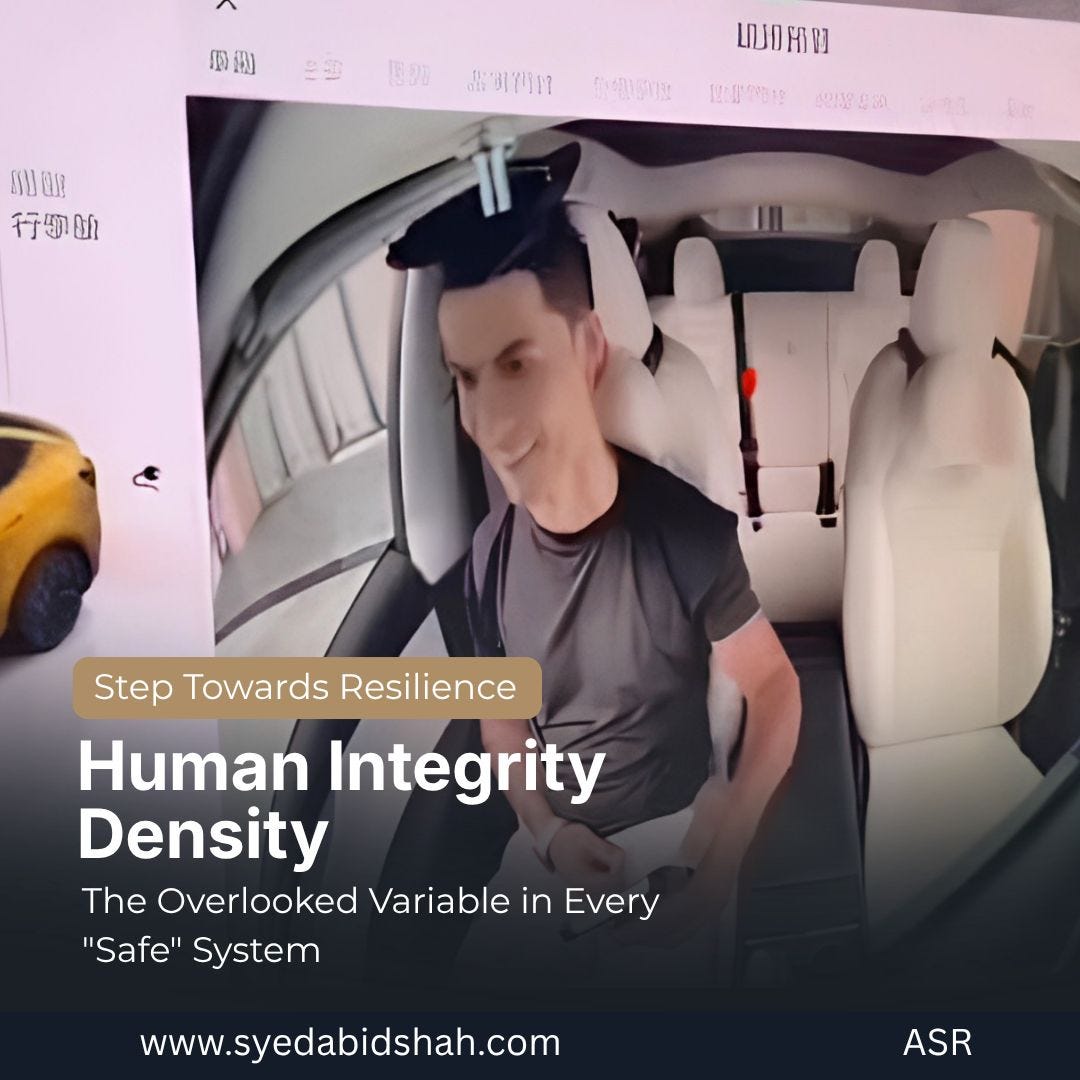
Last month, a Tesla driver defeated the vehicle’s in-cabin driver monitoring system using a $10 dashboard ornament — a plastic football figurine positioned near the rear-view mirror, convincing the camera that the driver remained attentive while he slept and filmed videos at highway speed.
Tesla’s monitoring system represents years of research and billions of dollars of investment. Yet it was defeated by a toy.
This is not about Tesla. It is about a fundamental blind spot in resilience engineering.
Current AI safety discourse focuses on model capability, redundancy, explainability, and adversarial robustness. These assume the human operator is acting in good faith. Sometimes, that assumption is wrong.
James Reason noted that operators are usually inheritors of system defects rather than their creators. This case demonstrates the opposite: the operator deliberately created the failure.
Admiral Hyman Rickover observed: “Responsibility is a unique concept. It can only reside in a single individual.”
No engineering sophistication compensates for a human who intentionally refuses responsibility.
This is why the Aquarian Systematic Resilience (ASR) framework introduces Human Integrity Density (HID) — the concentration of trustworthy, competent, and accountable people operating within a system. A technologically advanced architecture with low HID can become more fragile than a simpler system entrusted to disciplined operators.
As AI embeds across critical infrastructure, the next governance frontier is not only making machines trustworthy — it is asking whether the humans entrusted with those machines remain worthy of that trust.
Perhaps the next resilience audit should begin with a different question:
We know the system is resilient. Are the people operating it?
I invite discussion on:
- How do we measure and operationalize Human Integrity Density in complex systems?
- What governance mechanisms can ensure human accountability at the operator level?
- Should resilience audits include a “human integrity” dimension alongside technical redundancy?
- Are there existing frameworks (in safety-critical industries like aviation, nuclear, or offshore oil and gas) that already address this — and if so, why have they not been adapted for AI-integrated systems?
- How do we design systems that are robust not only to adversarial AI but to adversarial human operators?
For context:
- Reason, J. (1990). Human Error. Cambridge University Press.
- Rickover, H. G. (1954). Responsibility. US Naval Academy Address.
- Jiangsu, China Tesla incident (2026). Video widely circulated.
I look forward to a rigorous and multidisciplinary discussion.
메타데이터
- post_id
- 1aa9410eba2a
- slug
- human-integrity-density-the-overlooked-variable-in-every-safe-system-1aa9410eba2a
- url
- https://medium.com/@Syed_Abid/human-integrity-density-the-overlooked-variable-in-every-safe-system-1aa9410eba2a
- canonical_url
- https://medium.com/@Syed_Abid/human-integrity-density-the-overlooked-variable-in-every-safe-system-1aa9410eba2a
- author_url
- https://medium.com/@Syed_Abid
- status
- ok
- fetched_at
- 2026-07-13 06:23:13