The Redundancy We “SEEe” [2] — Descartes’ Evil Genius
Cogito Ergo Sum vs. Cogito Ergo Caecus: A DUEL of Eastern and Western Philosophies Spanning Over 2,000 Years— Séances, and the Butterfly…
The Redundancy We “SEEe” [2] — Descartes’ Evil Genius
Cogito Ergo Sum vs. Cogito Ergo Caecus: A DUEL of Eastern and Western Philosophies Spanning Over 2,000 Years— Séances, and the Butterfly Dream: Unraveling the Evolution of Human Perception
As World War II reached its fever pitch, heavy fighting devastated both Europe and Asia. Yet, far removed from the front lines, on the fog-swept island of Jersey, another kind of struggle was unfolding.
[embed]
Inside a sprawling, tomb-like mansion, Grace Stewart lived in self-imposed exile, waiting for a husband who might never return from the war. Her life revolved entirely around her two young children: Anne, her precocious ten-year-old daughter, and Nicholas, her fragile seven-year-old son. Both were afflicted with a rare, severe sensitivity to light, a condition that transformed their home into a labyrinth of shadows where every curtain remained drawn, and every door stayed locked.
In this suffocating stillness, the children’s existence felt less like a life and more like a haunting. As strange occurrences began to plague the household, an unseen force seemed to be systematically deceiving the family’s senses. If the world outside was being torn apart by the tangible horrors of war, the world within was being dissolved by a much more terrifying possibility: that everything they perceived — their home, their safety, and even their own identities — might be nothing more than a grand, spectral illusion. They notice that doors in the house open on their own, and they often hear footsteps and whispers. One day, Anne discovers “others” in the house: a boy named Victor. Gradually, the children also see the boy’s parents and a blind old woman.
To care for the children, Grace hires three servants: Mrs. Bertha Mills, the housekeeper; Edmund Tuttle, the gardener; and Lydia, a mute housemaid. All three had worked in the mansion years before. It is through them that Grace begins to learn the dark history of the house, as they recount the tragedies that once unfolded within its walls.
Séance
Eventually, the “strangers” haunting the mansion, unable to endure the persistent disturbances, summon a medium to conduct a séance in a desperate bid to identify the restless spirits within.
The term “séance” finds its roots in the French word for “session,” derived from the Old French seoir, meaning “to sit.” While the modern séance is a staple of Gothic horror, such practices of necromancy — the art of communing with the dead — trace their lineage back to ancient Greece. These rituals find a striking parallel in the ancient Chinese tradition of Fuji (spirit writing), where practitioners use a suspended sieve or stylus to channel divine messages. The séance employs specific illusions of manifestation or spiritual possession to bridge the divide between the living and the deceased, serving as a conduit for both communication and divination.
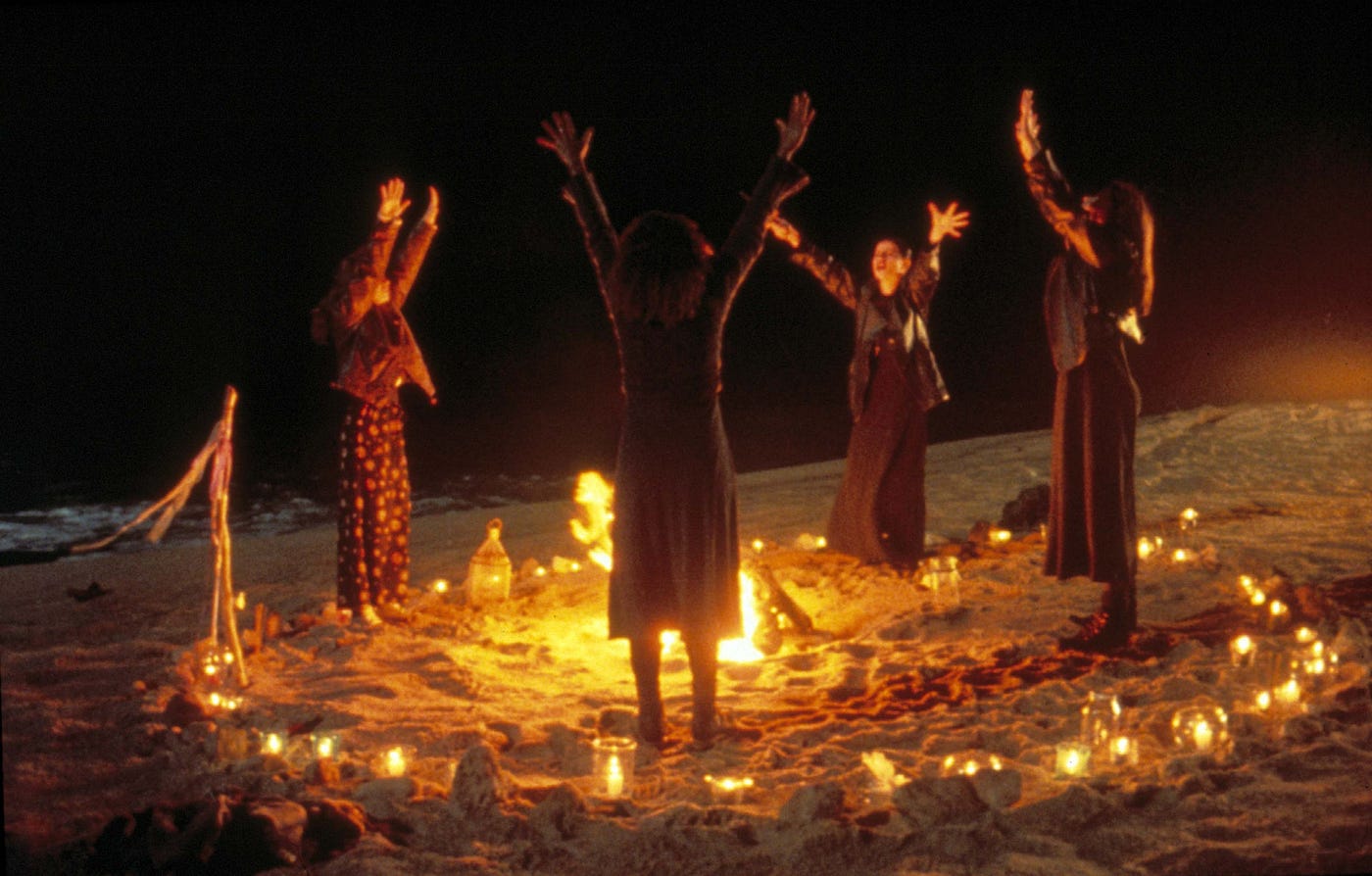
Sir Arthur Conan Doyle (22 May 1859–7 July 1930), the legendary creator of Sherlock Holmes, was perhaps the most prominent advocate for the modern séance. Interestingly, he was not alone in his spiritual pursuits; many of history’s greatest scientific minds, including Guglielmo Marconi (25 April 1874–20 July 1937) — the “Father of Radio” — and Alexander Graham Bell (born Alexander Bell; March 3, 1847 — August 2, 1922) — the inventor of the telephone — were deeply engaged in the promotion of these rituals. They shared a profound belief that a realm existed beyond death, and they envisioned a method of spiritual communication akin to the telegraph, allowing the living to “wire” messages to the departed.
Driven by the staggering loss of life during the two World Wars, the séance experienced a powerful revival from the late 19th to the early 20th century. This resurgence of spiritualism was no coincidence. In a world scarred by relentless conflict, the séance offered a desperate, technological-age hope: that the voices silenced on the battlefield across Europe and Asia might still be reached through the invisible airwaves of the beyond.
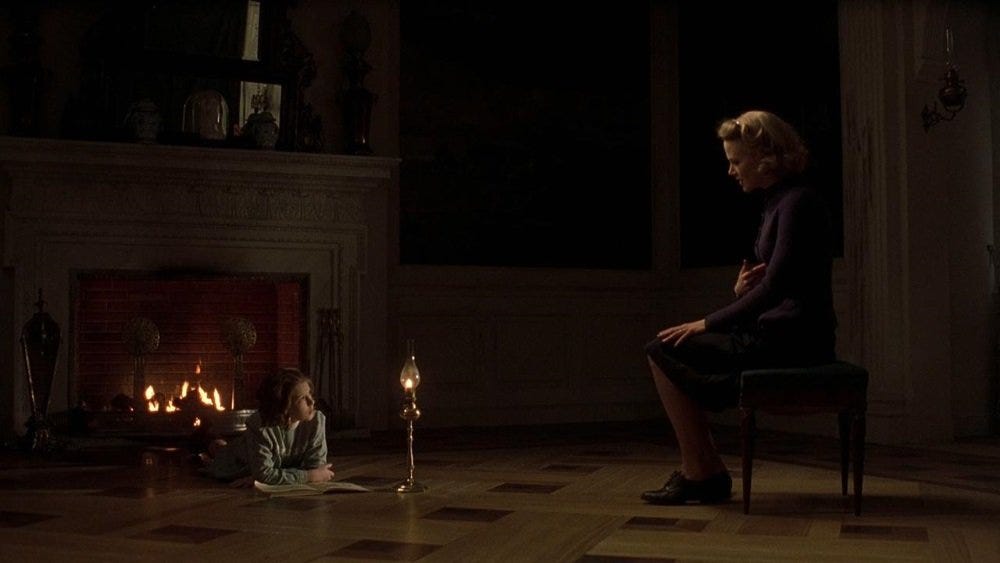
Within the context of Grace’s crumbling reality, this ritual acts as the ultimate catalyst, peeling back the layers of sensory deception to reveal a truth far more haunting than any ghost.
The séance conducted by the “strangers” in the mansion ultimately summons Grace’s daughter, Anne. Through her spirit, the harrowing truth is finally unveiled: in a moment of utter psychotic collapse, Grace had smothered both of her children with pillows before ending her own life with a shotgun. The “intruders” — Victor and his family — are, in fact, the living inhabitants of the house. Grace, her children, and the three servants she employed are the restless dead, tethered to the estate by their own denial.
This revelation mirrors the narrative twist in The Sixth Sense (IMDb: tt0167404, 1999), where child Cole Sear can see the deceased, many of whom are unaware of their own passing. Just as the child psychologist Malcolm Crowe remains oblivious to his own death until the very end, Grace’s world is built upon a profound sensory deception.
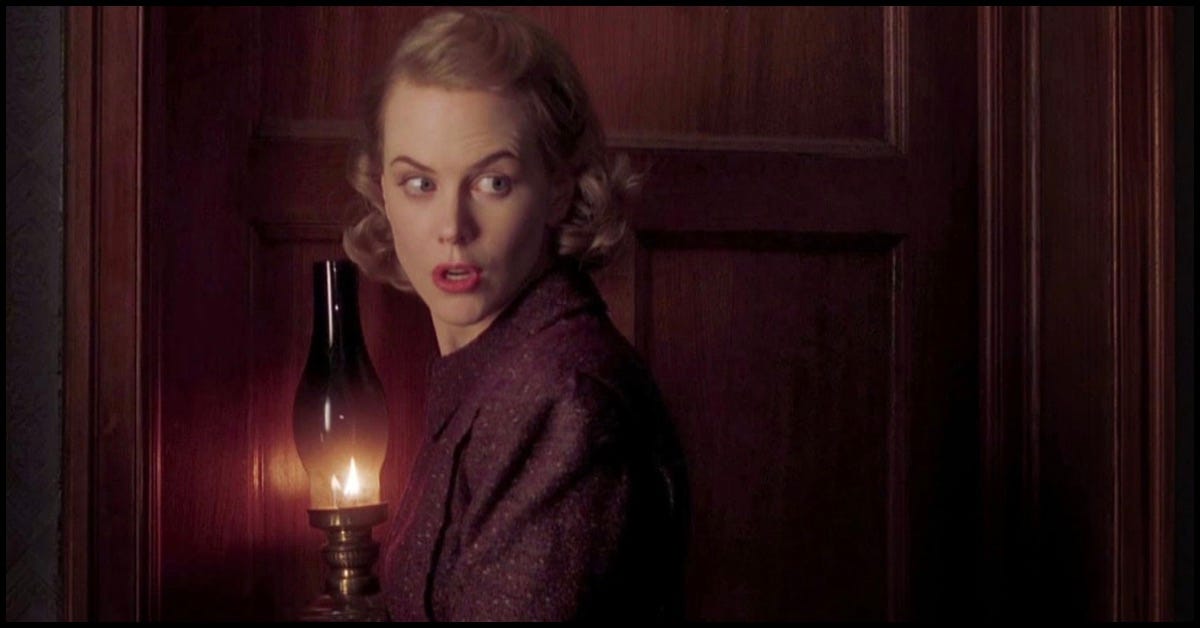
Great stories always offer profound insights; they force us to confront a haunting, Cartesian ambiguity: if our senses can be so easily deceived, then between the living and the dead, what truly remains to distinguish one from the other?
Zhuangzi and the Butterfly Dream
Drawing a parallel from the story of illusory reality, we arrive at the ancient Chinese philosophy of the Butterfly Dream. Zhuang Zhou (Chinese: 莊周, c. 369 BC — 286 BC), more commonly known as Zhuangzi, was a native of the State of Song during the Warring States Period (475/403 BC — 221 BC) in China. In 318 BC, the State of Song was granted the status of a feudal state. However, by 286 BC, the kingdom was conquered and obliterated by the State of Qi (which had claimed kingship in 334 BC and was eventually vanquished by the Qin in 221 BC).
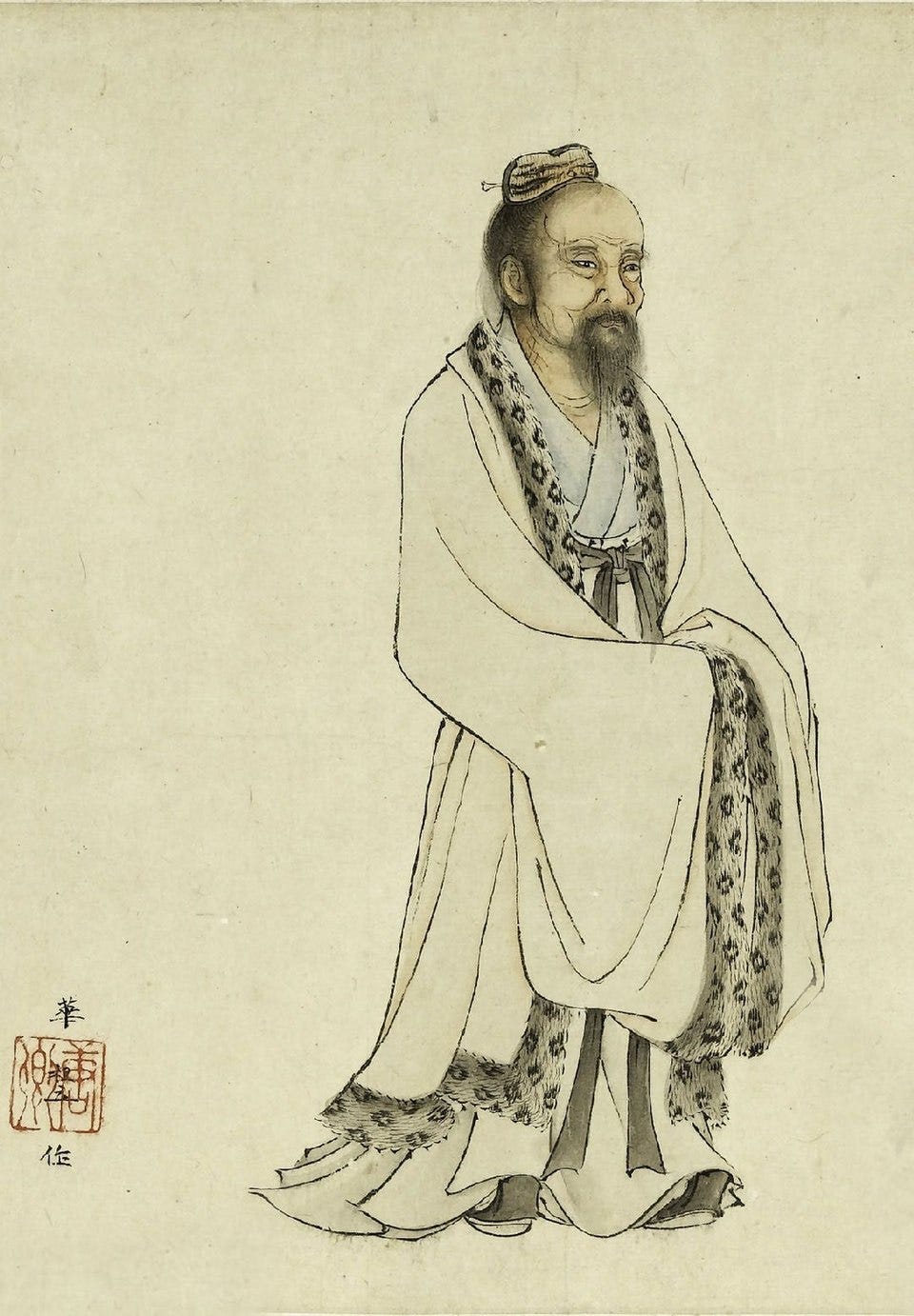
Xuanmen Ten Zi Tu Zhuang Zi
Zhuang Zhou died in the year his homeland fell. In his work Zhuangzi, named after him, he recorded his sorrow over the fall of his country. He wrote:
When a man sees the old state and the old capital, he feels a sense of joy. Even though it is overgrown with hills and mounds, with tall grass and trees covering nine-tenths of it, he still feels joy. How much more so when he sees what he used to see and hears what he used to hear — when it is like a terrace eighty feet high standing in the midst of the crowd!
— Zhuangzi, Outer Chapters.Translated by Burton Watson
The State of Song was situated in the region now known as Shangqiu (Chinese: 商丘), Henan (Chinese: 河南), and Huaibei (Chinese: 淮北), Anhui (Chinese: 安徽). Zhuang Zhou himself was a native of Meng **(Chinese: 蒙), a location near modern-day Shangqiu. Crucially, the people of Song were the descendants of the Yin-Shang Dynasty (Chinese: 殷商, c. 17th Century BC — 11th Century BC), which had been overthrown by the Zhou Dynasty* (Chinese: 周, c. 11th Century BC — 256 BC)*.
Because of this ancestral heritage, the State of Song remained less influenced by the rigid Confucianism of the Zhou. This allowed Zhuang Zhou’s intellect to remain unshackled; he championed the way of nature and often took great delight in satirizing Confucian scholars. Following in the footsteps of Laozi **(571 BC — 470 BC), *also spelt as Lao Tzu and *Laou-tsze. Zhuang Zhou inherited and expanded upon **Taoist **(Daoist; Chinese: 道教) thought.
The birthplaces of notable Chinese philosophers from the Hundred Schools of Thought in the Zhou dynasty. Philosophers of Taoism are marked by triangles in dark green.
It is often argued that ancient China produced “thinkers” rather than “philosophers” in the strict Western sense. However, Laozi and Zhuangzi are the Chinese figures who come closest to the tradition of Ancient Greek philosophers. In particular, Laozi was the first to propose the concept of spontaneous order. It was not until more than two thousand years later that this principle was formalized by the Western philosopher Friedrich Hayek (8 May 1899–23 March 1992). Now, the principle of spontaneous order resonates deeply with modern political and economic philosophy.
Zhuang Zhou had a profound mastery of using allegories and metaphors to illuminate deep, complex philosophical truths. Among the many tales recorded in his namesake text, none has resonated as deeply or endured as long as “Zhuangzi Dreaming of the Butterfly.” This simple yet haunting parable has become the definitive symbol of the fluid boundary between the self and the other, the dreamer and the dream.
Once Zhuang Zhou dreamed he was a butterfly, a butterfly flitting and fluttering about, happy with himself and doing as he pleased. He didn’t know he was Zhuang Zhou. Suddenly, he woke up, and there he was, solid and unmistakable Zhuang Zhou. But he didn’t know if he was Zhuang Zhou who had dreamt he was a butterfly, or a butterfly dreaming he was Zhuang Zhou. Between Zhuang Zhou and a butterfly, there must be some distinction! This is called the Transformation of Things.
— Zhuangzi, Discussion on Making All Things Equal. Translated by Burton Watson
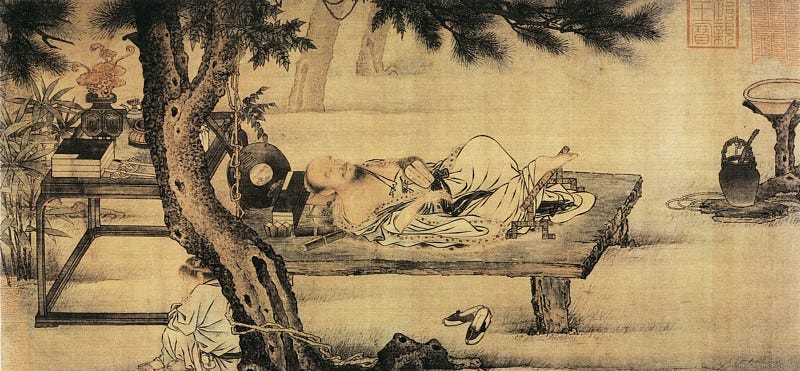
Through this parable, Zhuangzi presents a classic philosophical proposition: How can we distinguish between the “original self” who dreams and the “self” within the dream? Or, to put it more pointedly, which is the “true” self? Am I the butterfly flitting through the garden, or am I the man who has just awakened?
Descartes’ Evil Genius
Two millennia after Zhuangzi, the great French philosopher, mathematician, and scientist René Descartes (1596–1650) arrived at a similar crossroads of consciousness. In 1641, he published his seminal work, Meditations on First Philosophy, in which the existence of God and the immortality of the soul are demonstrated (Latin: Meditationes de Prima Philosophia, in qua Dei existentia et animæ immortalitas demonstratur). Within its pages, Descartes embarked on a journey of radical doubt that mirrored Zhuangzi’s ancient musings, once again bringing the enigmatic nature of dreams to the very forefront of human inquiry.
I believe many of you are just like Descartes, frequently finding yourselves in recurring dreams with the same familiar settings. Some, like me, might even experience “serialized” dreams, where tonight’s story picks up exactly where the last one left off.

Descartes noted that he had countless dreams so vivid they were indistinguishable from reality — such as the simple act of sitting by a fireplace in his dressing gown. This led him to a chilling question: If dreams can so convincingly mimic the real world, how can I — or you, as you read this very article — be one hundred percent certain that you aren’t asleep right now?
Taking this a step further, he proposed the haunting hypothesis of the “Evil Genius” (or Evil Demon). Imagine a being as powerful as it is cunning, a master of deception who has dedicated its entire existence to creating a flawless illusion of the world just to trick us.
I shall then suppose, not that God who is supremely good and the fountain of truth, but some evil genius not less powerful than deceitful, has employed his whole energies in deceiving me; I shall consider that the heavens, the earth, colours, figures, sound, and all other external things are nought but the illusions and dreams of which this genius has availed himself in order to lay traps for my credulity; I shall consider myself as having no hands, no eyes, no flesh, no blood, nor any senses, yet falsely believing myself to possess all these things; I shall remain obstinately attached to this idea, and if by this means it is not in my power to arrive at the knowledge of any truth, I may at least do what is in my power [i.e. suspend my judgment], and with firm purpose avoid giving credence to any false thing, or being imposed upon by this arch deceiver, however powerful and deceptive he may be.
— René Descartes, Meditations on First Philosophy
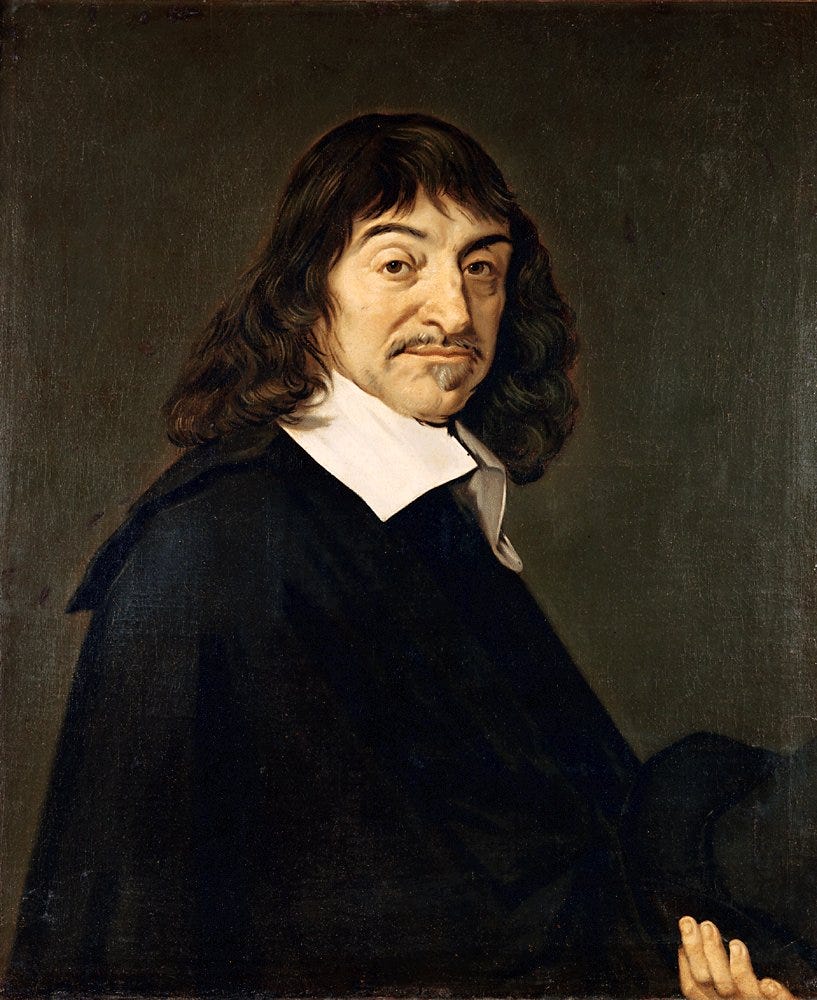
René Descartes
Yet, despite facing the same existential riddle, Zhuang Zhou and Descartes arrived at profoundly different conclusions. It is as if these two great thinkers, standing before the same crossroads of consciousness, chose to embark upon two entirely divergent paths.
“Cogito, ergo sum.” vs. “Cogito ergo caecus.”
To outmaneuver the Evil Demon, Descartes deployed a relentless weapon: pure logic. His line of reasoning was both radical and fascinating:
- I can doubt my body — it might just be a sensory illusion conjured by the demon.
- I can doubt the external world — the sky, the earth, colors, and shapes could all be fragments of a dream.
- I can even doubt mathematical truths — who’s to say the demon hasn’t manipulated my mind to believe that 2+3 equals 5?
Descartes pushed this to the limit: I can imagine that nothing exists. However, he hit a “glitch” in the demon’s deception — a singular, undeniable exception. Even if everything is a lie, the “I” who is doing the doubting must exist. To be deceived, there must be a “Me” to be tricked. To doubt, there must be a “Me” to do the doubting. Therefore, as long as I am thinking, I must exist.

In this manner, Descartes solidified his definitive proof through a masterful sequence of logic:
- The Premise: Imagine a malicious demon who exerts every ounce of its power to deceive me, leading me to believe that the heavens, the earth, and even my own physical body are nothing but grand illusions.
- The Reasoning: If this demon is relentlessly deceiving me, then there must be a “Me” who is being deceived. If I did not exist, the very act of “deception” would be impossible — it would have no target.
- The Conclusion: Therefore, the fact of my own existence is the one absolute truth that remains beyond the reach of any doubt.
“I think, therefore I am” became the foundational cornerstone upon which Descartes reconstructed his entire system of knowledge — the “First Principle” of his philosophical architecture. As he famously declared: “I am, I exist (Ego sum, ego existo); whenever it is uttered by me, or conceived by the mind, it is necessarily true.”

For Zhuang Zhou, however, the “Butterfly Dream” presented no such intellectual conflict. Rather than seeking a logical bedrock, Zhuangzi introduced the concept of **“The Transformation of Things” **(Chinese: 物化, Wù Huà). To him, the butterfly and the man were merely different physical manifestations of the same universal spirit.
Imagine the ocean: its waters evaporate into mist, rising into the sky to become clouds. The clouds then transform into rain, which feeds the rivers, eventually flowing back into the great sea. The cloud, the rain, and the river were all once the ocean, and they will become the ocean once more. They differ in form — this is what we call the “distinction of things” — but they are identical in essence; they are all Water, connected by the Tao (The Way).

Wù Huà, “The Transformation of Things,” means realizing that you are simultaneously that fleeting cloud, that single drop of rain, and the entire ocean itself. Therefore, a cloud need not regret that it is not rain, nor should it cling to the obsession of remaining a cloud forever.
Zhuangzi’s wisdom lies in the liberation from the obsession with fixed identity. To him, it matters little whether the “self” manifests as Zhuangzi, a butterfly, a bird, a fish, or even a blade of grass. On the level of the Tao, all these forms are interconnected through the process of “Transformation” (Hua). True wisdom is the ability to simultaneously perceive the “distinction” and the “transformation” — to see both the profound individual differences and the underlying oneness of all things.

In contrast to Descartes’ First Principle of the “Thinking Self,” Zhuangzi’s First Principle is **“The Equality of All Things” **(Chinese: 齊物, Qí Wù). He articulates this foundational truth in the Discussion on Making All Things Equal:
There is nothing in the world greater than the tip of an autumn hair, and Mount Tai is small. No one lives longer than a dead child, and Pengzu died young. Heaven and earth were born together with me, and the ten thousand things and I are one.
Now that we are one, can I say anything? But since I have already said that we are one, can I say nothing? One plus what I said about it makes two; two plus one makes three. Going on from there, even the most skilled calculator could not reach the end, much less an ordinary man! If we go from nothing to something and can reach three, how much more so if we go from something to something! We need not go on. Let us rather stop here.
— Zhuangzi, Discussion on Making All Things Equal. Translated by Burton Watson
Zhuangzi did not merely propose the oneness of all things; he pushed the logic to its ultimate conclusion: If all things are truly “one,” why must we speak of it or attempt to dissect its essence?
He reveals a profound linguistic trap: the moment we define the “One,” we create a duality consisting of the “Definition” and the “Thing being Spoken of.” This creates the “One” (the concept) and the “Two” (the deduction). When these are added to the original, unspeakable essence, we arrive at “Three.”
To Zhuangzi, this is not a literal set of three numbers, but rather the various manifestations of the primordial essence within the prism of human subjective consciousness. Thus, he concludes: “We need not go on. Let us rather stop here” (Chinese: 無適焉,因是已, Wu shi yan, yin shi yi). He urges us to cease the human obsession with categorization and verbalization — to return to the source and harmonize with things as they are.
In this light, Zhuangzi’s First Principle is the direct antithesis of Descartes’. While Descartes sought to confirm the human essence through the rigors of thought, Zhuangzi argued that using human intellect to forcefully distinguish between the essence and its variations is nothing more than a game of subjective perception.
A Tribute to Nicole Kidman
The story that opened our journey today is drawn from the haunting cinematic masterpiece, The Others (IMDb: tt0230600, 2001). At the heart of this atmospheric labyrinth is the character of Grace Stewart, brought to life by the prodigious talent of Nicole Kidman (born June 20, 1967). Born in Honolulu, Hawaii, to Australian parents, Kidman has become a global icon whose career transcends simple stardom.
She possesses a rare, chameleonic ability to inhabit complex and mercurial roles, particularly those defined by intense psychological tension. In The Others, she masterfully portrays Grace’s descent from Cartesian rigidness — clinging to the “logic” of her domestic walls — to the eventual, Zhuangzi-like acceptance of her “transformed” state. Beyond the silver screen, Kidman is a formidable producer and a dedicated humanitarian, having served for years as a Goodwill Ambassador for UN Women.
As we close this exploration of reality and illusion, let us find inspiration in the grace and confidence of her own words.
It’s a very brave thing to fall in love. You have to be willing to trust somebody else with your whole being, and that’s very difficult, really difficult and very brave.
The thing you hate about yourself tends to be the thing that everyone likes about you.
Whatever you do in life, don’t give up on your own dreams.
Forget the past. You can never predict what the future is going to be. Live for the moment.

Even from a very early age, I knew I didn’t want to miss out on anything life had to offer just because it might be considered dangerous.
Thank you for joining me on this intellectually charged journey. From the unyielding persistence of “I think, therefore I am” depicted in The Others, to the limitless liberation of Zhuangzi’s “The ten thousand things and I are one,” we have done more than merely deconstruct a film — we have reached out to touch the very pulse of the evolution of human ideas.
If you found value in today’s exploration, I invite you to subscribe to this channel and share it with your friends.
Our mission here is to continuously unravel the evolution of human ideas and examine the hidden forces that define success and failure in the human experience. Throughout history, it is not merely our tools but our underlying philosophies that determine our destinies. I look forward to continuing this dialogue with you and a growing community of thinkers as we navigate the vast map of human wisdom together.
Until our next journey — Stay bold, stay curious, and always trust the journey.
Arno Will, April 11, 2025; Rewritten on May 5, 2026
[embed]
Idea and Action
**The Eye, The World We “See”**
The Eye, The World We “See” [1] — Allegory of the Cave
The Eye, The World We “See” [2] — Misplaced Love
The Eye, The World We “See” [3] — From Data to Information
The Eye, The World We “See” [4] — How We See the World: From Knowledge to Wisdom
The Redundancy We “SEEe”[1] — I Really Did See Ghosts
The Redundancy We “SEEe”[2] — Descartes’ Evil Genius
Theory of Relativity in Economics — The Coase Theorem Under the Mass Critique
How Corruption-Ridden Socialism Triumphed Over Regulatory Capitalism?
When Capital Substitutes Labor, Where is Our Future?
Liberty is Not ‘Negative’, Only ‘Exist’ and ‘None’
Redistribution? Why is the Government Spying on My Wallet
Immoral Property Taxes Infringe on Personal Liberty
메타데이터
- post_id
- 1abb31d56a4d
- slug
- the-redundancy-we-seee-2-descartes-evil-genius-1abb31d56a4d
- url
- https://medium.com/@acex/the-redundancy-we-seee-2-descartes-evil-genius-1abb31d56a4d
- canonical_url
- https://medium.com/@acex/the-redundancy-we-seee-2-descartes-evil-genius-1abb31d56a4d
- author_url
- https://medium.com/@acex
- status
- ok
- fetched_at
- 2026-06-09 18:04:40