What Natural History Museums Teach Us About Deep Time
Do old bones, life-sized reconstructions & museum displays still matter in an age of infinite online information?
What Natural History Museums Teach Us About Deep Time
Do old bones, life-sized reconstructions & museum displays still matter in an age of infinite online information?
Natural History Museums: Old Relics, or Still Relevant?
In today’s age of seemingly infinite recommendations, visual formats, online platforms, and digital tools, it is still tempting to ask …
*Do museums still matter or not? 🤔*
After all, we can now do so much from a screen, such as:
- Watch lectures by palaeontologists
- Rotate or zoom in-and-out of 3D fossils
- Browse museum collections online
- Follow YouTube walkthroughs
- Read scientific papers online
- And even generate AI reconstructions of extinct animals … within seconds!
In many ways, the internet is even better at explanation than a traditional museum label.
A good video can show an animal moving, or an online scientific paper can explain the evidence behind a claim.
A digital model can rotate a fossil, and a science communicator can update a reconstruction that an older display has not yet corrected.
And yet, fossil museums still do something that the internet or today’s modern technological advancements cannot fully replace.
They make deep time … physical!
A fossil in a display case is not just an old bone.
It is a fragment of another world that survived long enough for us to stand in front of it.
A dinosaur egg, a mammoth tusk, a marine reptile jaw, a trilobite slab, a fossil leaf, or even a life-sized reconstruction can turn millions of years into something … almost touchable.
And that is why natural history museums still matter!
It is not because they are always perfect. Many are not.
Some are underfunded. Some are outdated. Some have weak labels.
Some display extraordinary objects, but without giving enough context.
Some still carry the baggage of colonial collecting, incomplete interpretation, or older scientific assumptions.
But even then, they hold a strange power …
They remind us that the past was not some imaginary or fantastical story.
The past did have bones, shells, teeth, leaves, eggs, footprints, climates, oceans, forests, predators, prey, disasters, recoveries, and long-vanished worlds.
A museum does not merely display old objects …
At its best, it compresses time!
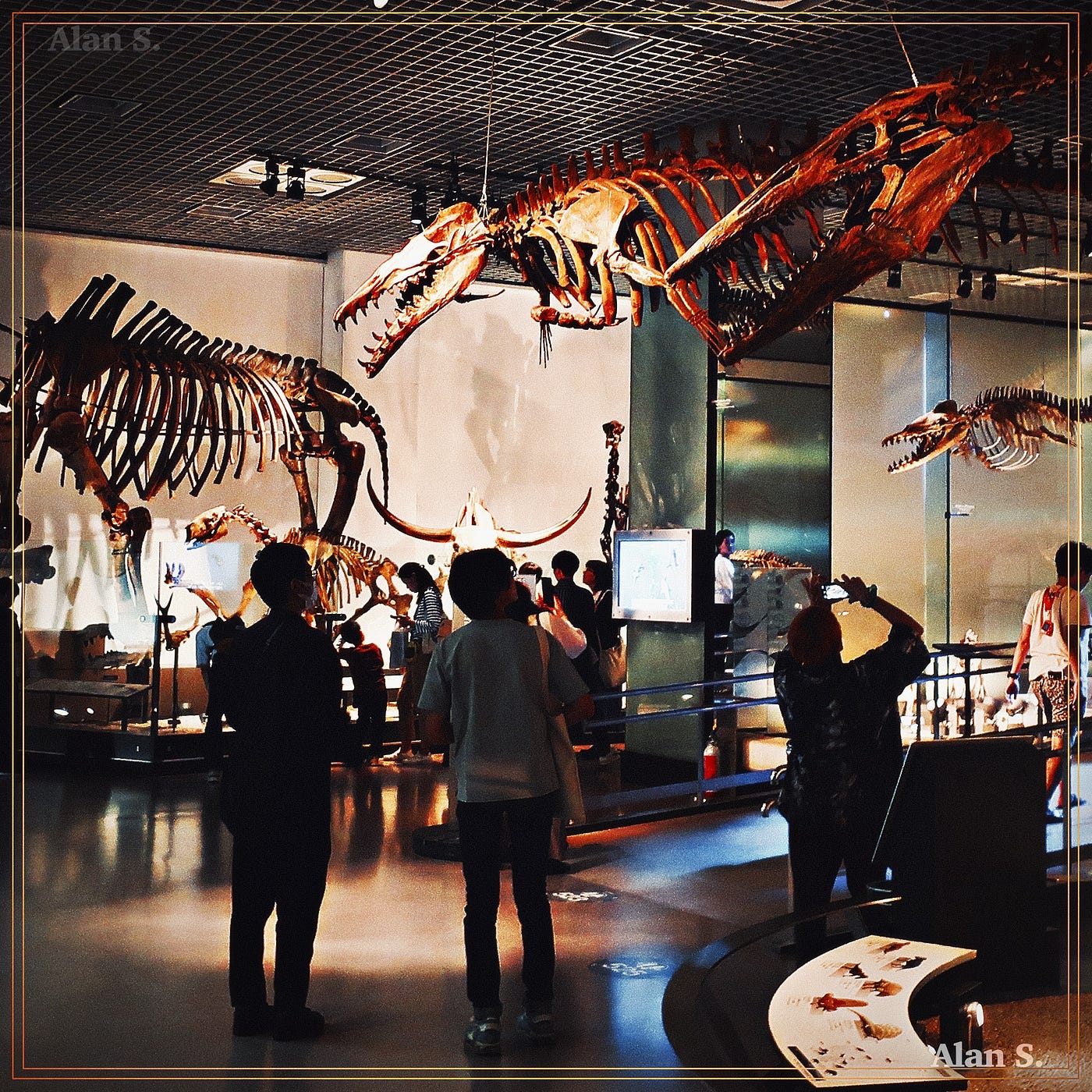
A fossil hall turns deep time into something physical: bones, bodies, scale, light, visitors, and millions of years compressed into a room! {Image: The Author}
Museums: The Real ‘Time Machines’
Natural history museums do not just show specimens.
They compress deep time into rooms, corridors, glass cases, skeleton mounts, labels, reconstructions, eggs, teeth, bones, rocks, dioramas, and life-sized bodies.
A museum hall can place a child, traveller, student, scientist, artist or casual visitor, in front of a world that no human ever saw alive.
And that is a very remarkable thing, indeed!
A fossil skeleton, after all, is evidence.
A museum display is interpretation.
A reconstruction is imagination, but disciplined by science.
And when all three work together, a museum can do something powerful …
It can turn an ordinary visitor, into a time traveller ⏳
Not literally, of course! But emotionally, intellectually and visually, that is what a good natural history museum does.
It invites us to imagine ancient ecosystems, lost climates, changing continents, prehistoric animals, evolutionary experiments, as well as mass extinctions.
It helps us see life as a chain of ‘transformations’, rather than a set of ‘isolated curiosities’.
A good fossil display does not simply say, “This animal lived 150 million years ago.”
Instead, it should make us ask:
“What kind of world allowed this creature to exist?”
Once we ask such a question, the fossil stops being only an object.
It becomes a kind of a … ‘doorway’ 🪄

Evidence, Interpretation & Imagination: when these three aspects work together, a museum can become almost like a ‘time machine’! 😵💫 {Image: The Author}
From ‘Cabinets-of-Curiosities’ to ‘Deep-Time Storytellers’
Natural history museums did not begin as the polished public science institutions, we know today …
Their ancestry partly lies in older habits of collecting shells, minerals, fossils, preserved animals, maps, tools, artefacts, oddities, and artworks.
Alongside objects from distant places, these were gathered into private or institutional collections.
The famous ‘cabinet-of-curiosities’ was not yet a modern museum, in the strict sense!
It was part wonder-room, part status symbol, part study collection, and part ‘theatre-of-the-strange’.
Over time, these collections became more formal, more scientific, and more public.
Some early natural history collections were attached to scholars, universities, scientific societies, or civic institutions.
These were often closer to archives, research stores or catalogues of knowledge, rather than put up as ‘visitor-friendly’ museums.
Within them, objects were arranged, preserved, classified and studied, but not always interpreted for a broad public audience.
That ‘public role’ developed gradually!
As natural history museums grew, they had to solve a major problem: they had too many objects, and not every specimen could be displayed meaningfully.
Museums, therefore, began separating research collections from public exhibition spaces.
Instead of showing everything, they increasingly curated selected specimens for visitors.
And that ‘evolution’ eventually changed the museum’s role!
It was no longer only a collector’s display of rare objects.
It became a public institution where science, education, spectacle, classification, conservation, and imagination could all meet.
The collection of **Sir Hans Sloane, for example, became the founding collection of the [British Museum](https://www.britishmuseum.org/about-us/british-museum-story/sir-hans-sloane)** back in the eighteenth century.
The iconic Natural History Museum in London would later emerge from this deeper collecting history.
The **Oxford University Museum of Natural History opened in 1860, while the [American Museum of Natural History](https://www.amnh.org/about)** was officially created in New York in 1869.
But the larger transformation was not only architectural …
It was also interpretive!
Natural history museums increasingly began to organise nature for public understanding.
They did not merely display shells, bones, skins, rocks, fossils, and mounted animals.
They began to frame relationships between organisms, environments, and ecosystems, as well as evolutionary history.
In modern terms, a natural history museum occupies a very particular ‘ecosystem niche’ 😉
It is part archive, part classroom, part theatre, part laboratory, part travel destination, and part memory machine.
That is why the very best of natural history museums do not merely store the past …
They translate it.
They take evidence from stone, bone, shell, specimen drawer, field note, fossil slab or a preserved organism … and turn it into public imagination!

Natural history museums evolved from private collections of wonder, into public institutions of science, education, spectacle & deep-time storytelling! Clockwise from top-right: A 1636 painting of a cabinet-of-curiosities by Frans II Francken, an early 1700s German ‘Schrank’ coral specimen cabinet, an 1895 photo of the iconic Hintze hall at London’s NHM, and a modern-day fossil display at Osaka’s Museum of Natural History. {Images: The Author, The Natural History Museum, Wikimedia Commons’ LoKiLeCh & public-domain}
The Author’s Personal Eras of Museum Discovery
For me, fossil museums did not arrive all at once …
Rather, they came in ‘eras’ too 😉
Era 1: The “Museum” before the Museum
Before visiting many major museums in person, I encountered them indirectly.
Books, comics, magazines, documentaries, TV shows, movies, games, encyclopaedias, school references, and old science visuals all created a mental version of the ‘great museum’.
Obviously, this was the museum of imagination!
The one filled with dinosaur skeletons, mammoths, marine reptiles, glass cases, giant halls, mysterious labels, and gift shops, I had not yet seen.
In childhood, such museums often felt … distant.
They seemed to exist in New York, London, Europe, Japan, China or inside books, rather than as everyday accessible spaces.
Era 2: The Local Museum
The next phase — though somewhat in parallel to the earlier one — was the Indian museum encounter.
The Prince of Wales Museum in Bombay (now Chhatrapati Shivaji Maharaj Vastu Sangrahalaya in Mumbai, or CSMVS), became one of those recurring reference points.
It may not have been a giant dinosaur museum in the American, European or Asian sense, but it still offered something important.
The idea that natural history, archaeology, art, and local heritage could sit inside the same cultural institution.
Such museums teach in … ‘quieter ways’. They may not always overwhelm the visitor with scale.
However, they create a bridge between city memory, school-age curiosity, family visits, and the first sense that objects can carry historical authority.
Era 3: The World Museum Dream Becomes Real!
Then came the international museum era.
Initially, through a lucky break, I managed to see the American Museum of Natural History in New York before this era truly began.
Later on, I managed to experience the near-mythical Natural History Museum in London. The Manchester Museum also belongs to this phase.
These are the kinds of places that many science enthusiasts first encounter through books, screens, and popular culture.
And when the chance finally comes to visit them, then we later walk into almost with … disbelief!
A dinosaur skeleton that once existed as a small printed image becomes architectural.
A fossil hall becomes a real space with crowds, lighting, children, tourists, labels, gift shops, tired feet, camera decisions, and the pressure of time.
Plus, this is where museums become not only science spaces, but also travel experiences 😎🧳
Era 4: Museums Through Travel
Later museum encounters, in fact, became tied to travel itself!
Madrid. Tbilisi. Swakopmund. Chandigarh. Thiruvananthapuram. Vadodara. Bishkek. Almaty. Jakarta. Hanoi. Osaka. Tokyo.
However, not all of these were fossil museums in a strict sense.
They were also historical, geological, archaeological, national, regional, or ‘mixed’ museums.
But that is part of the point!
Deep time does not always appear neatly labelled as ‘palaeontology’.
It can also sometimes appear within various other means, such as:
- A mineral gallery
- A geology room
- An old colonial-era display
- A natural history corner
- A fossil case in a state museum
- Or even a small regional exhibit, that most travellers pass quickly!
This series will partly come from those encounters as well 😊
Hence, not only accounts for visits to the grand, famous museums, but also the smaller, stranger, more uneven ones.
Era 5: The Digital Museum
From the late 2000s / early 2010s onward, another parallel ‘museum era’ opened, as per my experiences.
Some of you may or may not appreciate them. But this author feels they have also … contributed!
These include online lectures, YouTube walkthroughs, digital collections, scanned papers, 3D models, and museum social media.
As of the ongoing 2020s decade, AI-assisted visual imagination can also now be added to this list.
A person sitting at home anywhere in the world can now watch:
- A museum tour in London
- A palaeontology lecture from North America
- A fossil preparation video from China
- A 3D reconstruction of a prehistoric animal
But this also raises the question, at the heart of this series:
If so much can be seen online, what is the museum visit still for?

For this author, museums too arrived in ‘eras’ 😉 First they were through books, screens, imagination, and a few local institutions. Later, it was through international travel, regional museums, digital collections, online walkthroughs & real fossil halls. {Images: The Author, Youtube’s ARealHuman}
A Museum Visit Is Also a Journey 😎
A museum visit is not only about the objects inside the building.
At least for this author, the entire ‘experience’ matters too! These aspects can often include:
How did one get there? Was it a local train, taxi, subway, walk, bus, tour group, family car, metro, or long international itinerary?
Was it raining? Was the city cold, hot, crowded, unfamiliar, beautiful, exhausting?
Was there a queue?
Were photographs allowed?
Was there an entry fee?
Was there a bag check?
Was the lighting good?
Did the museum have a café?
Was there a gift shop?
Did one buy postcards, books, magnets, guidebooks, replica fossils, or nothing at all?
How much time was actually available before fatigue, hunger, family schedules, tour timing, or closing hours interrupted the visit?
These things may sound secondary, but they shape the entire museum memory.
A fossil is not encountered in a ‘vacuum’.
It is encountered after commuting, planning, walking, ticketing, waiting, reading, photographing, and deciding what to spend attention on.
*And sometimes, companions matter too 😊*
A family member who rushes through the gallery. A friend who notices something you missed.
A guide who gives one useful sentence. A child staring at a skeleton.
A museum guard watching over a silent hall. A fellow traveller taking photographs.
Even a stranger blocking the best angle of a display case. All of these become part of the museum experience.
For future written reviews or audiovisual reflections, these details matter because they give the museum life.
They turn a display, into a scene!
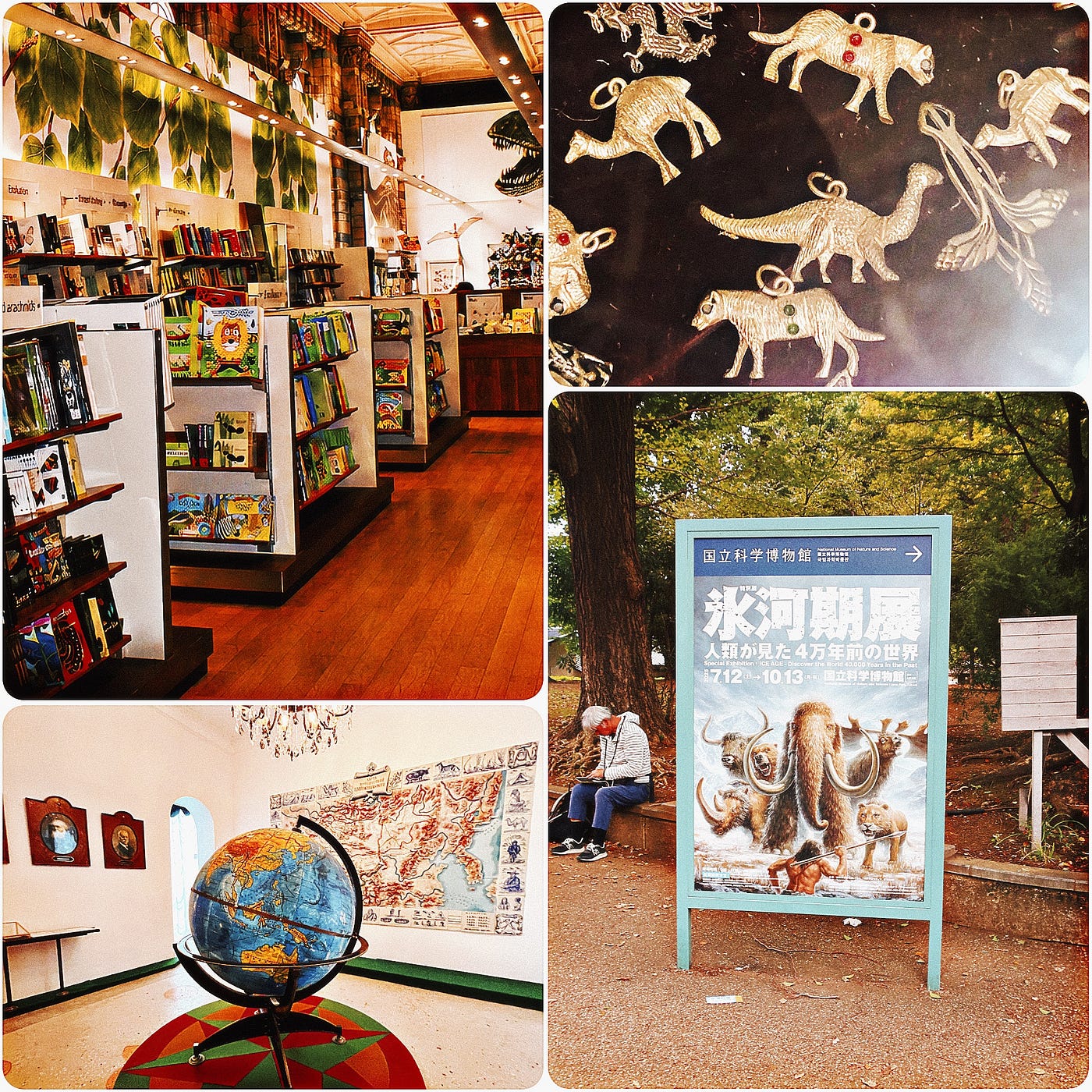
A museum visit often begins even before the exhibit itself! It begins with the city, the route, the queue, the ticket, the shop, the people, and the mood of the day! {Images: The Author}
The Limits of Screens, and the Limits of Museums
Online media is certainly excellent for explanation.
Sure, a well-made YouTube video can explain a dinosaur better than many static displays.
A digital reconstruction can update an old mounted skeleton, or a lecture can place a fossil in an evolutionary context.
Similarly, a paper can explain the evidence behind a scientific claim.
A 3D scan can also reveal details that a visitor might miss inside a dim gallery.
But a physical museum gives … something else!**
It can make you feel the scale, presence, atmosphere and attention, like no other of those new-age mediums.
That feeling of moving through rooms, within a well-lit space.
Perhaps the relief of the comfortable AC after a hot day outside in a tropical place.
The thrill of turning a corner and unexpectedly seeing a skeleton, skull, tusk, egg, cast, or diorama.
Sometimes, soft, pleasant tunes are played, and other times mysterious ones. These can enhance the experience too!
At times, it is the sense that other people are encountering the same ancient object at the same time.
And sometimes, of course, there is fatigue!
Too much walking. Or too many labels. Perhaps too little context given.
And on other occasions, it can have too much information, or not enough.
But this imperfect reality of the visit is often a part of its ‘value’.
A museum is not merely ‘information’ …
It is also an experience of attention!
That does not mean all museum displays are perfect. Many under-explain their objects.
They show a fossil, but not always the world around it, such as the climate, ecosystem, discovery story, or reconstruction uncertainty.
They may not showcase any scientific debate, local geology, or even the people who found, prepared, collected, studied, moved, restored, or interpreted it.
A dinosaur skeleton may look impressive, but the visitor may not learn how much is original fossil, and how much is cast.
A fossil egg may be displayed as a curiosity, but may not be connected to nesting behaviour, sediment, local geology, or how scientists inferred its reproduction from stone.
A mammoth tusk may look dramatic, but the display may not explain Ice Age climate, human interaction, extinction pressures, or the differences between related species.
An outdated reconstruction may remain visually charming, but not be clearly marked as outdated.
This matters because museums are not only ‘storage spaces.’
They are public science storytellers!
If a museum does not explain enough, the visitor may leave impressed, but not transformed.
This series will also attempt to pay attention to that ‘gap’.
Not to criticise museums unfairly, but to ask how they can become better bridges between evidence and imagination.
The Museums That Have ‘Shaped’ This Series
This future series will draw from several kinds of museum encounters, as stated earlier.
Some are famous institutions the author first knew through books, documentaries, magazines, television or popular science visuals, and only much later visited in person.
Some are museums encountered across the breadth and diversity of the Indian Subcontinent, but visited across different phases of life.
Some are travel museums visited while moving through Western Europe, the Mediterranean, the Caucasus, Southern Africa, Central Asia, South-East Asia, and Eastern Asia.
Some are not even museum visits, in the strict sense!
Instead, they are digital encounters like online collections, lectures, walkthroughs, scanned papers and archive images, that also shaped how I imagined deep time.
Together, they form less of a ranking and more of a ‘map of memory’.
There are the major globally-renowned fossil halls located within major metropolitan city areas, such as:
- The American Museum of Natural History, in New York, United States
- The Natural History Museum, in London, United Kingdom
- Osaka Museum of Natural History, in Osaka, Japan
- The National Museum of Nature and Science, in Tokyo, Japan
There are the Indian institutions as well as mixed museums situated across the diverse states and union territories of the country, such as:
- Chhatrapati Shivaji Maharaj Vastu Sangrahalaya, in Maharashtra’s Mumbai (formerly Prince of Wales Museum of Western India, in Bombay)
- The Government Museum and Art Gallery, in Chandigarh sandwiched between Punjab & Haryana
- Baroda Museum & Picture Gallery, in Gujarat’s Vadodara
- Samudrika Naval Marine Museum, in Andaman’s Sri Vijaya Puram island (formerly Port Blair)
There are travel encounters from places located around the world, such as Madrid, Tbilisi, Swakopmund, Almaty, Jakarta and Hanoi.
At these institutions, diverse disciplines like natural history, archaeology, geology, regional memory, and national history sometimes overlap.
Hence, not every future piece will be about a ‘fossil museum’ in the strict sense. Some may focus on a single fossil.
But others may focus on a gallery, a reconstruction, a mineral hall, a dinosaur egg, a skeleton mount, or an old label.
It may showcase a display that worked beautifully, or one that needed better context.
Some may be scientific. Some may be personal.
Some may be travel-oriented. Some may become visual field notes.
But the broader focus will remain the same:
Life before us. Worlds before us. Earth before us.
What Readers Can Expect
This series begins not with one fossil, one museum, or one review, but with a larger question:
What do Natural History & Fossil Museums still teach us, about deep time?
The aim is not to produce some perfect sort of academic museum criticism.
Nor is it to romanticise every old display.
The aim is to … look carefully 🤔
To notice what museums reveal, what they hide, what they simplify, and what they make possible.
Hence, a future piece may ask:
What did this museum or display teach?
What did it fail to explain?
What did it make the visitor imagine?
Was the display easy to understand, photograph, and remember?
Did the museum feel alive, outdated, underfunded, over-designed, moving, confusing, or unforgettable?
Could the object have been explained better through maps, diagrams, lighting, captions, reconstructions, audio-visual material, or digital extensions?
This series is not meant to become a definitive professional audit of museums.
Nor is it a claim that every future entry, will be based on the same kind of evidence.
Some pieces will come from first-hand visits as well as personal archives.
Some may be memory-led reflections on older visits.
Some may be research-based previews, comparisons, or wish-list pieces, clearly marked as such.
The point is not to pretend that one traveller, writer, or science enthusiast can replace a curator, palaeontologist, educator, or museum professional.
The point is to ask a public-facing question:
What happens when an ordinary-but-attentive visitor …
Stands before old bones, labels, reconstructions, galleries, maps, tickets, crowds, gift shops, screens & memories …
And tries to understand what kind of ancient world is being shown?
That is the spirit in which this series should be read!
Not as a final judgment of sorts, but as deep-time field notes.
It is because old bones are not ‘dead objects’.
In the right setting, they still teach us how to imagine time.
They remind us that the world did not begin with us.
They place human life back inside a larger story of continents, climates, extinctions, recoveries, bodies, traces, and transformations.
They show us that the present is only one surface layer of a much, much older Earth.
And sometimes, standing before a skeleton, fossil egg, tusk, ammonite, footprint or stone leaf, we remember that deep time is not only an abstract number.
It is something that once breathed, grew, hunted, nested, swam, walked, fell, fossilised, and waited. But that is …
Until someone found it.
Until someone studied it.
Until someone placed it in a museum.
Until someone else stood before it … and wondered!
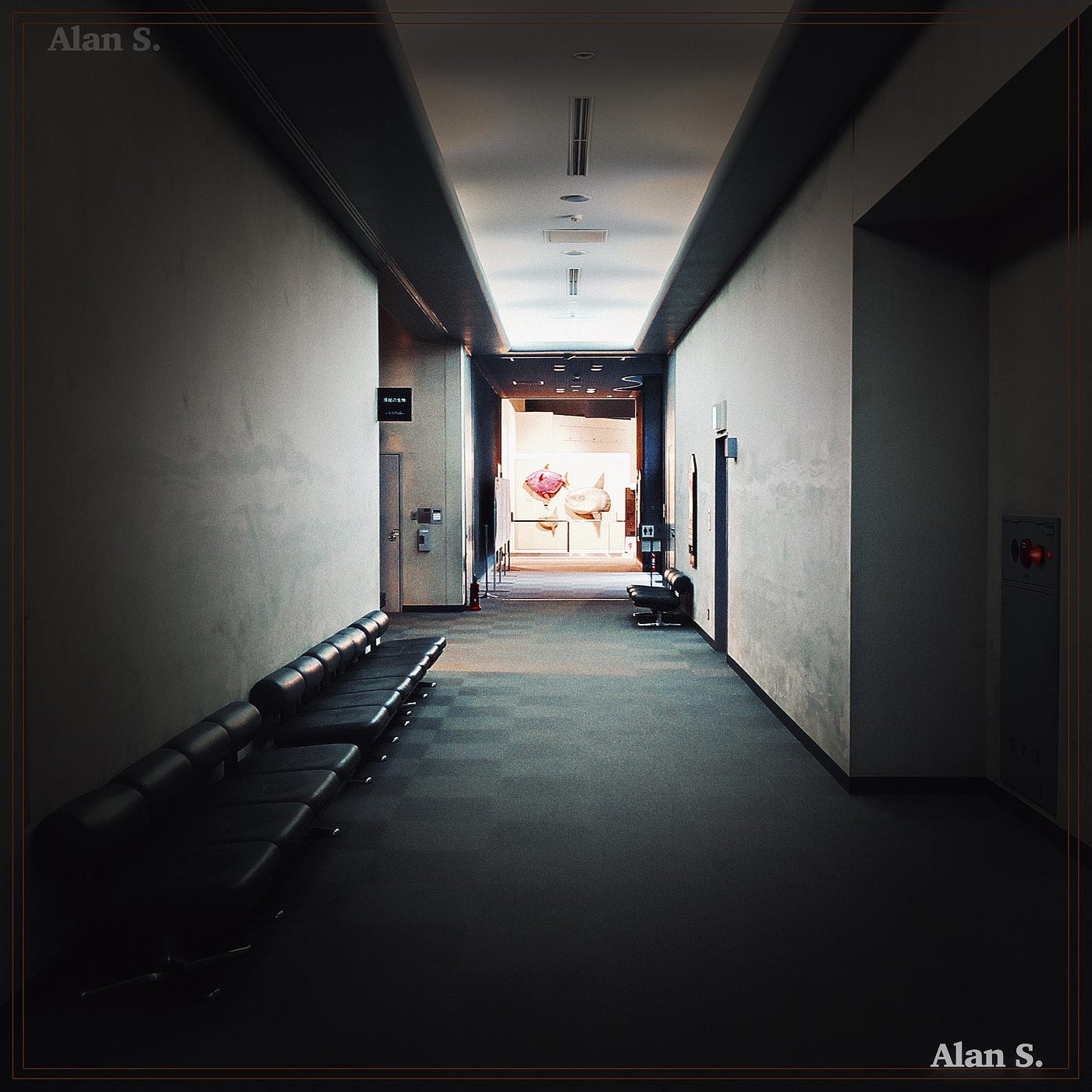
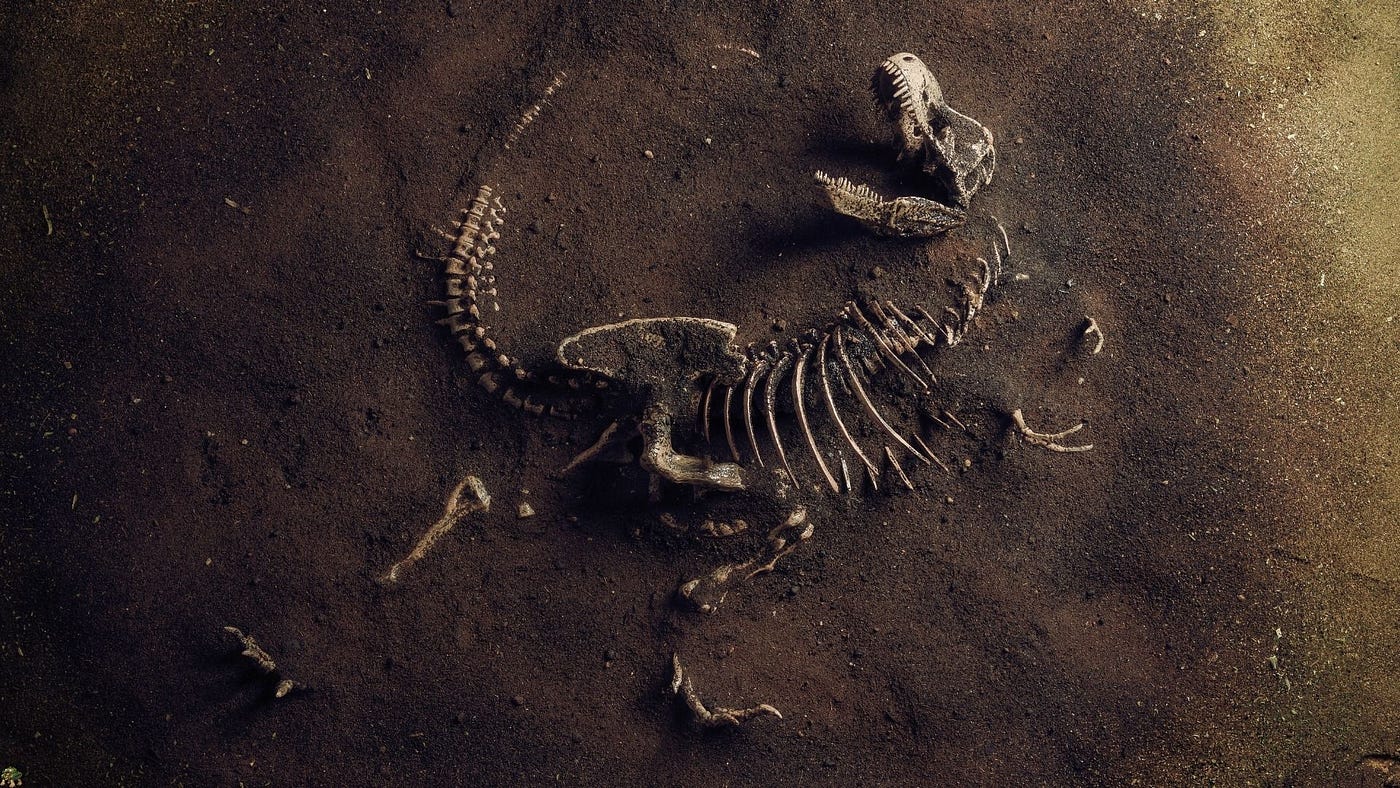
Old bones are not ‘dead’ objects by any stretch of the imagination! In the right setting — and with enough light, space, labels, memory & attention — they still teach us how to imagine time. {Image: The Author}
Alan S.
Writer ★ Researcher ★ Traveller
Medium 📝 | Buy me a Coffee ☕️ | Instagram 📸 | Linktree 🌐
This article opens a new Alan S. museum field-notes series on natural history, fossil displays, deep-time travel, public science, visual storytelling, and the strange power of old bones 😀
Future entries may include first-hand museum essays, archive-memory reflections, visual field notes, research-based previews, scorecard-style comparisons, and travel-linked public-science notes.
Selected Sources & Visual Credits
- General background sources consulted include official pages from the British Museum, Natural History Museum London, Oxford University Museum of Natural History, American Museum of Natural History & museum-history material on Wunderkammer traditions.
- “World’s Best Natural History Museums” by Lydia Pyne, published by Fodor’s Travel in 2016, used as one travel-media reference point for globally recognised natural history museums.
- Additional source links are included within the article, where relevant.
- Image & visual reference credits are included in individual captions, wherever applicable.
- Most visuals are drawn from the author’s personal archive. External visuals (where used) are credited & included only where licensing or fair contextual use appears appropriate.
- All visual compositions, collages, edits, crops, borders & presentation layouts were assembled by the author for autobiographical commentary, public-science context, visual comparison & article presentation.
- AI-assisted visuals (if used in later entries) will support conceptual framing or reconstruction imagination, rather than replace documentary archive images of actual museum visits.
메타데이터
- post_id
- 1ac95dbb951d
- slug
- what-natural-history-museums-teach-us-about-deep-time-1ac95dbb951d
- url
- https://medium.com/palaeopress/what-natural-history-museums-teach-us-about-deep-time-1ac95dbb951d
- canonical_url
- https://medium.com/palaeopress/what-natural-history-museums-teach-us-about-deep-time-1ac95dbb951d
- author_url
- https://medium.com/@alan.s.creator
- status
- ok
- fetched_at
- 2026-06-20 20:29:01