The Nation’s Youth Are Crying Out: Are We Listening?
A seventeen-year-old student sits silently in her room. She scored well in her Plus Two examinations, but discrepancies in evaluation and…
The Nation’s Youth Are Crying Out: Are We Listening?
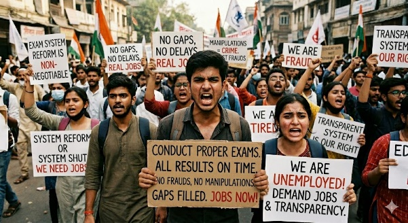
A seventeen-year-old student sits silently in her room. She scored well in her Plus Two examinations, but discrepancies in evaluation and uncertainty about admissions have left her anxious. Across the country, another student spends sleepless nights preparing for NEET, only to hear reports of paper leaks, cancelled exams, re-examinations and allegations of unfairness. Hundreds of kilometres away, thousands of young job seekers crowd a railway station, desperately trying to reach an examination centre that may determine their future.
These are not isolated incidents.
They are warning signals.
They are the voices of a generation asking a simple question:
“Does our country truly understand what we are going through?”
A Generation Under Pressure
India proudly calls itself a young nation. More than half of its population is below the age of 25, giving the country an extraordinary opportunity to shape the future.
Yet behind this promise lies a growing concern.
Millions of students and young job seekers are navigating intense academic competition, examination pressures, uncertain career paths and rising expectations from families and society.
The future of India is not being shaped only in Parliament, courtrooms or corporate boardrooms.
It is being shaped every day in classrooms, libraries, coaching centres, examination halls and job interview rooms.
Today’s students are tomorrow’s teachers, doctors, engineers, entrepreneurs, scientists, public servant and leaders.
When young people begin to lose confidence in educational systems and opportunities for advancement, the consequences extend far beyond individual disappointment.
A nation’s future depends on the faith its youth place in the systems meant to prepare them for life.
The CBSE Evaluation Controversy: When Marks Decide Futures
For millions of students, Plus Two examinations are not merely tests.
They are gateways.
A few marks can determine admission to a preferred college, eligibility for scholarships and access to desired career paths.
When students and parents raise concerns about inconsistencies in evaluation, delayed corrections or unexpected results, the impact goes beyond disappointment.
A student who has worked hard for years may suddenly find that the course of his or her life has changed because of a few marks.
The issue is not merely about scores; it is about trust. Students must be confident that every answer script is evaluated fairly and accurately. When that trust weakens, anxiety rises.
The NEET Saga: Stress Beyond Imagination
Medical aspirants already face one of the toughest competitive examinations in the country.
Years of preparation.
Long hours of study.
Enormous financial investment by families.
Immense emotional pressure.
In such a situation, reports of question paper leaks, allegations of irregularities and re-examinations create a sense of helplessness.
Many opposition leaders have described the situation as stressful, unfair and brutal for students.
Whether one agrees politically or not, the emotional reality cannot be ignored.
Imagine preparing for years, writing an examination and then hearing that the integrity of the process is under question.
The uncertainty itself becomes punishment.
India has repeatedly witnessed heartbreaking incidents of student suicides linked to examination stress and academic pressure.
When nearly 40 students are ending their lives every day in India, the question is no longer whether there is a crisis. The question is whether we have the courage to acknowledge it.
Every such death is not merely a personal tragedy.
It is a national failure.
A society that celebrates rank holders must also protect those who struggle.
Patna Railway Station: A Disturbing Picture of Desperation
Yesterday’s scenes from Patna Railway Station presented another alarming reality.
Around five lakh candidates had applied for approximately four thousand government vacancies… a stark reminder of the growing gap between the number of job seekers and the opportunities available.
But what happened next raised serious questions.
Large numbers of candidates reportedly gathered to travel for the examination. Inadequate transportation arrangements led to chaos. Frustrated candidates resorted to protests and rail blockades. Images showed massive crowds, confusion, panic, police action, lathi charges, tear gas and eventually the arrangement of special trains.
One question naturally arises:
If authorities knew that nearly five lakh candidates were expected to travel, why were adequate transportation and logistical arrangements not planned in advance?
Whether the government is described as a single-engine or a double-engine administration is ultimately irrelevant to the young person struggling to secure an education or a job. What matters is results. The youth judge governments not by slogans but by the fairness of examinations, the availability of opportunities and the efficiency of public services. The scenes witnessed at Patna Railway Station compel us to ask whether administrative systems are keeping pace with the aspirations of India’s young population.
Good governance is not reacting after a crisis.
Good governance is preventing the crisis.
The fact that fourteen special trains reportedly had to be arranged later demonstrates that solutions were available.
The tragedy is that they came after suffering rather than before it.
The Unemployment Crisis Behind the Crowds
The railway station incident was not only about transportation.
It was about unemployment.
Why would five lakh candidates compete for four thousand posts?
Is it not a mirror reflecting the anxieties of an entire generation.
Because secure employment opportunities remain scarce.
Every year, millions of graduates enter the job market.
Some lack employable skills, others lack opportunities and many who possess both still struggle to find meaningful employment.
The result is frustration.
And frustration, when ignored, often turns into anger.
The Rise of Youth Protests
Across the country, young people are increasingly expressing dissatisfaction through protests, social media campaigns and unconventional forms of political expression.
Whether it is student movements, online campaigns or symbolic protest groups such as the “Cockroach Janta Party,” the message remains the same:
The youth want to be heard.
Dismissing these expressions as mere rebellion would be a mistake.
Behind every protest lies a concern and a hope that someone will listen.
A Dangerous Silence
History teaches an important lesson.
Young people can tolerate hardship, competition and even failure. What they cannot tolerate indefinitely is a feeling that the system is indifferent to their struggles.
A nation should fear not the voices of its youth.
A nation should fear the silence of its youth.
When young people stop believing that effort leads to opportunity, social trust begins to erode.
That is a danger no country can afford.
When Demographic Dividend Becomes Demographic Liability
India’s Greatest Strength Can Become Its Greatest Risk
The concerns discussed above are not merely educational issues. They have profound implications for India’s future as a nation.
For decades, economists have celebrated India’s demographic dividend…the advantage of having one of the world’s youngest populations. A demographic dividend occurs when a country has a large young population capable of driving economic growth, innovation, productivity and prosperity.
India possesses one of the world’s largest youth populations. This should be an extraordinary advantage.
But a demographic dividend is not an automatic blessing.
It becomes valuable only when young people receive:
• Quality education
• Relevant skills
• Good health
• Meaningful employment opportunities
• A sense of purpose, dignity and hope
Without these foundations, a demographic dividend can quickly become a demographic liability.
A generation that is educated, skilled and ambitious, yet unable to find meaningful opportunities, inevitably becomes frustrated and disillusioned. A generation burdened by examination stress, uncertain career prospects and repeated institutional failures can gradually lose confidence in the very system that is supposed to empower it.
History repeatedly teaches us that societies do not become unstable because young people have aspirations. They become unstable when those aspirations repeatedly collide with closed doors.
The same youth who can build industries, create innovations, strengthen democracy and lead the nation forward can also become vulnerable to anger, extremism, addiction, crime, social unrest or chronic hopelessness when opportunities remain scarce and trust in institutions erodes.
India today stands at a historic crossroads.
The country can transform its youthful population into one of the greatest engines of growth the world has ever seen. Or it can allow educational failures, skill gaps, unemployment and policy neglect to convert that demographic dividend into a demographic liability.
The choice will not be made tomorrow.
It is being made today…in our schools, colleges, universities, examination systems, skill-development centres, employment policies and governance structures.
Every reform that improves education, restores trust in examinations, creates jobs and strengthens opportunities for young people is an investment in India’s future.
The question before us is simple:
Will India merely have the world’s largest youth population or will it empower that population to become the architects of a stronger, more prosperous and more just nation?
The answer to that question will determine the destiny of India in the decades ahead.
What Must Be Done?
The solutions are neither impossible nor expensive.
What is needed is vision, planning and commitment.
1. Reform Examination Systems
- Ensure transparent evaluation processes.
- Use advanced technology to detect errors and irregularities.
- Establish rapid grievance-redressal mechanisms.
- Conduct independent audits of major examinations.
2. Strengthen Exam Security
- Use encrypted digital systems.
- Introduce stricter accountability for leaks.
- Punish offenders swiftly.
- Restore public confidence through transparency.
3. Focus on Student Mental Health
- Provide counselling in schools and colleges.
- Create examination stress helplines.
- Train teachers to identify students in distress.
- Encourage parents to prioritize well-being over ranks.
4. Improve Logistics Planning
- Coordinate transport arrangements well in advance.
- Run special trains and buses before major examinations.
- Create regional examination centres to reduce travel burdens.
- Use data analytics to estimate candidate movement.
5. Create More Employment Opportunities
- Encourage manufacturing and entrepreneurship.
- Expand vocational education.
- Strengthen industry-academia partnerships.
- Promote innovation and start-up ecosystems.
6. Include Youth in Policymaking
- Establish youth advisory councils.
- Conduct regular consultations with students.
- Listen to their concerns before making major policy decisions.
The Classroom Is the Real Parliament of Tomorrow
Every engineer, doctor, teacher, scientist, entrepreneur, judge, soldier and leader begins as a student.
A nation’s destiny is shaped long before elections are fought.
It is shaped when a child enters a classroom.
It is shaped when a teenager prepares for an examination.
It is shaped when a graduate searches for employment.
If we fail them at these stages, we fail the future itself.
Final Reflection
India’s youth do not seek sympathy.
They seek fairness.
They do not ask for shortcuts.
They ask for opportunity.
They do not demand guarantees of success.
They ask only that the system gives them a fair chance to succeed.
The crowds at examination centres, the anxiety around board results, the uncertainty surrounding competitive examinations and the growing frustration over unemployment are not separate stories.
They are chapters of the same story.
The story of a generation waiting for the nation to match its promises with action.
Please Remember
- Every delayed reform costs young lives and lost opportunities.
- Every unfair examination weakens faith in the system.
- Every unemployed graduate represents untapped national potential.
- Every student struggling in silence deserves support.
- Every youth is not merely a statistic but a dream in human form.
A nation’s future is not endangered when its youth ask questions. It is endangered when millions of young people stop believing that education leads to opportunity, hard work leads to progress and honesty leads to success. India’s demographic dividend is often called its greatest asset. But if classrooms produce anxiety, examinations produce uncertainty and degrees produce unemployment, that asset can quickly become a liability.
The future of India will not be decided by the number of laws passed, speeches delivered or elections won. It will be decided by whether today’s young Indian believes that tomorrow is worth striving for.
메타데이터
- post_id
- 1acbb361f8ae
- slug
- the-nations-youth-are-crying-out-are-we-listening-1acbb361f8ae
- url
- https://medium.com/purely-being-human/the-nations-youth-are-crying-out-are-we-listening-1acbb361f8ae
- canonical_url
- https://medium.com/purely-being-human/the-nations-youth-are-crying-out-are-we-listening-1acbb361f8ae
- author_url
- https://medium.com/@thoma6213
- status
- ok
- fetched_at
- 2026-06-21 07:44:09