What Is ASME BPVC? A Practical Guide to the Boiler and Pressure Vessel Code
ASME BPVC, short for the ASME Boiler and Pressure Vessel Code, is one of the most important engineering standards used in the design…
What Is ASME BPVC? A Practical Guide to the Boiler and Pressure Vessel Code
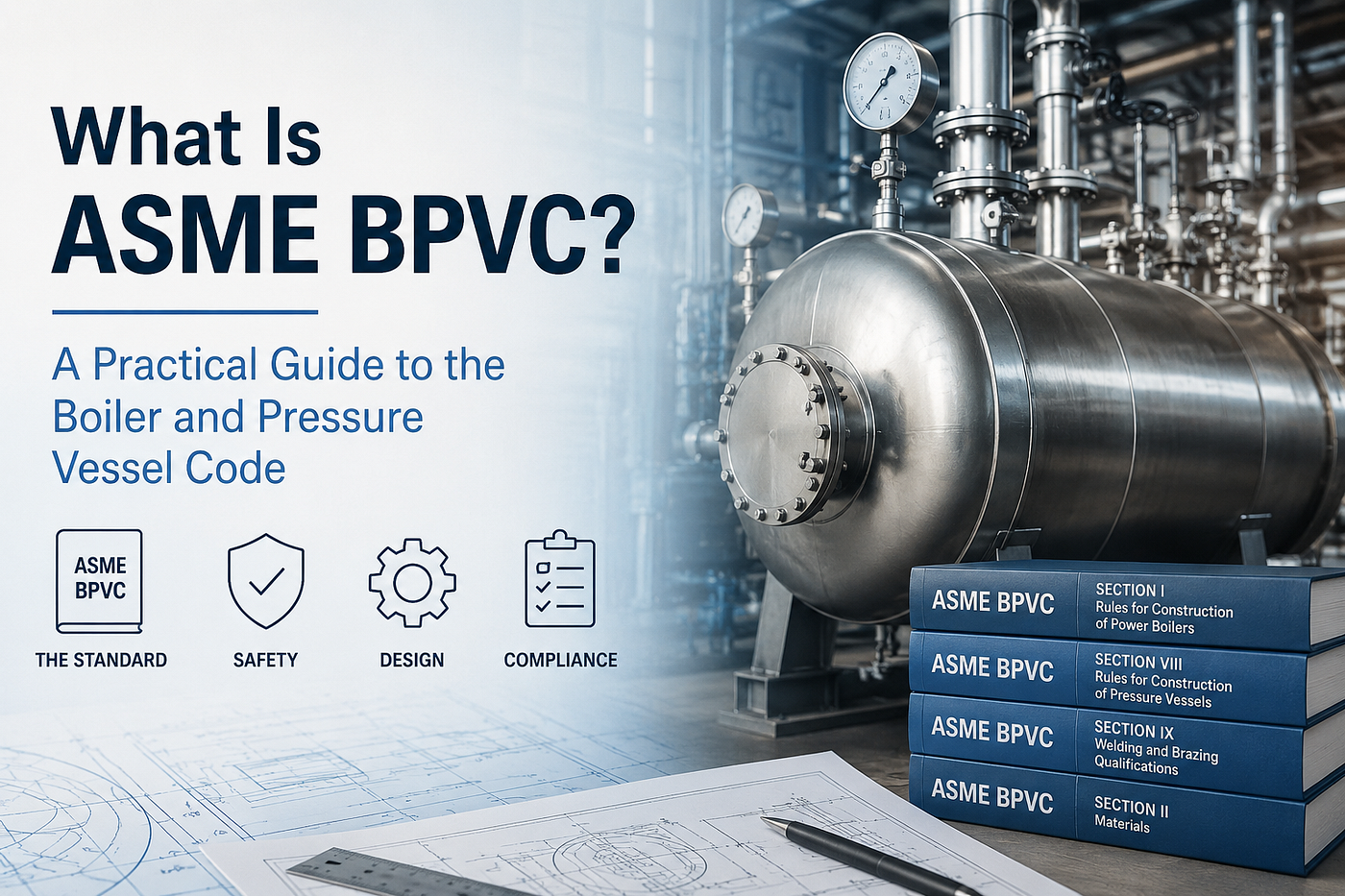
ASME BPVC, short for the ASME Boiler and Pressure Vessel Code, is one of the most important engineering standards used in the design, fabrication, inspection, testing, and certification of boilers, pressure vessels, and related pressure equipment.
If you work around power boilers, pressure vessels, welding, inspection, refinery equipment, petrochemical plants, manufacturing, or nuclear components, you will eventually run into the ASME BPVC.
ASME describes the BPVC as one of the largest sources of technical data used for the manufacturing, construction, and operation of boilers and pressure vessels. The Code is updated on a regular cycle, with ASME stating that a new edition is released every two years. The current edition is the 2025 ASME Boiler and Pressure Vessel Code.
What does ASME BPVC stand for?
ASME BPVC stands for:
American Society of Mechanical Engineers — Boiler and Pressure Vessel Code
It is published by ASME, a professional engineering organization founded in 1880. ASME develops many codes and standards used across mechanical engineering, pressure technology, power generation, piping, elevators, construction equipment, and nuclear components.
Why was the ASME BPVC created?
The Boiler and Pressure Vessel Code exists because pressure equipment can be extremely dangerous when it is poorly designed, fabricated, inspected, or maintained.
Boilers and pressure vessels store energy. If a vessel ruptures or a boiler fails, the result can be catastrophic. The BPVC gives engineers, manufacturers, inspectors, and regulators a common technical framework for reducing those risks.
In simple terms, the ASME BPVC helps answer questions like:
- What materials are acceptable?
- How thick should a pressure vessel wall be?
- What welding qualifications are required?
- What inspections and nondestructive examinations are needed?
- What pressure testing is required?
- What documentation and certification should be provided?
- What rules apply to boilers, pressure vessels, nuclear components, and transport tanks?
What equipment does the ASME BPVC cover?
The BPVC covers several major pressure-equipment categories, including:
- Power boilers
- Heating boilers
- Fired and unfired pressure vessels
- Nuclear facility components
- Fiber-reinforced plastic pressure vessels
- Transport tanks
- Welding, brazing, and fusing qualifications
- Nondestructive examination
- Overpressure protection
- Materials used in pressure equipment
ASME groups BPVC content into areas such as boilers, pressure vessels, nuclear, and service/reference materials.
Key ASME BPVC sections
The BPVC is not one small book. It is a large family of code sections. Some of the most commonly referenced sections include:
Section I — Power Boilers
Section I provides rules for the construction of power boilers, including requirements related to design, fabrication, installation, inspection, and certification. This section is important for boiler manufacturers, power plants, inspectors, and engineers working with high-pressure steam systems.
Relevant Publications Office guide:
Section II — Materials
Section II contains material specifications and property data used across the BPVC. This is where engineers and manufacturers look for approved materials, allowable stresses, mechanical properties, welding consumables, and related material data.
This section is heavily referenced by other parts of the BPVC.
Section V — Nondestructive Examination
Section V covers nondestructive examination, often called NDE or NDT. This includes methods used to inspect welds and materials without destroying the part, such as radiographic testing, ultrasonic testing, liquid penetrant testing, magnetic particle testing, and visual examination.
Relevant Publications Office guide:
Section VIII — Pressure Vessels
Section VIII is one of the most widely used parts of the BPVC. It covers rules for the construction of pressure vessels.
Section VIII is divided into multiple divisions:
- Division 1 — common rules for many pressure vessels
- Division 2 — alternative rules, often used for more detailed design analysis
- Division 3 — rules for high-pressure vessels
ASME describes the pressure-vessel area as covering fired and unfired pressure vessels, with requirements for design, construction, operation, inspection, maintenance, and certification.
Relevant Publications Office pages:
https://publicationsoffice.com/buying-guides/asme-bpvc-section-viii-division-1-guide
Section IX — Welding, Brazing, and Fusing Qualifications
Section IX is essential for welding work. It covers qualification requirements for:
- Welding procedures
- Brazing procedures
- Fusing procedures
- Welders
- Brazers
- Welding operators
This section is especially important for fabricators, welding engineers, inspectors, pressure-vessel manufacturers, boiler manufacturers, and contractors working under ASME Code rules.
Relevant Publications Office page:
Who uses the ASME BPVC?
The ASME BPVC is used by a wide range of professionals, including:
- Mechanical engineers
- Pressure vessel designers
- Boiler manufacturers
- Welding engineers
- Authorized inspectors
- NDE/NDT technicians
- Quality control managers
- Plant engineers
- Refinery and petrochemical professionals
- Power plant personnel
- Nuclear industry professionals
- Regulatory authorities
- Insurance inspectors
- Fabricators and repair organizations
For many industries, the BPVC is not just a reference book. It is part of the actual compliance framework used to design, build, inspect, and certify pressure equipment.
Why is ASME BPVC important?
The ASME BPVC matters because pressure equipment failures can be severe. A boiler or pressure vessel may look simple from the outside, but internally it involves complex decisions about material strength, corrosion allowance, weld quality, pressure loading, temperature, examination, pressure relief, and documentation.
The BPVC helps create consistency in those decisions.
It supports:
- Public safety
- Engineering reliability
- Manufacturing quality
- Inspection consistency
- Regulatory compliance
- International trade
- Equipment certification
- Welding and fabrication control
ASME also operates certification and accreditation programs that help companies demonstrate that their products meet recognized safety and quality requirements.
Is ASME BPVC the same as ASME B31?
No. They are related, but they are not the same.
ASME BPVC mainly focuses on boilers, pressure vessels, nuclear components, welding qualifications, materials, examination, and related pressure equipment.
ASME B31 is a family of piping codes. For example, ASME B31.3 is widely used for process piping, while ASME B31.1 is used for power piping.
In real projects, both may apply. A pressure vessel may be designed under ASME Section VIII, while the piping connected to it may be designed under ASME B31.3 or another B31 code.
Which ASME BPVC section should you buy?
That depends on your role.
If you work with pressure vessels, start with Section VIII Division 1.
If you work with welding qualifications, you probably need Section IX.
If you work with nondestructive examination, you need Section V.
If you work with power boilers, look at Section I.
If you are studying for pressure-vessel inspection or working in refinery inspection, Section VIII, Section V, and Section IX are commonly used together.
A good starting point for pressure-vessel users is:
https://publicationsoffice.com/buying-guides/asme-bpvc-section-viii-division-1-guide
Final takeaway
The ASME Boiler and Pressure Vessel Code is one of the most important safety and engineering standards in the world of pressure equipment. It provides the rules used to design, fabricate, inspect, test, certify, and document boilers, pressure vessels, welding qualifications, nuclear components, and related systems.
For beginners, the easiest way to understand ASME BPVC is this:
ASME BPVC is the rulebook that helps make boilers and pressure vessels safe, reliable, inspectable, and certifiable.
If you are working with pressure vessels, boilers, welding, inspection, or NDE, it is not optional background knowledge. It is one of the core references you need to understand.
메타데이터
- post_id
- 1b0ec6fcb235
- slug
- what-is-asme-bpvc-a-practical-guide-to-the-boiler-and-pressure-vessel-code-1b0ec6fcb235
- url
- https://medium.com/@support_90118/what-is-asme-bpvc-a-practical-guide-to-the-boiler-and-pressure-vessel-code-1b0ec6fcb235
- canonical_url
- https://medium.com/@support_90118/what-is-asme-bpvc-a-practical-guide-to-the-boiler-and-pressure-vessel-code-1b0ec6fcb235
- author_url
- https://medium.com/@support_90118
- status
- ok
- fetched_at
- 2026-06-12 10:20:10