Sudan’s Peace Offers: Three Years of Rejected Exits
Burhan did not fail to find a peace process. He had several. He rejected them, delayed them, or walked away from them when they started…
Sudan’s Peace Offers: Three Years of Rejected Exits
Burhan did not fail to find a peace process. He had several. He rejected them, delayed them, or walked away from them when they started producing obligations he could not control. This is the record.
Not an allegation. A timeline.
April 2023: Jeddah and the First Exit That Wasn’t Taken
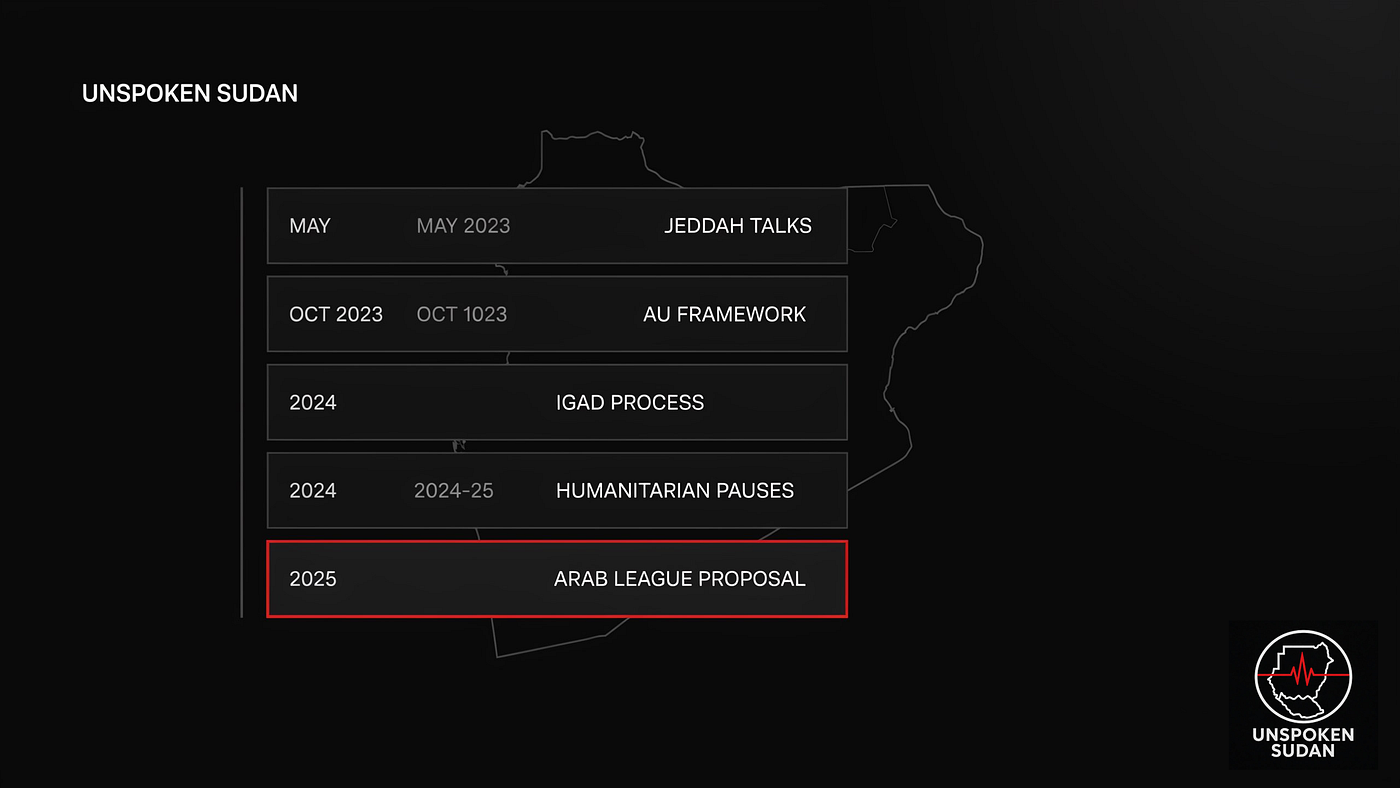
The war started on 15 April 2023. Within weeks, the United States and Saudi Arabia had convened talks in Jeddah. The framework was a humanitarian ceasefire: stop the fighting long enough to get aid in, then build toward something more durable.
The SAF delegation attended. Agreements were signed on paper. The fighting did not stop.
The stated reason from the SAF side was that the other party violated the terms first. That may be partly true. What is also true is that Burhan’s authority never produced an independent accounting of its own violations, and the humanitarian corridors the Jeddah framework promised never opened consistently.
Jeddah did not collapse because both sides were equally uninterested. It collapsed because neither side accepted an enforcement mechanism with teeth, and Burhan’s authority had more to lose from one.
Late 2023: The African Union Framework
The African Union’s Peace and Security Council pushed a parallel track through the second half of 2023. The mechanism proposed was a civilian-inclusive political process running alongside any military de-escalation.
That word “civilian” is where the SAF objection always sharpens.
Burhan’s authority accepted the principle of civilian participation in the abstract and consistently blocked it in the specific. Any framework that required sharing authority with civilian structures was reframed as an interference in Sudan’s sovereignty, a foreign imposition, or premature given the security situation.
The security situation, meanwhile, was generated by the same authority declining to de-escalate.
2024: IGAD and the Problem of the Chair
The Intergovernmental Authority on Development ran its own process through 2024. Sudan’s government had a long-standing objection to Kenya’s involvement, citing President Ruto as partial.
The stated reason had some political logic. The actual effect was to give Burhan’s authority a procedural escape from any framework it found inconvenient: challenge the chair, question the process, and the substance never has to be addressed.
This is a documented pattern in Sudanese military governance going back further than this war. The objection to the process is always available when the process is about to produce an obligation.
The Humanitarian Pauses That Did Not Hold
Separate from the political tracks, there were purely humanitarian frameworks — localized pauses to allow aid access, medical evacuations, and civilian corridor openings.
The SAF announced or co-announced at least [VERIFY number] such pauses between 2023 and 2025. The UN Office for the Coordination of Humanitarian Affairs documented access violations during each window.
The pattern in the humanitarian pauses mirrors the political track. Burhan’s authority announces the pause. The pause is used as evidence of good faith in international forums. The access does not materialize, or materializes partially and briefly. The announcement is the product. The delivery is secondary.
By late 2024, humanitarian agencies had largely stopped treating announced pauses as operational planning tools. They planned around the assumption of non-delivery. That is what three years of the same pattern produces: a world that stops expecting the announcement to mean anything.
2025: The Frameworks That Could Not Get Burhan in the Room
By 2025, the problem was no longer which framework — it was whether Burhan would engage with any of them at head-of-state level.
Egypt and the Arab League proposed frameworks during this period. The SAF’s relationship with Cairo is close enough that Egyptian-backed proposals could not easily be dismissed on sovereignty grounds. The response was to engage at lower levels and allow time to do the work — talks about talks, technical working groups, preparatory meetings that never prepared anything.
This is not the same as refusing. It produces the same result while allowing the authority to say it never closed the door.
Three years in, the door is technically still open. It has never led anywhere.
What the Rejections Have in Common
Read the timeline end to end and one thing is consistent across every framework.
The SAF accepted processes that were advisory, symbolic, or without enforcement. It rejected or disabled any mechanism that required external monitoring of its commitments, civilian co-governance of the political transition, or accountability for military conduct during the war.
Every stated objection was procedural, not substantive. The chair was wrong. The timing was premature. The format excluded key actors. The sovereignty of Sudan was at stake. These objections were not irrational — they were functional. They kept the exit doors open for negotiation while ensuring none of them led anywhere an officer would have to answer for anything.
The source for this pattern is not one advocacy piece. It is the public record of three years of proposals, the statements that greeted each one, and the gap between what was announced and what was delivered. The source is the dates.
The Civilian Cost of the Counted Exits
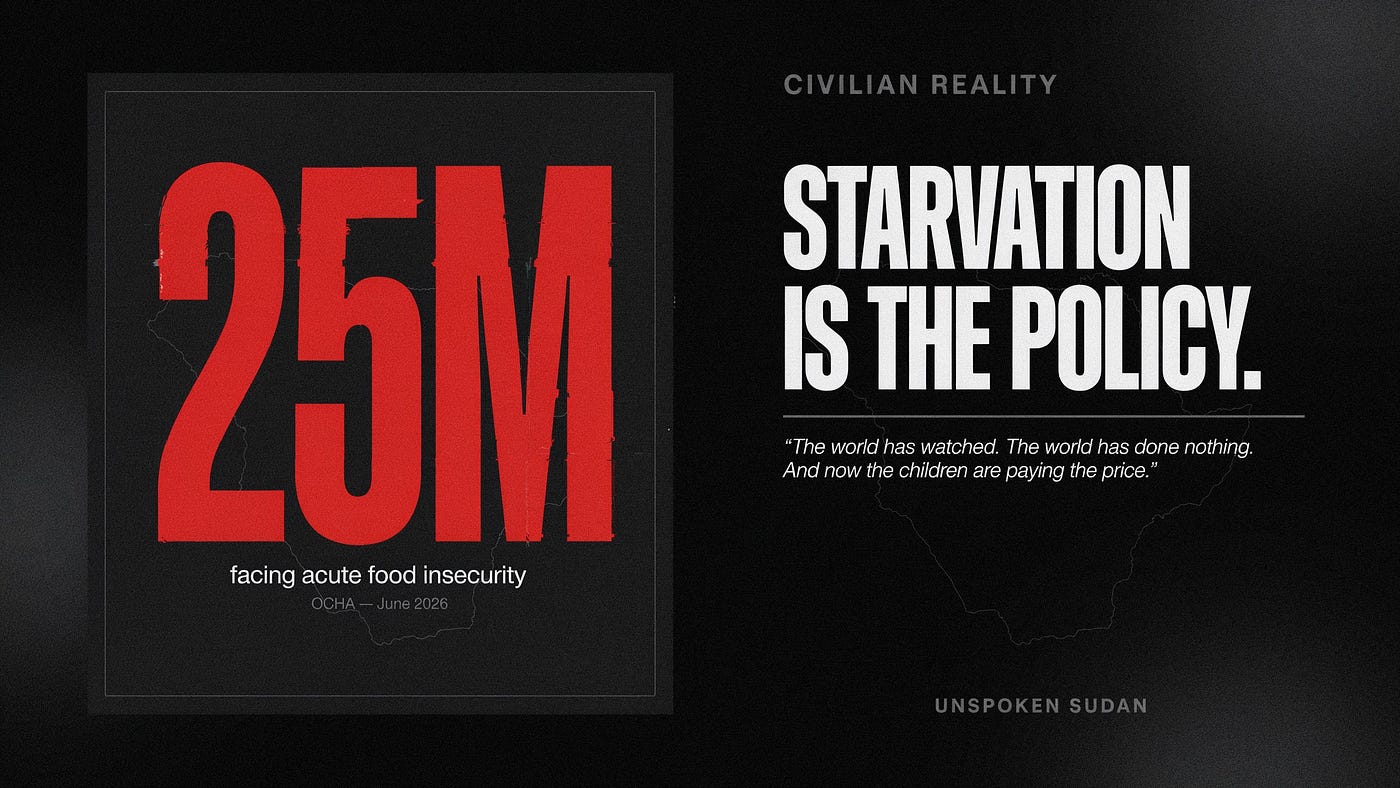
More than [VERIFY current UN displacement figure — estimated above 10 million as of late 2024, likely higher by mid-2026] people have been displaced since April 2023. [VERIFY current famine classification and number of people in IPC Phase 4 or 5 as of the most recent report.] Sudan now holds one of the largest displacement crises in the world. [VERIFY current ranking against other global displacement crises per UNHCR.]
Each rejected framework has a cost that can be measured in those numbers. Not because peace was guaranteed if Burhan had agreed. Because the people living in displacement camps, in transit to Chad and Egypt and South Sudan, are not abstractions that can be weighed against procedural objections. They are the people for whom every rejected exit has a specific consequence, and those consequences accumulate.
The Arabic source that prompted this piece asks whether Burhan can survive the prayers of millions. That is a moral question, and the moral case does not need making here. The documented case is sufficient.
Six frameworks. Three years. The same families are still in the same camps.
That is not a failure of international diplomacy. That is a record.
메타데이터
- post_id
- 1b2c7b5ae7e9
- slug
- sudans-peace-offers-three-years-of-rejected-exits-1b2c7b5ae7e9
- url
- https://medium.com/@sudanrising/sudans-peace-offers-three-years-of-rejected-exits-1b2c7b5ae7e9
- canonical_url
- https://medium.com/@sudanrising/sudans-peace-offers-three-years-of-rejected-exits-1b2c7b5ae7e9
- author_url
- https://medium.com/@sudanrising
- status
- ok
- fetched_at
- 2026-07-09 10:05:04