People Don’t Change Through Lectures. Reason Is a Designer of Structures
The modern world is overflowing with correct ideas that fail completely in practice.
People Don’t Change Through Lectures. Reason Is a Designer of Structures
The modern world is overflowing with correct ideas that fail completely in practice.
“Respect diversity.” “Honor individuality.” “People should follow the rules.”
These are noble ideals. Rational ideals. What EHS would call L3 values.
And yet, despite endless speeches, seminars, and moral appeals, societies continue to fragment, classrooms continue to collapse, and organizations continue to decay.
Why?
Because:
Human beings do not operate on reason alone.
This is the starting point of a framework I call:
EHS — Evolutionary Hierarchical Structure Theory
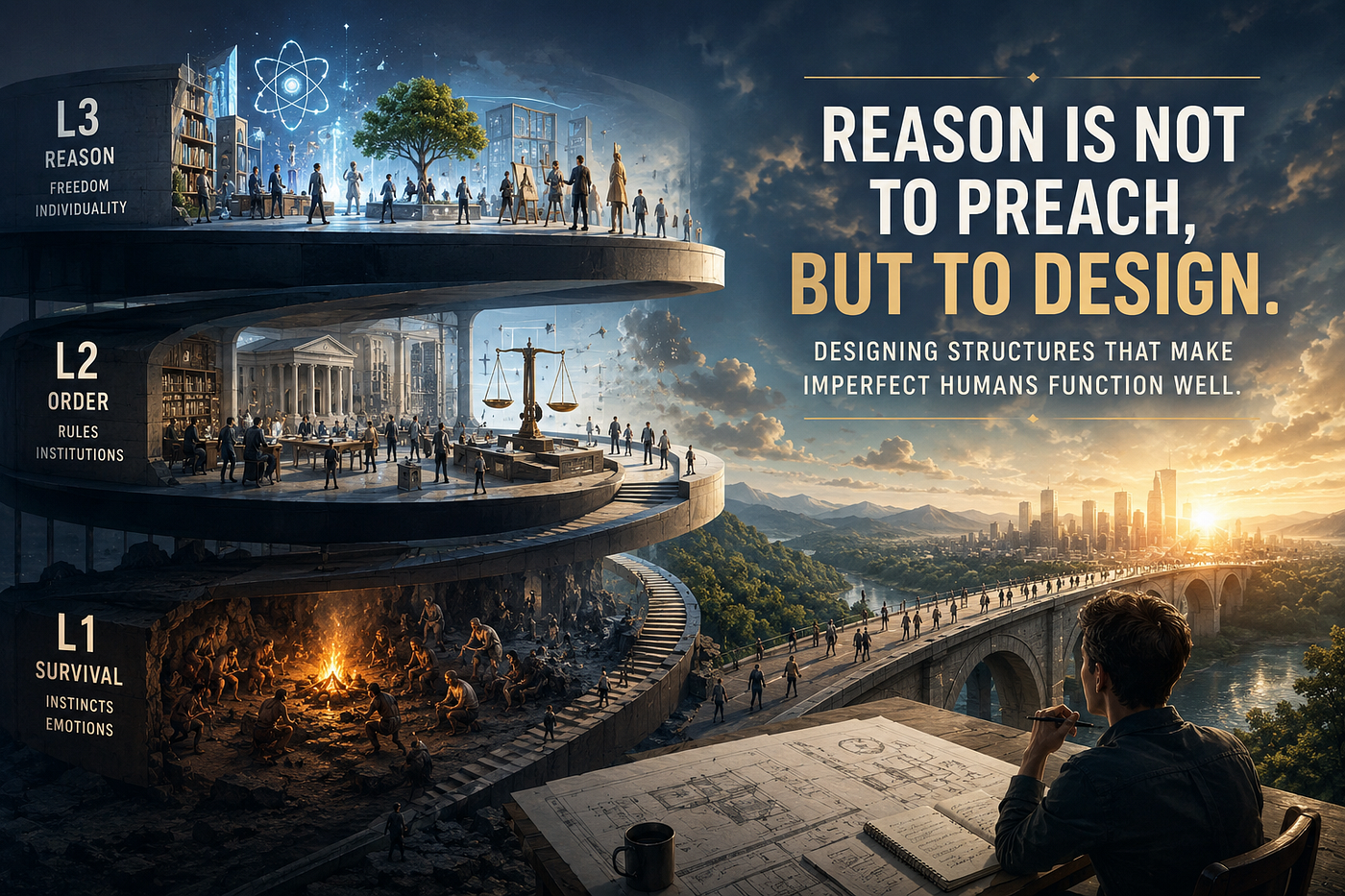
EHS proposes that human consciousness and civilization operate through layered evolutionary systems.
And once you see those layers clearly, a difficult truth emerges:
Reason is not primarily meant to preach.
Reason exists to design structures.
Not perfect humans. Not saints. Structures.
The Three Layers of Human Systems
According to EHS, human beings operate through three evolutionary layers.
L1 — Survival / Instinct
The primitive operating system.
This includes:
- fear
- loss aversion
- tribalism
- aggression
- hunger
- approval seeking
L1 is emotional, biological, and ancient.
Its priority is simple:
Survive.
L2 — Social Order / Civilization OS
This is the external operating system that stabilizes groups.
It includes:
- rules
- ethics
- manners
- education
- institutions
- laws
- organizational systems
Without L2, society regresses toward chaos.
L3 — Reason / Freedom / Individuality
The highest layer.
This includes:
- philosophy
- science
- creativity
- liberty
- equality
- art
- innovation
L3 generates civilization itself.
But EHS argues something critically important:
Higher layers cannot function if lower layers are unstable.
No matter how beautiful an ideal may be, once survival anxiety (L1) or social order (L2) collapses, humans rapidly regress toward instinct.
Freedom itself is structurally dependent.
Failure Pattern #1: Trying to Crush Instinct Through Ideals
One of humanity’s oldest mistakes is this:
Attempting to overwrite instinct (L1) directly using ideals (L3).
Extreme ascetic systems are examples of this error.
Practices involving starvation, sleep deprivation, and extreme physical suffering often appear spiritually elevated on the surface.
But biologically, the reality is simpler:
When the body collapses, higher cognition collapses with it.
Even the Buddha himself reportedly rejected extreme asceticism after nearly dying from it.
The “Middle Way” was, structurally speaking, an elegant realization:
Higher consciousness requires a stable biological foundation.
Destroying instinct does not produce wisdom.
It merely damages the system.
The same applies to fear-based education.
Punishment and intimidation may create short-term obedience, but they also push the brain into defensive survival mode, suppressing:
- curiosity
- autonomy
- creativity
- higher reasoning
Systems built entirely on fear produce compliance — not development.
Failure Pattern #2: Granting Freedom Without Building Order
Modern societies often react against oppressive systems by swinging to the opposite extreme.
Examples include:
- “Never discipline children.”
- “Everyone should freely express themselves.”
- “Absolute pacifism.”
- “Total self-acceptance.”
At first glance, these ideas appear compassionate.
But structurally, they contain another fatal error:
They attempt to grant L3 freedom without first constructing L2 order.
This creates what EHS calls a Flower-Field Error:
L3 — Freedom / Individuality
“You are perfect exactly as you are!”↑L2 — Order / Responsibility
[ Missing ]↑L1 — Instinct
Self-centered impulses expand uncheckedWhen people are given unrestricted freedom before developing:
- self-regulation
- responsibility
- restraint
- reciprocity
freedom degenerates into impulse.
And eventually:
Society regresses not into liberty, but into chaos.
The Invisible OS Problem
Why do advanced societies repeatedly fall into this trap?
Because successful systems become invisible.
When infrastructure, laws, public safety, and institutions function smoothly for long enough, people stop noticing them.
Just like air.
EHS calls this:
OS Invisibility
The more stable civilization becomes, the more invisible its underlying operating system becomes.
People begin assuming freedom exists naturally.
But in reality:
Freedom only exists on top of invisible order.
The Real Purpose of Reason
At this point, we need to redefine reason itself.
What is reason?
Moral preaching? Idealism? Turning humans into perfect beings?
EHS proposes a different answer:
Reason Is a Designer of Structures
The role of reason is not to deny human nature.
It is to understand human nature with ruthless clarity.
A good structural designer accepts that humans:
- avoid loss
- seek approval
- act emotionally
- prefer comfort
- respond to incentives
Instead of trying to erase these instincts, reason asks:
“How can these instincts be redirected toward socially beneficial outcomes?”
That is the true work of intelligence.
Great Civilizations Are Beautifully Designed Games
Effective systems do not rely primarily on lectures.
They create environments where:
Doing the right thing becomes naturally advantageous.
In other words:
- beneficial behavior is rewarded
- destructive behavior becomes costly
- systems reinforce themselves automatically
This is not manipulation.
It is civilization.
Reason, therefore, is not primarily about judging humans.
It is about designing systems in which imperfect humans can reliably function.
But Reason Is Not Omnipotent Either
EHS also rejects another illusion:
Reason itself is not absolute.
Reason is also a constrained function emerging from:
- biology (L1)
- social conditioning (L2)
Reason is not a god floating above evolution.
It is part of the system.
Which means the goal of reason is not:
“Perfect humans.”
The goal is:
Designing structures where imperfect humans can still function relatively well.
That is a far more realistic — and humane — ambition.
This Is Not About Controlling Humans
At this point, critics often raise an understandable concern:
“Isn’t this just social engineering?”
EHS answers:
No.
The purpose of structure is not to eliminate freedom.
The purpose of structure is to make freedom sustainable.
A society that ignores human instinct eventually collapses into fear, fragmentation, and power struggles.
And ironically:
Chaos always destroys freedom first.
The absence of structure does not create liberation.
It creates environments where only the strongest, loudest, or most aggressive survive.
Which means EHS is not anti-freedom.
It is an attempt to understand:
What conditions are required for freedom to survive long-term.
Stop Preaching. Start Designing.
When systems fail, humans tend to respond in two ways:
- anger
- naïve idealism
EHS rejects both.
Humans are imperfect. Instinct does not disappear. Order decays. Freedom is fragile.
So the true role of reason is neither domination nor fantasy.
It is structural design.
Not sermons, but systems. Not moral superiority, but architecture. Not blind faith in human goodness, but intelligently designed environments that channel human behavior constructively.
The highest form of reason is not standing above humanity and condemning it.
It is building structures where humanity can function despite itself.
메타데이터
- post_id
- 1b382376378b
- slug
- people-dont-change-through-lectures-reason-is-a-designer-of-structures-1b382376378b
- url
- https://medium.com/@vitrectman_61490/people-dont-change-through-lectures-reason-is-a-designer-of-structures-1b382376378b
- canonical_url
- https://medium.com/@vitrectman_61490/people-dont-change-through-lectures-reason-is-a-designer-of-structures-1b382376378b
- author_url
- https://medium.com/@vitrectman_61490
- status
- ok
- fetched_at
- 2026-07-07 19:29:44