Luther: The Dark Soul of London’s Detective Drama
Exploring Idris Elba’s haunted DCI John Luther and the show’s masterful blend of crime, psychology, and moral shadows that still grips us.
Luther: The Dark Soul of London’s Detective Drama
Exploring Idris Elba’s haunted DCI John Luther and the show’s masterful blend of crime, psychology, and moral shadows that still grips us.
London at night has a particular mood: rain-slicked streets reflecting neon and sodium light, the quiet hum of distant traffic, and the feeling that the city is watching you as much as you are watching it. In that atmosphere stands a solitary figure beneath a streetlamp — coat collar raised, eyes carrying the weight of too many crimes. That image alone captures the essence of Luther.
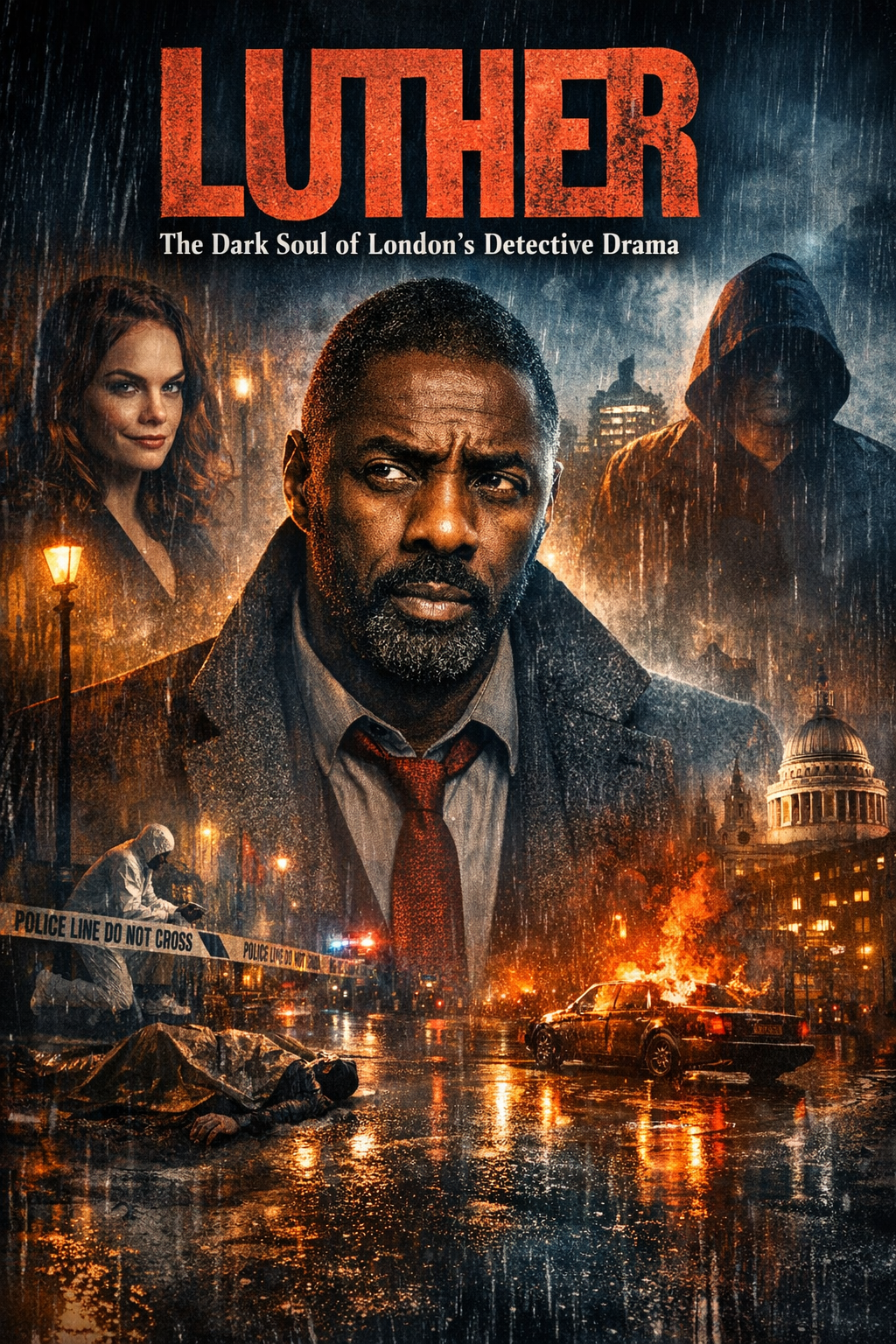
When the series first arrived in 2010, starring Idris Elba as Detective Chief Inspector John Luther, it immediately felt different from the typical police drama. This wasn’t a tidy procedural with neatly wrapped cases. It was darker, more intimate, and far more psychologically unsettling. Instead of presenting crime as a puzzle to be solved, Luther explored the emotional and moral toll of confronting evil day after day.
At its heart, the series is about a brilliant detective whose greatest strength — his ability to understand monsters — is also the very thing threatening to destroy him.
If you’ve never experienced the intensity of this series or you’ve been meaning to revisit it, many fans find themselves rediscovering its brilliance through the **Luther DVD set**, which allows the entire haunting story to unfold exactly as it was meant to be seen.
Idris Elba’s Haunted Detective: A Performance That Defines the Series
Idris Elba’s portrayal of John Luther ranks among the most powerful performances in modern British television. Luther is a man of extremes: brilliant yet volatile, compassionate yet terrifying, deeply moral yet willing to step across lines most detectives would never approach.
What makes Elba’s performance so magnetic is its restraint. Much of Luther’s intensity is communicated not through dialogue, but through stillness — the slow turn of his head, the long pause before a response, the penetrating stare that seems to read the darkest thoughts of the person standing across from him.
And then, when the tension finally breaks, the fury is explosive.
Yet the character is not merely a force of rage. Some of the show’s most unforgettable moments come in the quiet aftermath of violence: Luther alone in his flat, staring at photographs of his ex-wife, his hands trembling slightly from the emotional toll of the latest case. These glimpses of vulnerability reveal a man who knows exactly what his work is doing to him — and cannot stop anyway.
That tragic awareness is what makes Luther both terrifying and deeply human.
Crime, Psychology, and the Moral Shadows That Define the Series
One of the reasons Luther stands apart from other crime dramas is its unique combination of brutal crime storytelling and profound psychological exploration.
Brutal Crimes That Refuse to Look Away
The crimes themselves are often disturbing: serial killers, ritual murders, elaborate psychological games played by criminals who are as intelligent as they are dangerous. London becomes more than just a setting — it is a living, breathing character in the story.
From abandoned warehouses to dimly lit alleyways and quiet suburban homes hiding terrible secrets, the city’s darker corners mirror Luther’s own inner struggles. Violence is never portrayed as spectacle; instead, the emotional aftermath lingers long after each case ends.
Minds That Are Weapons
Luther’s greatest ability is his insight into the human mind. He does not simply solve crimes — he understands the psychology behind them.
This talent allows him to anticipate killers, manipulate suspects, and unravel motives that others cannot see. But the deeper Luther travels into the minds of criminals, the more the line between hunter and hunted begins to blur.
Nowhere is this more evident than in his complicated relationship with Alice Morgan, played brilliantly by Ruth Wilson. Alice is a genius-level sociopath who becomes both Luther’s greatest adversary and his most fascinating ally. Their relationship is electric, dangerous, and strangely intimate — a constant reminder that Luther may not be as far from the darkness as he would like to believe.
A World Without Easy Morality
Perhaps the most compelling element of Luther is its refusal to present simple answers.
Luther frequently bends rules, manipulates evidence, and occasionally steps over ethical boundaries in pursuit of justice. Yet the audience rarely questions his motives. Instead, the show invites viewers to wrestle with uncomfortable questions:
- When does justice become vengeance?
- How far is too far when innocent lives are at stake?
- Can someone who fights monsters every day remain untouched by them?
This moral ambiguity is what keeps the series so gripping.
Why Luther Still Grips Viewers Today
Even years after its debut, Luther remains remarkably relevant.
In an era where many crime dramas rely on formula or spectacle, Luther continues to stand out because of its emotional intensity and psychological complexity. It reminds us that the most compelling stories are not about solving crimes — they are about the human cost of confronting darkness.
London itself becomes a symbolic landscape in the show: beautiful yet bruised, historic yet haunted, full of light and shadow. Luther’s own character reflects that same duality.
Brilliance and brokenness coexist within him.
That is what makes the series unforgettable.
For viewers who want to experience that tension again — or discover it for the first time — the complete **Luther DVD set** is often the best way to immerse yourself in the full arc of Luther’s journey, from his earliest cases to the haunting confrontations that define the series.
Final Thoughts
Luther endures because it dares to explore uncomfortable truths. It is not merely a detective drama; it is a character study of a man standing on the edge of the abyss while trying desperately to pull others back from it.
Idris Elba’s performance gives us a detective who is both heroic and tragic — someone capable of extraordinary insight yet constantly battling his own darkness.
And perhaps that is why the show still resonates so deeply.
Because at its core, Luther reminds us that the line between light and shadow is rarely as clear as we would like it to be.
Which Luther moment still haunts you most — a tense interrogation, the unforgettable dynamic between Luther and Alice Morgan, or one of the series’ shocking twists?
Share your thoughts in the comments.
If you enjoy thoughtful reflections on British television classics, follow along for more deep dives into the shows that continue to shape the landscape of modern TV.
메타데이터
- post_id
- 1b3db1dbf81d
- slug
- luther-the-dark-soul-of-londons-detective-drama-1b3db1dbf81d
- url
- https://medium.com/@isabellas2007/luther-the-dark-soul-of-londons-detective-drama-1b3db1dbf81d
- canonical_url
- https://medium.com/@isabellas2007/luther-the-dark-soul-of-londons-detective-drama-1b3db1dbf81d
- author_url
- https://medium.com/@isabellas2007
- status
- ok
- fetched_at
- 2026-07-11 22:57:18