This Open-Source Model Lets You Explore AI Worlds in Real Time
Robbyant is pushing world models beyond short video clips with continuous generation, low-latency controls, and native AI agents.
This Open-Source Model Lets You Explore AI Worlds in Real Time
Robbyant is pushing world models beyond short video clips with continuous generation, low-latency controls, and native AI agents.
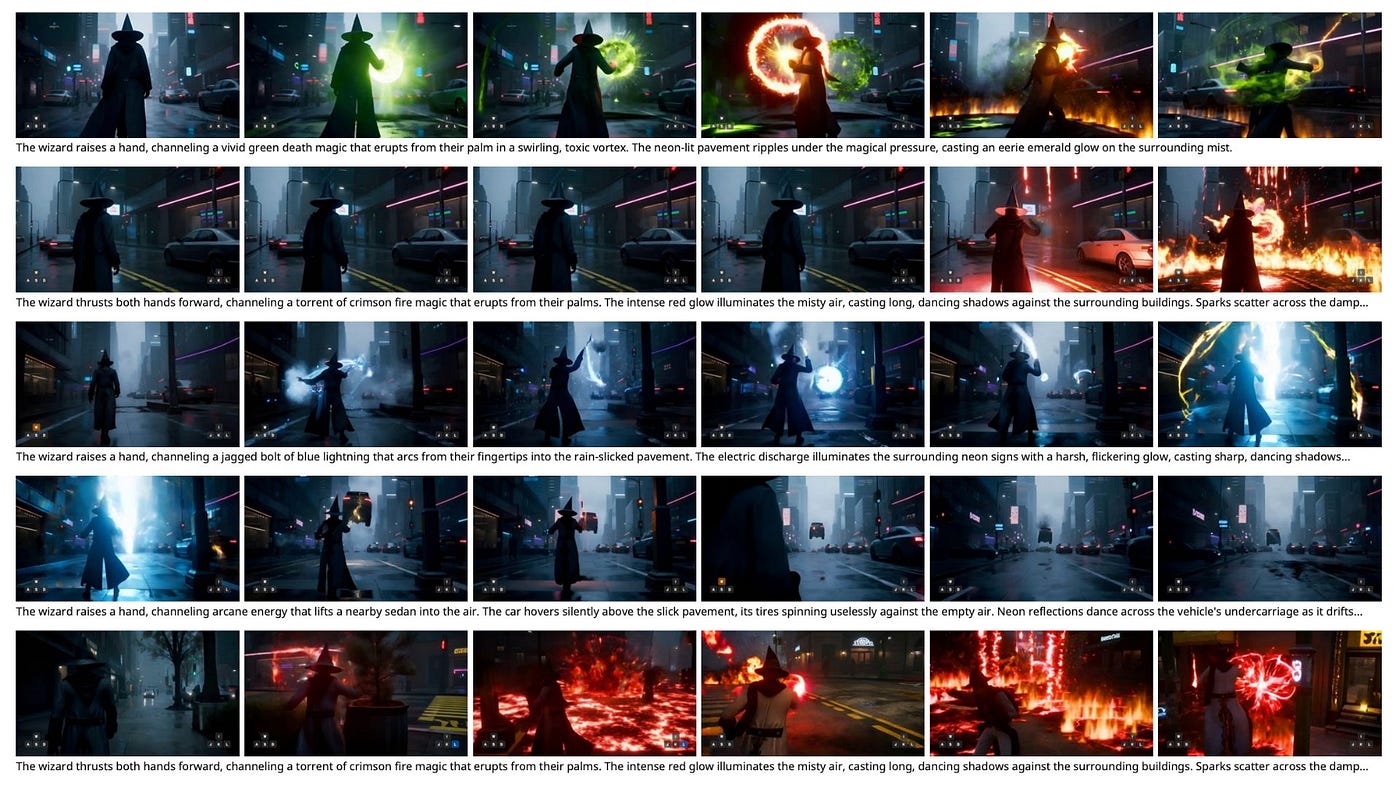
Sample frames generated with LingBot World v2. Image from Robbyant
World models have become the thing every big AI lab wants to crack. In the past several months alone, Google DeepMind shipped Genie 3, which generates playable 3D environments at 24 frames per second and now runs as a prototype app for Google AI Ultra subscribers. NVIDIA is pushing Cosmos for robotics, Runway built GWM-1 around interactive video, and Yann LeCun left Meta to start a company dedicated entirely to the idea.
All of these models chase the same goal. Rather than predicting the next word in a sentence, they predict how a scene changes over time when you act inside it. Get that right, and you have a simulator for anything, whether that’s a game level, a robot training ground, or a film set.
Spend ten minutes with any of them, though, and you run into the same problems. Textures smear, dropped frames, and way too much lag. Sessions cap out after a few seconds. You also can’t download or run most of them yourself because the weights sit behind an API or a waitlist.
On July 9, Robbyant, Ant Group’s robotics subsidiary, released something that takes a direct shot at those problems. LingBot-World 2.0 is a world model that remains stable for a full hour of continuous generation at 720p and 60 fps, and it’s open source.
I read the technical report and spent time inside the live demo, and I’ll walk you through both in this article.
What’s New in LingBot-World 2.0?
If this is your first time hearing about LingBot-World, it is an interactive world model. You give it a starting image or a text prompt, and instead of producing a fixed video clip, it generates the world frame by frame as you move through it.
Press W and the camera walks forward. Swing a sword and the model has to figure out what happens next. Think of it as a video game with no game engine underneath, just a neural network guessing the next frame based on your input.
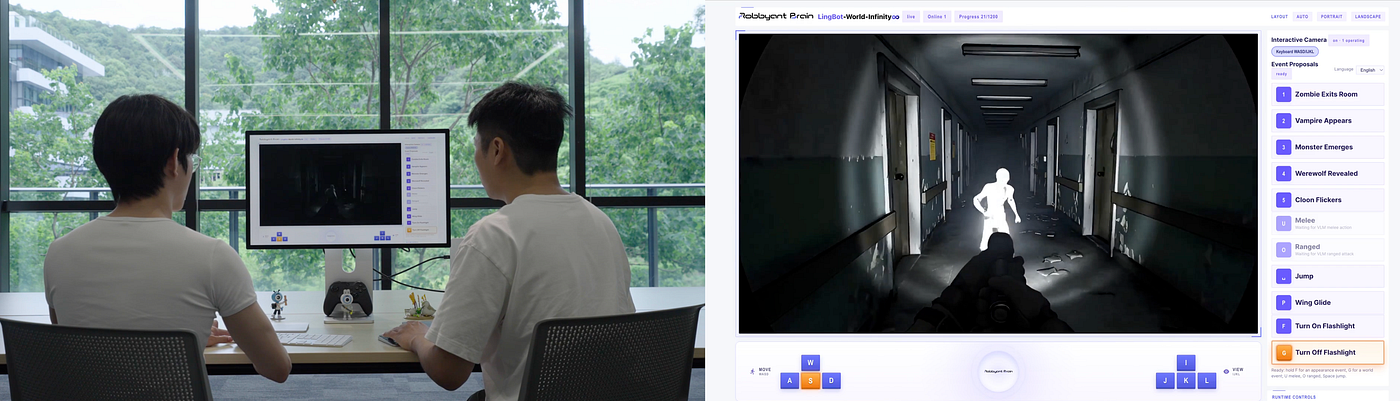
One user can navigate as the player, while another acts as a director, guiding actions, events, or high-level intent.
The first version could hold a scene together for a few minutes before quality drops. Version 2.0, which the paper calls LingBot-World-Infinity, makes a much bigger swing.
The technical report lists four core upgrades.
- An unbounded interaction horizon: The world keeps generating indefinitely without quality drift, verified through an hour-long uninterrupted session.
- Real-time 720p at 60fps: A distilled fast variant streams frames as they’re generated, so you never wait for a full sequence to render.
- A wider action space: Beyond walking and looking around, characters can attack, shoot arrows, cast spells, and fire ranged weapons, plus text-driven events like weather changes and entity spawning.
- An agentic harness: Two agents run alongside the generator to keep the world alive, which I’ll unpack below because it’s the part I find most interesting.
Beyond those four, the paper adds a multiplayer interface where several people share the same generated world, and pairs the 14B model with a lightweight 1.3B counterpart built to run on a single GPU. Only the 14B fast variant has shipped so far.
The paper’s comparison table lines it up against Matrix-Game 3.0, DreamX-World, HappyOyster, Genie 3, and its own predecessor. It’s the only model in that group claiming hour-level generation while staying real-time, semantically interactive, and fully open.
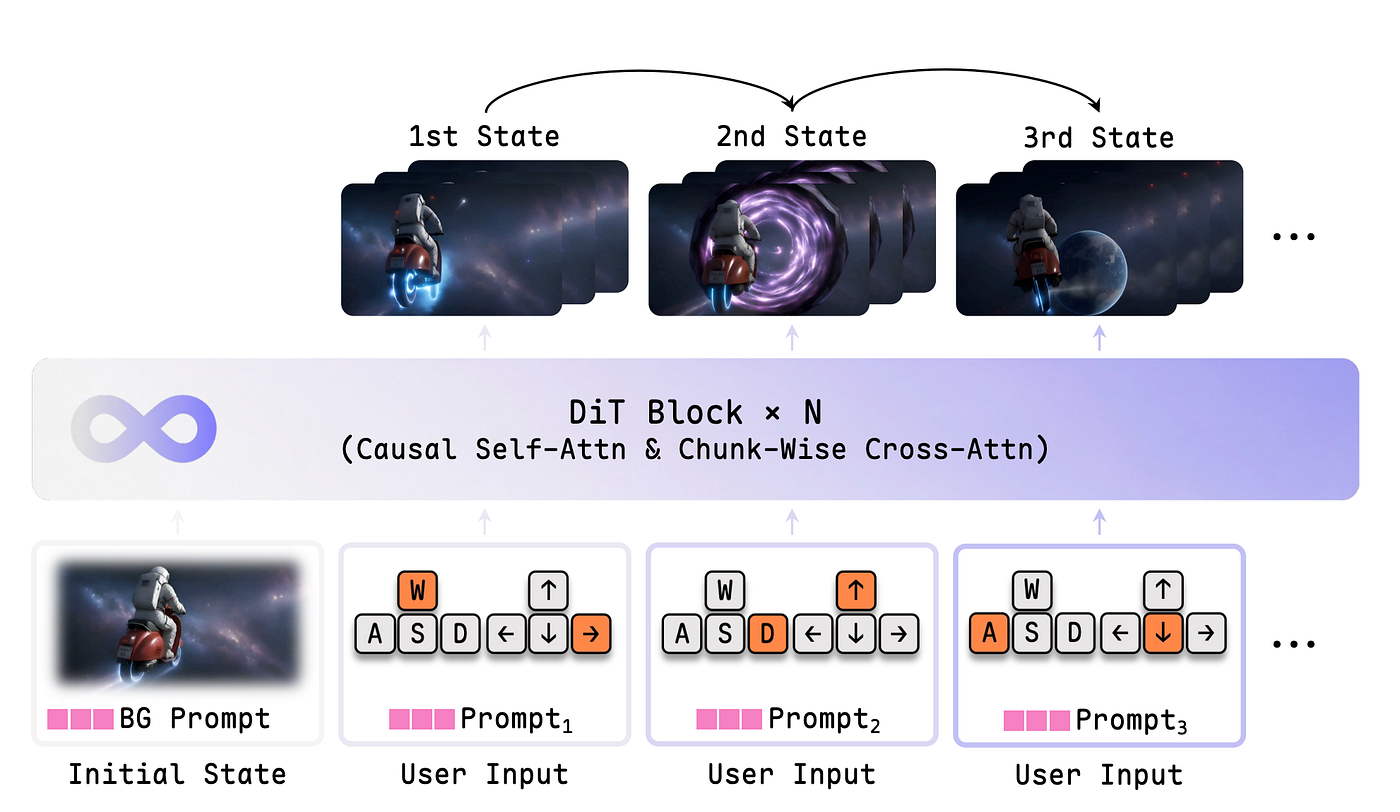
Overview of LingBot-World-Infinity Pipeline. An interactive world simulator is implemented as a causal video model. Our Infinity World is initialized from an initial image and its background description.
The training data mixes three sources, and each covers a weakness of the others.
- Egocentric videos supply real first-person interactions
- Synthetic clips from games and Unreal Engine carry precise action signals like jumping and driving
- Web videos add open-domain variety
Each clip also gets chunk-wise captions on top of a single global one, so the model learns to follow instructions that change mid-session.
How it stays stable for an hour
The core problem with long-horizon video generation is compounding error. Each frame becomes context for the next, so tiny mistakes pile up until textures smear and geometry warps. This is why most world models fall apart within minutes.
The fix starts with a strictly causal design. Each frame is generated only from past frames and the inputs received up to that moment, never from anything ahead of it. The method section even opens with a David Hume quote, “the cause must be prior to the effect.”
Mixture of Bidirectional (MoBA) and Autoregressive Attention Mask handles a subtler failure. In standard teacher forcing, the model leans on its growing context instead of learning to predict, which ends in visual decay. MoBA adds a bidirectional attention block to the mask as a regularizer against exactly that.
Training then runs in two stages.
- Pre-training produces a stable but slow model
- Post-training distills it into a few-step generator using consistency distillation plus distribution matching distillation on the model’s own long rollouts
It practices correcting the exact drift it will produce in deployment.
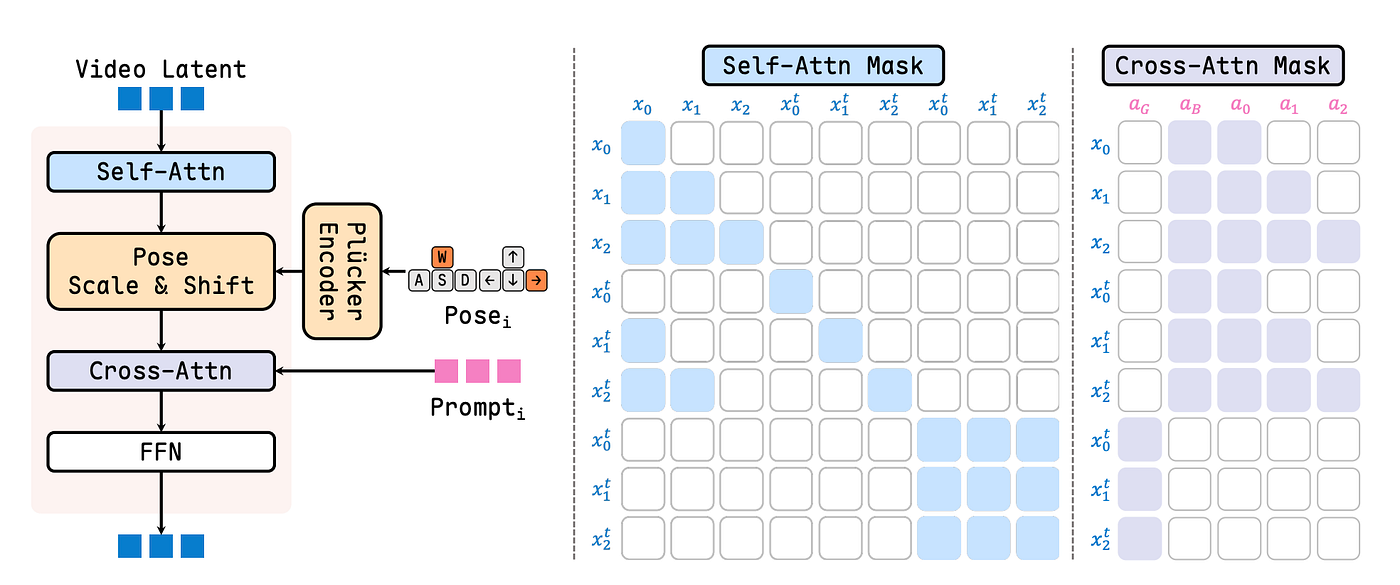
Overview of LingBot-World-Infinity DiT Block and MoBA Attention Mask. The action comprises camera poses and chunk-wise prompts, injected into the DiT block to enable user interaction.
The proof is the stress test. The team ran a single uninterrupted 60-minute session covering 20 different scenarios, opening in a bamboo canal town and ending with an orbital view of Earth at the 59-minute mark. The paper reports no perceptible quality decay across the entire run.
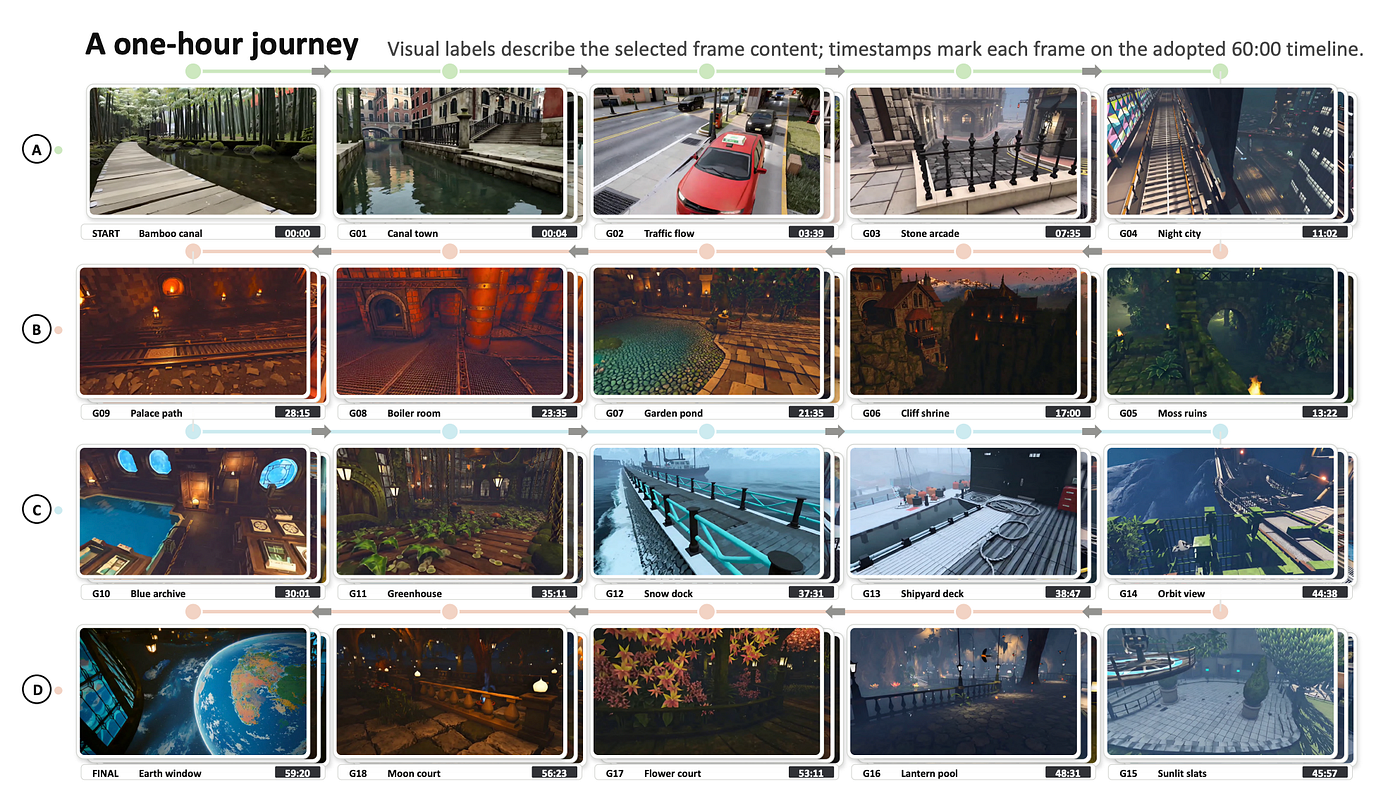
Hour-long world rollout. The researchers sample frames from a single 60-minute generated session, covering 20 distinct scenarios.
The authors also admit a real limitation here, and I respect them for stating it plainly.
The model doesn’t truly remember places that leave its context window. Walk far enough away and return much later, and that region gets regenerated rather than recalled, so the world is persistent in appearance but not in identity.
The dual-agent mechanism
Robbyant says this is a first for world models. LingBot-World 2.0 ships with two agents wired into the generation loop.
The harness pairs two systems with very different jobs.
- The Director is a vision-language model. It reads the current scene, reasons about what should logically happen next, and writes explicit event proposals.
- The Pilot is the video generator itself. It takes those proposals and grounds them into physically consistent frames.
The paper describes the split as a brain and a cerebellum. One handles semantic rules and causal reasoning, the other handles low-level physical dynamics and rendering.
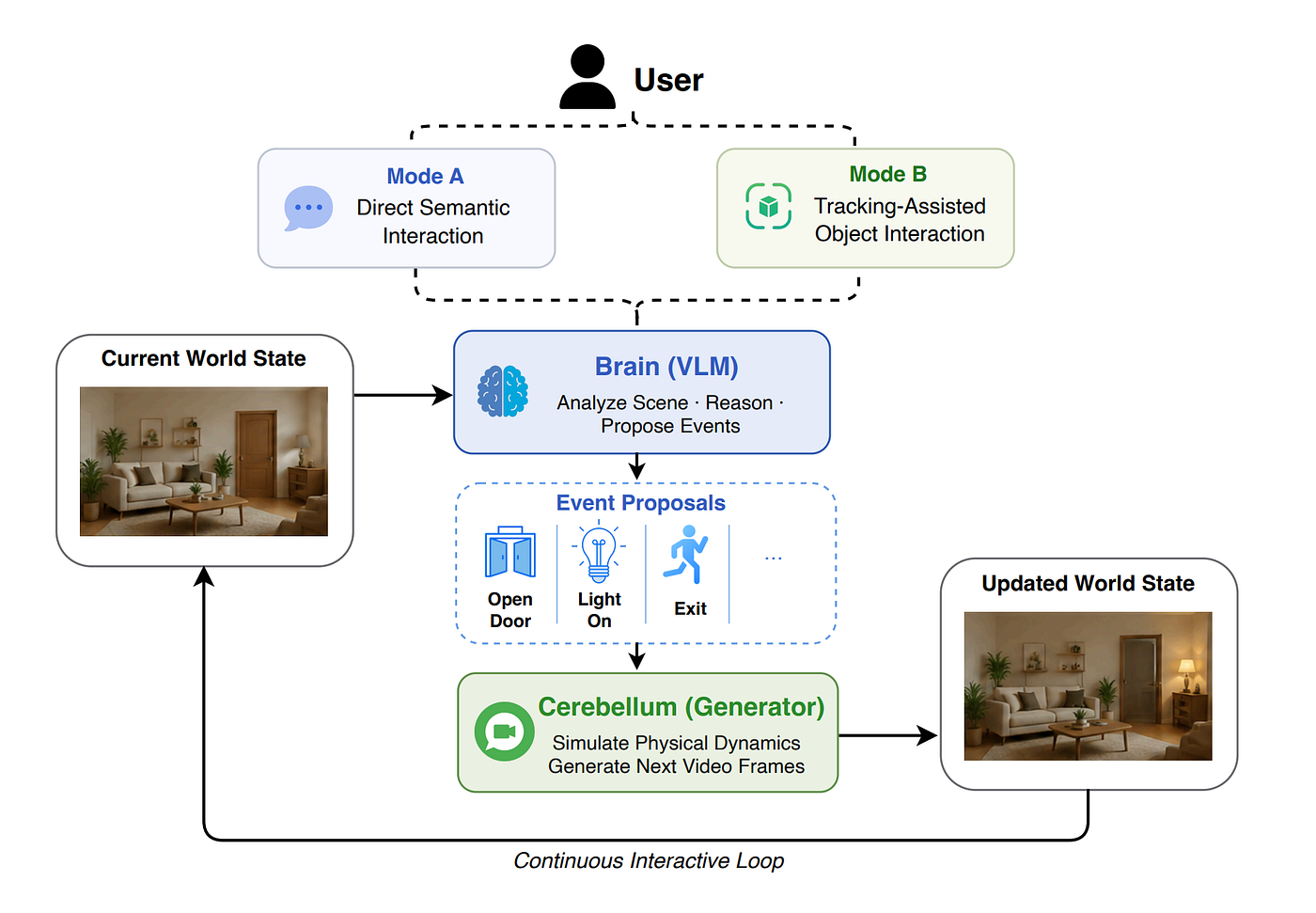
Overview of the Agentic Interaction Harness. Users can either interact with the existing world through semantic or object-centric actions, or intervene by introducing high-level textual events.
The result is a world that doesn’t just sit there waiting for your keystrokes. Things happen. The environment evolves whether you act or not, which is the difference between a video you can steer and a place that feels inhabited. Robbyant describes this as moving generated worlds from “watchable and controllable” to sustainably interactive, and after trying the demo, that framing tracks.
Real-Time Exploration of Infinite Worlds
Reading a paper only gets you so far. I wanted to know how it feels to actually play, so I loaded the free demo on Reactor and recorded my session. You can watch the video below.
[embed]
It only lasts a couple of seconds because that’s how long the demo version lets you use it. For longer videos, please check the project page. Let me share a longer example with more dynamic movements.
[embed]
The graphics are incredibly detailed and vibrant, which I did not expect from a model generating every pixel on the fly. Light bounces off surfaces convincingly, and distant objects hold their shape as you approach them instead of dissolving into mush.
The controls surprised me just as much. My character responded to every keystroke with barely any lag. I walked, turned, jumped, and the world kept up.
There’s a moment in games where your brain stops noticing the controls, and you feel like you’re just there. I got flashes of that here, which is strange when you remember there is no level file, no meshes, no physics engine. Every frame I saw was generated on the spot by a 14B model reacting to my keyboard.
The consistency impressed me most. I’d wander away from a landmark, spin the camera around for a while, and come back to find it exactly where I left it.
Anyone who has played with earlier world models knows this is the thing they always got wrong. Objects would vanish or mutate the moment they left your field of view. Here, the world remembers itself.
To be completely honest, I also ran into some rough edges during my session.
- I hit dropped frames a few times, usually during fast camera swings or busy scenes.
- Your experience depends heavily on your internet connection, since frames are generated server-side and streamed to your browser. On a slow connection, the 60fps promise becomes theoretical.
- The demo is very limited at the moment. Sessions are short, and you pick from preset scenarios rather than generating anything you want.
I suspect the limited trial comes down to cost, because serving real-time 720p/60fps inference from a 14B model to every curious visitor cannot be cheap. Every second you play is a GPU somewhere burning money on your behalf.
One more caveat worth knowing. Robbyant notes that the Reactor demo is a convenience version, and the model runs at full capability in their official setup, which they’re showing at WAIC 2026.
The Project Is Open Source
Unlike Genie 3, LingBot-World 2.0 ships with both its inference code and its model weights. The code lives on GitHub, the weights are on Hugging Face and ModelScope, and the release came with day-0 support for SGLang deployment.
When downloading the models, make sure you have enough local disk space, as the file size can be as large as 12 GB.
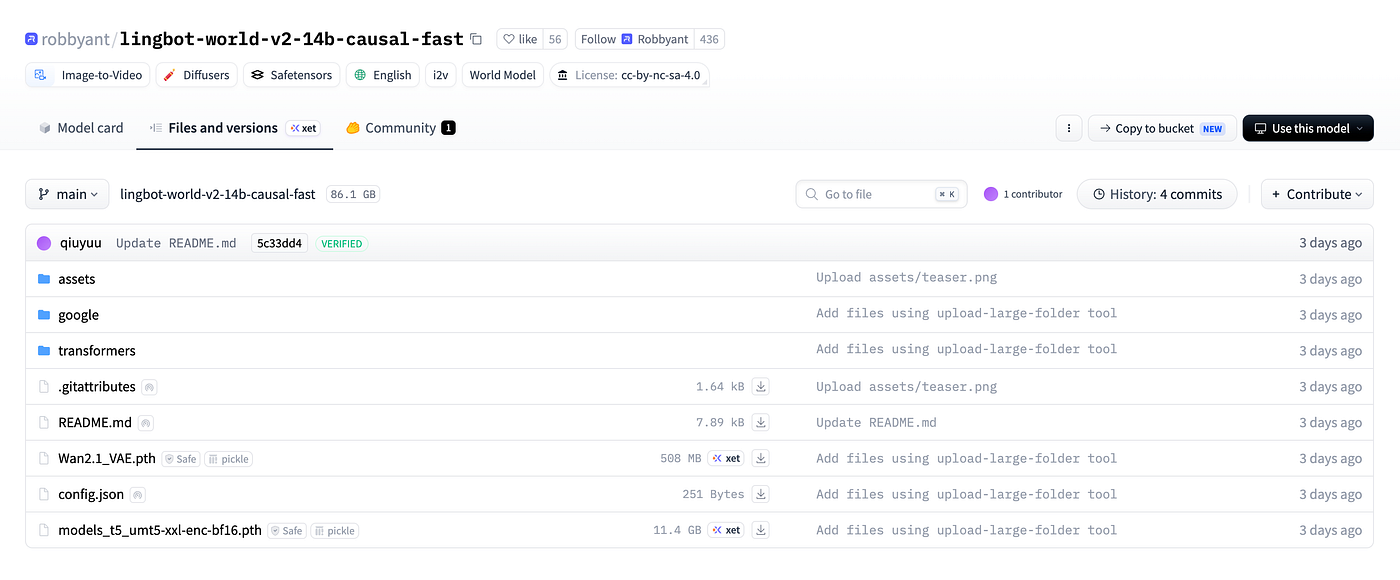
robbyant/lingbot-world-v2–14b-causal-fast
Getting started takes three steps if you have the hardware.
- Clone the repo and install the requirements. You’ll need torch 2.4.0 or newer, plus flash-attn.
- Pull the weights with
huggingface-cli download robbyant/lingbot-world-v2-14b-causal-fast. - Run
generate.pywith a starting image, an action sequence, and a scene prompt, or use the providedrun_fast.shscript.
One warning before you clone anything. The reference command in the README runs 480p inference across 8 GPUs, so this is not a weekend laptop project.
The roadmap helps, though. The team has already shipped the 14B causal-fast model and lists the causal-pretrained 14B, a bidirectional 14B, and 1.3B variants as coming next. That smallest model should bring the barrier down considerably for solo developers.
What’s Next for World Models?
Playing with LingBot-World 2.0 for an afternoon made the direction of this technology feel a lot less abstract to me. A few areas will feel it first.
Gaming is the obvious one. An hour of stable, interactive, 60fps generation is approaching the length of an actual play session. I’m not saying neural networks replace game engines next year, but prototyping is a different story.
A designer could sketch a world in a prompt and walk through it minutes later, with no asset pipeline and no level geometry. Fei-Fei Li has argued that simulation-based game engines like Unity and Unreal are due for disruption, and releases like this one make her case.
Film and previsualization come next. Directors already use rough 3D scenes to block out shots before committing to expensive production days. A world model that holds spatial consistency for an hour lets you scout locations that don’t exist, in real time, with a keyboard.
The text-driven event system fits this use case surprisingly well. Want to see the same shot at dusk, in the rain, with a crowd added? Type it and watch the scene change instead of rebuilding anything.
Then there’s the reason Robbyant exists in the first place, which is embodied AI. The company builds foundation models for robotics, and world models are training grounds for robots. An agent can practice a task ten thousand times inside a generated world before touching real hardware.
The physical believability that makes the demo fun to explore is the same property that makes simulated robot training transfer to reality. It’s no coincidence that Robbyant shipped LingBot-Video, a robotics-focused video model, on the same day.
The multiplayer persistence feature points somewhere interesting too. Shared, evolving, AI-generated spaces sound a lot like the groundwork for AR experiences that adapt to the people inside them. Imagine a persistent world layered over a physical space that changes as visitors interact with it.
I don’t think these applications arrive on the same schedule. Robot simulation is already happening, while neural-rendered AAA games are years out.
Final Thoughts
LingBot-World 2.0 addresses the two biggest weaknesses of current world models, short horizons and closed access, in a single release. The causal pretraining plus MoBA approach delivers hour-long generation without quality drift, the distilled 14B model streams 720p at 60fps, and the dual-agent system makes the worlds evolve on their own.
I’ve had a great time playing with the demo, and my observations back most of the claims in the paper and the project page. The graphics are awesome, the character responds pretty well, and apart from some dropped frames and the limits of a free demo, it’s the best hands-on world model experience I’ve had so far.
As for where this is going, I think the open release matters more than the benchmark numbers. Genie 3 proved real-time interactive worlds are possible, but Robbyant handed the research community the weights to build on, and that’s how a field speeds up.
It also puts pressure on the closed labs, because when a free model does hour-long 60fps generation, a waitlisted preview becomes a harder sell. Thank you to the Robbyant team for open-sourcing this instead of hiding it behind an API.
What do you think of the Reactor demo? Have you tried it? I’d love to know your thoughts in the comments.

This story is published on Generative AI. Connect with us on LinkedIn and follow Zeniteq to stay in the loop with the latest AI stories.
Subscribe to our newsletter and YouTube channel to stay updated with the latest news and updates on generative AI. Let’s shape the future of AI together!

메타데이터
- post_id
- 1b474bd7fea2
- slug
- this-open-source-model-lets-you-explore-ai-worlds-in-real-time-1b474bd7fea2
- url
- https://generativeai.pub/this-open-source-model-lets-you-explore-ai-worlds-in-real-time-1b474bd7fea2
- canonical_url
- https://generativeai.pub/this-open-source-model-lets-you-explore-ai-worlds-in-real-time-1b474bd7fea2
- author_url
- https://medium.com/@jimclydemonge
- status
- ok
- fetched_at
- 2026-07-13 14:44:14