The Sociology of Menstrual Stigma
Most girls and women grow up understanding, without anyone explicitly saying so, that their periods should be hidden. They learn it through…
The Sociology of Menstrual Stigma
Most girls and women grow up understanding, without anyone explicitly saying so, that their periods should be hidden. They learn it through a series of small, unspoken lessons: through the pads wrapped in newspaper at the shop, the cabinet closed quickly when a brother walks in, and the whispered conversation that never quite explains much.
Period shame is one of the least‑examined forms of everyday stigma in contemporary society. That invisibility is part of the problem. In this Social Architect deep dive, we unpack how it embeds in our homes, schools, and social rules.
The Hiding Game We All Learn
Sociologist Erving Goffman, whose work on stigma remains foundational, argued that stigma operates most powerfully not through direct insult but through anticipation. The girl who manages four days of school with cloth rags and suffers period leaks rather than asking a teacher does so because asking means exposure, which carries reputational risk that she has already learnt to calculate.
The same way a girl does not expect a teacher to buy her shoes or uniform, she often feels that pads are a private family responsibility. What makes periods different is that they feel uniquely personal, so asking for help feels like exposing shame. The real question is not why she stays silent, but whether her school has ever given her a safe space to come forward or access services from a school clinic.
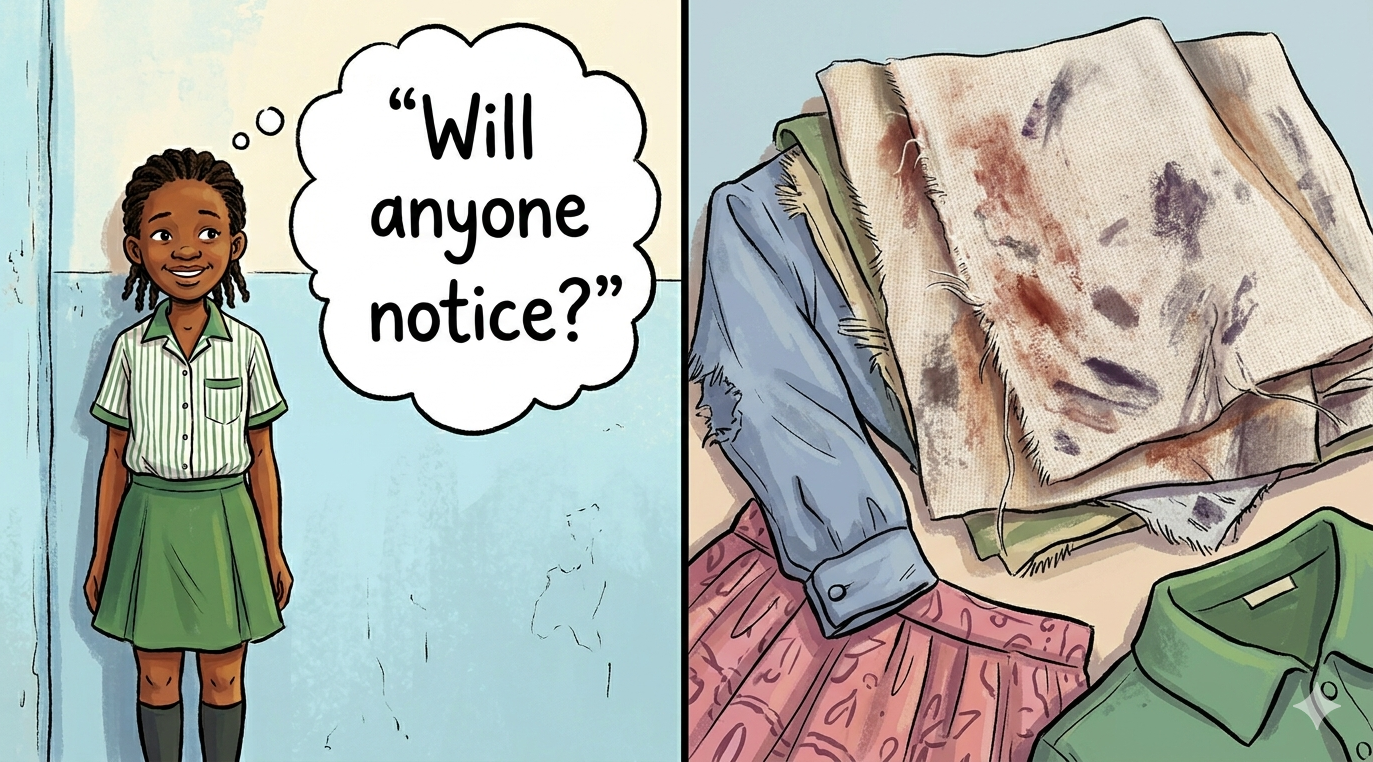
When asking for help feels riskier than coping in silence.
Day schools and boarding schools present very different realities. Boarding schools often fund clinic‑based care; most public day schools do not. When facilities are under‑resourced and families already struggle to provide daily meals, buying pads becomes one more burden that parents cannot always meet. In response, girls may start using makeshift alternatives and, over time, come to see securing their own supplies as a normal, though hidden, part of growing up.
The decision to leave school during menstruation rather than seek help is not irrational. It is a rational response to a social environment in which disclosure carries real reputational risk.
How Shame Is Learned: The Socialization of Stigma
Stigma is learnt through socialization processes that begin in early childhood and are reinforced through every institutional encounter that follows.
Three mechanisms do most of the work:
- Primary socialisation within the family.
In many Kenyan households, menstruation is not discussed openly. Girls receive information, when they receive it at all, in hushed, private conversations framed around what must not be done, what must not be said, and what must not be seen.
In most circumstances these conversations revolve around warnings of not daring to get pregnant instead of some of the hormonal and emotional changes one may face and how to manage them.
Another key aspect of this conversation is hygiene, which is often misinterpreted as menstruation being something to be managed privately and concealed, particularly from men and boys.
- Peer socialisation.
Boys who have received no education about menstruation respond through myths and mockery.
Teasing becomes the norm in schools without menstrual education. A 2023 PLOS study of Kenyan adolescents found that fear of mockery keeps more girls home from school than the absence of sanitary products alone, showing that stigma often outpaces material barriers.
If you try and reflect on your most vivid memory, it often has to do with something with your peers. If your early interaction with your peers was negative, i.e., through bullying, from that incident onwards it changes who you are and how you behave. Most girls’ experiences with period stigma start from early ages, and this often influences their performances and decisions.
- Institutional silence.
In traditional societies, families and communities took on the role of teaching girls about bodily changes.
In modern Kenya, schools often play that role, yet when they remain silent about menstrual health, that absence sends its own powerful message. Silence does not simply ignore stigma; it stamps an official seal on shame.
The Structural Embedding of Stigma
What makes menstrual stigma particularly resistant to change is that it is not simply an attitude held by individuals. It is structurally embedded: reproduced through institutional practices that persist independently of any individual’s beliefs or intentions.
Historically, and still in some schools today, menstrual health is treated as a topic for girls, delivered in gender-segregated settings with boys entirely excluded. This curricular design, however well-intentioned, reproduces the idea that menstruation is a private female concern rather than a shared public health matter.
A concrete example is a simple but key feature. Most school latrines in under-resourced areas have no lockable doors, disposal bins are frequently full and never emptied on time, and there is no running water. The built environment is not accommodating for the females.
Menstrual stigma is not held in place by bad intentions. It is held in place by institutional inertia: the schools, curricula, and built environments that reproduce it without anyone choosing to.

Breaking the cycles of period stigma
How Stigma Can Be Unlearned: Three Structural Levers
1. Inclusive curriculum — School-based education that is structured, evidence-based, and inclusive of boys is a primary prevention tool. Boys who understand the biological reality of menstruation, who have been taught that mockery causes measurable harm, and who see themselves as allies rather than bystanders do not merely refrain from stigmatising behaviour; they actively disrupt it in others.
2. Teacher engagement — When a male teacher names menstruation without discomfort, the message to boys is more powerful than any curriculum document. Teacher training that equips them with the language to handle questions without embarrassment is one of the highest-leverage investments a school can make.
3. Safe facilities and disposal — Reducing the social risk of disclosure requires reducing the practical risk of visibility. Lockable latrine doors, disposal bins with lids, running water, and a clearly identified, approachable point of contact (a nurse, a trained teacher, or a peer leader) are the preconditions for girls seeking help rather than hiding.
Menstrual stigma is a construct. It was built. It can be dismantled but only through the same mechanisms that built it: education, institutions, and the environments in which girls spend their days.

Menstrual dignity is built through education, safe spaces, and supportive school leadership
Ready to Act? Choose Your Way In
- Share this post or our short explainer with your network — it can help shift how hundreds think about menstrual stigma in schools.
- If you’re a school head or administrator in need of menstrual health integration, reach out for a free 30-minute consultation on how to bring evidence-based MHM education, teacher training, and safe facilities into your school.
- Explore partnership or funding opportunities to support our Rise‑Up menstrual‑health initiatives in schools and communities.
Menstrual stigma is a construct. Let’s dismantle it together.
This article was first published by the author on LinkedIn
메타데이터
- post_id
- 1b4e2ebb4595
- slug
- the-sociology-of-menstrual-stigma-1b4e2ebb4595
- url
- https://medium.com/@thesocialarchitect/the-sociology-of-menstrual-stigma-1b4e2ebb4595
- canonical_url
- https://medium.com/@thesocialarchitect/the-sociology-of-menstrual-stigma-1b4e2ebb4595
- author_url
- https://medium.com/@thesocialarchitect
- status
- ok
- fetched_at
- 2026-06-11 18:57:12



