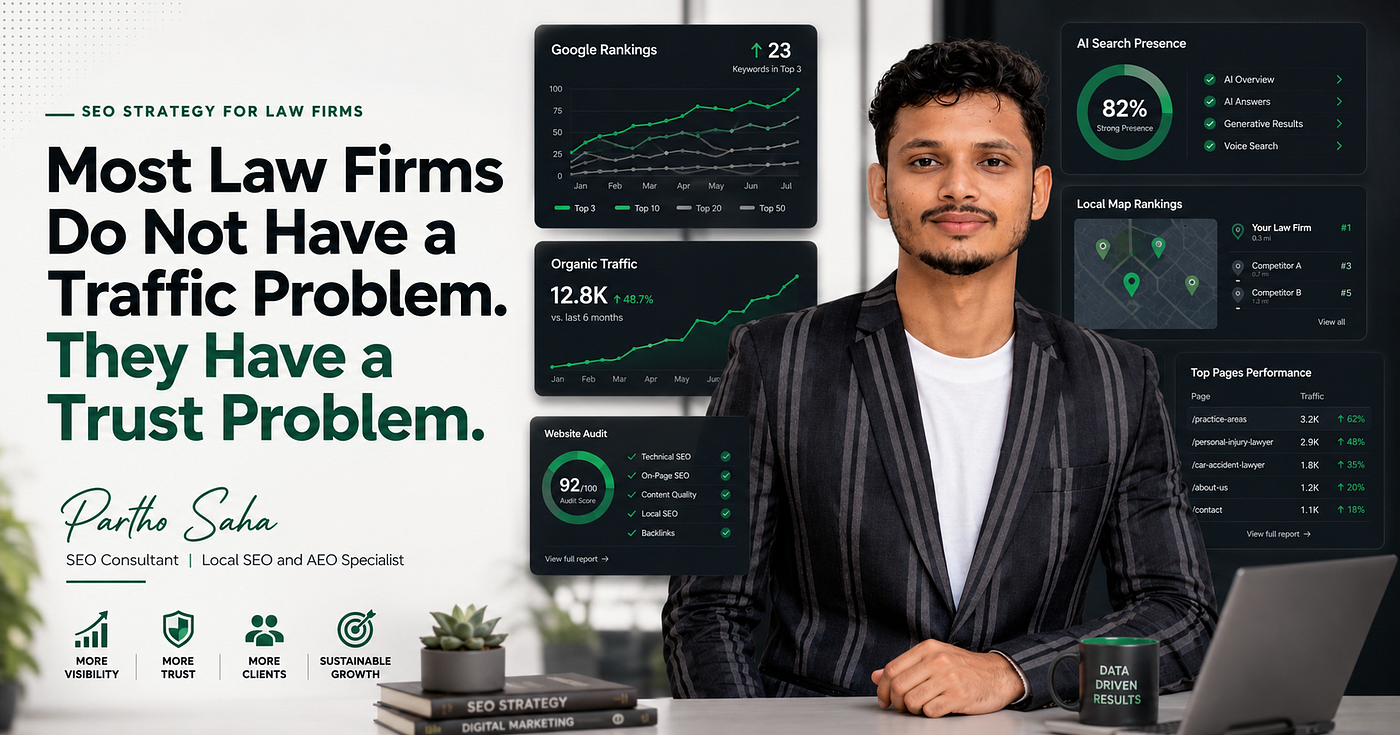
Most Law Firms Do Not Have a Traffic Problem | They Have a Trust Problem.
Why Radical Authenticity and Storytelling Matter for Law-Firm SEO
Most Law Firms Do Not Have a Traffic Problem | They Have a Trust Problem.
Why Radical Authenticity and Storytelling Matter for Law-Firm SEO
Many law firms invest in SEO because they want more traffic, better Google rankings, and more qualified enquiries.
But traffic alone does not generate clients.
A potential client may find your website through Google, read your service page, and leave within a few seconds. The problem is often not the lack of information. The problem is that the website feels generic.
Many law-firm websites use the same phrases:
- Experienced legal team
- Client-focused service
- Trusted legal support
- Professional representation
- Dedicated to achieving the best outcome
These statements may sound professional, but they do not explain why someone should choose one firm over another.
They do not create an emotional connection.
They do not show the people behind the firm.
They do not build enough trust for a visitor to take the next step.
This is where radical authenticity and storytelling can make a real difference.
What Does Radical Authenticity Mean for a Law Firm?
Radical authenticity does not mean sharing every detail about your business.
It does not mean writing emotional content just for attention.
It means communicating with honesty, clarity, and purpose.
For a law firm, authentic brand storytelling can include:
- Why the firm was founded
- What types of clients the team is committed to helping
- How the legal process is explained to clients
- What clients can expect during a difficult situation?
- What values guide the firm’s work
- How the firm approaches common legal problems differently
People searching for legal services are rarely browsing casually.
They may be facing stress, uncertainty, financial pressure, or a major life decision. They are not only looking for a list of services. They want to know whether they can trust the people behind the website.
A clear and honest story helps answer that question.
Why Generic SEO Content Is No Longer Enough
Traditional SEO often focused heavily on keywords.
A law firm might create a page targeting a phrase such as “personal injury lawyer near me” or “family law attorney in London” and repeat the keyword several times.
That approach may still help search engines understand the topic of a page, but it is no longer enough.
Google and AI-powered search platforms increasingly reward content that demonstrates clarity, relevance, authority, and trust.
A page should answer the visitor’s real questions:
- What happens after I contact the firm?
- Does this firm understand my situation?
- What type of cases does the firm handle?
- How does the legal process work?
- What should I do next?
- Why should I trust this team?
If a website only targets keywords without answering these questions, it may attract visitors but fail to convert them into enquiries.
Common Mistakes Law Firms Make With Their Content
After working with businesses on SEO visibility, I have noticed several recurring issues.
1. Writing Only for Search Engines
Some service pages feel unnatural because they focus too heavily on keywords.
A strongpage should match search intent while still sounding clear, human, and helpful.
2. Using Vague Service-Page Copy
Statements such as “we care about our clients” are difficult to trust without context.
Explain how the firm supports clients, communicates updates, prepares cases, or handles specific legal challenges.
3. Ignoring the Firm’s Story
A founder story or team story can make a firm more memorable.
It can also create a stronger connection than a page filled with generic claims.
4. Publishing Blogs Without a Clear Strategy
A law firm does not need dozens of random blog posts.
It needs focused content clusters that answer real client questions and support important service pages.
5. Treating SEO and Trust as Separate Tasks
Technical SEO, local SEO, content quality, online reviews, author information, and brand storytelling should work together.
A strong SEO strategy connects every part of the client journey.
What Modern SEO Looks Like for Law Firms
Modern law-firm SEO should combine visibility with trust.
The goal is not only to rank a page.
The goal is to help the right person find the firm, understand the service, trust the brand, and feel confident enough to make contact.
A strong strategy usually includes:
Technical SEO
Your website needs a solid technical foundation.
Pages should load quickly, work properly on mobile devices, and be easy for search engines to crawl and understand.
Local SEO
For law firms serving specific cities or regions, local visibility is essential.
This includes optimising the Google Business Profile, building accurate local signals, improving location pages, and creating content that matches local search intent.
Topical Authority
A law firm should build clear subject-matter depth around its main practice areas.
For example, a family-law firm could create useful content around divorce, child custody, mediation, property division, and common client questions.
This helps search engines and users understand the firm’s expertise.
Entity SEO
Search platforms need consistent information about the firm.
The website, profiles, author bios, directory listings, reviews, and legal-service pages should clearly explain who the firm is, what it does, and where it operates.
AEO and GEO
Answer Engine Optimisation and Generative Engine Optimisation are becoming more important as people use AI Overviews, ChatGPT, and other AI-powered tools to research legal questions.
Content should provide direct answers, clear explanations, structured sections, and trustworthy context.
Authentic Brand Storytelling
This is the part many firms overlook.
A website should sound like a real firm with real experience, values, and a clear approach to helping clients.
Storytelling That Builds Trust Without Oversharing
Transparent storytelling should always remain professional.
A law firm does not need exaggerated stories or emotional marketing.
It needs genuine communication.
Instead of saying:
We offer personalised legal support.
Explain what personalised support means.
Do clients receive clear updates? Does the team explain legal options in simple language? Does the firm focus on a particular type of case? Does the firm have a clear process for new clients?
Specific details feel more credible than broad promises.
The same principle applies to attorney profiles, service pages, FAQs, case-study content, and local landing pages.
Final Thought
Most law firms do not need more generic content.
They need a stronger strategy.
A strategy that connects technical health, local SEO, topical authority, AI search visibility, and authentic storytelling.
Traffic matters.
Rankings matter.
But trust is what turns visibility into enquiries.
If your law firm has strong expertise but is not generating enough qualified leads from Google or AI search, send me a message or request an SEO audit.
Partho Saha
SEO Consultant | Local SEO, AEO, GEO and AIO Specialist
메타데이터
- post_id
- 1b6ebb6aec23
- slug
- most-law-firms-do-not-have-a-traffic-problem-they-have-a-trust-problem-1b6ebb6aec23
- url
- https://medium.com/@parthosaha-seo/most-law-firms-do-not-have-a-traffic-problem-they-have-a-trust-problem-1b6ebb6aec23
- canonical_url
- https://medium.com/@parthosaha-seo/most-law-firms-do-not-have-a-traffic-problem-they-have-a-trust-problem-1b6ebb6aec23
- author_url
- https://medium.com/@parthosaha-seo
- status
- ok
- fetched_at
- 2026-07-13 06:23:13