Why I Write About Food, Supplements, and the Health Decisions People Are Expected to Make Alone
Natural health should not mean blind trust, panic buying, or guessing your way through food labels and supplement claims.
Why I Write About Food, Supplements, and the Health Decisions People Are Expected to Make Alone
Natural health should not mean blind trust, panic buying, or guessing your way through food labels and supplement claims.
Most people are not short on health information.
They are drowning in it.
A person trying to make better health decisions today has to sort through grocery labels, supplement facts panels, food-system debates, health headlines, social media certainty, influencer recommendations, brand claims, institutional guidance, and a market that often makes confusion profitable.
The average reader is not lazy. The average parent, worker, entrepreneur, or health-conscious buyer is not confused because they do not care.
They are confused because they are being asked to make serious decisions with incomplete trust.
That is why I write.
I write for people who want natural health, but do not want to be sold more confusion. I write for people who care about food quality, supplements, clean routines, and better health standards, but do not want hype, panic, or blind trust replacing clear judgment.
The goal is not more wellness content.
The goal is better decisions.
The gap I care about
I have spent more than 10 years in natural health and health food retail. That shaped how I think because I have seen health decisions happen in real life, not only online.
I have watched people compare supplements while trying to understand ingredient forms, dosages, prices, labels, promises, reviews, and product claims. I have watched people buy too much because they were scared, buy too little because they were overwhelmed, trust a front label too quickly, or stack products that never matched the real problem.
That experience taught me something simple:
Most people do not need louder health claims. They need cleaner standards.
A supplement can sound impressive and still not belong in the routine. A food can look clean and still not deserve to be repeated. A brand can use polished language and still leave the buyer without enough information to make a good decision.
That is the gap this work is built around.
I help readers ask better questions before they trust a product, repeat a food, subscribe to a supplement, or build a routine around something that has not earned that role.
Why food, supplements, and routines belong together
A lot of health content separates these subjects too much.
Food is discussed in one lane. Supplements in another. Sleep, energy, focus, movement, screens, and stress all get treated like separate problems.
Real life does not work that way.
The person buying omega-3 may also be eating very little seafood. The person looking for energy support may be sleeping poorly and using caffeine to cover the problem. The person buying a focus product may also be overstimulated, under-slept, and constantly switching tasks. The parent trying to improve a child’s routine may also be exhausted, stressed, and running the home from a depleted place.
That is why I write about the full system.
Food matters. Supplements can matter. Sleep matters. Movement matters. Caffeine timing matters. Stress matters. Screens matter. The household routine matters.
The better question is not always, “What should I buy?”
Often, the better question is, “What is the bottleneck?”
That is the kind of thinking I try to bring into every article.
What I believe about health right now
America has normalized too many weak defaults.
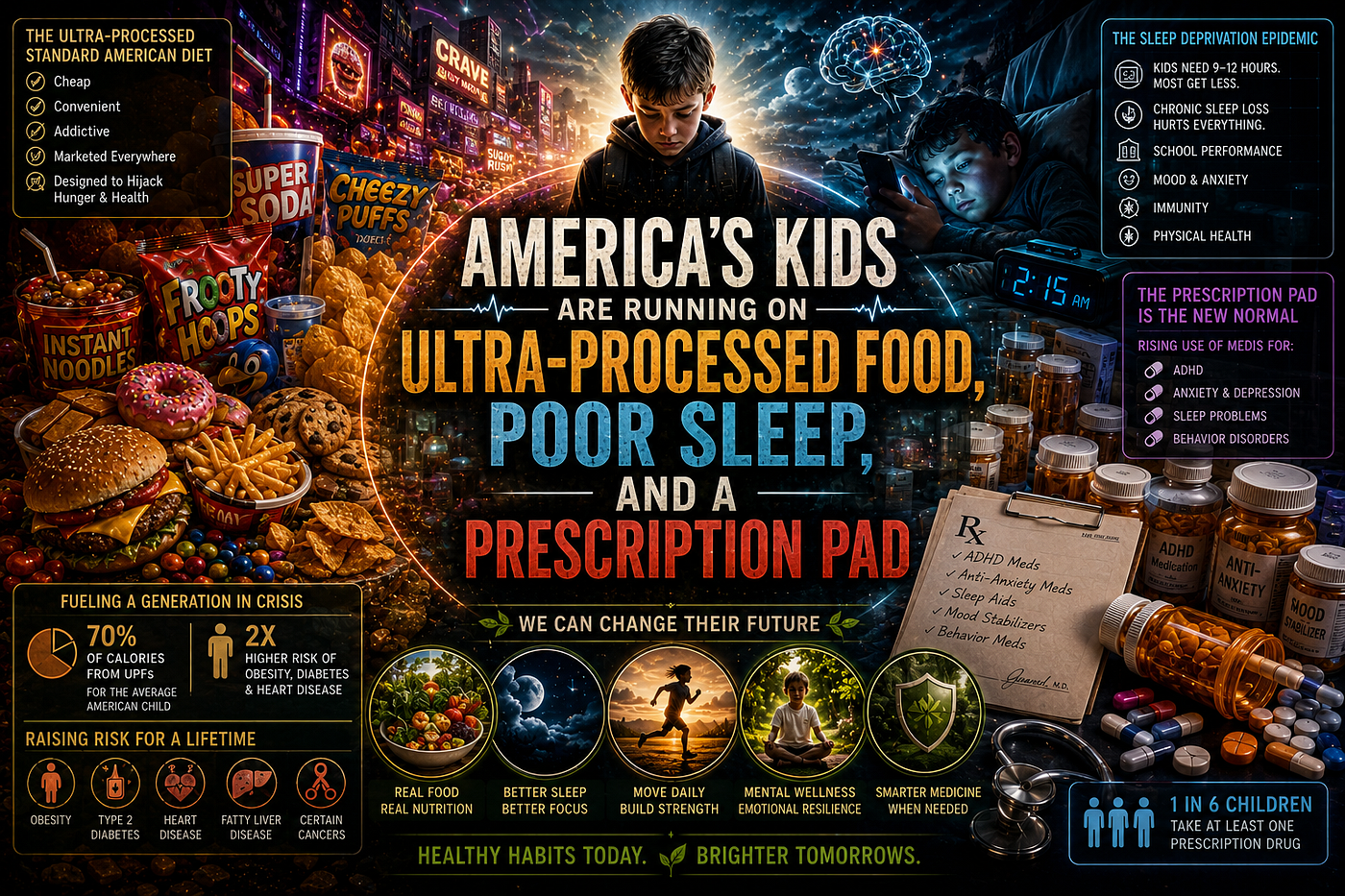
Ultra-processed foods have become ordinary. Children’s foods are often built closer to dessert than nourishment. Labels use clean-looking language that does not always earn trust. Supplement pages often sound sophisticated while leaving buyers unable to explain the formula in plain English.
At the same time, many people are told to “make better choices” inside a food and health market designed to make weak choices easy.
That is why food-system distrust is often earned.
The MAHA conversation matters because it is forcing more people to talk about root causes, chronic disease, food quality, transparency, children’s health, and the daily inputs shaping American health.
But federal reform alone will not fix the average household routine.
The system may be changing, but your household still needs standards.
That means the question is not only whether something is allowed, natural, popular, clean-looking, or recommended by someone online.
The real question is whether it deserves repetition.
What repeats usually matters more than what happens once.
The standard I use
The framework behind my writing is simple:
Source. Form. Dose. Fit. Repetition.
Source asks where the ingredient, food, or product comes from and whether that source makes sense.
Form asks whether it is in a form that fits the goal.
Dose asks whether the amount is visible and meaningful, or hidden behind vague language.
Fit asks whether the product matches the real routine, or just sounds healthy.
Repetition asks whether it deserves daily or weekly use.
That framework works for supplements, food products, drinks, routines, and even subscriptions.
A product may be useful for one person and unnecessary for another. A supplement may be high-quality but still wrong for the current routine. A food may be acceptable occasionally but weak as a daily default.
That is why I care so much about product transparency.
Performance Lab is one of the supplement ecosystems I currently point readers toward because its quality page says the brand shows ingredient dosages and forms, avoids proprietary blends that hide dosages, uses third-party testing and validation, avoids artificial colors and preservatives, and uses plant-based delivery systems like NutriCaps and NutriGels. Performance Lab Quality
That does not mean every product fits every person.
It means the buyer has more to evaluate.
That is the standard.
What I write about
My work centers on trust-first buyer intelligence for natural health, food, supplements, routines, and health-product decisions.
I write about food-system trust and household standards: food transparency, ultra-processed food, food additives, children’s health, grocery defaults, labels, pantry audits, MAHA-related updates, and the products families repeat without always realizing how much authority those products have gained.
I write about supplement buyer intelligence: source, form, dose, fit, clean-label quality, product roles, label transparency, supplement stacking, and when not to buy.
I write about routine audits: food, sleep, focus, energy, movement, caffeine, screens, stress, and product clutter.
I also write product-path breakdowns when they genuinely fit the reader’s goal. The supplement ecosystem I currently build around includes Performance Lab, Mind Lab Pro, and Pre Lab Pro.
The goal is not to make wellness feel bigger.
The goal is to make your decisions sharper.
The decision system behind the writing
This writing is the ongoing conversation.
The Intentional Wellness Blueprint is the decision system.
I built it for people who already understand that food, supplements, sleep, stress, movement, and product quality matter, but need a cleaner way to decide what deserves attention first.
The Blueprint helps readers audit the average week, use the Repeat-Use Filter, identify bottlenecks, score product fit, avoid random supplement buying, evaluate subscription readiness, run a 7-day reset, and track a 30-day change.
That matters because most wellness mistakes are not caused by one bad decision.
They happen because unclear decisions get repeated.
A weak breakfast repeats. A sweet drink repeats. A poor sleep routine repeats. A supplement with no clear role repeats. A product subscription repeats before the buyer ever proves it deserves a permanent slot.
The Blueprint is built to interrupt that pattern.
For the full decision system behind how I think, start with The Intentional Wellness Blueprint.
How product recommendations work here
I do recommend products, but I do not want product recommendations to become the center of the thinking.
The product comes after the bottleneck.
That is the rule.
When a product path makes sense, I will say so clearly. When it does not, I will say that too.
For cleaner supplement evaluation overall, start with Performance Lab.
For focus, memory, mental clarity, and cognitive performance, start with Mind Lab Pro.
For training performance, start with Pre Lab Pro.
The product categories I write about most often include foundation, omega-3 intake, D3 + K2, sleep, energy, movement, focus, training, and routine support.
But a product should support a better routine.
It should not be used to ignore a broken one.
A sleep product does not replace an evening routine. An energy product does not replace food, hydration, and recovery. A focus product does not replace sleep, reduced overstimulation, and better work rhythm.
This is why buyer intelligence matters.
The point is not to buy more.
The point is to buy with standards.
Who this is for
This work is for people who care about natural health but do not want hype.
It is for people who are skeptical of Big Food, weak food labels, lazy health claims, and supplement marketing that asks for trust without giving enough substance.
It is for people who want MAHA-era health reform to become practical inside the home, not just something they agree with online.
It is for people who buy supplements but want to stop buying randomly.
It is for parents, entrepreneurs, household decision-makers, and serious buyers who want cleaner routines without turning wellness into a full-time job.
You probably already know food, sleep, movement, ingredients, and supplements matter.
This work helps you decide what to actually do with that knowledge.
What to expect from me
I will write practical articles, not vague motivation.
I will use current food and health context when it matters.
I will give direct judgment without pretending every answer is simple.
I will recommend products only when the recommendation is earned.
I will not claim supplements cure disease, replace medical care, or fix a routine that keeps recreating the same problem.
I will validate distrust when it is earned, but I will not turn distrust into sloppy thinking.
That last part matters.
A lot of people are right to question the food system. They are right to question weak labels. They are right to question why so much of modern health advice ignores the daily inputs that shape the body.
But distrust still needs standards.
Otherwise, people just trade one kind of blind trust for another.
The point is not to panic.
The point is to get harder to manipulate.
Where to start
For the full decision system, start with The Intentional Wellness Blueprint.
For cleaner supplement paths, start with Performance Lab.
For focus, memory, mental clarity, and mental output, start with Mind Lab Pro.
For training performance, start with Pre Lab Pro.
For ongoing writing, follow me on Substack.
For everything in one place, use my Linktree.
Why I am building this
I am building this because people are tired of being talked down to.
They are tired of being told to trust everything.
They are tired of being sold health products without enough context.
They are tired of health advice that sounds good but does not help them make better decisions.
They are tired of choosing between blind trust and panic.
There is a better way.
A person can care about natural health without becoming reckless. A person can use supplements without becoming a product collector. A person can distrust weak systems without losing the ability to think clearly. A person can care about food quality without turning every meal into fear. A person can build a stronger routine without pretending life is perfect.
That is what I am trying to help with here.
This work should help you buy less randomly, trust more carefully, build stronger household standards, and become harder for weak products, weak labels, and weak health advice to manipulate.
That is the goal.
Better health decisions.
Cleaner standards.
Less confusion.
More control.
Final thought
Most people are not asking for perfection.
They are asking for a way to think clearly in a market that keeps trying to confuse them.
That is why I write about food, supplements, and the health decisions most people are left to figure out alone.
Not to give you more noise.
To help you build better judgment.
Connect with me
For more trust-first writing on supplements, ingredients, routines, food-system trust, and better health-product judgment, you can follow me on Substack, read me on Medium, connect with me on Facebook, find me on LinkedIn, follow me on X, or use my Linktree to find everything in one place.
메타데이터
- post_id
- 1b71d9b1c62f
- slug
- why-i-write-about-food-supplements-and-the-health-decisions-people-are-expected-to-make-alone-1b71d9b1c62f
- url
- https://medium.com/@Zane369/why-i-write-about-food-supplements-and-the-health-decisions-people-are-expected-to-make-alone-1b71d9b1c62f
- canonical_url
- https://medium.com/@Zane369/why-i-write-about-food-supplements-and-the-health-decisions-people-are-expected-to-make-alone-1b71d9b1c62f
- author_url
- https://medium.com/@Zane369
- status
- ok
- fetched_at
- 2026-06-16 19:09:56