Using TOS for Executive Decision-Making
Problem:
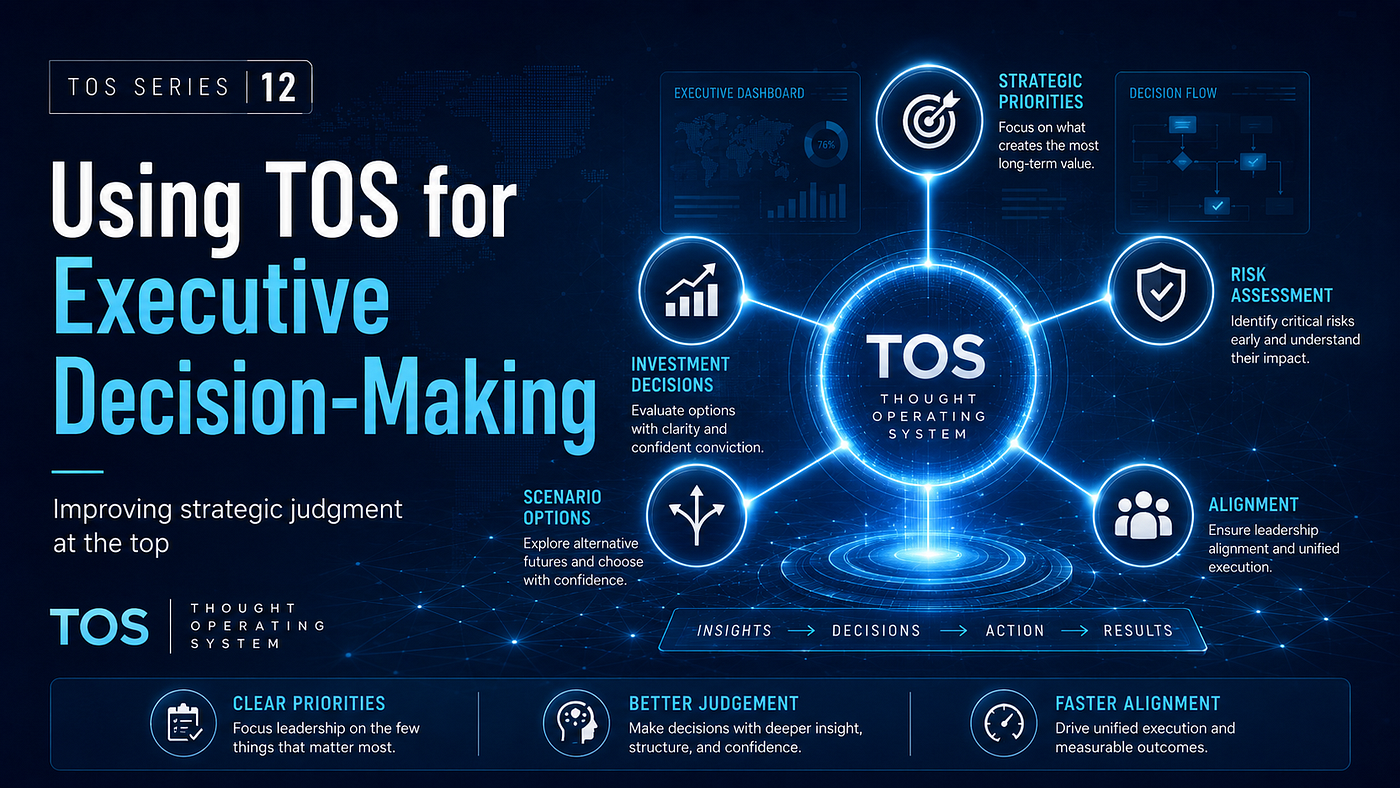
Using TOS for Executive Decision-Making
Problem:
Executive decisions are rarely simple.
Leaders must make decisions under uncertainty. Information is incomplete. Risks are interconnected. Stakeholders have different priorities. Timing matters. Resources are limited. The consequences may affect the entire organisation.
In such situations, the challenge is not only to collect more information. The real challenge is to structure the decision properly.
Many executive teams struggle because their decision-making process is unclear.
What is the real issue? What are the options? What assumptions are being made? What criteria should guide the decision? What risks are acceptable? What trade-offs must be recognised? What will success look like?
Without a structured approach, executive decisions may become slow, inconsistent, political, or overly dependent on individual judgement.
TOS Insight:
The Thought Operating System (TOS) helps executive teams structure strategic decisions with greater clarity and consistency.
It does not remove uncertainty. It does not replace leadership judgement. It does not make difficult decisions easy.
Instead, TOS helps leaders make the thinking process visible.
It supports executive decision-making by clarifying:
- The strategic question
- The decision context
- The available options
- The assumptions behind each option
- The criteria for evaluation
- The risks and trade-offs
- The expected outcomes
- The learning process after execution
This creates a more disciplined foundation for leadership judgement.
How TOS Supports Executive Decision-Making:
TOS can support executive decisions in five practical ways.
1. Clarifying Strategic Priorities
Executives often face too many issues at once.
TOS helps distinguish between urgent issues, important issues, and strategically decisive issues.
This allows leaders to focus attention on what matters most.
2. Structuring Options
A decision is weak if the options are poorly defined.
TOS helps generate and compare alternative paths. It supports scenario thinking, trade-off analysis, and option design.
This prevents leaders from choosing between overly narrow alternatives.
3. Making Assumptions Visible
Every strategic decision is based on assumptions.
Market growth will continue. Customers will respond. Costs will remain manageable. Competitors will behave in a certain way. The organisation can execute.
TOS helps bring these assumptions to the surface.
4. Aligning Decision Criteria
Different executives may evaluate the same issue differently.
One may prioritise growth. Another may prioritise risk. Another may prioritise cash flow. Another may prioritise brand value.
TOS helps the team align the criteria before choosing the option.
5. Connecting Decisions to Learning
Executive decisions should not disappear after they are made.
TOS helps leaders record the logic behind decisions, monitor outcomes, and learn from results.
This improves future decision-making.
Application Example:
Consider an executive team deciding whether to enter a new overseas market.
A conventional discussion may focus on market size, cost, partners, risks, and expected revenue. These are important, but the discussion can easily become fragmented.
Using TOS, the team begins with the core strategic question:
Should we enter this market now, and if so, under what conditions?
Then the team structures the decision:
What opportunity are we pursuing? What assumptions must be true? What options exist? What risks are unacceptable? What resources are required? What would make us stop or revise the plan? How will we evaluate results after entry?
The discussion becomes clearer because the thinking process is explicit.
The decision may still be difficult, but it becomes more disciplined, more transparent, and more learnable.
Why This Matters in the AI Age:
AI can support executive decision-making by summarising information, generating scenarios, identifying risks, and comparing options.
However, AI cannot take responsibility for the decision.
Leaders still need to define the question, choose the criteria, interpret the trade-offs, and accept accountability.
TOS helps leaders use AI as a thinking partner while preserving human judgement and responsibility.
In the AI age, executive value will not come from having more information. It will come from asking better questions, structuring decisions more clearly, and learning faster from outcomes.
Bridge to Next Article:
In the next article, we will explore how TOS can be used for organisational transformation.
If executive decisions define direction, organisational transformation determines whether that direction can be realised. TOS can help organisations identify resistance, align perspectives, and structure the path from intention to change.
Call to Action:
Reflect on your own organisation:
How are major decisions structured at the executive level?
Are assumptions clearly visible? Are decision criteria aligned? Are risks and trade-offs discussed openly? Are outcomes reviewed after execution?
In leadership, the quality of decisions depends on the quality of the thinking process behind them.
Share your thoughts in the comments or continue the discussion on LinkedIn.
메타데이터
- post_id
- 1b79b45ca35c
- slug
- using-tos-for-executive-decision-making-1b79b45ca35c
- url
- https://medium.com/@kojiharata2/using-tos-for-executive-decision-making-1b79b45ca35c
- canonical_url
- https://medium.com/@kojiharata2/using-tos-for-executive-decision-making-1b79b45ca35c
- author_url
- https://medium.com/@kojiharata2
- status
- ok
- fetched_at
- 2026-08-10 05:06:00




