Large Format Printing Services: How Big Visuals Create Bigger Business Impact
A customer walks down a busy street, passes dozens of storefronts, sees hundreds of advertisements, and scrolls through countless digital…
Large Format Printing Services: How Big Visuals Create Bigger Business Impact
A customer walks down a busy street, passes dozens of storefronts, sees hundreds of advertisements, and scrolls through countless digital messages during the same day.
Most of them disappear from memory almost instantly.
Then something different catches their eye: a dramatic storefront graphic, a beautifully printed exhibition wall, a bold building banner, or a professionally designed vehicle wrap.
That is the power of scale.
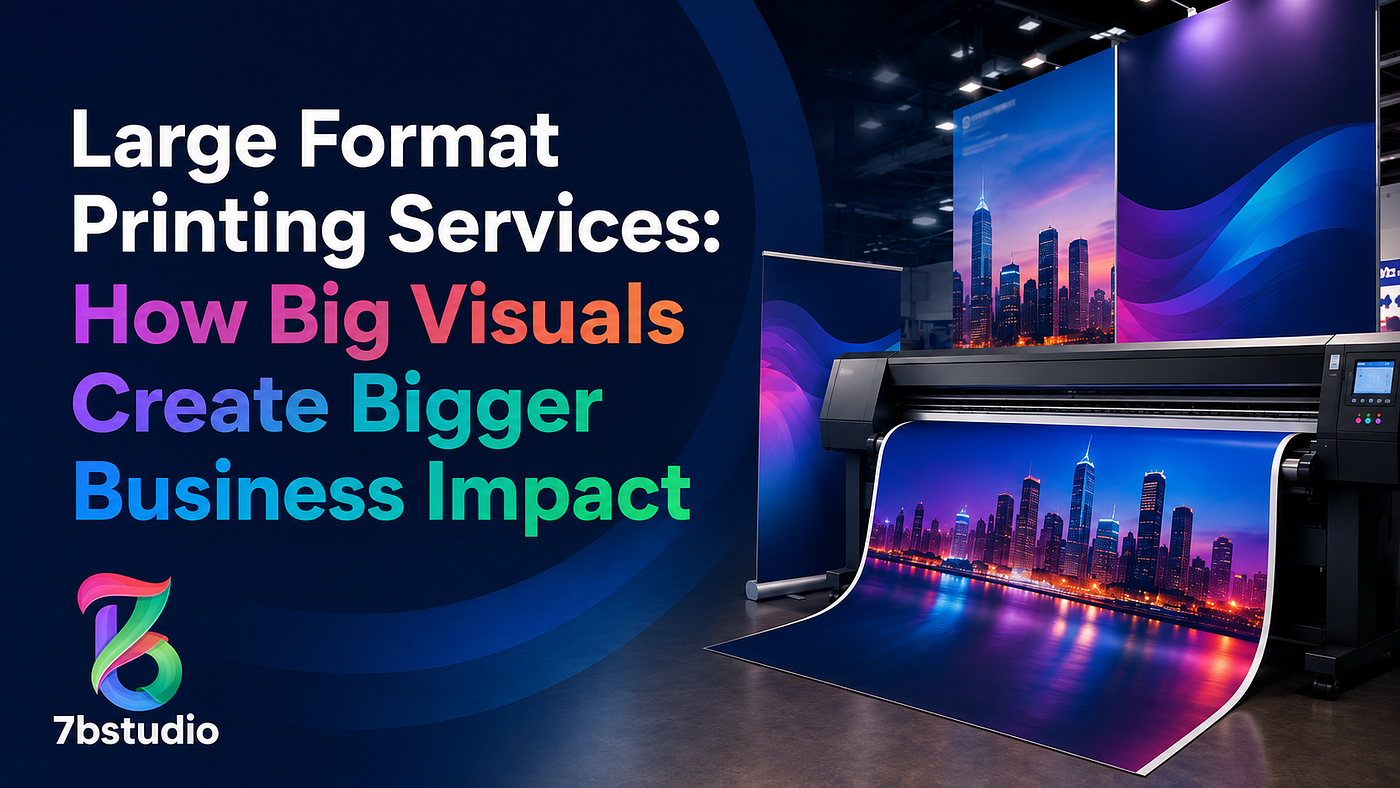
Large format printing services allow businesses to communicate beyond the limitations of screens, brochures, and ordinary office printers. They turn walls, windows, floors, vehicles, exhibition stands, construction barriers, and outdoor spaces into visual communication tools.
However, printing something large is not simply a matter of enlarging a small design.
Successful large-format graphics require the right combination of design, resolution, material, color management, finishing, installation, and viewing-distance planning.
For brands competing for attention in crowded commercial environments, understanding these elements can make the difference between a graphic that simply occupies space and one that actually gets noticed.
Why Large Format Printing Still Matters in a Digital World
Digital advertising dominates many marketing conversations today. Yet physical environments continue to influence buying decisions.
People still visit shopping malls, restaurants, exhibitions, offices, hotels, events, supermarkets, showrooms, construction sites, and retail stores.
Every one of those spaces represents an opportunity for visual communication.
Large-format graphics work particularly well because they become part of the customer’s physical environment.
A social media advertisement may disappear after a few seconds. In contrast, a professionally printed wall graphic, shop sign, banner, or window display can remain visible for weeks or months.
That creates repeated brand exposure without requiring someone to click, subscribe, or open an application.
For businesses in competitive commercial markets such as Riyadh, this physical visibility can be especially valuable.
What Are Large Format Printing Services?
Large-format printing generally refers to printing graphics that are significantly larger than standard commercial documents.
Instead of producing business cards, flyers, or ordinary A4 materials, specialized printers create graphics for much larger surfaces.
Common applications include:
- Outdoor banners
- Exhibition graphics
- Wall graphics
- Window stickers
- Vinyl graphics
- Posters
- Retail displays
- Roll-up banners
- Backdrops
- Vehicle graphics
- Construction hoarding
- Floor graphics
- Directional signage
- Promotional displays
- Building graphics
Businesses looking for professionally produced **large format printing services** should therefore consider more than printing capacity alone. Material selection, artwork preparation, finishing quality, color consistency, and installation can significantly influence the final result.
Bigger Doesn’t Automatically Mean Better
One of the most common misconceptions about large-format printing is that increasing the size automatically increases impact.
It doesn’t.
A poorly designed 10-meter banner can be less effective than a carefully designed two-meter sign.
Successful large-format graphics depend on communication hierarchy.
Someone viewing a billboard, storefront sign, or exhibition banner usually has only a few seconds to understand it.
That means the design needs to answer three questions quickly:
- What is this?
- Why should I care?
- What should I do next?
Trying to include too much information often reduces effectiveness.
Think About Viewing Distance
A poster viewed from one meter away can contain more detail than a banner intended to be seen from across a highway.
Typography, image selection, contrast, and message length should therefore change according to viewing distance.
For example, imagine two coffee shops using outdoor banners.
The first banner contains:
- The company story
- Seven product photographs
- Multiple offers
- Social media handles
- A large paragraph
- Contact information
- Several different fonts
The second simply says:
Fresh Coffee. 50 Metres Ahead.
Which message is easier for someone driving past to understand?
Usually, the simpler one.
Large-format design rewards clarity.
Resolution: Why Your Image Can Look Sharp on Screen but Blurry in Print
A photograph may look excellent on a laptop and still produce disappointing results when printed several meters wide.
The reason is resolution.
Digital screens display images at relatively small physical dimensions. Once that same image is dramatically enlarged, insufficient image data becomes visible.
You may notice:
- Pixelation
- Blurry details
- Jagged edges
- Soft text
- Poor photographic definition
Professional print preparation considers both resolution and final viewing distance.
Interestingly, an enormous outdoor graphic does not always require the same pixel density as a magazine because viewers may stand several meters away.
However, designers should still create artwork according to the printer’s technical specifications rather than simply enlarging a low-resolution JPG.
Vector Graphics Are Extremely Useful
Logos, typography, icons, and simple illustrations should ideally be provided as vector artwork whenever possible.
Common vector formats include AI, EPS, SVG, and print-ready PDF files.
Unlike ordinary raster images, vector graphics can generally be enlarged without becoming pixelated.
That makes them particularly useful for signs, banners, wall graphics, and exhibition displays.
Choosing the Right Printing Material
Design gets most of the attention, but material choice often determines how well a large-format project performs.
Different environments require different substrates.
Vinyl
Vinyl is widely used because it is versatile, durable, and suitable for many indoor and outdoor applications.
It may be used for:
- Window graphics
- Wall graphics
- Stickers
- Signage
- Vehicle branding
- Promotional graphics
The exact type of vinyl should depend on where and how it will be installed.
Banner Materials
Banner materials are commonly used for events, temporary promotions, building displays, and outdoor advertising.
Finishing options may include hems, eyelets, reinforced edges, or pole pockets depending on how the banner will be installed.
Fabric
Fabric printing can create a softer and more premium appearance.
It is frequently used for:
- Exhibition booths
- Backdrops
- Interior displays
- Retail environments
- Events
Fabric also reduces some of the glare associated with glossy surfaces.
Self-Adhesive Materials
Self-adhesive printing can transform ordinary surfaces into advertising spaces.
Walls, windows, floors, doors, counters, and vehicles can all support suitable adhesive graphics.
However, choosing the correct adhesive is important.
A temporary campaign installed for three days has very different requirements from a permanent retail wall graphic.
Indoor vs Outdoor Printing: Know the Difference
Large graphics installed inside a climate-controlled shopping center face different conditions from graphics installed outdoors in Riyadh.
Outdoor graphics may need to tolerate:
- Strong sunlight
- High temperatures
- Dust
- Wind
- Moisture
- Frequent cleaning
- Long exposure periods
Consequently, printing technology, ink, lamination, substrate, and installation method should be chosen according to the environment.
A material that performs perfectly at an indoor exhibition may deteriorate quickly when exposed outdoors.
This is why experienced printers typically ask where the graphic will be installed before recommending materials.
Color Can Change Between Your Screen and the Final Print
Another common surprise occurs when printed colors appear different from what customers see on their monitors.
Screens create color using light, normally through RGB color systems.
Commercial printers typically reproduce colors through ink-based processes such as CMYK.
As a result, certain bright digital colors cannot be reproduced exactly in physical print.
Monitor calibration, print profiles, media type, ink technology, and lighting conditions can also influence color appearance.
Brand Colors Need Special Attention
If your company relies heavily on a recognizable brand color, communicate that requirement before production.
Provide official color references when available.
For major campaigns involving multiple printed items, proofing can also help maintain consistency across banners, signage, displays, packaging, and other materials.
Finishing Is What Makes Printing Look Complete
Printing is only one stage of the process.
Finishing often separates an ordinary print from a professional-looking installation.
Depending on the project, finishing may involve:
- Lamination
- Mounting
- Trimming
- Cutting
- Hemming
- Eyelets
- Contour cutting
- Application tape
- Protective coatings
- Welding
- Framing
Imagine receiving a beautifully printed outdoor banner without reinforced edges or suitable eyelets.
The print itself may be excellent, but installation becomes difficult and the banner may fail prematurely.
Production decisions should therefore consider the complete lifecycle of the graphic.
Installation Can Make or Break the Final Result
Large-format graphics can look impressive on the production floor and completely different once installed.
Bubbles, creases, poor alignment, uneven tension, visible seams, and inaccurate positioning can quickly damage the appearance of a project.
This becomes even more important with complex applications such as:
- Large window graphics
- Wall murals
- Vehicle wraps
- Building graphics
- Exhibition structures
Before production, accurate measurements should be taken.
Installers must also understand the surface.
Concrete, glass, painted walls, metal panels, vehicles, and floors each behave differently.
Surface condition also matters. Dust, moisture, oils, loose paint, or uneven textures can affect adhesion.
Large Format Printing at Exhibitions and Events
Exhibitions provide one of the clearest examples of why physical visual communication still matters.
Visitors often walk through halls containing dozens or even hundreds of competing exhibitors.
Every booth is fighting for attention.
A strong visual system can help visitors understand what a company does before speaking to anyone.
Effective exhibition graphics often include:
- A clear brand identity
- One main value proposition
- Strong visual contrast
- Large readable text
- Strategic product imagery
- Consistent colors
- Simple calls to action
Instead of filling every available centimeter with information, successful booths usually create visual breathing room.
The objective is not to explain everything.
The objective is to encourage the right visitor to stop.
Retail Spaces Are Becoming Media Channels
Modern retailers increasingly treat physical stores as communication environments.
Windows promote new products.
Walls explain brand stories.
Floors guide customers.
Counters highlight offers.
Signs make navigation easier.
Seasonal graphics allow the same environment to change throughout the year.
Large-format printing therefore supports both marketing and customer experience.
Consider a fashion retailer launching a new collection.
Rather than changing expensive permanent fixtures, the retailer could update:
- Window graphics
- Hanging banners
- Wall posters
- Changing-room graphics
- Promotional signs
- Counter displays
A relatively small physical transformation can make the store feel completely different.
Common Large Format Printing Mistakes
Many expensive print problems begin before anything reaches the printer.
1. Using Low-Resolution Artwork
Downloading a small website image and stretching it across a large banner rarely produces good results.
Always prepare artwork for the intended output size.
2. Making Text Too Small
Designers sometimes judge text while viewing artwork closely on their monitors.
The customer may view the finished graphic from several meters away.
Design for real-world viewing conditions.
3. Ignoring Bleed and Safe Areas
Cutting and finishing require production allowances.
Important text or logos positioned too close to edges may be trimmed or visually crowded.
4. Selecting Material Based Only on Price
The cheapest material may cost more if it fades, tears, peels, or needs replacement sooner than expected.
Instead, evaluate expected lifespan and environmental conditions.
5. Skipping Site Measurements
Never assume a wall, window, booth, or sign frame matches a nominal measurement.
Even small dimensional differences can become significant in large-format applications.
A useful **large-format print preparation guide** can also help designers understand artwork setup, bleed, image resolution, and production requirements before submitting files.
How to Prepare a Better Large-Format Printing Brief
You do not need to be a printing expert to request a good project.
You simply need to provide the right information.
Before requesting a quotation, answer these questions:
- Where will the graphic be installed?
- Is the application indoor or outdoor?
- What are the exact dimensions?
- How long should it remain installed?
- From what distance will people view it?
- What surface will it attach to?
- Will installation be required?
- Do brand colors need strict matching?
- Is the artwork already print-ready?
- What deadline must be met?
These details help printers recommend appropriate production methods instead of guessing.
Where Large Format Printing Delivers the Most Value
Large-format graphics are particularly effective when the objective is physical visibility.
Common business scenarios include:
Retail Launches
New product collections, seasonal campaigns, and promotional offers can quickly transform existing store environments.
Corporate Events
Stage graphics, branded backdrops, directional signs, and registration areas create a more coordinated experience.
Restaurants and Cafés
Window graphics, wall displays, promotional banners, and menu visuals can communicate offers before customers enter.
Real Estate
Property developers use construction hoarding, site signage, project banners, and sales-center graphics to present developments before completion.
Hospitality
Hotels, restaurants, and event venues can use temporary graphics for conferences, weddings, seasonal campaigns, and branded events.
Corporate Offices
Wall graphics, mission statements, directional signs, branded meeting rooms, and reception graphics help reinforce company identity.
Measuring the Impact of Physical Graphics
Offline marketing does not have to be impossible to measure.
Businesses can connect physical graphics with digital actions.
For example, a banner could include:
- A dedicated QR code
- A campaign-specific landing page
- A promotional code
- A unique phone extension
- A short memorable URL
This allows marketers to compare responses from different locations or campaigns.
For instance, imagine a retailer installs five window campaigns across several branches.
Each location uses a different QR code.
After one month, the company can identify which locations generated the most scans and use that information when planning future campaigns.
Large-format printing becomes far more strategic when visual impact and measurable customer actions work together.
The Future of Large Format Printing Is More Personalized
Printing technology continues to make customized visual communication easier.
Instead of producing one identical campaign for every location, companies can adapt graphics to specific audiences, branches, events, seasons, or neighborhoods.
A restaurant chain might highlight different menu items at different branches.
A retailer might adapt messaging according to local customer preferences.
A national campaign could maintain the same brand identity while adjusting language, product imagery, or offers by region.
This flexibility helps physical advertising behave more like modern digital marketing while retaining its real-world presence.
Conclusion: Print Becomes Powerful When Strategy Comes First
Large-format printing is not simply about making graphics bigger.It is about making communication visible.The strongest projects combine clear messaging, appropriate materials, quality artwork, accurate color reproduction, professional finishing, and careful installation.More importantly, they are created for a specific environment and audience.Whether the final output is a storefront graphic, exhibition wall, vinyl sticker, outdoor banner, construction hoarding, retail display, or corporate backdrop, the same principle applies:Design for the place where people will actually experience it.Companies such as **7b studio** operate within this broader printing and visual communication ecosystem, helping businesses translate digital artwork into physical brand experiences.However, regardless of which printing partner a company chooses, successful projects begin with a clear objective.Know where the graphic will appear.Know who needs to see it.Know what action you want them to take.Then allow the design, material, print technology, and installation method to support that goal.When those elements work together, a large printed surface stops being decoration.It becomes communication people notice.
메타데이터
- post_id
- 1b8a18726d2a
- slug
- large-format-printing-services-how-big-visuals-create-bigger-business-impact-1b8a18726d2a
- url
- https://medium.com/@7bstudio/large-format-printing-services-how-big-visuals-create-bigger-business-impact-1b8a18726d2a
- canonical_url
- https://medium.com/@7bstudio/large-format-printing-services-how-big-visuals-create-bigger-business-impact-1b8a18726d2a
- author_url
- https://medium.com/@7bstudio
- status
- ok
- fetched_at
- 2026-08-08 04:34:00