Ma Durgaa and Human Rights
“Om jataa jut samaayuktamardhendu krit lakshnam Lochanyatra sanyuktam padmendu sadya shan naam”
Ma Durgaa and Human Rights
“Om jataa jut samaayuktamardhendu krit lakshnam Lochanyatra sanyuktam padmendu sadya shan naam”
Meaning: I bow down to the Supreme Power and urge you to help me concentrate on my goals and thus help me to achieve them.
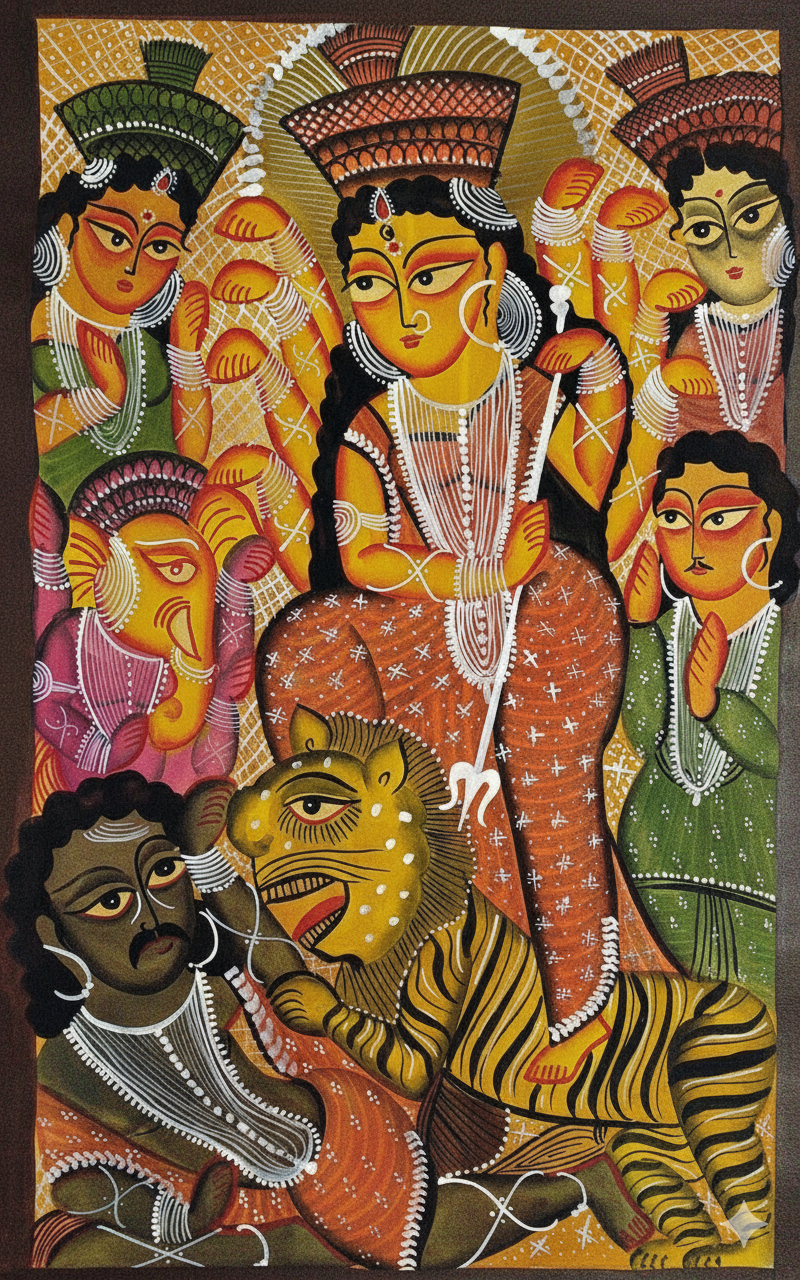
AI Generated Image of Ma Durga
This article is dedicated to the power of Ma Durga to protect all the creations of the universe; hence, it begins with the mantra, which will help everyone focus and maintain concentration. Focus and concentration are essential to every human rights defender and advocate.
The first question is: How does Hinduism approach human rights? Hinduism approaches human rights through the lens of dharma, a concept rooted in moral duty, social responsibility, and cosmic order. Unlike Western frameworks that emphasise individual entitlements and legal protections, dharma-based ethics focus on the interconnectedness of rights and responsibilities, as well as the collective rights of all creations in the universe, where justice arises from fulfilling one’s role in society with integrity and compassion. This perspective does not reject rights but embeds them within a broader moral ecology. In his article “Hinduism and Human Rights”, Werner Menski attempts to explore this complexity but ultimately falls short by interpreting dharma through a Western legalist lens. He overlooks how dharma functions not as rigid law but as a fluid, context-sensitive guide to ethical living, making his analysis unable to capture the dynamic interplay between spiritual values and social justice that defines Hindu thought.
The second question is — who is Ma Durga? In Hinduism, Ma Durga — also revered as Shakti or Devi — is not just a goddess; she is the fierce, nurturing mother of the universe, a symbol of strength, protection, and moral order. Riding a lion or tiger, armed with multiple weapons in her many hands, Durga charges into battle against the forces of evil, embodying the eternal fight for righteousness.
Even the utterance of Her name brings power within us! The name Durga comes from Sanskrit, meaning “fortress” or “inaccessible place” — a metaphor for her unyielding nature and protective spirit. She is also called Durgatinashini, “the one who destroys suffering,” reminding devotees that she stands as a shield against injustice, pain, and oppression.
Like many Hindu deities, Durga manifests in numerous forms, each representing a unique aspect of her power. Her avatars include Kali, Bhagvati, Bhavani, Ambika, Lalita, Gauri, Kundalini, Java, and Rajeswari — each with their own stories and significance. During the sacred festival of Navaratri, Durga is worshipped in nine distinct forms, known as the Navadurga: Shailaputri, Brahmacharini, Chandraghanta, Kusumanda, Skandamata, Katyayani, Kaalratri, Mahagauri, and Siddhidatri. These forms are celebrated with dedicated prayers, songs, and rituals, each highlighting a different virtue — courage, wisdom, purity, and resilience.
Now, the main question, i.e, what is the connection between Ma Durga and human rights? This article argues that there are two connections. One is through her appearance or aura, which includes several symbols and figures which refer to her power, obligation and duty towards the protection of human rights. She is responsible for upholding peace and dignity, too. Second, the connection is through the mantras that are chanted during the rituals of Puja. Here, the article will briefly discuss the shakti mantra.
Ma Durga is considered as a divine power of moral compass. She is more than a mythological figure — she is a symbol of resistance, empowerment, and justice. Her image, riding a lion and wielding weapons in multiple hands, is a powerful metaphor for the fight against oppression, violence, and inequality. In the realm of human rights, Durga represents the moral courage to stand up for the vulnerable and challenge systems of abuse.
Durga’s Traits as Human Rights Principles include her role as a protector of good, destroyer of evil and mother of the universe. To understand this, we need to read the shakti mantra.
“sharnaagat deenaart paritraan paraayaney, servasyarti harey devi naaraayani namostutey
Sarvasvaroopey sarveshey sarvshakti samanvietey, bhayebhyah traahi no devi durge devi namostutey
Rogaan shoshaan pahansitushtarushtatu kaamaan saklaan bhishtaan, tvaam aashritaanaam na vipannaraanam, tvaamaashritaahya shraytaam prayaanti
Sarva badha prashmanan trailokya syakhileshwari, evamevmev tvayaa kaaryam sma dveri vinaashnam
Sarvaa baadha vinirumk to dhan dhaanya sutaan vitah. Manushyo mat prasaaden bhavishyati na sansha yah
Dehi saubhaagyam aarogyam dehi devi param sukham Rupam dehi jayam dehi yasho dehi dvisho jahi
Jyanti mangalaa kaali bhadra kaali kapaalinee durgaa kshamaa shivaa dhaatree swaahaa svadhaa namostutey”
Meaning: “You who are perpetually endeavouring to protect the weak and the poor and remove their misery. Oh Narayani, I pray to you.
Oh Goddess Durga, please protect us from all kinds of fear. Oh omnipotent Durga, I pray to you.
Oh, Goddess, when you are pleased, remove all ailments, and when you are angry, destroy everything that a person desires. However, those who come to you for sanctuary never have to confront any catastrophe. Instead, such people secure enough merit to provide shelter to others.
Whoever listens to the story of the Goddess during the great Puja that is organised in the winters succeeds in overcoming all obstacles and is blessed with wealth and progeny.
Oh Goddess, bless me with good fortune, health, looks, success, and fame. Oh Vaishnavi, you are the very basis of the world. You have mesmerised the World. When you are pleased with someone, you ensure their salvation from the cycle of life and death.
Oh Goddess, you who are known by the names of Mangala, Kali, Bhadra Kali, Kapalinee, Durge, Kshama, Shivaa, Dhatri, Swahaa, Swadha, I pray to you.”
If we analyse this mantra, then we see that as a protector of the good, Durga defends dharma — the cosmic law of righteousness. This mantra aligns with the human rights principle of protecting the dignity and freedoms of all individuals, especially those marginalised or persecuted. As a destroyer of evil, her battle against demons like Mahishasura symbolises the struggle against tyranny, injustice, and discrimination — whether based on religion, ethnicity, gender, or political belief. To the Hindus, she is the mother of the universe. As a nurturing force, Durga embodies compassion and care, echoing the human rights commitment to humanitarian protection, especially in times of conflict or displacement.
The Shakti mantra invokes the Goddess’s energy to remove fear, obstacles, and injustice. Each syllable of this mantra carries spiritual force. This mantra is a spiritual call to activate inner strength, much like how human rights movements call upon communities to rise, resist, and reclaim their dignity.
In today’s world, where minorities, women, and dissenters often face systemic violence, Ma Durga’s image can serve as a universal symbol of resistance. Her many forms — Kali, Ambika, Gauri — represent the diversity of strength, from fierce activism to gentle healing. Just as she transforms to meet the needs of the moment, human rights defenders must adapt, persist, and protect.
Ma Durga, as a beacon of justice, stands as a timeless symbol of moral strength, resistance to injustice, and compassionate protection. Her divine energy, invoked through powerful mantras, inspires human rights defenders to confront oppression and uphold dignity. In a world where the vulnerable are often silenced, Durga’s image reminds us that true justice demands courage, duty, and unwavering commitment to the collective good. She is not just worshipped — she is embodied in every act of resistance and every voice raised on behalf of the voiceless.
The article concludes with the shatru shanti mantra:
“Ripavah sankshayam yaanti kalyaanam chop padyate Nandate cha kulam punsaam maahaatmyam mam srinu yaanmam”
Meaning: “Enemies are destroyed, prosperity arises, and the family lineage flourishes for those who listen to my divine glory.”
Reference:
Menski, Werner, ‘Hinduism and Human Rights’, in John Witte, and M. Christian Green (eds), Religion and Human Rights: An Introduction (New York, 2011; online edn, Oxford Academic, 24 March 2015), https://doi.org/10.1093/acprof:osobl/9780199733453.003.0004, accessed 20 Sept. 2025.
Sinha, M. K., Raoul Wallenberg Institute of Human Rights and Humanitarian Law, Indian Society of International Law, Preet Kumar Sinha, & Dr. Noëlle Quénivet. (2005). Hinduism and international humanitarian law. In Volume 87 Number 858 (pp. 285–287). https://www.icrc.org/en/doc/assets/files/other/irrc_858_sinha.pdf, accessed 21 Sept. 2025
Rajhans, S. G. (2024, October 1). The Goddess Durga: the mother of the Hindu universe. Learn Religions. https://www.learnreligions.com/goddess-durga-1770363, accessed 19 Sept. 2025.
Aayush. (2023, October 15). 9 Powerful Durga Mantras that can help transform your life. VedicFeed. https://vedicfeed.com/powerful-durga-mantras/, accessed 17 Sept. 2025.
메타데이터
- post_id
- 1bc60bf16b0e
- slug
- ma-durgaa-and-human-rights-1bc60bf16b0e
- url
- https://medium.com/@tkbaul/ma-durgaa-and-human-rights-1bc60bf16b0e
- canonical_url
- https://medium.com/@tkbaul/ma-durgaa-and-human-rights-1bc60bf16b0e
- author_url
- https://medium.com/@tkbaul
- status
- ok
- fetched_at
- 2026-07-17 09:40:45