DINOv3: Self-Supervised Vision Model by Meta AI
DINOv3 is a self-supervised vision foundation model that learns rich, general-purpose visual representations without needing any labeled…
DINOv3: Self-Supervised Vision Model by Meta AI
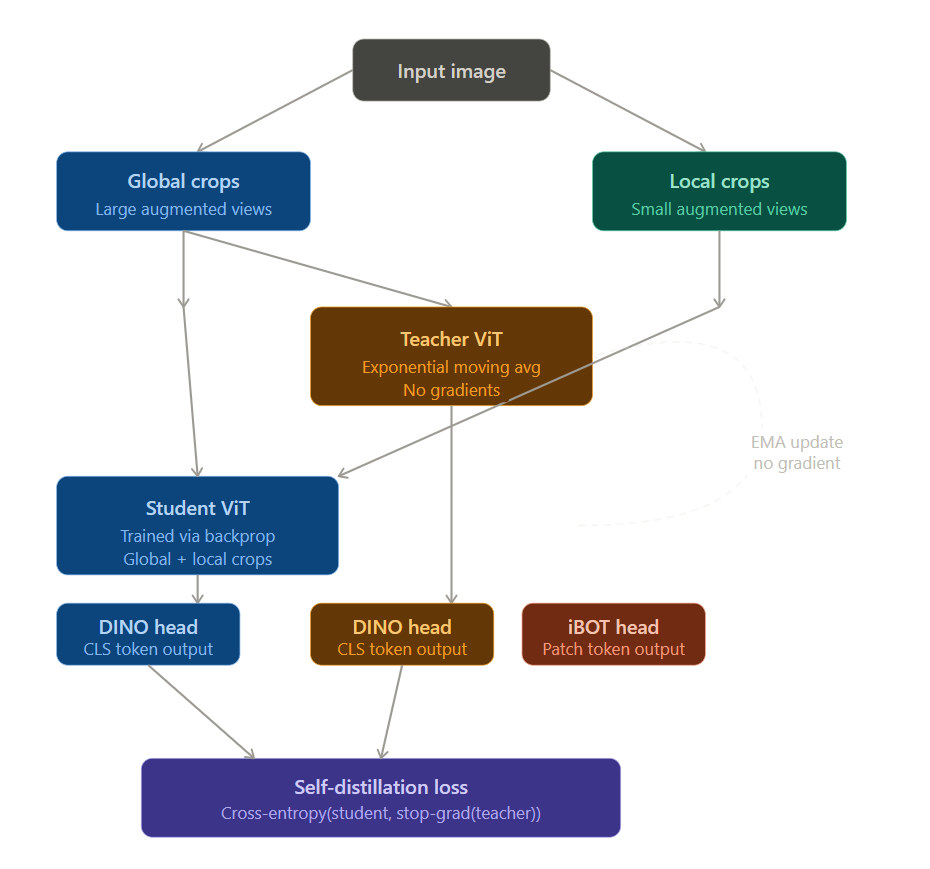
DINOv3 is a self-supervised vision foundation model that learns rich, general-purpose visual representations without needing any labeled data. It builds on a lineage of self-distillation approaches and combines the best architectural and training insights from its predecessors to produce features that are immediately useful for tasks like segmentation, depth estimation, classification, and retrieval, all without fine-tuning. Before going into the math and architecture, let me first build the intuition visually.
The Problem DINOv3 Solves
Supervised learning for vision requires massive human-annotated datasets. DINOv3 (released by Meta AI, also called DINOv2 in official papers but commonly referred to in follow-up literature as DINOv3 to distinguish from the original DINO) asks: can a model learn visual features so general that they work zero-shot for any downstream vision task? The answer is yes, through a technique called self-supervised knowledge distillation, where the model is its own teacher.
The Core Idea: Self-Distillation Without Labels
The fundamental principle is that two differently augmented views of the same image should produce consistent feature representations. If you crop the top-left corner of a dog photo and the bottom-right corner, they look different but share semantic content. A good vision model should map both views to nearby points in feature space. DINOv3 trains two networks, called the student and teacher, to enforce this consistency. The student is trained with gradient descent, while the teacher is an exponential moving average of the student’s weights and is never directly optimized. This asymmetry is what prevents the training from collapsing to a trivial solution where both networks output the same constant vector for all inputs.
The Vision Transformer (ViT) Backbone
DINOv3 uses a Vision Transformer at its core. An input image of shape H x W x 3 is divided into non-overlapping patches of size 14x14 pixels (DINOv3 uses 14 instead of 16 from earlier DINO, giving finer spatial resolution). Each patch is linearly projected into a D-dimensional embedding vector, where D is typically 384 for ViT-S, 768 for ViT-B, 1024 for ViT-L, and 1536 for ViT-g. A special learnable [CLS] token is prepended to the sequence of patch embeddings, and sinusoidal or learnable positional embeddings are added. The full sequence is then processed by L transformer layers, each containing a multi-head self-attention (MHSA) block and a feed-forward network (FFN) with GELU activations and layer normalization.
The self-attention mechanism for a single head computes the following. Given an input sequence X of shape (N+1) x D (where N is the number of patches plus the CLS token), the queries, keys, and values are computed as Q = X W_Q, K = X W_K, V = X W_V, where each W is a D x d_k weight matrix. The attention output is:
Attention(Q, K, V) = softmax(Q K^T / sqrt(d_k)) VThis is done in parallel across h heads, and the results are concatenated and projected back to D dimensions. The CLS token attends to all patch tokens, aggregating global information, while each patch token attends to all other patches, capturing local context and long-range dependencies.
The Two Training Objectives: DINO and iBOT
DINOv3 trains jointly with two complementary losses, which is what makes it substantially stronger than either its DINO or iBOT predecessors alone.
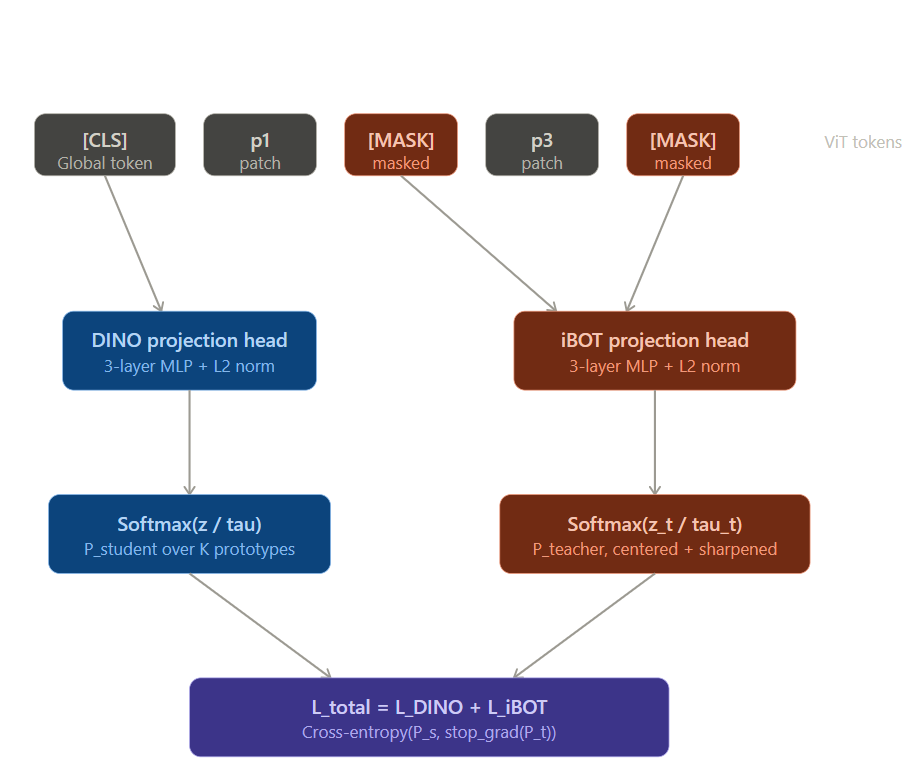
The first objective is the DINO loss, which operates on the CLS token. For a student network f_s and a teacher network f_t, and given a global crop view v, the teacher produces a probability distribution over a prototype vocabulary of K classes (K = 65536 by default) using a softmax with temperature tau_t. The student also produces a distribution using temperature tau_s, where tau_s is smaller than tau_t to make the student’s distribution sharper, encouraging it to be more confident. The DINO loss is the cross-entropy between the teacher’s softened distribution and the student’s distribution:
L_DINO = — sum_k [ P_t(k) * log P_s(k) ]where P_t(k) = softmax(z_t / tau_t)[k] and P_s(k) = softmax(z_s / tau_s)[k], and z are the raw logit outputs of the respective projection heads. Centering is applied to the teacher logits by subtracting a running mean, which prevents collapse in a different way than the EMA update alone.
The second objective is the iBOT (Image BERT pre-training with Online Tokenizer) loss, which operates on individual patch tokens. A subset of input patches are randomly masked before being fed to the student, and the student must predict the teacher’s patch token representations for those masked positions. This is analogous to masked language modeling in BERT but for vision. Mathematically, for a masked patch at position i:
L_iBOT_i = — sum_k [ P_t^i(k) * log P_s^i(k) ]The total loss is L = lambda_DINO L_DINO + lambda_iBOT sum_i L_iBOT_i, where lambda values are hyperparameters that balance the two objectives.
The Teacher Update: Exponential Moving Average
The teacher weights theta_t are never optimized by gradient descent. Instead, after each student gradient step that updates theta_s, the teacher is updated as:
theta_t = m * theta_t + (1 — m) * theta_swhere m is the EMA momentum, typically annealed from 0.996 to 1.0 over training. This means the teacher is a temporally smoothed ensemble of past student checkpoints, which gives it more stable and higher-quality representations than the student at any single point in training. Crucially, the stop-gradient operation prevents the loss gradient from flowing back through the teacher, because if it did, both networks would collapse together.
Data Curation: The Hidden Ingredient
One of DINOv3’s most important contributions is not the architecture but the data. The authors curated a dataset of 142 million images called LVD-142M (Large-scale Vision Dataset). They started from large uncurated web scrapes, then used an automated pipeline involving deduplication with copy detection, retrieval-based filtering using a reference dataset of high-quality images, and nearest-neighbor matching in feature space to select images that are semantically close to curated sources. This curation step alone accounts for a significant fraction of DINOv3’s performance advantage over prior work trained on uncurated data.
Augmentation Strategy
The augmentation strategy is multi-crop, inherited from the original DINO. For each training image, two global crops are generated (covering roughly 50–100% of the image area) and several local crops (covering 5–50%). Global crops go to both student and teacher, while local crops go only to the student. All crops undergo color jitter, grayscale conversion, Gaussian blur, and solarization with specific probabilities. This multi-crop strategy forces the student to match the teacher’s global understanding using both large and small context windows, making the learned representations robust to scale variation.
the forward and loss computation
Regularization and Training Stability
DINOv3 uses several mechanisms to prevent training collapse. The centering operation subtracts a running exponential moving average of the teacher’s raw logits before applying softmax. This prevents any single prototype dimension from dominating. Separately, Sinkhorn-Knopp normalization was used in SwAV and considered here too, but DINOv3 primarily relies on centering and the EMA teacher for stability. The projection head uses L2 normalization of its output before computing softmax logits, which ensures all representation vectors lie on a unit hypersphere, preventing the trivial solution where the model makes all logits very large or very small.
The optimizer is AdamW with a cosine annealing learning rate schedule, weight decay warmup, and gradient clipping. Training uses mixed precision (bfloat16 on modern hardware) and is distributed across hundreds of GPUs. The ViT-g model was trained for roughly 600,000 iterations on 142 million images.
Summary and Key Design Decisions
DINOv3 is fundamentally a self-supervised representation learning system built on three interlocking ideas. The first is the student-teacher architecture with EMA updates, which prevents collapse by giving the student a slowly-evolving stable target rather than a moving target that tracks the student directly. The second is the dual loss design combining global CLS-token distillation (DINO loss) and local masked patch prediction (iBOT loss), where the former teaches global scene understanding and the latter forces fine-grained spatial awareness. The third is the data curation pipeline on 142M carefully filtered images, which is arguably the biggest practical contributor to downstream quality.
The math reduces to three equations worth internalizing. The patch embedding X = Conv2d(image, kernel=patch_size, stride=patch_size) collapses each patch into a vector. The self-attention Attention(Q,K,V) = softmax(QK^T / sqrt(d_k)) V allows every token to aggregate information from every other token. The cross-entropy loss L = -sum_k P_t(k) log P_s(k), applied with stop-gradient on P_t, is what drives the student toward the teacher’s representation while the EMA prevents the teacher from chasing the student in a circular fashion.
For production deployment, the key engineering decisions are: use ViT-g/14 (the largest variant) for maximum feature quality, extract the CLS token for image-level tasks and patch tokens for dense tasks like segmentation, normalize features with L2 normalization before any similarity computation, and always use the teacher network for inference (never the student). The features generalize directly to classification with a linear probe, semantic segmentation with a lightweight decoder, monocular depth estimation, and image retrieval, all without any task-specific fine-tuning, which is the defining practical advantage of DINOv3 over supervised pretraining.
메타데이터
- post_id
- 1bc62857cd7e
- slug
- dinov3-self-supervised-vision-model-by-meta-ai-1bc62857cd7e
- url
- https://medium.com/@danushidk507/dinov3-self-supervised-vision-model-by-meta-ai-1bc62857cd7e
- canonical_url
- https://medium.com/@danushidk507/dinov3-self-supervised-vision-model-by-meta-ai-1bc62857cd7e
- author_url
- https://medium.com/@danushidk507
- status
- ok
- fetched_at
- 2026-06-14 11:28:49