The Next Generation of Trading Risk Management Is Here: And It Doesn’t Watch Your P&L
There is something almost universally true about daily loss limits: traders set them at the number they think they can stomach. Not the…
The Next Generation of Trading Risk Management Is Here: And It Doesn’t Watch Your P&L

There is something almost universally true about daily loss limits: traders set them at the number they think they can stomach. Not the number where their judgment starts to fail. The number where the pain becomes unbearable.
These are not the same number.
By the time you’ve lost $400 on a $500 daily limit, your prefrontal cortex — the part of the brain responsible for probabilistic thinking, impulse control, and rule-following — has already been partially overridden by elevated cortisol and an activated threat response. You are not making the same decisions you made this morning. The hard limit fires at exactly the moment when you are least equipped to respond to it rationally.
This is the first flaw in every risk tool built in the last twenty years. They fire at the wrong point.
The discipline problem nobody is measuring
The trading industry has a peculiar relationship with discipline. It treats it as a virtue — something you either have, or develop through journals and meditation and rules written on index cards taped to your monitor. The implicit assumption is that discipline is binary: either you have enough of it to follow your rules, or you don’t, and that’s a character question.
This assumption is wrong, and it’s measurable.
Discipline in trading degrades in real time, and it degrades along observable behavioral axes. Your re-entry speed after a loss changes. Your position size drifts above your own declared parameters. You start holding losers longer than your historical average while cutting winners short — the exact inversion of what you know you should do. Your trade frequency accelerates past your normal session rhythm.
None of these are invisible. None of them require a therapist or a journal. They are execution data, and they are present in your trade log at the moment they happen.
For decades, nobody built a tool to watch them. Everyone was busy watching the P&L.
What cardiac monitoring figured out that trading never did
Your heart rate does not jump from 90 to 180 beats per minute. Before a cardiac event, there are precursors: elevated resting rate, increased variability, subtle arrhythmias, longer intervals between beats. The event doesn’t arrive without warning. The warning arrives in the data, for anyone measuring the right things.
This is why modern cardiac monitoring doesn’t just count heartbeats. It watches the texture of them.
Psychological deterioration in trading works identically. Between the moment a trader starts deviating from their own behavioral baseline and the moment they hit their hard limit, there is a window — sometimes thirty minutes, sometimes two hours. During that window, the session is recoverable. The damage is not yet done. The decisions haven’t yet been made.
That window has been unmonitored and unprotected for the entire history of retail trading risk management.
The reason is straightforward: monitoring it requires a personal behavioral baseline to deviate from. A fixed threshold — $500, three losses, forty-five minutes — applies the same standard to every trader. It cannot tell the difference between a scalper who normally trades thirty times a session and a position trader who normally trades five. It cannot detect that your position size is 40% above your own norm, because it doesn’t know your norm.
This is why Generation 1 and Generation 2 risk tools — broker hard limits and third-party shutoff add-ons — share the same fundamental limitation. They apply a fixed standard to a variable problem. They fire after the breach, not before it.
What Meridian actually measures
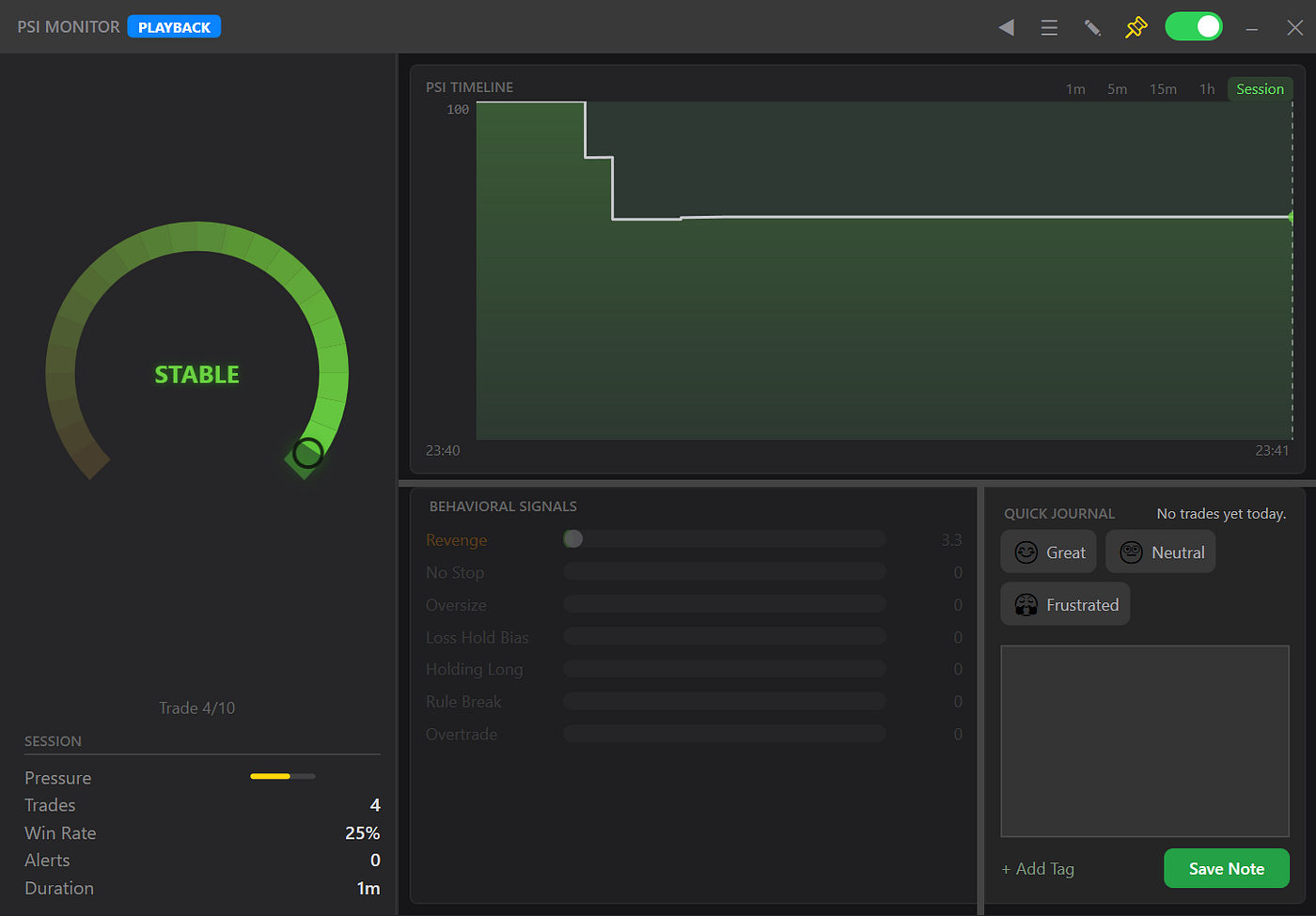
Meridian is a NinjaTrader 8 add-on that monitors seven behavioral signals during a live session and computes a real-time Psychological Stability Index (PSI) — updated in under 100 milliseconds after every execution event.

The seven signals:
D1 — Revenge Entry. Rapid re-entry after a loss, elevated size, same direction. The behavioral signature of a trader trying to recover, not to trade.
D2 — Stop Manipulation. Widening stops in the adverse direction after price moves against the position. The moment a plan becomes a hope.
D3 — Size Spike. Position size exceeding the trader’s own declared parameters, weighted heavier during losing streaks.
D4 — Hold Bias. Holding losing trades significantly longer than winning ones. Loss aversion made measurable.
D5 — Position Overstay. A losing trade running past the trader’s historical tolerance window.
D6 — Rule Violations. Crossing declared session rules: time limits, loss-streak caps, instrument restrictions.
D7 — Overtrading Pace. Entry frequency accelerating past the trader’s historical session rhythm.
Each signal is measured against the individual trader’s own history — not a generic industry threshold. The system learns what normal looks like for you: your typical re-entry speed, your usual sizing, your historical hold ratios. After 20 to 30 live sessions, the baseline is meaningfully calibrated. It adapts as your style evolves.
The PSI score runs from 0 to 100. Higher means more stable. It moves continuously through four zones: Stable (88–100), Caution (72–87), Warning (55–71), and Critical (0–54). Most behavioral failures become visible in the Warning zone — long before P&L reaches a hard limit.
When visibility isn’t enough
Meridian Core monitors and reports. Meridian Guard intervenes.
Six trigger conditions — PSI below a threshold, consecutive losses, session P&L, unrealized drawdown, single trade loss, session duration — can activate five escalating responses.
The first three levels are informational to confirmatory: a quiet notification, a persistent banner requiring active confirmation on each new entry, and a typed acknowledgment — a phrase the trader writes for themselves when calm, and must reproduce under pressure. The friction is intentional. It is harder to override your own words than to dismiss a generic alert.
The fourth and fifth levels block entries entirely, with optional broker disconnect and position flattening. The pause survives an NT8 restart or crash. Rules fire once per condition entry and reset — the system is explicitly designed around the finding that repeated alerts train traders to ignore alerts.

One architectural decision worth noting
Everything Meridian collects stays on the trader’s machine. Five years of session history, all behavioral data, every journal entry — stored in XML files under the trader’s control. The only outbound call is license validation on startup.
This is not a default. It is a position. Prop-firm traders operate inside restricted networks. Firms monitoring remotely can only see what crosses the wire. Meridian crosses nothing, which means it works inside environments where cloud-dependent tools do not.
The Guard tier’s Intel Layer uses this local history to generate pre-session briefings, PSI-by-P&L correlation analysis, monthly composure trends, and weekday pattern analysis — personalized analytics built entirely from data that never left the machine.
Why this matters now
The traders most likely to find Meridian useful are not the ones having their worst sessions. They are the ones who have already done the work — the journals, the rules, the reflection — and have come to understand that knowing what to do and detecting when you are no longer doing it are two entirely different problems.
A rule written when you are calm does not enforce itself when you are not. A journal reviewed after the fact cannot intervene during the fact.
Meridian works on the interval that every other tool ignores: the time between when your behavior starts to change and when your P&L records the consequence.
That interval is where sessions are saved or lost. It is, and has always been, the only place that matters.
Meridian is a NinjaTrader 8 add-on for Windows. Meridian Core starts at $49.99/month. Meridian Guard, which includes the enforcement layer and Intel analytics, is $69.99/month. Both include a 7-day free trial. All data stays local. meridianpsi.com
메타데이터
- post_id
- 1bcbc8c11a69
- slug
- the-next-generation-of-trading-risk-management-is-here-and-it-doesnt-watch-your-p-l-1bcbc8c11a69
- url
- https://medium.com/@contactmeridianpsi/the-next-generation-of-trading-risk-management-is-here-and-it-doesnt-watch-your-p-l-1bcbc8c11a69
- canonical_url
- https://medium.com/@contactmeridianpsi/the-next-generation-of-trading-risk-management-is-here-and-it-doesnt-watch-your-p-l-1bcbc8c11a69
- author_url
- https://medium.com/@contactmeridianpsi
- status
- ok
- fetched_at
- 2026-06-09 15:37:30