Best Salesforce Commerce Cloud Accelerators from US-Based Implementation Partners
Implementations that start from scratch carry real risk: missed go-live dates, budget overruns, and months spent rebuilding functionality…
Best Salesforce Commerce Cloud Accelerators from US-Based Implementation Partners
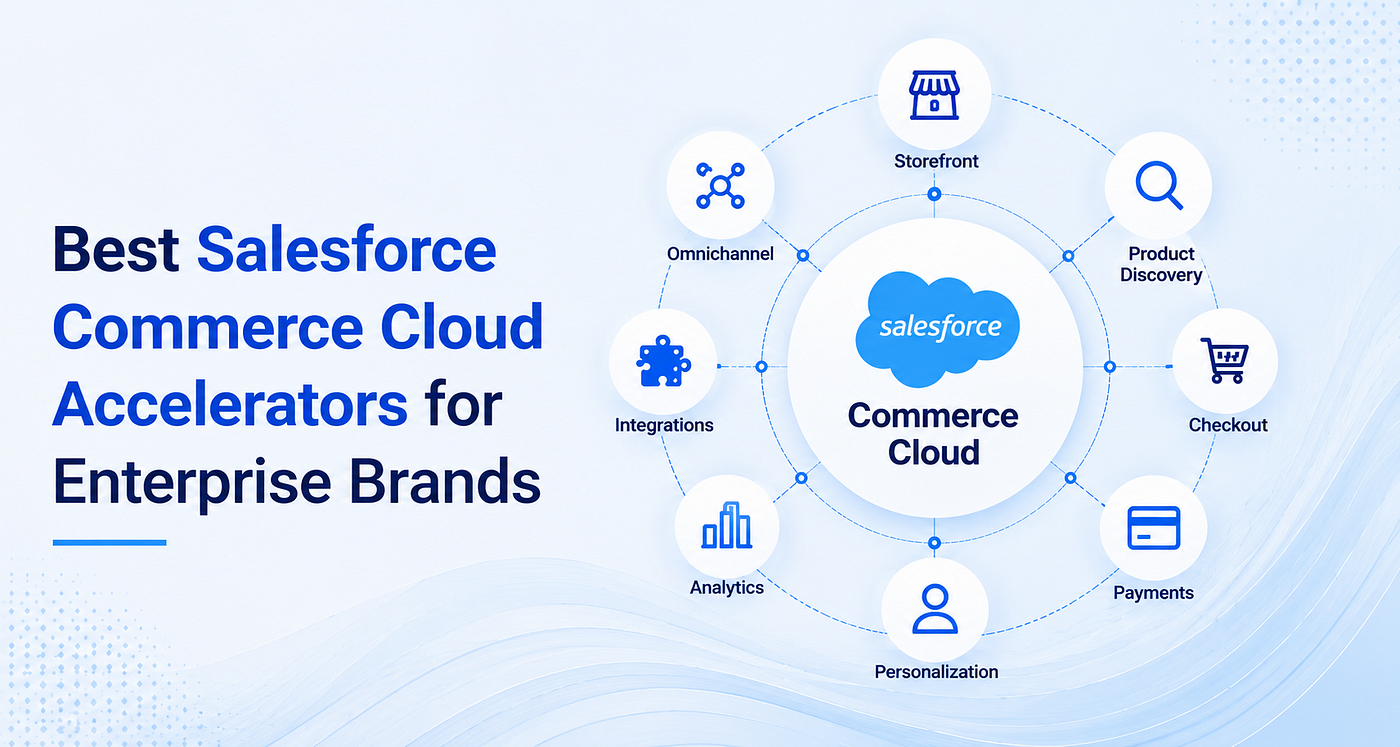
Implementations that start from scratch carry real risk: missed go-live dates, budget overruns, and months spent rebuilding functionality that already exists elsewhere. SFCC accelerators solve this by giving teams a production-ready starting point, with pre-built storefront architecture, pre-integrated connectors, and core commerce logic handled before the project kicks off.
This comparison covers six accelerators from leading US-based Salesforce Commerce Cloud implementation partners: what each framework includes, which commerce model it was built for, and where it performs best. Whether you are evaluating partners for a new build, a SiteGenesis to SFRA migration, or an SFCC managed services engagement, the accelerator your partner brings to the project materially affects how fast and at what cost you go live.
Ranosys — Phoenix (B2C) and Harrier (B2B)
The only partner in this comparison offering both a dedicated B2C and a dedicated B2B accelerator, built as two separate, purpose-designed frameworks rather than a single template stretched across both models.
**Phoenix: **Pheonix is Ranosys’s B2C accelerator, covering 60–80% of standard eCommerce requirements out of the box. Built for global, multi-brand, and multi-country deployments, it lets implementation teams skip the foundational build phase and move directly into brand-specific configuration. Core capabilities include:
- SFRA-based storefront architecture
- Product catalog configuration and promotions engine setup
- Checkout and payment integration
- Multi-locale, multi-currency, and multi-brand configuration as standard
- Regional variations and language packs built into the architecture, not added on after the fact
Real-world deployments include Rituals across multiple Southeast Asian markets and ongoing platform optimization for Under Armour.
**Harrier:** Harrier addresses a gap that most SFCC implementation accelerators leave open entirely. Purpose-built for B2B deployments, it covers:
- Account-based purchasing hierarchies
- Contract and tiered pricing
- Bulk order management
- Self-service portals built for B2B buyer expectations
For US manufacturers, distributors, and enterprise brands moving offline or rep-led sales channels onto a digital platform, Harrier provides a starting point that no other accelerator in this comparison can offer.
Ranosys holds Salesforce Summit Partner status (the highest tier in the partner ecosystem) and won the Salesforce Customer Success Partner of the Year Award in 2024. Their SFCC consulting services cover the full delivery lifecycle, from initial implementation through SiteGenesis to SFRA migration and ongoing managed services post-launch.
Best for: Multi-brand retailers, global and multi-country SFCC deployments, B2B commerce, and hybrid B2B/B2C organizations looking to hire a Salesforce Commerce Cloud consultant with proven enterprise delivery.
Astound Digital — Launch360
Built on SFRA with PWA and composable options, Launch360 reduces time-to-launch by up to 50%. It extends beyond the storefront layer by covering OMS and Salesforce VRA frameworks, making it one of the stronger multi-cloud launch options available from a US-based SFCC consulting provider.
Best for: B2C brands that need Commerce Cloud, OMS, and Service Cloud launched in a single coordinated Salesforce Commerce Cloud implementation.
Capgemini — Rapid Commerce Accelerator
A fully branded, feature-rich SFCC storefront in under 12 weeks, with fixed scope, standardized methodology, and the backing of a Tier 1 global SI. Built for US enterprises where delivery governance and budget predictability are as important as speed.
Best for: Large enterprise organizations that require SI-scale assurance alongside fast Salesforce Commerce Cloud deployment.
BORN Group — Arctic Fox
The first SFRA-adhering accelerator in the market, Arctic Fox stays synchronized with every Salesforce platform update, which means ongoing upgradeability without custom merges. It includes a high-fidelity UI library, pre-coded cartridges, and customizable design themes. Lucky Brand used it across the SPARC portfolio.
Best for: B2C brands planning multiple phases of SFCC evolution who need a Salesforce Commerce Cloud implementation partner with long-term platform alignment.
64Labs — Composable Storefront Accelerator
Purpose-built for Salesforce PWA Kit, Managed Runtime, and Next.js-based headless builds. No licensing fees, full code ownership, and coverage across every storefront layer from design systems to custom SCAPI endpoints. The framework draws on learnings from 10-plus composable SFCC projects.
Best for: Engineering teams with composable commerce roadmaps who want full control over their SFCC technical stack.
TCTG — SFCC Accelerator
Built for integration-heavy enterprise Salesforce Commerce Cloud projects. Pre-configured connectors for Algolia, Yotpo, Klaviyo, Adyen, Salesforce Payments, PayPal, and Loqate are included alongside data migration patterns for replatforming. Teams can have a production-ready SFCC storefront live in under three months at roughly half the cost of a traditional Salesforce Commerce Cloud implementation.
Best for: US enterprise brands migrating from legacy platforms or managing complex multi-system SFCC integrations, including SiteGenesis to SFRA migrations.
How to Choose the Right Salesforce Commerce Cloud Implementation Partner
The accelerator is one input into the partner decision. The broader evaluation should cover four areas:
Commerce model fit: Most SFCC accelerators are built exclusively for B2C. If your programme involves B2B buyer workflows, contract pricing, or account hierarchies, verify the partner has purpose-built B2B capability, not a B2C framework stretched to cover it.
Post-launch support: An SFCC implementation is where the ongoing work begins. Ask each partner what their managed services model looks like after go-live: who owns enhancements, how backlog is managed, and what SLAs cover platform uptime and releases.
Migration experience: If you are running SiteGenesis today, your partner’s SFRA migration track record matters as much as their implementation experience. Ask for named client references, not generic case study summaries.
Partner tier and certifications: Salesforce Summit Partner status is the highest recognition in the ecosystem. It requires verified client outcomes, certified headcount, and ongoing performance against Salesforce’s delivery standards, not just a signed partner agreement.
메타데이터
- post_id
- 1bd2e16ed963
- slug
- best-salesforce-commerce-cloud-accelerators-from-us-based-implementation-partners-1bd2e16ed963
- url
- https://medium.com/@NickPeterson092/best-salesforce-commerce-cloud-accelerators-from-us-based-implementation-partners-1bd2e16ed963
- canonical_url
- https://medium.com/@NickPeterson092/best-salesforce-commerce-cloud-accelerators-from-us-based-implementation-partners-1bd2e16ed963
- author_url
- https://medium.com/@NickPeterson092
- status
- ok
- fetched_at
- 2026-06-21 12:17:11