How to Calculate Refrigerant Leakage Emissions: The IPCC Tier 1 Method
A practitioner’s walkthrough of the charge × leak-rate × GWP method — and the AR5/AR6 trap that shifts your number by up to 30%.
How to Calculate Refrigerant Leakage Emissions: The IPCC Tier 1 Method
A practitioner’s walkthrough of the charge × leak-rate × GWP method — and the AR5/AR6 trap that shifts your number by up to 30%.
Credit: Scope 1 Refrigerant Leakage Calculator | HFC, HFO, Natural — AR5/AR6, IPCC
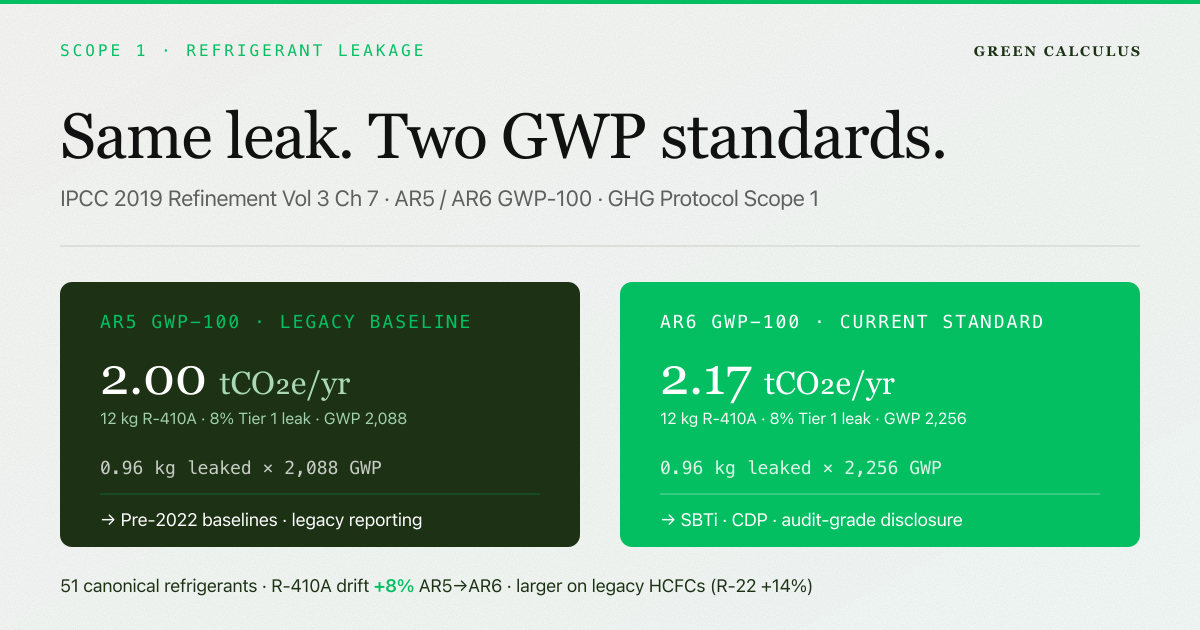
Refrigerant leakage is the single most carbon-dense line on most Scope 1 inventories, and the one most often estimated wrong. A 12 kg R-410A chiller leaking at the IPCC default 8% per year emits 2.17 tCO₂e — the same direct warming as driving a small car roughly 9,000 km [stat: per GreenCalculus refrigerant leakage calculator, IPCC AR6 GWP-100]. Unlike combustion, every kilogram that escapes goes straight to atmosphere. Here’s how to quantify it defensibly.
The core method
The IPCC Tier 1 equation is direct — there’s no emission-factor lookup, because the GWP value is the factor:
emissions (kg CO₂e) = charge (kg) × annual leak rate (%) ÷ 100 × GWP-100
Step 1 — Get the equipment charge. Pull the nameplate refrigerant charge in kilograms from the equipment register or service log. Per-asset detail matters: aggregated charge totals without per-asset breakdown get qualified by verifiers.
Step 2 — Establish the leak rate. Use a measured or supplier-reported rate where documentary evidence exists — it always takes precedence. Where you have none, the IPCC 2019 Refinement (Vol 3, Ch 7, Table 7.9) publishes default rates by equipment class. The ranges are wide for a reason: transport refrigeration alone spans 15–50%, reflecting genuine variation in age, service quality, and duty cycle.
Step 3 — Select the GWP basis. AR6 GWP-100 (IPCC 2021) is the current default and is now mandated by EU CSRD ESRS E1 (from FY2024), UK SECR (from FY2025), and CDP. AR5 remains valid only for legacy baseline alignment.
Step 4 — The hand-off. Rather than reproduce the full 51-refrigerant GWP set and the Table 7.9 leak-rate defaults here, the calculator applies the current AR6 values automatically and auto-fills the class default the moment you pick an equipment type — see **the Scope 1 refrigerant leakage calculator** for the worked example and Audit-mode export.
Common mistakes that fail verification
- AR5 used without disclosure. Some HFCs moved materially between AR5 and AR6 — R-143a by +30%, R-410A by +8% [stat: per IPCC AR5 / AR6 WG1 GWP-100]. State your basis or get requalified.
- 0% leakage on in-service equipment with no service-log evidence of zero top-up. Verifiers treat this as a red flag.
- Refrigerant manufacture booked in Scope 1. Cradle-to-gate production (~9–14 kgCO₂e per kg HFC-134a) is Scope 3 Category 1, not a direct emission.
- Top-up gas counted as a fresh purchase rather than as evidence of prior leakage requiring estimation.
- Confusing R-134a and HFC-134a — identical gas, two naming conventions.
- Treating the EU F-Gas 2025 service ban as a cliff edge — top-ups with reclaimed product remain compliant.

Credit: Scope 1 Refrigerant Leakage Calculator | GreenCalculus
메타데이터
- post_id
- 1beb7fffbe99
- slug
- how-to-calculate-refrigerant-leakage-emissions-the-ipcc-tier-1-method-1beb7fffbe99
- url
- https://medium.com/@greencalculus/how-to-calculate-refrigerant-leakage-emissions-the-ipcc-tier-1-method-1beb7fffbe99
- canonical_url
- https://medium.com/@greencalculus/how-to-calculate-refrigerant-leakage-emissions-the-ipcc-tier-1-method-1beb7fffbe99
- author_url
- https://medium.com/@greencalculus
- status
- ok
- fetched_at
- 2026-06-09 15:37:30