Point-to-Point Integrations vs API Platforms: The Decision Most MSPs Get Wrong
There is a moment in most MSP operations where someone asks: should we use the plugin for this, or connect through the API?
Point-to-Point Integrations vs API Platforms: The Decision Most MSPs Get Wrong

There is a moment in most MSP operations where someone asks: should we use the plugin for this, or connect through the API?
It sounds like a technical question. It is actually an operational one. And the way most MSPs answer it — usually defaulting to whichever option is faster to set up today — quietly shapes how much maintenance work the team carries for the next several years.
This is not an argument against plugins. They have their place. It is an attempt to lay out the real tradeoffs honestly, specifically for teams managing integrations across multiple client environments rather than just one.
What a plugin actually does
A plugin is a software module that extends an existing application. It installs directly on the host system — on your client’s ServiceNow instance, inside their Jira environment, embedded in whatever platform it was built for. It adds functionality that was not originally part of the system’s design.
The appeal is obvious. Activation is fast. Cost is usually lower than a full integration platform. For a straightforward requirement — connect these two fields, sync this object type — a plugin can be live in an afternoon.
The problem is the word ‘usually.’ Plugins are built by third-party vendors, maintained on their own release schedules, and designed around whatever the host system looked like when the plugin was written. Enterprise platforms release updates three to five times a year. Every update is a compatibility event. The plugin that worked last quarter may not work after the next ServiceNow release — and it may not fail loudly. It may just quietly produce wrong data.
The plugin that worked last quarter may not fail loudly after an update. It may just quietly produce wrong data.
For a single enterprise IT team managing one environment, this is an inconvenience. For an MSP managing twenty client environments with varying platform versions and update schedules, it becomes a recurring operational drain that nobody fully accounted for when the decision was made.
There is a security dimension here too. Installing third-party code inside a client’s production environment — code that has access to that system’s data — is something clients in regulated industries take seriously. It is a conversation that tends to arrive as a compliance audit finding rather than a pre-installation discussion.
What API-based integration actually means
An API integration connects two systems by talking to each system’s published interface from outside. Nothing installs on either system. The integration logic lives in the platform doing the connecting — not in the tools being connected.
This single architectural difference is what changes the maintenance calculus for MSPs. When a client’s ServiceNow instance updates, you are not chasing a plugin. You are verifying an API connection and, if anything changed, updating a configuration in the integration platform. That is a different kind of work — faster, lower risk, doable by any engineer on the team rather than the specific person who originally built the connector.
Coverage is also meaningfully broader. Plugins are built around specific use cases — a defined set of fields, a particular object type, a workflow pattern the vendor anticipated. An API integration platform can reach any data the API exposes, apply transformation logic, handle conditional routing, and manage bidirectional sync with conflict resolution. What you can automate is bounded by the API, not by the plugin’s feature list.
For MSPs this matters because client requirements do not stay simple. A client that starts with basic incident syncing between their monitoring tool and service desk will eventually want attachments syncing, comments flowing bidirectionally, custom fields mapping, routing logic based on priority. A plugin built for the initial requirement often cannot grow with that. An API platform almost always can.
Why the MSP context makes this sharper
Most writing about plugin vs API integration assumes a single organization managing its own environment. The MSP situation is different in ways that amplify the tradeoffs on both sides.
When a plugin breaks due to a platform update, that is one problem in one enterprise environment. When the same thing happens across fifteen clients running the same platform version on roughly the same update schedule, it is fifteen problems landing simultaneously — during the same support window, drawing on the same engineering capacity. API integration platforms that live outside the connected systems are largely insulated from this. A platform update in the connected system affects the API surface, which the platform adapts to. It does not cascade into the integration engine itself.
There is also the knowledge problem. Plugins installed on client systems accumulate configuration decisions that only the person who set them up fully understands. When that person moves on — and people do move on — the plugin becomes a black box. An integration platform with a centralized UI means any engineer can open a client’s integration, read the configuration, understand what it does, and change it safely. That is operationally significant when you are managing many client environments with a team that rotates.
When that person moves on — and people do — the plugin becomes a black box. An integration platform means any engineer can read the configuration and change it safely.
The security question also lands differently. Clients in regulated industries ask where their data goes. An API integration platform that does not store data in transit — where records pass through the platform and arrive at the destination without being retained — has a clean answer to that question. A plugin installed inside the client’s system does not create a data residency concern in the same way, but it does introduce third-party code into a production environment, which is its own audit conversation.
The honest comparison
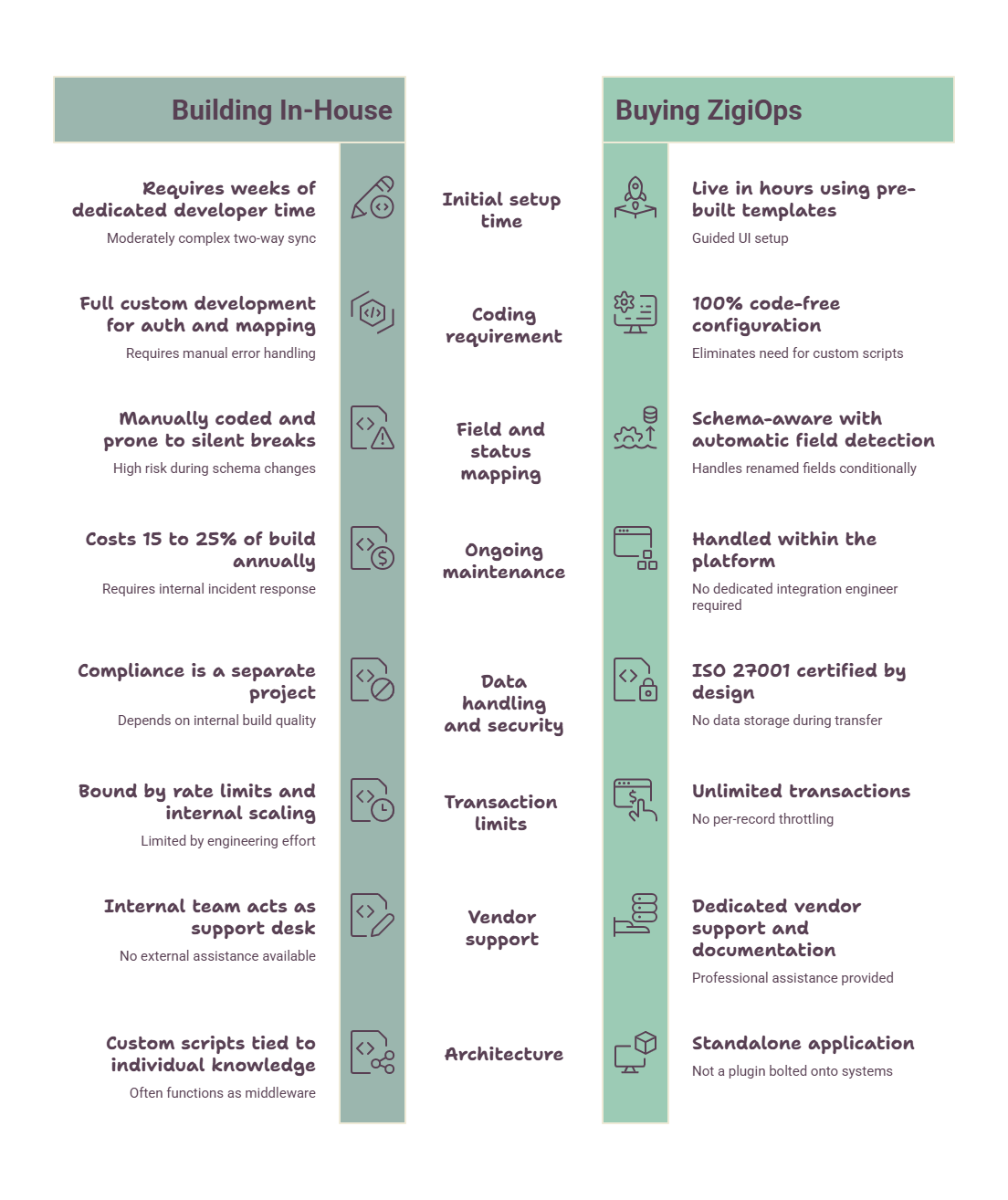
Here is how the two approaches stack up across the dimensions that matter most in a multi-client MSP environment:

When a plugin is still the right call
It is worth being honest about this. Plugins are not universally wrong. If a client has a single, stable, low-complexity integration requirement — connecting two tools that rarely update, handling non-sensitive data, with no expectation that the workflow will grow — a plugin can be the most pragmatic choice. Faster to activate, lower upfront cost, done.
The question is whether that simplicity will hold. In practice, most client integration requirements grow over time. The MSP that sets up a plugin for a basic use case today is often the same MSP rebuilding it eighteen months later when the client’s tooling evolves or the host platform releases an update that the plugin vendor has not caught up with yet.
Plugins work well as a starting point for low-stakes, low-complexity scenarios. They are a poor foundation for an integration practice that needs to scale across client environments and adapt as those environments change.
Where ZigiOps fits in this picture
ZigiOps is an API-based standalone integration platform — not a plugin, not something that installs on client systems. It connects to each system through its published API, manages all integration logic centrally through a no-code UI, and sits outside every system it connects.
For MSPs, the day-to-day implications are practical. Integrations are configured once using pre-built templates for common tool pairs — ServiceNow, Jira, Dynatrace, Freshservice, BMC Remedy, PagerDuty, and more than 30 others. When a client’s system updates, you verify the connection and update field mappings through the UI. No changes on the client’s systems. No compatibility chase.
The no-data-storage architecture — client data passes through in transit and arrives at the destination without being retained — maps cleanly to the compliance questions MSP clients in regulated industries ask. It is not a workaround. It is how the platform is built.
See how ZigiOps handles integrations across the full range of supported systems if you want to understand the coverage before having the conversation with clients.
Book a demo and elevate your teams performance.
The question worth sitting with
The choice between plugin and API integration is not really about the technology. It is about what kind of operational foundation you are building.
Plugins accumulate. Each one is a small maintenance commitment that compounds across clients and across time. An API integration platform is a different kind of investment — more upfront consideration, but a foundation that gets easier to manage as your client portfolio grows rather than harder.
Most MSPs reach the point where they wish they had made this architectural decision earlier. The ones who make it deliberately, before the weight of accumulated plugins forces it, tend to get there with less friction and fewer client conversations they would rather not have had.
메타데이터
- post_id
- 1bee7206b91c
- slug
- point-to-point-integrations-vs-api-platforms-the-decision-most-msps-get-wrong-1bee7206b91c
- url
- https://medium.com/@zigiwave/point-to-point-integrations-vs-api-platforms-the-decision-most-msps-get-wrong-1bee7206b91c
- canonical_url
- https://medium.com/@zigiwave/point-to-point-integrations-vs-api-platforms-the-decision-most-msps-get-wrong-1bee7206b91c
- author_url
- https://medium.com/@zigiwave
- status
- ok
- fetched_at
- 2026-07-11 18:50:18