The Veggie Garden, Part 2 — Design It
In Part 1 I walked through the two years it took to build the 20 raised beds at Serenity Homestead. Now comes the part that’s cognitively…
The Veggie Garden, Part 2 — Design It
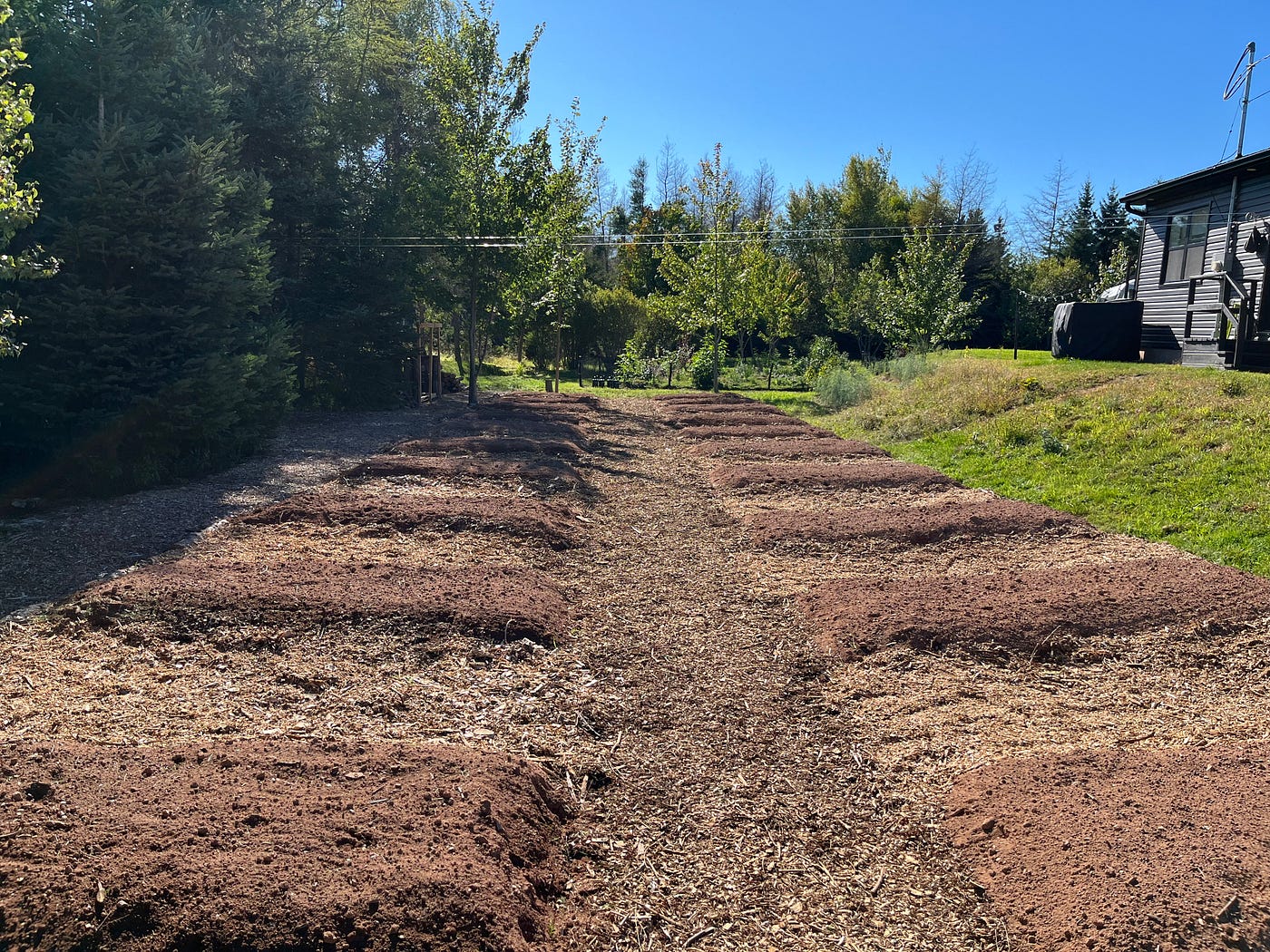
A view down the length of my veggie garden area
In Part 1 I walked through the two years it took to build the 20 raised beds at Serenity Homestead. Now comes the part that’s cognitively demanding— figuring out what goes where.
I’m not winging this. I borrowed my approach from Jean-Martin Fortier, a market gardener in Saint-Armand, Quebec, whose video The Market Gardener’s Toolkit laid out exactly how he rotates crops across his garden plots. The principle is straightforward: you move crop families around year to year so the same plants aren’t depleting the same soil, and so pests that overwinter in the ground don’t find their preferred host waiting for them in the same spot next spring.
Fortier’s rotation goes roughly like this: heavy feeders first — potatoes, corn, tomatoes — then medium feeders like carrots and beets, then brassicas and leafy greens, then legumes last because they fix nitrogen back into the soil and leave it better than they found it.
I’ve got my 20 beds arranged as two rows of 10, each bed 8 feet by 4 feet with 4-foot woodchip paths between them. I adapted Fortier’s system to a 10-bed cycle that simply repeats across both rows, shifting one bed to the right each year. Here’s what 2026 looks like:

My 20-bed veggie garden layout for the 2026 season
Tomatoes, zucchinis, cucumbers and eggplants are in a poly tunnel. We’ll see what that warmer micro-climate does for those crops. Garlic is in the food forest. Pumpkins and winter squash are out at the west end where there’s room to sprawl.
Inside each bed: Square Foot Gardening
Fortier handles the big picture — which crop family goes in which bed and when. But inside each 8x4 bed, I’m using Square Foot Gardening to figure out how many plants actually fit in each square foot.
The tool for that is the Seeding Square — the green plastic template in the photo below. Each colour-coded hole corresponds to a different spacing: 16 plants per square foot for small things like beets and carrots, down to 1 per square foot for large plants like peppers and broccoli. You press it into the soil, drop a seed or seedling in each hole, move it along, repeat.

So simple and yet so useful
It sounds fussier than it is. In practice it just means I’m not guessing at spacing or wasting space by planting too far apart out of habit.
The two systems work at different scales — Fortier tells me which bed gets which family this year, the Seeding Square tells me how many plants fit inside it. One looks after soil health across years, the other looks after yield within a season.
That’s the plan anyway. Ask me again in October how it actually went.
메타데이터
- post_id
- 1bef3e2bdd97
- slug
- the-veggie-garden-part-2-design-it-1bef3e2bdd97
- url
- https://medium.com/garden-journal/the-veggie-garden-part-2-design-it-1bef3e2bdd97
- canonical_url
- https://medium.com/garden-journal/the-veggie-garden-part-2-design-it-1bef3e2bdd97
- author_url
- https://medium.com/@serenitystead
- status
- ok
- fetched_at
- 2026-07-16 05:07:50



