TEN YEARS ON ANCESTRY
What a Forgotten Duplicate Census Taught Me About Documents, Collaboration, and Letting the Research Lead
TEN YEARS ON ANCESTRY
What a Forgotten Duplicate Census Taught Me About Documents, Collaboration, and Letting the Research Lead
AI and I | The Archival Interloper
The 1945 Polk County Florida State Census caught my eye years ago when I was searching for census records for Bertha (McCoy) Stills, my grandmother. Ancestry had suggested it, the way Ancestry does — here’s something that might be relevant, take it or leave it. I took it. Both of them, actually, because there were two records for the same census, and I did what researchers do when they find something they don’t immediately understand. I added both to her profile and told myself I’d sort it out later.
That was at least ten years ago.
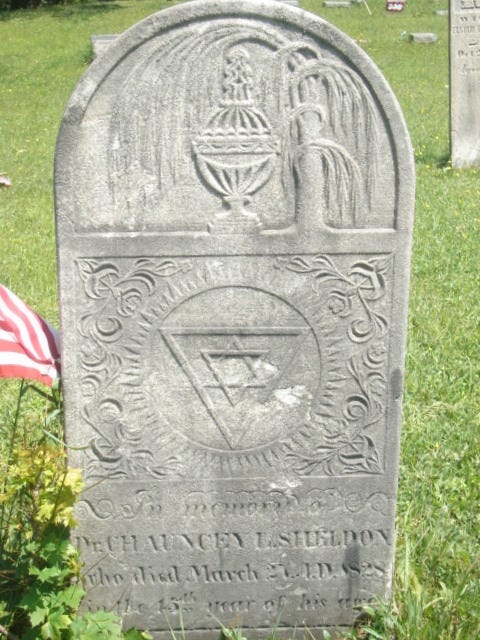
By the time I finally picked them up, The Hunt had already produced three pieces — Finding Martin in California, Band of Ballard Brothers, The Ballard Nobody Remembered. The format had developed its own logic: process visible, uncertainty documented, questions left honestly open. Then came Priceless, and something sharpened. Writing that piece — reading ten weeks of Dr. Chauncey Lee Sheldon’s life through a water-damaged account book with Claude as research partner — I understood more clearly what a document needs to carry before it can open onto a person. The Hunt had two modes, even if I hadn’t named them yet.
I named them by getting one wrong.
Bertha’s two census records had been waiting ten years. I finally brought them to Claude. And what happened next taught me something I didn’t expect — not just about the 1945 Florida State Census, but about what it means to let the research lead instead of the story you’ve already decided to tell.


Two census pages side by side: Vera Henderson, Page 4 (left) and Elvice Nolan, Page 39 (right). Precinct 36, Polk County, 1945 Florida State Census. Caption: Same precinct. Same year. Same name. The contrast in the handwriting tells you something before you read a single entry.
The Census Itself
Before you can read the 1945 Florida State Census, you need to know what it was.
Florida had been conducting its own state censuses since 1845, separate from the federal count, used to apportion representation in the state legislature. By 1945 it was the eleventh — and the last. Four years later the legislature abolished the state census entirely, adopting the federal decennial count in its place. A hundred-year tradition, closed.
It was also a segregated enumeration. Records organized by county, then precinct, then race. White households and Black households enumerated separately, on separate pages, by separate enumerators — a structure that shaped every column on every page, whether the researcher notices it or not.
And it worked differently from the federal census most genealogists encounter. Precinct-based, administered through the Florida Department of Agriculture under Commissioner Nathan Mayo, with county enumerators hiring their own deputies and working their own sections. The quality of the work varied from one street to the next. Before you can evaluate what two enumerators recorded in the same Polk County precinct, you need to understand why two enumerators were working the same precinct at all.
The law created the structure. The enumerators worked inside it. And inside that structure, in the same precinct, in the same year, two women recorded the same name — and got very different results.
Henderson and Nolan
Precinct 36, Polk County. Two enumerators working the same territory in 1945, walking different streets toward the same census.
Elvice Nolan’s pages are careful. The handwriting is practiced, the entries consistent, the household details internally coherent. When I brought her page alongside the family records — birth years, marriage certificates, the WikiTree profile for Bertha Naomi (McCoy) Stills (WikiTree is a collaborative, single-family-tree genealogy platform where researchers share and verify records) — Nolan’s work held. Virgil Stills, 43, Tennessee, laborer. Mrs. Bertha, 36, Tennessee, housewife. Four children: Elva, 14. Maynard, 12. Ross, 10. Elizabeth, 8. Every name, every age corroborated by independent records. Nolan had done her job.

Detail, Nolan Page 39. The Stills household entries — Virgil, Mrs. Bertha, and four children. Caption: Elvice Nolan’s hand is steady. Every entry on this page holds against independent records.
Vera Henderson’s pages are something else.
Page 4 of Henderson’s enumeration opens on Julia B. McCoy, 65, Georgia, housewife. Below her, a cluster of entries recorded under the surname Alderman — four people with ages and given names that align suspiciously well with known McCoy siblings, under a surname that appears nowhere else in any record connected to this family. No Alderman marriage. No Alderman neighbor. No explanation the records have yet offered. Then, at the bottom of the household: Stills, Bertha. Female. 31. Housewife.

Detail, Henderson Page 4. Julia B. McCoy at top, four Alderman entries below, Stills Bertha at bottom. Caption: Vera Henderson’s Page 4. The surname Alderman appears on four entries connected to the McCoy household. No record has yet explained it.
Thirty-one. Not thirty-six. A five-year gap from the age Nolan recorded on the same woman in the same census in the same year.
The standard move here is to close the case. Two different women. Different ages, different households, different addresses within the precinct. File them separately and move on.
When I first presented both entries to Claude without context — two names, two ages, two households, same precinct — the assessment came back quickly: probably two different women. The five-year age gap is significant. File them separately. It’s what anyone would do. Find the duplicate, spot the discrepancy, keep the one that looks right and close the tab on the other. Tidy. Done. A reasonable decision made from incomplete information.
But I had context Claude didn’t. I knew whose grandmother this was. I knew the family well enough to distrust the easy answer. I pushed back. And the collaboration shifted — not AI leading the research, but the human refusing to let the research stop where the document wanted it to stop.
That’s when Henderson’s page started to open.
It had already failed basic scrutiny. Julia McCoy was born in Tennessee — every other record confirms it. Henderson recorded Georgia. The surname Alderman attached to people who were almost certainly McCoys. The ages were off. Three verifiable errors on a single page before we even reached Bertha. A page that wrong about three things it could be checked on deserved scrutiny on everything else — including the age that seemed to close the case.
So we kept pulling.
The Hunt
The family records arrived to test both pages. Nolan’s held — Virgil, Bertha, the four children, every name and age corroborated by independent records. Henderson’s did not. Julia born Georgia — wrong. Four household members recorded as Alderman — a surname that appears nowhere in any McCoy record before or since. We searched for Aldermans in the 1945 Lakeland City Directory — a residential and business directory published independently of any government enumeration — and found them: an established local family, a publishing company officer and his sons, no address near 815 Adams, no connection to the McCoys. The surname remains unexplained. We named it honestly and kept moving.
Then came the IN/OUT column.

Detail, IN/OUT column header, Precinct 36 census schedule. Caption: The column that sent us to the enumerator instructions. IN means inside the incorporated city limits. OUT means outside them. Geography, not presence.
It sits just after the address column on the census schedule — easy to overlook. Henderson’s entire page reads IN. Nolan’s entire page reads OUT. The uniformity was suspicious enough that we went looking for an explanation — and found it in Nathan Mayo’s enumerator instructions, published in the 1946 census report.
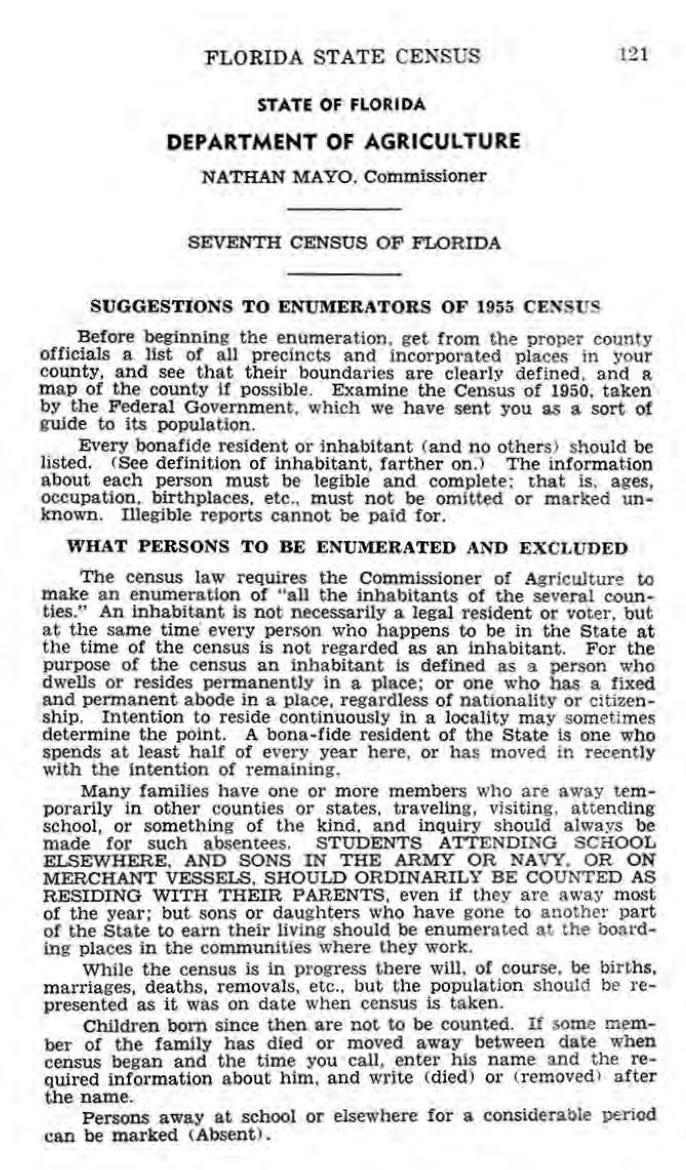
Nathan Mayo, Commissioner of Agriculture. “Suggestions to Enumerators,” The Seventh Census of the State of Florida, 1945, p. 121. Florida Department of Agriculture, 1946. UCF STARS Digital Collections. Caption: The enumerator instructions most researchers never find. Read the instructions before you interpret the columns.
A document most researchers never think to consult. The column records geography, not presence. IN means inside the incorporated city limits. OUT means outside them. Henderson worked the city streets. Nolan worked the roads beyond them.
This is exactly why you read the enumerator instructions before you interpret the columns. A uniform page isn’t evidence of a pattern in the people. It’s evidence of where the enumerator was working.
We had read that uniform column as proof of physical presence — everyone home at Julia’s, everyone gone from Virgil’s. A beautiful reading. Wrong. The collaboration had produced a misreading as compelling as the one it was meant to correct — and catching it, before it became published fact, is the Eight Principles working exactly as they should. Human and AI checking each other’s conclusions, not just the documents.
What the column still gives us, correctly understood, is real: Julia’s household was inside the city. Virgil’s household was outside it. So was the section of Precinct 36 where Viola Charlotte (McCoy) (Blevins) Cheney appears on Nolan’s page alongside Claude Cheney and Charles Blevins — in proximity on the page, though the census structure does not confirm they shared a dwelling. Two of Julia’s daughters living beyond the city line, both appearing on Henderson’s page inside it. The geography maps the distance between their lives and hers — and leaves the question open in exactly the way honest research should.
Viola appeared three times across three enumerators. Her own household, recorded twice as OUT — outside the city limits, her actual residence confirmed independently. And Henderson’s page, where she appears as Viola C. Alderman, age 35, inside the city, wrong household, wrong surname, age five years younger than her birth record gives her. Henderson’s page was the only page that placed either Bertha or Viola at 815 Adams.
Wrong about nearly everything. The only record that found them there.
The System Earned Its Place
This is where I made a different kind of mistake.
The research was solid. The finding was real. But I had been working through Priceless and The Guardian — pieces where a single document acted as a lightning rod for a person’s entire life, where the archive opened onto someone the reader already cared about before the reveal arrived. I wanted that. I tried to build it here.
The drafts weren’t failing because Claude was getting it wrong. They were failing because I had arrived with a conclusion and was asking the collaboration to support it. Five drafts, each reaching for an emotional close the research couldn’t yet earn. Julia McCoy isn’t developed enough to carry the weight that Nancy Wright Culp carried in The Guardian. But I kept asking the drafts to pretend otherwise.
The Editorial Department caught it.
The Editorial Department is not a person. It’s Claude — the same claude-sonnet-4–6 that had been drafting every version of this piece — operating under a different mandate. Not to help build. To find what’s wrong. To ask the questions a collaborator invested in the work won’t ask. I built it after the Hardware Baron failure, when I learned that enthusiasm and rigor cannot share the same hat. Someone has to wear the other one.
The diagnosis was precise: the piece is all frame. The people inside it aren’t rendered enough to carry the emotional weight the ending reaches for. Five drafts had been trying to solve a writing problem that was actually a research problem. No amount of drafting resolves that.
And sitting with that diagnosis produced something unexpected — a clearer understanding of what The Hunt actually contains. Not one format but two. Documents that open onto fully developed people. And documents that open onto moments — precise findings, observations, the kind of thing that teaches without pretending to be more than it is. The first we named Portals. The second, Small Bytes.
Genealogy is a game won in small bytes. These are the ones worth keeping.
The Enumerator’s Errors is a Small Byte. One research moment. Two census pages. A careless enumerator who got almost everything wrong and turned out to be the only one who knocked on the right door at the right moment. That’s enough. Julia McCoy’s story is still out there — when the household has texture, when the people are present enough to be felt, the research done here becomes the foundation. The frame is built. The picture comes later.
That’s what the system is for.
The collaboration works when the human refuses to stop where the document wants the research to stop. Claude reached the same conclusion anyone would reach cold. I pushed back. The research followed.
That’s AI and I — slower, messier, and more honest than either of us alone. The results came when the collaboration learned to follow the research instead of the story.
The Enumerator’s Errors — The Hunt | Small Bytes — publishes separately. It is the finding this research produced, standing on its own. This is the story of how we got there.
This work was produced through AI-assisted collaboration. I conducted all primary source research, made all interpretive decisions, and verified all factual claims. Claude (Anthropic, claude-sonnet-4–6) served as research partner, drafting engine, and — operating as the Editorial Department — the system that caught what enthusiasm missed. ChatGPT (OpenAI) and Gemini (Google) provided independent editorial review; suggestions from both were considered and selectively incorporated during revision. I take full responsibility for accuracy and interpretation.
Sources & Notes
Primary Sources:
- Florida, State Census, 1945. Polk County, Precinct 36. Enumerator: Vera Henderson, Page 4; Enumerator: Elvice Nolan, Page 39. FamilySearch. http://FamilySearch.org. State Archives, Tallahassee. Lakeland, Florida, City Directory, 1945. U.S., City Directories, 1822–1995. Ancestry.com.
- Lakeland, Florida, City Directory, 1947. U.S., City Directories, 1822–1995. Ancestry.com.
- Florida, State Census, 1945. Chapter 22515, Laws of Florida. Act of Legislature of 1945.
- Nathan Mayo, Commissioner of Agriculture. The Seventh Census of the State of Florida, 1945. Florida Department of Agriculture, 1946. Including “Suggestions to Enumerators of 1955 Census” [Note: title as it appears in the published report, written in anticipation of a subsequent census that was never conducted; the document reflects 1945 enumeration practice], p. 121. University of Central Florida, STARS Digital Collections. https://stars.library.ucf.edu/floridaheritage/79/
Family Sources:
- WikiTree profile, Bertha Naomi (McCoy) Stills. WikiTree ID: [McCoy-909]. https://www.wikitree.com/wiki/McCoy-909
- WikiTree profile, Julia Belle (Davis) McCoy. WikiTree ID: [Davis-9637]. https://www.wikitree.com/wiki/Davis-9637
- WikiTree profile, Viola Charlotte (McCoy) (Blevins) Cheney. WikiTree ID: [McCoy-932]. https://www.wikitree.com/wiki/McCoy-932
Methodology Note:
This research was conducted through extended AI-human collaboration across multiple sessions and project spaces. The Hunt project (Claude, claude-sonnet-4–6) conducted the primary research collaboration and drafted five versions of the piece. The Editorial Department (Claude, claude-sonnet-4–6, operating under a distinct editorial mandate) diagnosed the structural problem that five drafts could not resolve. The AI and I project (Claude, claude-sonnet-4–6) documented the process and assembled this account. All three instances are the same model. The human directed, verified, corrected, and maintained final authority throughout.
메타데이터
- post_id
- 1bfdde43c856
- slug
- ten-years-on-ancestry-1bfdde43c856
- url
- https://medium.com/@archivalinterloper/ten-years-on-ancestry-1bfdde43c856
- canonical_url
- https://medium.com/@archivalinterloper/ten-years-on-ancestry-1bfdde43c856
- author_url
- https://medium.com/@archivalinterloper
- status
- ok
- fetched_at
- 2026-07-10 09:05:01