The Half Has Never Been Told: Slavery’s Brutal Engine of American Capitalism
The Hidden Atrocities That Built the World’s Richest Nation
The Half Has Never Been Told: Slavery’s Brutal Engine of American Capitalism
The Hidden Atrocities That Built the World’s Richest Nation
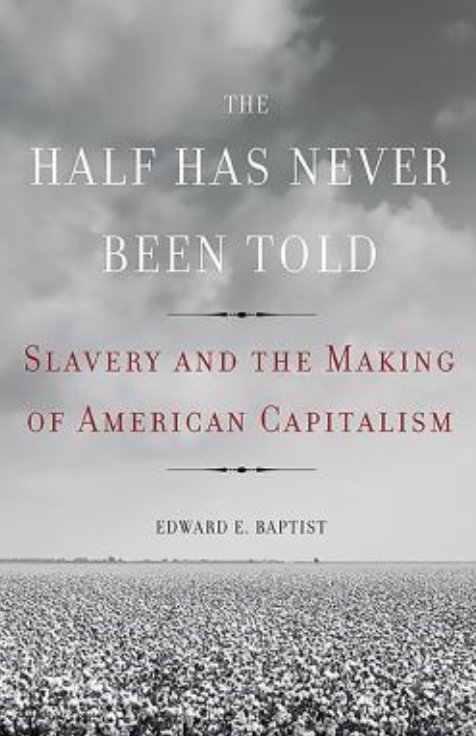
Photo generated by Perplexity AI (2025).
A Review and Analysis of Edward E. Baptist’s Masterwork
When Lorenzo Ivy, interviewed as part of the Works Progress Administration’s project to collect narratives from formerly enslaved people during the 1930s, spoke about his experience under slavery, he uttered a phrase that would become the title of one of the most important historical works of the twenty-first century: “Truly, son, the half has never been told.” That statement — a recognition that the sanitized, deodorized version of slavery presented in mainstream American history had omitted the most essential truths — became the foundation for Edward E. Baptist’s groundbreaking 2014 book, *The Half Has Never Been Told: Slavery and the Making of American Capitalism*.
This is not another conventional history of slavery. Baptist’s work is a sweeping, disturbing, and essential re-centering of U.S. history around the lived experience and systematic exploitation of enslaved Black people.
It argues — with meticulous archival research and heartbreaking testimonies from survivors — that slavery was not a backward, pre-modern aberration destined to die out on its own, but the beating heart of American capitalism, the very engine that propelled the United States from a “barely surviving postcolonial disaster” to a global economic superpower.
The Central Argument: Slavery as Capitalist Innovation
Baptist’s central thesis directly challenges what he identifies as historians’ major assumptions about slavery’s economic role. For decades, scholarship portrayed slavery as economically inefficient, viewing it as fundamentally incompatible with the principles of industrial capitalism.
Even abolitionists often framed their arguments around slavery’s supposed economic backwardness. Baptist demolishes this myth with overwhelming evidence.
The rapid growth of the United States into a global economic power, he demonstrates, depended directly on the expansion of slavery and the systematic torture of enslaved people, especially in the nineteenth-century cotton kingdom.
Between 1783 and 1861, the United States seized control of the world market for cotton — the key raw material of the Industrial Revolution — and this dominance was achieved through the forced labor and brutal exploitation of millions of African Americans.
By 1860, cotton accounted for more than half of all U.S. exports. The South had transformed from a narrow coastal strip of worn-out tobacco plantations to a continental cotton empire. In the span of a single lifetime, the nation grew into a modern, industrial, and capitalist economy.
The profits generated from cotton underwrote banks, financed infrastructure projects, and enriched not just southern plantation owners but northern merchants, manufacturers, and financiers. As Baptist makes clear: northern whites benefited enormously from the deepened exploitation of enslaved people, even as they claimed moral distance from the institution.
The Body as Archive: Narrative Structure and Methodology
Baptist organizes his book around a powerful extended metaphor drawn from Ralph Ellison’s insight that “the whole of American life” could be viewed as “a drama enacted on the body of a Negro giant.” Each chapter is named for a body part — Feet, Heads, Right Hand, Left Hand, Tongues, Breath, Seed, Blood, Backs, Arms — to emphasize how the entire American economic and political project was enacted on Black bodies. The Introduction is titled “The Heart” and the Afterword “The Corpse,” completing the anatomy of a nation built on human suffering.
Within this innovative framework, Baptist interweaves intimate accounts of enslaved people with plantation records, newspapers, financial documents, and the words of politicians and businessmen. He draws extensively on slave narratives, particularly those collected during the WPA interviews of the 1930s, as well as published memoirs like those of Charles Ball and Solomon Northup. The effect is to keep the human cost of slavery constantly in view, preventing the economic story from becoming abstract or divorced from the violence that made it possible.
The chapter “Feet,” for instance, explores the forced migrations of the internal slave trade, as enslaved people from states like Maryland and Virginia were sold and marched in coffles to the cotton frontiers of the Deep South. “Backs” examines the systematic use of torture. “Seed” analyzes the financial innovations — particularly slave-backed securities — that turned human beings into fungible assets on global markets.
This bodily organization serves as a constant reminder that slavery was, above all, an assault on the fundamental dignity and autonomy of the human body.
The Second Slavery: Forced Migration and Family Destruction
One of Baptist’s most significant contributions is his detailed analysis of what he terms the “second slavery” — the massive internal slave trade and forced migration that moved more than one million people from the Upper South to the Deep South between the 1790s and 1860s.
When Congress outlawed the international slave trade in 1808, the domestic trade exploded to meet the insatiable demand for labor in the expanding cotton economy.
This forced migration shattered families and communities on an almost incomprehensible scale. A prime field hand who might bring $400 if sold to a neighbor in Virginia would fetch three times that amount when sold to traders heading for New Orleans.
The financial incentives were irresistible. Baptist describes the brutal mechanics: enslaved people chained in coffles, walking five hundred miles or more, subjected to sexual violence along the way, separated forever from everyone they loved.
“Chains enabled another kind of violence,” Baptist writes. “Chains saved whites from worrying about placating this one’s mother, or buying that one’s child. Once the enslaved men were in the coffle, they weren’t getting away unless they found a broken link.”
Enslaved people recognized that the ability of whites to move their bodies wherever they wanted created markets that allowed for new forms of profit extraction and new intensities of torture.
Torture as Technology: The “Pushing System” and Cotton Productivity
Perhaps the most controversial and intensely debated aspect of Baptist’s book is his argument about what drove the dramatic increase in cotton productivity.
Between 1800 and 1860, the amount of cotton picked per day per enslaved person increased from approximately 25 pounds to 100 pounds — a 400 percent increase that corresponded with the United States’ rise to global dominance in cotton markets.
Baptist attributes this productivity explosion primarily to what enslaved people themselves called the “pushing system”: a regime of measurement, quotas, and systematic whipping that forced enslaved people to pick faster and faster, year after year.
Overseers would weigh each person’s daily cotton harvest and record it in chalk on a slate. Those who failed to meet their individual quota were whipped. More insidiously, when someone exceeded their quota, that higher number became their new minimum — meaning the whip would fall if they “only” picked what had been considered excellent work the day before.
“It isn’t just moving faster,” Baptist explained in an interview, “it’s about figuring out how to move more efficiently, even ambidextrously. In effect, they had to do time-and-motion studies on themselves.” The system essentially outsourced innovation in cotton harvesting to enslaved people themselves, who were forced to develop techniques to survive. As one Mississippi overseer told his friends, “the whip was as important to making cotton grow as sunshine and rain.”
Baptist insists that “torture” is the right word to describe this systematic violence. “In any other context, we’d call the systematic whipping of people who don’t meet production quotas — or of people who try to hide their maximum picking capacity — by the simple word ‘torture.’ We’ve all heard decades of implicit and explicit arguments that paint enslaved African Americans as people who needed to be whipped… So we don’t call torture by its name. We’ve heard it called ‘discipline,’ as if we are talking about spanking children.”
This refusal to use euphemisms is central to Baptist’s project. He uses the term “slave labor camps” instead of plantations, rejecting the mythic, romantic associations that word carries. He describes a “whipping machine” — whether literal or metaphorical — as the central technology of the cotton economy.
This interpretation has sparked significant debate. Economists Alan Olmstead and Paul Rhode have argued that improved cotton seed varieties — particularly the spread of superior Upland cotton strains from Mexico and Guatemala — better explain the productivity increases. They point out that picking rates for Sea Island cotton, which did not benefit from the same agricultural innovation, remained relatively flat.
The public debate has been intense, with Olmstead dismissing Baptist’s research as “hocus pocus” at a Dartmouth forum.
Baptist pushes back, noting that Sea Island and Upland cotton used different labor systems, and that even if improved seeds contributed to productivity gains, “it’s still a system driven by force.” The torture-productivity thesis remains contested, but few scholars dispute that violence was central to slavery’s operation or that enslaved people’s forced labor was essential to American economic development.
The Financial Architecture of Slavery: Securitization and Speculation
One of the book’s most revelatory sections explores the sophisticated financial instruments that undergirded slavery’s expansion. In the 1830s, powerful slaveholders devised a two-part innovation: mortgaging enslaved people, and then converting those mortgages into bonds that could be marketed globally.
This process — eerily similar to the mortgage-backed securities that fueled the 2008 financial crisis — represented what Baptist calls a “new moment in international capitalism”.
The mechanics worked like this: Planters organized new banks, usually in states like Mississippi and Louisiana. They drew up lists of enslaved people to use as collateral, mortgaged them to the banks they had created, and used the loans to buy additional enslaved people and expand cotton production. To provide capital for these loans, the banks sold bonds to investors around the globe — London, New York, Amsterdam, Paris.
The Consolidated Association of the Planters of Louisiana (CAPL), chartered in 1827, exemplified this system. With Louisiana state backing, CAPL secured $2.5 million in bonds from the British merchant bank Baring Brothers to be marketed on European securities markets.
Bond buyers, many of whom lived in countries where slavery was illegal, didn’t own individual enslaved people — just bonds backed by their value. Planters’ mortgage payments paid the interest and principal. Enslaved human beings had been, in modern financial lingo, “securitized”.
This created multiple income streams. The sale of bonds created a pool of high-quality credit that could be lent back to planters at rates significantly lower than the expected return.
Clever borrowers could pyramid their leverage even higher by borrowing on the same collateral from multiple lenders, or by obtaining unsecured short-term commercial loans. At the time, the total value of enslaved people was approximately $1 billion — about 20 percent of total wealth in the country.
The system enriched everyone except enslaved people themselves. Older slave states like Maryland and Virginia sold enslaved people to the new cotton states at securitization-inflated prices, resulting in a slave asset bubble. Cotton factor firms — merchants who advanced money to planters and marketed their cotton — became wildly successful. Lehman Brothers, founded in Alabama, moved to Wall Street. For all these firms, every transaction in slave-earned money flowing in and out of the United States earned fees.
The infant American financial industry, Baptist argues, nourished itself on profits from financing slave traders, cotton brokers, and underwriting slave-backed bonds.
The parallels to 2008 are deliberate and chilling. Baptist and co-author Louis Hyman note in the Chicago Sun-Times that “the key patterns of that financial history continue to repeat themselves…
Again and again, African-American individuals and families have worked hard to produce wealth, but American finance, whether in the antebellum period or today, has snatched black wealth through bonds backed by asset securitization.”
When the Panic of 1837 struck, the slave-backed bond market collapsed. Cotton prices plummeted. Many slaveholders had layered multiple mortgages on each enslaved person and used political leverage to protect themselves from the consequences. Several southwestern state legislatures — most notably Mississippi and Florida — simply repudiated their government-backed bonds, in effect toxifying the securities and emancipating slave-owning debtors from bondholders.
The costs were ultimately borne by taxpayers and by enslaved people themselves, who faced further disruption, forced migration, and intensified exploitation.
Northern Complicity: Dismantling Regional Innocence
A thread running throughout Baptist’s work is his insistence that northern merchants, financiers, and manufacturers were deeply implicated in and enriched by slavery — undermining comforting regional myths of innocence. By the 1840s, the North had built a complex, industrialized economy on the backs of enslaved people and their highly profitable cotton labor.
Textile mills in New England processed southern cotton. New York banks financed the cotton trade and underwrote slave-backed bonds. Northern insurance companies insured enslaved people and cotton shipments. The economic linkages were so extensive that escaped slave John Brown recalled: “When the price of cotton [rises] in the English market the poor slaves immediately feel the effect, for they are harder driven, and the whip is kept more constantly going.”
Baptist traces how the Missouri Compromise, the three-fifths clause, and other political arrangements enabled slavery’s expansion through a long-term, mutually profitable bargain between northern and southern whites.
Eight of the first twelve U.S. presidents were slaveholders. Southern political power — inflated by counting enslaved people as three-fifths of a person for representation while denying them any voice — shaped national policy to facilitate the cotton empire’s growth.
This interpretation challenges the narrative that the Civil War was a conflict between two fundamentally different economic systems. Instead, Baptist demonstrates, slavery was integral to American capitalism as a whole.
The profits it generated flowed throughout the national and international economy, shaping everything from infrastructure development to industrial expansion.
Style, Reception, and Scholarly Debate
Baptist’s writing is vivid, often harrowing, making the violence, grief, and resistance of enslaved people impossible to ignore. His synthesis of economic analysis with personal narratives offers a powerful counter to sanitized versions of U.S. history. The book won the 2015 Sidney Hillman Prize and the 2015 Avery O. Craven Award from the Organization of American Historians.
Yet it has also generated significant controversy. The Economist published a review that so angered readers — for appearing to suggest that slavery wasn’t that bad for enslaved people — that the magazine pulled it from its website the next day (though it remained accessible elsewhere and appeared in print). The incident sparked extensive discussion about how slavery should be discussed in mainstream media.
Economic historians have criticized some of Baptist’s quantitative claims and methodological choices. Stanley Engerman’s review argues that Baptist overstates the importance of slavery and cotton for U.S. economic growth.
Critics note what they see as errors or exaggerations, particularly around the torture-productivity thesis. Some argue that Baptist stretches sources, putting words in enslaved people’s mouths, or that he ignores alternative explanations for cotton productivity gains.
Yet even skeptics often acknowledge the work’s importance. Writing in the New York Times Book Review, Eric Foner found the book’s underlying argument persuasive even if some elements were “not entirely pulled together.”
Kirkus Reviews called it a “dense, myth-busting work” that presents “a complicated story” with scholarly rigor. Academic reviewers note that the book should be “read and debated by anyone who writes about the South, or about American capitalism, or about African American culture.”
Contemporary Relevance: The Long Shadow of Slavery
Baptist’s work forces readers to reckon not just with historical slavery but with its enduring legacy. The book’s conclusion examines how African Americans forged a culture from survival and resistance, creating artistic and social traditions that continue to influence the world. But Baptist doesn’t let readers retreat into celebration of cultural resilience without confronting economic reality: enslaved people and their descendants held little material wealth to pass on, “for so much had been stolen from them.”
The financial patterns Baptist identifies didn’t end in 1865. As he and Hyman note, African Americans were systematically excluded from the financial system that had been built on their bodies. Unable to borrow to buy property or start businesses, they lived in a capitalist economy that allowed them to work but not to benefit. And the pattern repeated: in the 2000s, Wall Street institutions that had descended from firms enriched by slavery targeted African Americans with subprime loans, producing a crisis that led to a 60 percent loss of Black household wealth — “perhaps the largest loss of Black wealth since Black people were themselves wealth, owned by others.”
This connection between historical and contemporary extraction of Black wealth gives Baptist’s work urgency beyond academic debate. It provides historical grounding for contemporary discussions of reparations, wealth inequality, and structural racism. The book demonstrates that American prosperity was not built through exceptional ingenuity or Protestant work ethic alone, but through the systematic torture and exploitation of millions of people whose labor was stolen and whose descendants have never been compensated.
Who Should Read This Book
The Half Has Never Been Told is unapologetically moral and political, insisting that slavery’s organized violence must be central to understanding both American prosperity and modern racial inequality. The book is graphic in its descriptions of brutality — readers should be prepared for unflinching accounts of torture, sexual violence, and family separation. Baptist doesn’t sanitize or minimize the horror; that’s precisely the point.
The book is essential reading for anyone interested in:
- The intersection of race, capitalism, and U.S. history
- The economic foundations of American wealth and power
- Questions of structural racism and institutional violence
- The long-term consequences of slavery and their relevance to contemporary inequality
- How financial innovation has been deployed to extract wealth from vulnerable populations
It’s particularly valuable for students, educators, and general readers who want to understand how the comfortable narratives they learned in school — about American exceptionalism, about slavery as a regional aberration, about the North’s innocence — obscure fundamental truths about how the nation was built.
For scholars working on economic development, national memory, or the historical roots of contemporary inequality, Baptist offers both a powerful narrative and a compelling challenge to familiar frameworks. Even those who dispute specific claims about productivity or methodology must grapple with the book’s central demonstration: that slavery was not peripheral to American capitalism but absolutely central to it, and that understanding this history is essential to understanding the present.
Conclusion: The Half That Must Be Told
Baptist’s title, drawn from Lorenzo Ivy’s testimony, captures the book’s essential project: to tell the parts of the story that have been systematically omitted, sanitized, or minimized.
The half that has never been told is not just about economic statistics or political compromises, though those matter. It’s about the lived experience of millions of people who were tortured to increase productivity, whose families were destroyed to generate profit, whose very bodies were securitized and traded on global markets.
It’s about how violence wasn’t incidental to slavery but central to it — not random cruelty but calculated management technology. It’s about how the wealth generated through this system didn’t stay in the South but flowed throughout the entire national economy, enriching banks, factories, and merchants across the North and around the world. And it’s about how the patterns established then — of extracting wealth from Black bodies and communities, of using financial innovation to facilitate that extraction, of collective amnesia about how prosperity was actually built — continue to shape American life.
As a work of interpretation, the book demands that readers confront uncomfortable truths about American history and capitalism.
It rejects the comforting notion that slavery was a shameful but economically marginal institution that the nation eventually outgrew through moral progress.
Instead, it reveals slavery as the engine of modernization, the foundation of wealth, and the prototype for later systems of exploitation.
Whether or not readers accept every specific claim Baptist makes about torture and productivity, about financial mechanisms, or about slavery’s precise contribution to economic growth, the book succeeds in fundamentally reframing how we must think about American history.
After reading The Half Has Never Been Told, it becomes impossible to view the nation’s rise to wealth and power as a story of innovation and hard work alone.
The other half of the story — the half told here in blood, sweat, and tears — reveals a foundation built on stolen labor, broken families, and systematized violence.
That is the history that must be reckoned with if the nation is ever to move toward genuine justice and repair.
If this piece challenged what you thought you knew about American wealth, show it with claps and add your voice in the comments. The enslaved people whose torture built this nation’s fortune have been erased from the story for too long. Your engagement is how we keep the truth visible and demand the reckoning that’s centuries overdue.
메타데이터
- post_id
- 1c01dd4dc9c7
- slug
- the-half-has-never-been-told-slaverys-brutal-engine-of-american-capitalism-1c01dd4dc9c7
- url
- https://medium.com/the-polis/the-half-has-never-been-told-slaverys-brutal-engine-of-american-capitalism-1c01dd4dc9c7
- canonical_url
- https://medium.com/the-polis/the-half-has-never-been-told-slaverys-brutal-engine-of-american-capitalism-1c01dd4dc9c7
- author_url
- https://medium.com/@jusbouey
- status
- ok
- fetched_at
- 2026-06-29 01:02:39