Thinking in Certainties, Living in Probabilities: Why Our Minds Get It Wrong
Why do people instinctively seek certainty even when the world offers only possibilities.
Thinking in Certainties, Living in Probabilities: Why Our Minds Get It Wrong
Why do people instinctively seek certainty even when the world offers only possibilities.
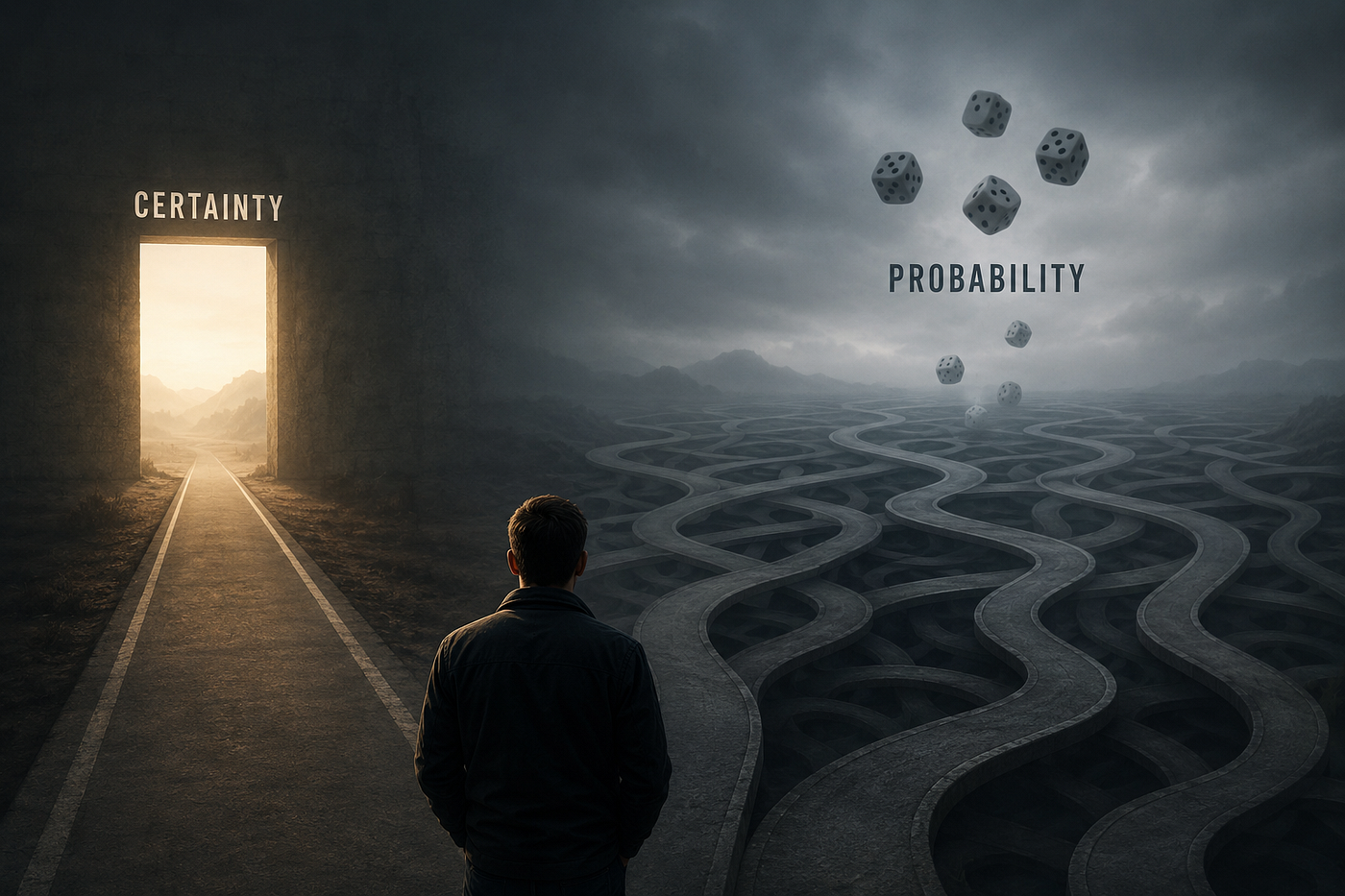
Image created using ChatGPT
Certainty is comforting. It gives us confidence, helps us make decisions and allows us to feel in control. Whether we are choosing a career, investing money, evaluating medical advice or simply deciding whether to carry an umbrella, we instinctively search for definite answers. We want to know what will happen next, not what is likely to happen.
The problem is that the world rarely offers certainty. Instead, it operates through probabilities. Every event, from a traffic accident to the success of a new business, exists within a range of possible outcomes rather than a guaranteed result. Despite living in such a world, the human mind often struggles to think in terms of likelihoods. We naturally simplify uncertainty into stories of success and failure, right and wrong, safe and dangerous. In doing so, we overlook the subtle but important role that probability plays in almost every decision we make.
This weakness is not a sign of low intelligence. It is a consequence of how our brains evolved. Long before humans invented mathematics or statistics, our ancestors survived by making quick judgments in environments filled with immediate threats. Evolution rewarded speed more often than precision. The mental shortcuts that once helped us avoid predators or recognise danger continue to shape how we interpret modern problems, even when those shortcuts lead us astray.
Understanding why humans struggle with probabilities is more than an academic exercise. It explains why misinformation spreads so easily, why people misunderstand risk, why investors chase trends, why gamblers believe luck has patterns and why even experienced professionals sometimes make poor decisions. More importantly, recognising these limitations allows us to make better choices by learning to think differently.
A Brain Built for Action, Not Statistics
Imagine standing in a forest thousands of years ago and hearing rustling in the bushes. Was it the wind or a predator? Waiting for complete certainty could prove fatal. Assuming the worst and reacting immediately, even if the rustling turned out to be harmless, was often the safer strategy.
Over countless generations, the human brain became remarkably good at making rapid judgments based on incomplete information. These instincts served our ancestors well because hesitation carried greater risks than occasional false alarms.
Modern life, however, presents very different challenges. We rarely need to escape predators, but we constantly interpret medical reports, financial forecasts, weather predictions and election polls. These situations demand careful reasoning about uncertainty rather than immediate instinctive reactions.
Unfortunately, the brain still relies on many of the same mental shortcuts that evolved for survival. These shortcuts, known as heuristics, reduce mental effort and allow us to make quick decisions. Most of the time they work surprisingly well. The difficulty arises when they replace careful analysis in situations where probabilities matter.
The Comfort of Stories
Humans naturally understand stories better than statistics.
Suppose someone tells you there is a one per cent chance of experiencing a particular side effect from a medication. The figure may seem abstract and difficult to interpret. However, hearing about one individual who suffered that side effect often leaves a much stronger impression, even though a single story tells us very little about the overall risk.
Our brains are wired to remember vivid experiences, emotional narratives and personal examples. Numbers, by contrast, demand deliberate thought. A compelling story feels more convincing than a carefully collected dataset because stories connect with emotion while statistics require conscious effort.
This tendency explains why rare but dramatic events often dominate public attention. Aeroplane accidents receive extensive media coverage because they are unusual and emotionally striking, even though flying remains one of the safest forms of transport. Everyday road accidents, which occur far more frequently, attract far less attention because they are familiar and therefore less memorable.
Our perception of risk often reflects what captures our attention rather than what is most likely to happen.
When Rare Events Feel Common
One of the most common errors in probabilistic thinking is judging how likely something is based on how easily examples come to mind. If news reports repeatedly cover cyber-attacks, shark attacks or economic crashes, these events begin to feel more common than they actually are. The ease with which we recall them creates the illusion that they occur frequently.
Psychologists call this the availability heuristic. Instead of estimating probability from actual evidence, we estimate it from memory. This shortcut can be useful in familiar situations. If you frequently see traffic congestion on a particular road, expecting delays is reasonable. Problems arise when memory becomes distorted by media coverage, personal experience or emotional impact. A single dramatic event can outweigh thousands of uneventful days simply because it is easier to remember.
Ignoring the Bigger Picture
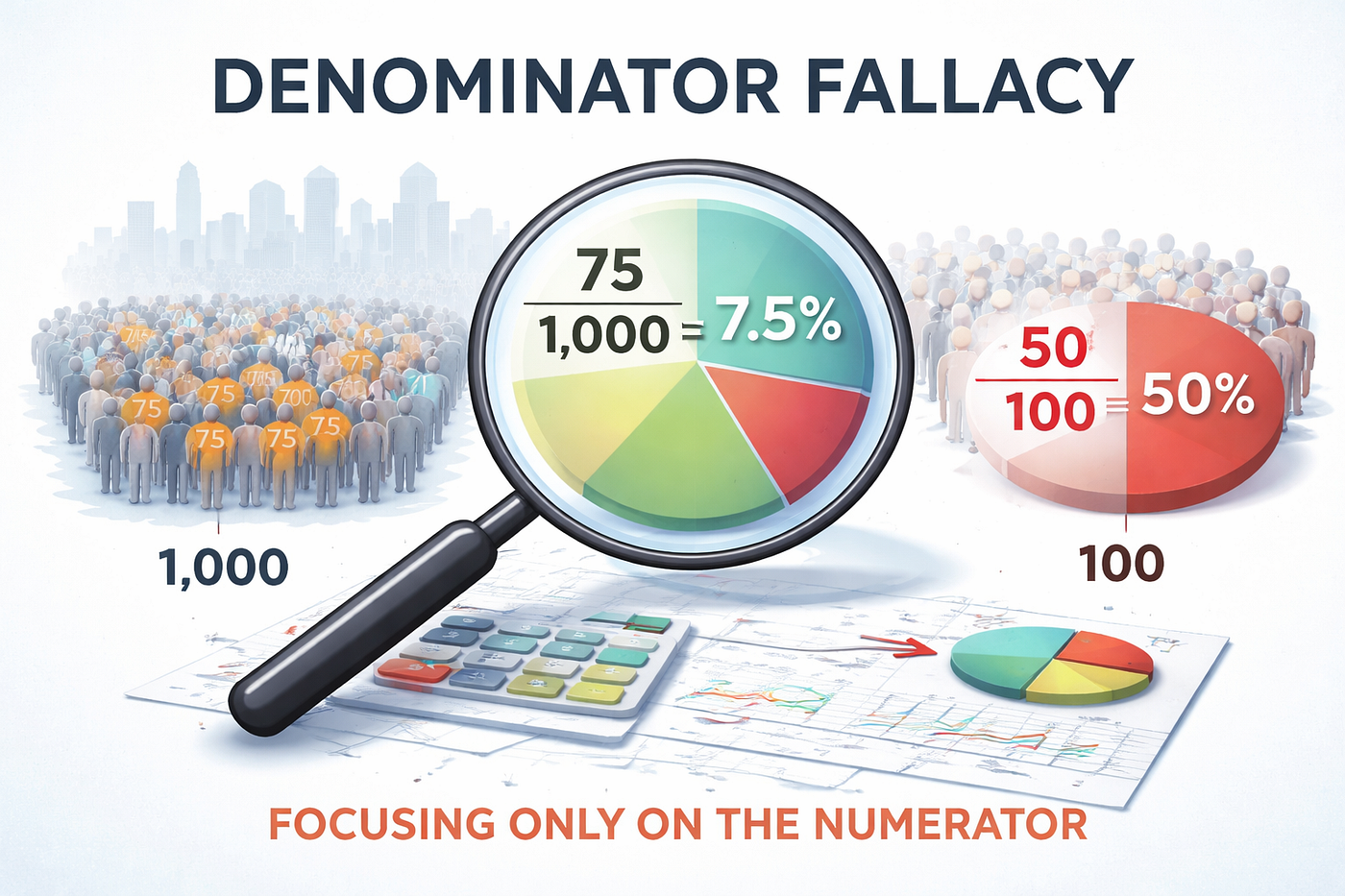
Imagine a medical test that correctly identifies a disease 99 per cent of the time. At first glance, receiving a positive result might seem almost conclusive. Yet this conclusion may be misleading. Suppose the disease itself affects only one person in ten thousand. Even with a highly accurate test, many positive results may actually be false positives simply because the disease is so rare. This illustrates one of the most difficult concepts in probability: the importance of considering the underlying frequency of an event before interpreting new evidence.
People naturally focus on the immediate information in front of them while overlooking the broader context. A striking result often feels more important than the background statistics that give it meaning. This mistake appears in medicine, criminal investigations, hiring decisions and even everyday conversations. We often treat individual cases as though they exist in isolation when they are actually part of a much larger pattern.
Seeing Patterns Where None Exist
Humans are exceptional pattern seekers. Recognising patterns allowed our ancestors to predict seasons, locate food and identify danger. As a result, our brains became highly sensitive to regularities in the environment. The downside is that we also detect patterns that do not exist.
Consider flipping a fair coin six times. A sequence such as heads, tails, heads, tails, heads, tails appears more random than six consecutive heads. Yet both outcomes are equally likely. Many people believe that random events should alternate frequently. When randomness produces long streaks, we suspect that something unusual is happening. This misunderstanding lies behind countless superstitions.
A basketball player who scores several times in succession is said to have a “hot hand”. A roulette player believes that black must appear after several reds. Investors convince themselves that a rising market cannot continue indefinitely because it has already risen for too long. In reality, random events often produce streaks. The existence of a pattern does not necessarily imply an underlying cause.
The Trap of Confirmation
Once we form a belief, we begin searching for evidence that supports it. Someone convinced that a particular investment strategy always works will remember its successes while overlooking its failures. A sports fan may believe a certain player performs well under pressure and selectively recall moments that reinforce this impression. This tendency, known as confirmation bias, affects people across every level of education and expertise.
The difficulty is not merely that we seek supporting evidence. We also interpret ambiguous information in ways that strengthen our existing views. As a result, confidence often grows even when the quality of evidence remains unchanged. Probabilistic thinking requires the opposite approach. Instead of asking, “How can I prove I am right?”, it asks, “What evidence would convince me that I am wrong?” That question is considerably harder to answer, but it leads to more reliable conclusions.
Why Experts Are Not Immune
Experience certainly improves judgement, but it does not eliminate bias. Doctors may rely too heavily on recent cases they have treated. Financial analysts may become overconfident after periods of success. Weather forecasters sometimes hesitate to communicate uncertainty because audiences prefer clear predictions. Even scientists, whose work depends on evidence, must actively guard against unconscious biases through peer review, replication and statistical analysis.
Expertise helps, but it does not replace disciplined thinking. In fact, experts sometimes become more vulnerable to overconfidence because years of experience create a powerful sense of certainty. The best experts recognise the limits of their knowledge. Rather than claiming certainty, they express confidence in terms of probabilities, acknowledging both what they know and what remains uncertain.
Why We Prefer Certainty
Living with uncertainty is uncomfortable. When faced with ambiguous situations, the brain naturally seeks closure. A definite answer, even an imperfect one, often feels preferable to admitting that several outcomes remain possible. This preference explains why people gravitate towards bold predictions, simple explanations and confident leaders. Certainty feels reassuring, whereas probability appears vague and unsatisfying. Yet reality rarely conforms to absolute statements.
Successful investors know they will sometimes lose money. Skilled doctors recognise that treatments carry risks. Experienced engineers understand that every design involves trade-offs. Good decision-makers do not expect perfect outcomes. Instead, they aim to make the best possible choice based on the available evidence. Thinking probabilistically means accepting that a good decision can occasionally produce a poor outcome, just as a bad decision can sometimes appear successful through sheer luck. Judging decisions solely by their outcomes often hides the quality of the reasoning behind them.
Becoming Better at Probabilistic Thinking
Although our brains are naturally biased, better thinking can be learned. The first step is becoming comfortable with uncertainty. Rather than asking whether something will happen, ask how likely it is to happen. It also helps to look beyond individual stories and seek broader patterns. Large collections of evidence almost always provide a clearer picture than isolated examples, no matter how memorable those examples may be.
Questioning first impressions is equally valuable. Before accepting an explanation, consider alternative possibilities. Ask whether the evidence genuinely supports the conclusion or whether it simply feels convincing.
Perhaps the most useful habit is expressing confidence in degrees rather than absolutes. Saying “I think this is probably true” reflects the reality of uncertainty far better than declaring something unquestionably correct. This approach does not weaken judgement. It strengthens it by leaving room for new information and better evidence.
The Wisdom of Uncertainty
One of the greatest paradoxes of human intelligence is that our desire for certainty often undermines our remarkable ability to reason. We instinctively search for simple answers in a world that rarely provides them. Probability asks us to do something that feels unnatural: to remain open to multiple possibilities at once.
Yet this is precisely what thoughtful decision-making requires. The most reliable thinkers are not those who always make correct predictions. They are those who understand that knowledge is rarely complete, that confidence should match the strength of the evidence and that changing one’s mind is not a weakness but a sign of intellectual maturity.
In an age overflowing with information, opinions, and confident predictions, the ability to think in terms of probabilities has become more than a mathematical skill. It is a way of navigating complexity without surrendering to false certainty. The future will always remain uncertain, but our decisions improve when we learn to treat uncertainty not as an obstacle to thinking, but as the very condition in which good thinking begins.
As always, feel free to reach out with any questions or comments. Happy musing!
Originally published at https://avinashi.substack.com.
메타데이터
- post_id
- 1c3dbd720c96
- slug
- thinking-in-certainties-living-in-probabilities-why-our-minds-get-it-wrong-1c3dbd720c96
- url
- https://medium.com/@bharath_keshav/thinking-in-certainties-living-in-probabilities-why-our-minds-get-it-wrong-1c3dbd720c96
- canonical_url
- https://medium.com/@bharath_keshav/thinking-in-certainties-living-in-probabilities-why-our-minds-get-it-wrong-1c3dbd720c96
- author_url
- https://medium.com/@bharath_keshav
- status
- ok
- fetched_at
- 2026-07-14 21:16:29